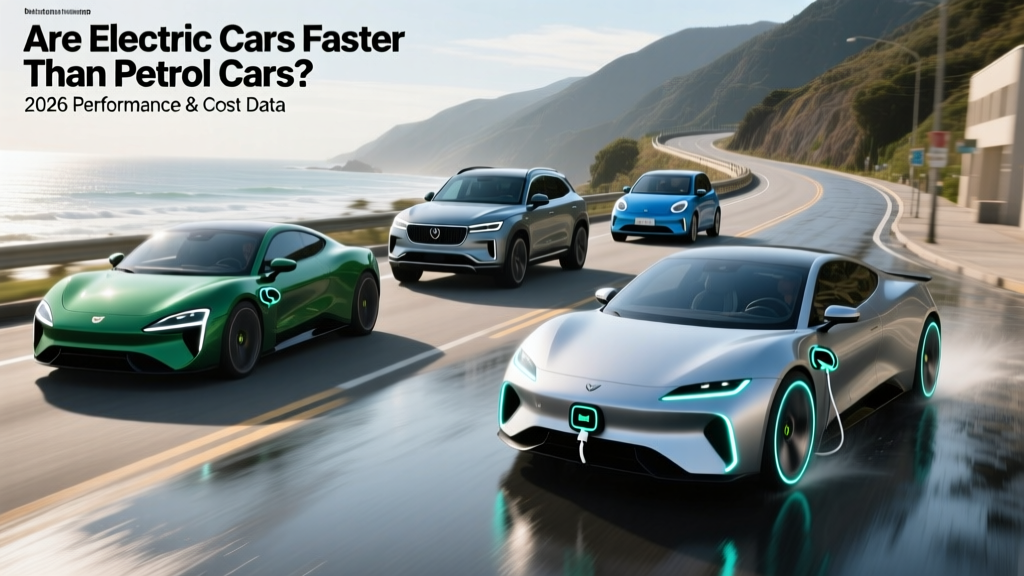
Quick Answer: Are Electric Cars Faster Than Petrol Cars?
Yes, in most everyday scenarios. Electric vehicles deliver instant torque from 0 RPM, giving them a decisive advantage in 0–60 mph acceleration and low-to-mid-speed passing. A $42,000 Tesla Model 3 Long Range AWD (346 hp) hits 0–60 in 4.2 seconds — matching or beating many $70,000+ petrol sports sedans. However, petrol cars still hold advantages in sustained top-speed runs and ultra-lightweight track performance. For 95% of real-world driving — city merging, highway on-ramps, stoplight-to-stoplight — EVs feel noticeably quicker.
Why Electric Motors Feel Instantly Faster
The physics advantage is straightforward. Internal combustion engines must build RPM to reach peak torque, and transmissions must downshift before delivering it. Electric motors produce maximum torque at 0 RPM — the instant you press the pedal, full force reaches the wheels.
This creates a driving experience that feels punchier than the spec sheet suggests. A Tesla Model Y Long Range (384 hp, 0–60 in 4.8 seconds per Tesla's official specs) will walk away from most V6 petrol SUVs off the line, even those rated at similar horsepower.
Key technical reasons EVs accelerate harder in daily driving:
- No turbo lag: Turbocharged petrol engines typically need 1–2 seconds of spool-up. EVs have zero delay.
- No gear hunting: Most EVs use single-speed reductions. There's no transmission pause during hard acceleration.
- Dual-motor AWD traction: Many EVs use independent front and rear motors, distributing torque to whichever axle has grip. This launches harder than mechanical AWD systems.
- Linear power delivery: An EV at 30 mph can summon the same passing surge as it can from 5 mph, without waiting for a downshift.
Side-by-Side: EV vs. Petrol Performance in 2026
Let's compare vehicles at similar price points to isolate the powertrain advantage. The data below uses EPA and manufacturer-published figures for current 2026 model-year vehicles.
| Vehicle (2026 MY) | Powertrain | Horsepower | 0–60 mph | MSRP |
|---|---|---|---|---|
| Tesla Model 3 Long Range AWD | BEV (dual motor) | 346 hp | 4.2 sec | $42,380 |
| BMW 330i xDrive | Petrol (turbo I-4) | 255 hp | 5.6 sec | $46,600 |
| Hyundai Ioniq 5 N | BEV (dual motor) | 641 hp | 3.25 sec | $67,900 |
| BMW M340i xDrive | Petrol (turbo I-6) | 382 hp | 4.1 sec | $61,400 |
| Ford Mustang Mach-E GT | BEV (dual motor) | 480 hp | 3.5 sec | $56,995 |
| Ford Mustang GT (5.0 V8) | Petrol (V8) | 480 hp | 4.3 sec | $44,090 |
The pattern is clear: at every price tier, the EV accelerates faster — sometimes dramatically so. The Ioniq 5 N costs roughly the same as the M340i but cuts the 0–60 time by nearly a full second. The Mach-E GT undercuts the Mustang GT V8 on price while beating it by 0.8 seconds to 60.
Where Petrol Cars Still Win on Speed
Honesty matters here. EVs carry a weight penalty from their battery packs — typically 500–1,200 lbs more than an equivalently sized petrol car. This mass shows up in specific situations:
- Top speed: Most mainstream EVs are electronically limited to 120–155 mph. Petrol performance cars routinely exceed 155 mph. The BMW M3, for example, tops out at 180 mph with the optional package.
- Repeated hard acceleration: After 3–5 back-to-back full-throttle launches, many EVs thermally throttle their battery output to protect the cells. Petrol engines, with adequate cooling, can sustain peak output longer on a track.
- Weight-sensitive handling: On a tight, technical circuit, the lighter petrol car carries less momentum into corners and brakes later. A 3,300-lb Porsche 718 Cayman will out-handle a 4,700-lb EV around most road courses despite the EV's power advantage.
- High-speed efficiency: Above 80 mph, EV range drops steeply. A petrol car's fuel economy degrades more gracefully at sustained triple-digit speeds.
For the vast majority of drivers — highway merging, city driving, occasional back-road fun — these edge cases are irrelevant. The EV's low-speed torque advantage is what you'll feel every day.
Real Cost of Ownership: EV vs. Petrol
Speed is only one part of the buying decision. The total cost picture is where EVs make their strongest case in 2026 — with important caveats.
| Cost Factor (5-Year / 75,000 Miles) | Tesla Model 3 LR AWD | BMW 330i xDrive |
|---|---|---|
| Purchase Price (MSRP) | $42,380 | $46,600 |
| Federal §30D Tax Credit | Up to $7,500* | $0 |
| Effective Purchase Price | ~$34,880 | $46,600 |
| Fuel / Electricity (75k mi) | $3,150 (home charging, $0.14/kWh avg) | $9,375 (30 MPG, $3.75/gal avg) |
| Maintenance (5 yr) | ~$1,800 | ~$4,500 |
| Insurance (5 yr avg) | ~$11,500 | ~$9,750 |
| 5-Year Total Cost | ~$51,330 | ~$70,225 |
*Federal §30D tax credit eligibility depends on buyer income caps ($150k single / $300k joint), vehicle MSRP caps ($55k sedans / $80k SUVs), and battery critical-mineral and component sourcing requirements per current IRS rules. The credit can be transferred to the dealer at point of sale as an upfront discount. Always verify eligibility with a tax professional before purchase.
The EV saves roughly $18,900 over five years in this comparison, driven by the tax credit, dramatically lower fuel costs, and reduced maintenance (no oil changes, fewer brake replacements due to regenerative braking, no transmission fluid). The insurance premium is typically 10–20% higher for EVs — a real cost that buyers often overlook.
Common Misconceptions: Myth vs. Fact
| Myth | Fact |
|---|---|
| "EVs are slow because they're heavy." | Weight hurts handling, but electric torque more than compensates for straight-line acceleration. The 4,700-lb Mach-E GT still hits 60 in 3.5 seconds. |
| "EVs lose their power as the battery drains." | Modern battery management systems maintain near-peak power output down to roughly 10% State of Charge. You won't notice a difference in daily driving. |
| "Petrol cars are always faster on the highway." | At highway speeds (65–85 mph), EVs still have strong passing power. The advantage narrows above 100 mph, where petrol engines breathe more freely. |
| "EV performance comes at the cost of range." | Aggressive driving reduces range in any vehicle. But a Tesla Model 3 LR still delivers an EPA-estimated 342 miles even with its 4.2-second 0–60 capability. Expect ~275–290 miles in real-world highway driving at 75 mph, per fueleconomy.gov data. |
| "All EVs are fast." | Not true. Single-motor, base-trim EVs like the Nissan Leaf S (147 hp, 0–60 ~7.5 sec) are modestly quick but won't outpace a turbocharged petrol hatchback. Performance is trim-dependent. |
Real-World Ownership: What First-Time Buyers Must Know
The speed advantage of an EV is meaningless if ownership doesn't fit your life. Here's what matters beyond the spec sheet:
Home Charging Access Is Non-Negotiable for Most Buyers
If you can install a Level 2 (240V) home charger — typically a 48-amp / 11.5 kW unit — an EV is transformative. You wake up every morning with a "full tank." A Level 2 charger adds roughly 30–44 miles of range per hour of charging, easily replenishing a day's driving overnight. Expect $800–$2,500 for a professional Level 2 installation (equipment + electrician + permit), assuming your electrical panel has capacity. A panel upgrade to 200A can add $1,500–$4,000.
If you rely solely on public DC fast charging, ownership becomes less convenient and more expensive. Public DC rates average $0.35–$0.55/kWh — roughly double home rates — and you'll spend 20–30 minutes per session at a 150+ kW charger. Apartment dwellers without charging access should strongly consider a PHEV (plug-in hybrid) instead.
Cold Weather Reduces Range 20–30%
Battery chemistry slows in freezing temperatures, and cabin heating draws significant energy. An EPA-estimated 342-mile Model 3 may deliver only 240–270 miles in sustained 20°F weather. Vehicles with heat pumps (standard on most 2026 Tesla, Hyundai, and Kia models) mitigate this loss by ~10 percentage points compared to resistive heaters. Petrol cars also lose efficiency in cold weather, but their waste heat warms the cabin essentially for free.
Charging Speed Matters More Than Peak Range
A car with 250 miles of range that charges at 250 kW (10–80% in ~18 minutes) is more road-trip-friendly than a 350-mile car limited to 150 kW (10–80% in ~30 minutes). The Hyundai Ioniq 5 and Kia EV6, built on 800V architectures, lead the mainstream market in DC charge speed. Tesla's V4 Superchargers deliver up to 350 kW for compatible models.
Decision Framework: Should You Buy an EV or Stick with Petrol?
Choose an EV if:
- You have access to home Level 2 charging (garage, driveway, or workplace charger)
- Your daily commute is under 80 miles round-trip (covers 90%+ of US drivers)
- You value instant acceleration and a quiet, vibration-free ride
- You want to minimize ongoing fuel and maintenance costs
- You qualify for the §30D federal tax credit or state incentives, lowering your effective purchase price
- You take road trips 1–3 times per year and can plan around DC fast-charging corridors
Choose a petrol car or hybrid if:
- You live in an apartment with no charging access and no workplace charger nearby
- You regularly drive 300+ miles in a single day through areas with sparse charging infrastructure (rural Midwest, mountain West)
- You tow heavy loads frequently (trailers, boats) — EV range drops 40–50% under heavy towing
- You live in extreme cold (-20°F or below regularly) where range loss compounds and charging slows further
- Your budget is strictly under $30,000 and you need a new vehicle — the most affordable new EVs (Chevrolet Equinox EV, Nissan Leaf) start around $33,000 before credits
Choose a PHEV if:
- You want electric-only commuting (25–45 miles) with petrol-engine road-trip flexibility
- You have home charging but frequently drive beyond battery range
- You want to reduce fuel consumption without any range anxiety
Frequently Asked Questions
Do electric cars have more horsepower than petrol cars?
Not necessarily. Horsepower figures overlap between the two. A base single-motor EV might produce 200 hp, while a turbocharged petrol sedan produces 255 hp. But EVs deliver their power differently — maximum torque at 0 RPM makes a 250-hp EV feel substantially quicker in city driving than a 250-hp petrol car that needs to rev to 4,500 RPM for peak torque.
What's the fastest accelerating electric car in 2026?
The Lucid Air Sapphire (1,234 hp, 0–60 in 1.89 seconds) and Tesla Model S Plaid (1,020 hp, 0–60 in 1.99 seconds) lead production vehicles. Among mainstream models under $70,000, the Hyundai Ioniq 5 N (641 hp, 3.25 sec) and Tesla Model 3 Performance (510 hp, 2.9 sec) are the quickest.
Why do some EVs have lower top speeds than petrol sports cars?
Most EVs use a single-speed gear reduction optimized for 0–100 mph acceleration and efficiency. Without a multi-speed transmission, the motor's RPM ceiling caps top speed. Petrol sports cars use 8–10-speed transmissions to keep the engine in its power band at very high speeds. For context, even a "limited" EV top speed of 130–155 mph exceeds every US speed limit.
Does an EV's acceleration degrade as the battery ages?
Minimally. Battery degradation primarily reduces total range (capacity), not peak power output. A 5-year-old EV with 90% battery health will still deliver near-identical 0–60 times. The battery management system reserves a buffer to protect power delivery even as capacity slowly declines.
Are EVs faster than hybrids?
Generally, yes. Most hybrids (HEVs) prioritize efficiency over performance and produce 120–200 combined hp. Plug-in hybrids (PHEVs) like the Toyota RAV4 Prime (302 hp, 0–60 in 5.7 sec) are quick, but full EVs at similar prices typically accelerate harder. The exception is high-performance PHEVs like the BMW XM (738 hp), which compete with high-end EVs.
The bottom line: for the acceleration you actually use every day — pulling away from stoplights, merging onto highways, passing on two-lane roads — electric cars are faster than petrol cars at nearly every price point. The trade-offs are weight, top-end speed, and the charging logistics that come with ownership. If your driving patterns and home setup support it, the performance advantage is one more reason the data favors going electric in 2026.