The Short Answer
Are electric cars cheaper? It depends on your timeline and driving profile. In 2026, most EVs still carry a higher sticker price than comparable gas cars — but federal tax credits (up to $7,500 under IRS §30D), dramatically lower fuel costs, and reduced maintenance can make EVs cheaper over a 5-to-7-year ownership window. The average EV driver who charges at home saves between $800 and $1,500 annually on energy alone versus a 25 MPG gas car. However, if you lack home charging, drive very few miles per year, or plan to sell within 2–3 years, a gas or hybrid vehicle will likely cost you less.
Purchase Price: The Upfront Reality in 2026
The biggest misconception in the EV cost debate is comparing the cheapest gas car to the cheapest EV and declaring a winner. The real analysis requires matching vehicles in the same segment and factoring in incentives.
Here's what the market looks like for popular segments heading into the 2026 model year:
| Segment | EV Example (2026) | EV MSRP | Gas Equivalent | Gas MSRP | Price Gap (Before Credits) |
|---|---|---|---|---|---|
| Compact Crossover | Chevrolet Equinox EV 2LT | $33,400 | Chevrolet Equinox 2LT (gas) | $28,600 | +$4,800 |
| Midsize Sedan | Hyundai Ioniq 6 SEL | $38,650 | Honda Accord EX-L | $34,200 | +$4,450 |
| Compact SUV | Tesla Model Y (Standard) | $44,990 | Toyota RAV4 XLE (gas) | $32,250 | +$12,740 |
| Midsize Truck | Ford F-150 Lightning XLT | $54,995 | Ford F-150 XLT (gas) | $44,870 | +$10,125 |
The price gap ranges from roughly $4,500 in the compact crossover space to over $12,000 in trucks. That gap narrows significantly once you apply the federal tax credit — but eligibility isn't automatic.
Federal Tax Credit: What Actually Qualifies in 2026
The IRS §30D Clean Vehicle Credit offers up to $7,500, split into two halves:
- $3,750 if the battery meets critical-minerals sourcing requirements
- $3,750 if battery components are manufactured in North America
To qualify, you must also meet:
- Income caps: Modified AGI ≤ $150,000 (single), $225,000 (head of household), $300,000 (joint)
- MSRP caps: ≤ $55,000 for sedans; ≤ $80,000 for SUVs, vans, and trucks
- Vehicle assembly: Final assembly must occur in North America
- Battery sourcing: Increasingly strict critical-mineral and component requirements that tighten each year through 2032
- Point-of-sale transfer: As of 2024, eligible buyers can transfer the credit to the dealer at purchase, reducing the out-of-pocket price immediately
Important: Battery sourcing rules change annually, and specific model eligibility shifts frequently. Always verify your exact vehicle on fueleconomy.gov before committing to a purchase. Consult a tax professional for your personal situation.
Fuel vs. Charging: Where EVs Win Big (With Caveats)
Energy cost is the single largest ongoing ownership expense where EVs hold a structural advantage — but only if you charge smart.
| Cost Factor | EV (Home Level 2) | EV (Public DC Fast) | Gas Car (25 MPG Combined) |
|---|---|---|---|
| Cost per kWh / gallon | $0.13–$0.18/kWh (avg US residential) | $0.30–$0.55/kWh | $3.20–$3.80/gallon (2026 avg) |
| Efficiency | 3.0–3.5 mi/kWh (e.g., Tesla Model Y: 3.5 mi/kWh, 119 MPGe) | Same | 25 MPG combined |
| Cost per mile | $0.037–$0.052 | $0.086–$0.157 | $0.128–$0.152 |
| Annual cost (12,000 mi/yr) | $444–$624 | $1,032–$1,884 | $1,536–$1,824 |
The numbers are clear: home charging is the economic engine of EV ownership. At the US average residential electricity rate of roughly $0.16/kWh, an efficient EV like the Tesla Model Y (3.5 miles per kWh) costs about $548 to drive 12,000 miles annually. That same distance in a 25 MPG gas car at $3.50/gallon costs $1,680 — a gap of $1,132 per year.
But the picture changes if you rely on public DC fast charging. Networks like Electrify America and EVgo typically charge $0.35–$0.55/kWh. At $0.45/kWh, your annual energy cost jumps to $1,543 — nearly matching the gas car. This is why home charging access is the single most important variable in the "are electric cars cheaper" calculation.
Real-World Charging Cost Nuances
Electricity rates vary enormously by state and time of use. California's average residential rate hovers around $0.30/kWh (making EV fueling cost ~$1,028/year), while Washington state averages closer to $0.11/kWh (~$377/year). Time-of-use plans can push overnight rates below $0.10/kWh in some utilities, making EVs absurdly cheap to fuel. Always check your local utility's EV-specific rate plans before buying.
Maintenance: The Quiet Savings Most Buyers Overlook
EVs have far fewer moving parts than internal-combustion vehicles. There's no engine oil to change, no transmission fluid to flush, no spark plugs, no timing belts, and no exhaust system to replace. The electric motor itself has essentially one moving part.
Based on aggregated ownership data and Consumer Reports analysis, EV owners spend roughly 50% less on maintenance over the vehicle's life compared to gas car owners:
- Average annual maintenance (gas car): $900–$1,200
- Average annual maintenance (EV): $400–$600
- Annual savings: $400–$600
The biggest maintenance item unique to EVs is tire replacement. EVs are heavier (typically 500–1,000 lbs more than their gas counterparts due to the battery pack) and deliver instant torque, which accelerates tire wear. Budget for tire replacement every 25,000–35,000 miles rather than the 40,000–60,000 miles typical for gas cars. A set of four EV-rated tires runs $800–$1,400.
Brake wear is actually lower on EVs thanks to regenerative braking, which uses the electric motor to slow the vehicle and recapture energy. Many EV owners report original brake pads lasting 80,000+ miles.
Insurance, Depreciation, and the Hidden Costs
Here's where the EV cost advantage gets complicated. Two factors can erode your fuel and maintenance savings:
Insurance Premiums
EVs typically cost 15–25% more to insure than comparable gas vehicles. The reasons are straightforward: higher repair costs after collisions (specialized parts, high-voltage safety protocols, and fewer qualified body shops), higher vehicle replacement values, and expensive battery packs that can total a car after relatively minor damage.
For a Tesla Model Y, expect annual premiums of $2,200–$3,000 depending on your state and driving record, versus $1,600–$2,200 for a Toyota RAV4. That's roughly $400–$800 more per year in insurance alone.
Depreciation
EV depreciation has been volatile. Early EVs depreciated steeply, but popular models like the Tesla Model Y and Hyundai Ioniq 5 have shown stronger residual values. However, aggressive manufacturer price cuts (particularly from Tesla in 2023–2024) hammered used EV values industry-wide. As of 2026, mainstream EVs are holding value more predictably, but expect 45–55% depreciation over 5 years versus 40–50% for popular gas models. The gap is narrowing as the used EV market matures.
Total Cost of Ownership: 5-Year Breakdown
Let's put it all together with a realistic scenario: a compact crossover EV (similar to the Chevrolet Equinox EV) versus a gas compact crossover (similar to the Chevrolet Equinox), driven 12,000 miles per year for 5 years, with home Level 2 charging.
| Cost Category | EV (5-Year Total) | Gas Car (5-Year Total) |
|---|---|---|
| Purchase price (after $7,500 credit) | $25,900 | $28,600 |
| Energy/Fuel (60,000 miles) | $2,500 | $8,400 |
| Maintenance | $2,500 | $5,000 |
| Insurance | $12,000 | $9,500 |
| Home charger install (Level 2) | $1,200 | $0 |
| Total out-of-pocket | $44,100 | $51,500 |
| Estimated resale value | $13,000 | $15,700 |
| Net 5-year cost | $31,100 | $35,800 |
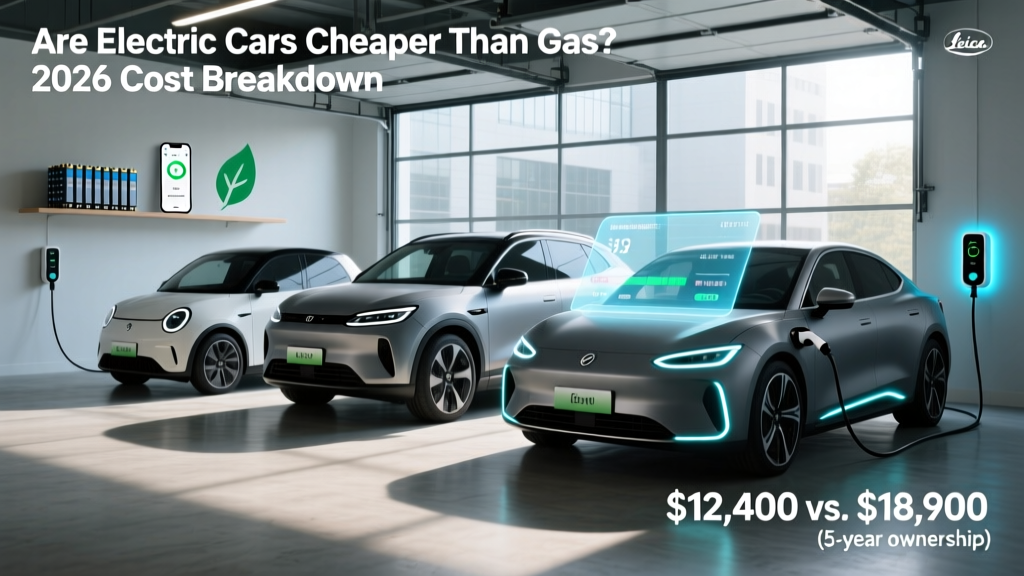
Result: The EV saves approximately $4,700 over 5 years in this scenario — roughly $940 per year. The savings grow larger in years 6 and 7 as the gas car's maintenance costs climb and the EV's energy advantage compounds.
But this assumes: full $7,500 tax credit eligibility, reliable home charging at average US electricity rates, and no major battery issues (which the 8-year/100,000-mile federal battery warranty largely covers).
Common Misconceptions About EV Costs
| Myth | Fact |
|---|---|
| "EV batteries cost $20,000 to replace" | Most EV batteries rarely need full replacement. Degradation averages 1–2% per year. A 2020 Model 3 battery replacement runs $13,000–$16,000, but the NHTSA-mandated warranty covers 8 years/100,000 miles against failure or excessive capacity loss (below 70%). |
| "EVs are always cheaper to own" | Not true for low-mileage drivers, apartment dwellers without charging, or those in high-electricity-rate states. A driver covering only 6,000 miles/year may never recoup the purchase premium. |
| "Public charging is as cheap as home charging" | Public DC fast charging at $0.35–$0.55/kWh often matches or exceeds the per-mile cost of gasoline. The economic case for EVs relies heavily on home or workplace Level 2 charging. |
| "All EVs qualify for the $7,500 tax credit" | Eligibility depends on MSRP caps, buyer income limits, battery sourcing requirements, and North American assembly. Many popular EVs qualify for $3,750 or nothing at all in 2026. |
| "EVs save money immediately" | The break-even point typically falls between years 3 and 5 depending on mileage, electricity rates, and tax credit eligibility. Short-term owners may lose money. |
Decision Framework: Is an EV Cheaper for You?
Choose an EV if:
- You have access to home or workplace Level 2 charging (this is non-negotiable for the economic case)
- You drive 10,000+ miles per year (higher mileage = faster payback on the purchase premium)
- You qualify for the full or partial §30D federal tax credit (check income caps and vehicle eligibility)
- You plan to keep the vehicle 5+ years (the savings compound over time)
- You live in a state with moderate-to-low electricity rates or offer time-of-use EV plans
- You value reduced maintenance visits and instant torque as quality-of-life benefits beyond pure economics
Choose a gas car or hybrid if:
- You rent or live in a condo/apartment without charging access and cannot install a Level 2 charger
- You drive fewer than 7,000 miles per year (the fuel savings won't offset the higher purchase price)
- You plan to sell or trade in within 3 years (depreciation may erase your savings)
- Your state electricity rates exceed $0.28/kWh and you have no access to off-peak pricing
- You regularly drive in extreme cold (below 10°F), where EV range drops 20–35% and charging slows significantly
- You frequently tow heavy loads over long distances (towing cuts EV range by 30–50%)
Consider a plug-in hybrid (PHEV) if:
- You want electric-only commuting (20–40 miles of EV range covers most daily trips) but gas flexibility for road trips
- You have home charging but worry about public charging infrastructure on longer drives
- You want lower running costs without the full EV purchase premium
What First-Time EV Buyers Should Know
If you've decided the numbers work in your favor, here are the practical realities that spec sheets don't tell you:
Install your home charger before taking delivery. A Level 2 home charger (240V, 32–48 amps, delivering 7.7–11.5 kW) adds roughly 25–44 miles of range per hour of charging. Professional installation by a licensed electrician typically costs $800–$2,500 depending on whether your electrical panel needs an upgrade (a 200-amp panel is ideal; older 100-amp panels may require a $1,500–$3,000 upgrade).
Understand the difference between kW and kWh. kW (kilowatts) measures power — how fast energy flows into your car. kWh (kilowatt-hours) measures energy — how much your battery holds. A 75 kWh battery charged at 11.5 kW (Level 2) takes about 6.5 hours from empty. That same battery at a 150 kW DC fast charger can go from 10% to 80% in roughly 25 minutes.
EPA range is a best-case estimate. Real-world range depends on speed, temperature, terrain, and climate control usage. Expect 15–25% less range at sustained highway speeds (70+ MPH) and 20–35% less in sub-freezing temperatures. A 310-mile EPA-rated EV may deliver 230–260 miles on a cold winter highway drive.
DC fast charging slows above 80%. Charging curves aren't linear. An EV might accept 200 kW from 10–50% state of charge, taper to 100 kW by 70%, and drop below 50 kW past 80%. This is why manufacturers quote 10–80% charging times — the last 20% can take as long as the first 70%.
Precondition your battery before fast charging. Most EVs allow you to set a charging station as your navigation destination, which warms the battery to optimal temperature for faster charging. Skipping preconditioning in cold weather can cut your peak charge rate by 30–50%.
Frequently Asked Questions
Are electric cars cheaper to insure than gas cars?
No. EV insurance premiums typically run 15–25% higher than comparable gas vehicles due to higher repair costs, specialized parts, and expensive battery replacement. However, some insurers now offer EV-specific policies, and the gap is narrowing as EV repair infrastructure matures.
Do electric cars save money on maintenance?
Yes, significantly. EVs eliminate oil changes, transmission service, spark plugs, timing belts, and exhaust repairs. Average annual maintenance costs are $400–$600 for an EV versus $900–$1,200 for a gas car. The main increased cost is tires, which wear faster due to vehicle weight and instant torque.
What happens if I can't charge at home?
Relying solely on public charging eliminates most of the EV cost advantage. DC fast charging at $0.35–$0.55/kWh costs roughly the same per mile as gasoline. Before buying an EV, confirm you have reliable access to Level 2 charging at home, work, or a nearby location with regular availability.
How long until an EV pays for itself versus a gas car?
For a typical driver covering 12,000 miles per year with home charging and full tax credit eligibility, the break-even point falls between years 3 and 5. High-mileage drivers (15,000+ miles/year) in low-electricity-rate states may break even in 2–3 years. Low-mileage drivers may never fully recoup the premium.
Are hybrids cheaper than both EVs and gas cars?
Conventional hybrids (HEVs) like the Toyota Prius often offer the lowest total cost of ownership for buyers who can't charge at home. They require no charging infrastructure, achieve 50+ MPG, and carry minimal purchase premiums ($1,000–$3,000 over gas equivalents). Plug-in hybrids (PHEVs) offer a middle ground: 20–40 miles of electric range for daily commuting with gas backup for road trips.
Does cold weather make EVs more expensive to own?
Cold weather reduces EV range by 20–35% and slows charging speeds, which increases your effective cost per mile. If you live in a climate with sustained sub-freezing winters, factor in roughly 25% more energy consumption during those months. An EV with a heat pump (standard on many 2026 models including Hyundai, Tesla, and BMW) mitigates some of this loss.
Sources: EPA fuel economy data from fueleconomy.gov; IRS Clean Vehicle Credit rules from irs.gov; vehicle pricing and specifications from manufacturer press sites. Tax credit eligibility and vehicle qualification change frequently — verify current status before purchasing.