The Short Answer
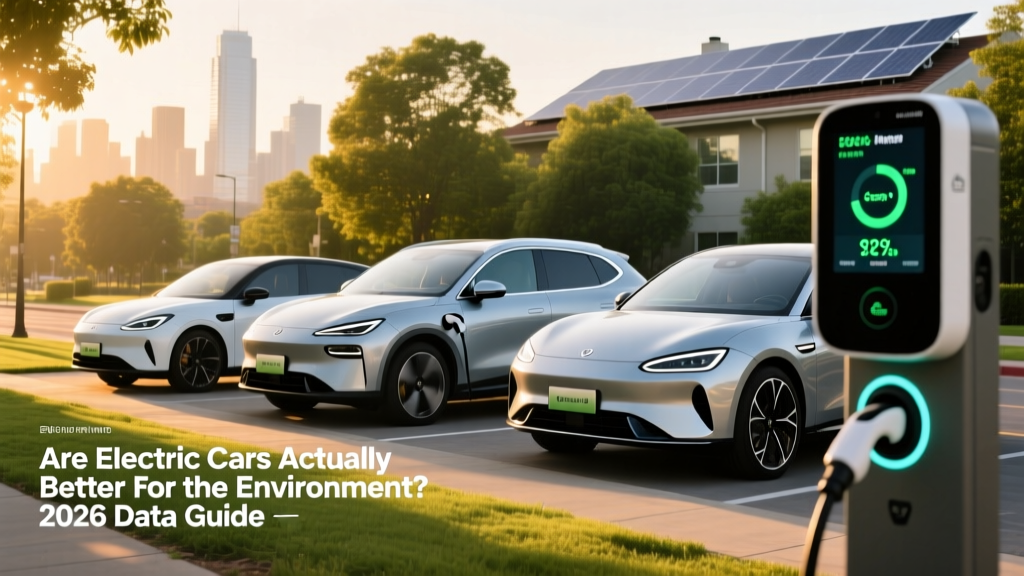
Yes — in most U.S. regions and driving scenarios, electric cars produce significantly fewer lifetime greenhouse-gas emissions than comparable gas vehicles, even when accounting for battery manufacturing. According to the Union of Concerned Scientists and EPA data, the average EV sold today generates roughly 60–70% fewer lifecycle emissions than a 30 MPG gas car over 150,000 miles of driving. However, the environmental advantage depends heavily on your local electricity grid mix, how long you keep the vehicle, and whether you can charge at home on cleaner power. An EV driven exclusively on coal-heavy grid electricity and replaced after 50,000 miles may offer a slimmer margin. For most buyers in 2026, the math is decisively in the EV's favor — but let's look at the actual numbers.
Lifecycle Emissions: Manufacturing, Driving, and End-of-Life
The environmental question isn't just about tailpipe emissions — it's about the full lifecycle: mining and refining raw materials, manufacturing the battery and vehicle, generating the electricity that charges it, and eventually recycling or disposing of it.
Manufacturing debt. Building an EV battery is energy-intensive. Producing a typical 75 kWh NMC (nickel-manganese-cobalt) battery pack generates approximately 5,000–7,500 kg of CO₂ equivalent, depending on the factory's energy source and mineral supply chain. This means an EV rolls off the assembly line with a larger carbon "debt" than a comparable gas car — typically 30–50% more manufacturing emissions, according to lifecycle analyses from Argonne National Laboratory.
Payback period. That manufacturing debt is repaid through zero tailpipe emissions during driving. On the average U.S. grid (which in 2026 is roughly 40% renewable, 35% natural gas, 15% nuclear, and 10% coal), an EV reaches carbon parity with a 30 MPG gas sedan after approximately 20,000–35,000 miles of driving. On a cleaner grid — say, California's or the Pacific Northwest's — that payback shrinks to 10,000–18,000 miles. On a coal-heavy grid like parts of the Midwest, it may stretch to 40,000–55,000 miles. After payback, every additional mile driven is a net environmental win.
End-of-life. Battery recycling is advancing rapidly. Companies like Redwood Materials and Li-Cycle recover 90–95% of critical minerals (lithium, nickel, cobalt) from spent EV batteries, reducing the need for virgin mining. Most 2026-model EV batteries are designed for second-life applications (grid storage) before recycling, further amortizing their environmental cost.
EV vs. Gas: Carbon Emissions by the Numbers
Let's compare a popular 2026 EV against a comparable gas sedan using real EPA and fueleconomy.gov data:
| Metric | 2026 Tesla Model 3 RWD | 2026 Toyota Camry LE (Gas) |
|---|---|---|
| EPA Efficiency | 132 MPGe (25 kWh/100 mi) | 32 MPG combined |
| Tailpipe CO₂ per mile | 0 g | 276 g |
| Well-to-wheel CO₂ (U.S. avg grid) | ~95 g/mi | ~350 g/mi |
| Lifetime CO₂ (150,000 mi) | ~14,250 kg (driving) + ~8,000 kg (mfg) | ~52,500 kg (driving) + ~6,000 kg (mfg) |
| Total Lifecycle CO₂ | ~22,250 kg | ~58,500 kg |
Even with the higher manufacturing emissions, the Model 3 produces roughly 62% fewer lifecycle emissions over 150,000 miles on the average U.S. grid. On a cleaner grid, that gap widens to 70–75%.
Your Grid Matters: Regional Emissions Breakdown
Electricity generation varies dramatically by region, and that directly affects your EV's environmental footprint. The EPA's Greenhouse Gas Equivalencies Calculator and utility data show wide variation:
- Pacific Northwest (hydro-dominant): ~30 g CO₂/kWh — EV emissions as low as 45 g/mi
- California (renewables + gas): ~180 g CO₂/kWh — EV emissions ~70 g/mi
- Texas (gas + wind + solar): ~350 g CO₂/kWh — EV emissions ~110 g/mi
- Midwest (coal + gas): ~550 g CO₂/kWh — EV emissions ~160 g/mi
- U.S. average (2026): ~380 g CO₂/kWh — EV emissions ~115 g/mi
Even in the most coal-heavy U.S. regions, an EV still produces fewer well-to-wheel emissions than a 25–30 MPG gas car. And grids are getting cleaner every year — an EV bought in 2026 will effectively become "greener" over its lifetime as renewables displace fossil generation.
Real Costs: Purchase, Charging, Fuel, and Maintenance
Environmental benefit matters, but buyers also need the financial picture. Here's a 5-year/75,000-mile cost breakdown comparing a 2026 Chevrolet Equinox EV (base MSRP ~$33,000 before incentives) against a 2026 Honda CR-V gas model (~$31,000 MSRP):
| Cost Category | 2026 Chevy Equinox EV 2LT | 2026 Honda CR-V LX (Gas) |
|---|---|---|
| Purchase Price (MSRP) | $33,000 | $31,000 |
| Federal Tax Credit (§30D)* | –$7,500 (if eligible) | $0 |
| Effective Purchase Price | $25,500 | $31,000 |
| Fuel/Energy (75,000 mi) | $2,625 (home charging @ $0.14/kWh) | $7,500 (gas @ $3.50/gal, 30 MPG) |
| Maintenance (5 yr) | ~$1,200 (tire rotations, cabin filter, fluid top-offs) | ~$3,500 (oil changes, brakes, filters, transmission fluid) |
| Insurance (5 yr avg) | ~$9,500 | ~$7,800 |
| 5-Year Total Cost | ~$38,825 | ~$49,800 |
*Federal §30D tax credit eligibility depends on buyer income caps ($150K single / $300K joint), vehicle MSRP caps ($55K sedans / $80K SUVs/trucks), battery component and critical-mineral sourcing requirements, and point-of-sale transfer availability. Confirm current-year rules with a tax professional.
The EV saves roughly $10,975 over five years in this scenario — primarily through fuel and maintenance savings that more than offset slightly higher insurance premiums. Without the tax credit, the savings narrow to ~$3,475 but remain positive.
Common Misconceptions: Myth vs. Fact
| Myth | Fact |
|---|---|
| "EVs are worse because of battery mining" | Battery manufacturing adds ~2,000–4,000 kg CO₂ vs. a gas car, but this is repaid within 20K–40K miles of driving. Over 150K miles, the EV still wins by 55–70%. |
| "EVs just shift pollution to the power plant" | Even on coal-heavy grids, large power plants are more thermally efficient than small car engines, and grids are decarbonizing. Average EV well-to-wheel emissions are ~65% lower than gas. |
| "Batteries end up in landfills" | Modern EV batteries are 90–95% recyclable. Most are repurposed for grid storage before recycling. No major EV battery has reached end-of-life in a landfill at scale. |
| "EVs don't have enough range for real life" | The median 2026 EV offers 270–340 miles EPA range. The average American drives 37 miles/day. Even with 25% cold-weather loss, most EVs cover a week of commuting on a single charge. |
| "Charging takes too long" | Home Level 2 charging (7–11 kW) adds 25–40 miles per hour — most owners wake up to a full battery. DC fast charging (150–250 kW) delivers 10–80% in 18–30 minutes on modern platforms. |
Real-World Ownership: What First-Time Buyers Should Know
The environmental and financial case for EVs is strong, but ownership satisfaction depends on practical fit. Here's what actually matters:
Home charging access is the biggest variable. If you can install a Level 2 charger at home (240V, 32–48 amps), an EV integrates seamlessly into daily life. Expect $500–$1,500 for the charger hardware and $800–$2,500 for electrician installation, depending on panel capacity and conduit run. If your electrical panel needs an upgrade to 200A, add $1,500–$3,500. Without home charging, you'll rely on public DC fast chargers and workplace Level 2 stations — workable, but less convenient and more expensive per kWh.
Cold weather reduces range 15–30%. In sub-freezing temperatures, battery chemistry slows and cabin heating draws significant energy. A 300-mile EPA EV may deliver 210–255 real-world miles in January in Minnesota. Heat pumps (standard on many 2026 models including Hyundai Ioniq 5, Tesla Model Y, and BMW iX) mitigate this loss to 15–20%.
Highway driving is less efficient than city driving. Unlike gas cars, EVs are most efficient in stop-and-go traffic thanks to regenerative braking. At sustained 75–80 MPH highway speeds, expect 10–20% below EPA range. Plan road trips around DC fast-charger locations using tools like A Better Routeplanner.
Insurance costs 10–25% more on average. EVs have higher repair costs (specialized parts, battery caution protocols) and higher replacement values. Shop quotes before buying — some insurers offer EV-specific discounts.
Decision Framework: Is an EV the Right Environmental (and Financial) Choice for You?
- Choose an EV if: You have home charging access (or reliable workplace charging), drive more than 10,000 miles/year (maximizing fuel savings), plan to keep the vehicle 5+ years (amortizing the manufacturing carbon debt), and live in a region with a moderately clean or improving grid.
- Choose a PHEV (plug-in hybrid) if: You lack reliable home charging, frequently drive 300+ miles in a day, live in an extreme-cold climate, or want to reduce emissions without range compromises. A PHEV like the Toyota RAV4 Prime (42 miles electric-only, 38 MPG gas) offers substantial emissions reduction with gas-car flexibility.
- Choose a conventional hybrid if: You cannot charge at home or work, drive in a very coal-heavy grid region, and need maximum range flexibility. A hybrid like the Toyota Camry Hybrid (52 MPG combined) still cuts emissions ~40% vs. a gas-only car.
- Wait or reconsider if: You drive fewer than 5,000 miles/year (the carbon payback takes longer), your only charging option is expensive public DC fast charging exclusively, or your budget can't absorb the higher upfront cost even with incentives.
Frequently Asked Questions
Are electric cars actually better for the environment if the electricity comes from coal?
Yes, in nearly all cases. Even on the most coal-heavy U.S. grids, an EV's well-to-wheel emissions are lower than a 25 MPG gas car because power plants are more thermally efficient than internal combustion engines, and emissions are concentrated at fewer, more regulatable sources. As grids add renewables, the EV's advantage grows over time — a gas car never gets cleaner.
How long does an EV battery last before it needs replacement?
Modern EV batteries (both NMC and LFP chemistries) are engineered for 200,000–300,000 miles before reaching 70–80% of original capacity. Federal law mandates a minimum 8-year/100,000-mile battery warranty; most 2026 models carry 8 yr/100K or 10 yr/150K coverage. Full replacement costs $8,000–$18,000 depending on pack size, but most original batteries outlast the vehicle's economic life.
Do EVs produce more particulate pollution from tire wear?
EVs are typically 500–1,000 lbs heavier than gas equivalents due to the battery, which increases tire wear particulates by roughly 10–20%. However, regenerative braking dramatically reduces brake-pad wear (a major particulate source), often offsetting the tire difference. Overall non-exhaust particulate emissions are roughly comparable between EVs and gas cars.
What's the single biggest thing I can do to make my EV greener?
Charge on cleaner electricity. If your utility offers a green-energy or time-of-use plan, enroll in it. Installing rooftop solar (or subscribing to a community solar program) can bring your EV's operating emissions close to zero. Charging during off-peak hours (overnight) also tends to use a cleaner grid mix in many regions.
Is a used EV still environmentally better than a new gas car?
Absolutely. A used EV has already "paid" its manufacturing carbon debt in its first ownership period. Driving it further adds zero tailpipe emissions and very low well-to-wheel emissions. A used EV is arguably the single lowest-carbon vehicle purchase you can make.