The Short Answer
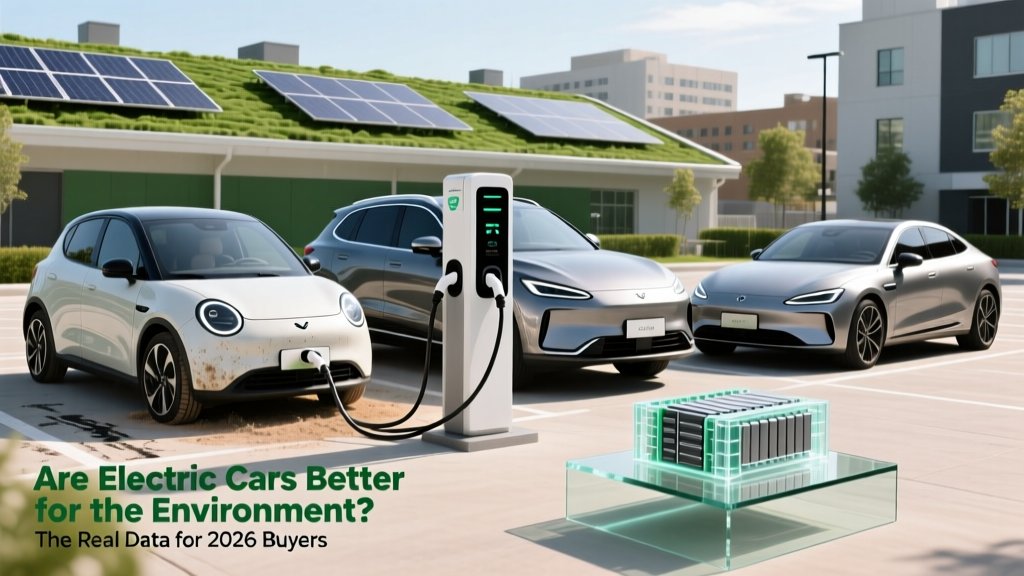
Yes — in most U.S. regions, electric cars produce significantly fewer lifecycle greenhouse-gas emissions than comparable gasoline cars, even when accounting for battery manufacturing. According to the Union of Concerned Scientists and EPA data, the average EV sold in the U.S. today emits the equivalent of a gasoline car getting roughly 90–100 MPG over its lifetime, versus the current new-car fleet average of about 28 MPG. However, the environmental advantage depends on your local electricity grid, how many miles you drive, and whether your home charging setup is practical. Below, we walk through the exact numbers so you can decide if an EV makes sense for your situation — not just the planet.
Lifecycle Emissions: EV vs. Gas Car by the Numbers
The most honest way to compare environmental impact is a full lifecycle analysis: mining and manufacturing (including the battery), years of driving, and end-of-life recycling. This is where EVs face their biggest initial disadvantage — and their long-term payoff.
Building an EV battery is energy-intensive. Manufacturing a typical 75 kWh NMC (nickel-manganese-cobalt) battery pack generates roughly 4,500–7,500 kg of CO₂ equivalent before the car drives its first mile, according to data synthesized by the Intergovernmental Panel on Climate Change and Argonne National Laboratory's GREET model. A gasoline car's manufacturing footprint is lower — roughly 6,000–7,000 kg CO₂e for the vehicle without a large battery.
That means an EV starts its life with an "emissions debt" of approximately 1,500–3,000 kg CO₂e compared to a gas car. The question is: how quickly does driving on electricity pay that debt off?
| Metric | Gasoline Car (28 MPG avg) | EV (U.S. Average Grid) | EV (Clean Grid — CA, NY, PNW) |
|---|---|---|---|
| Manufacturing emissions | ~7,000 kg CO₂e | ~10,500 kg CO₂e | ~10,500 kg CO₂e |
| Fuel/energy emissions over 150k mi | ~42,000 kg CO₂e | ~14,000 kg CO₂e | ~5,500 kg CO₂e |
| Total lifecycle | ~49,000 kg CO₂e | ~24,500 kg CO₂e | ~16,000 kg CO₂e |
| Breakeven vs. gas car | — | ~20,000–35,000 miles | ~12,000–18,000 miles |
The breakeven point — where an EV's total emissions drop below a comparable gas car — typically falls between 15,000 and 35,000 miles depending on your grid. On a coal-heavy grid (parts of Wyoming, West Virginia), breakeven stretches toward 50,000+ miles. On a renewable-heavy grid (California, Washington State, upstate New York), it can happen within the first year of average driving.
Tailpipe vs. Smokestack: Where Emissions Actually Come From
Gasoline cars emit CO₂ directly from the tailpipe — about 8.89 kg of CO₂ per gallon burned (per the EPA). A car averaging 28 MPG and driving 12,000 miles per year burns roughly 429 gallons, producing about 3,810 kg of CO₂ annually — just from combustion, not counting upstream oil extraction and refining.
EVs have zero tailpipe emissions. Their operational emissions come from electricity generation, which varies dramatically by zip code:
- California (CAISO grid): ~0.55 lbs CO₂/kWh → an EV averaging 3.5 miles/kWh emits ~1,543 kg CO₂/year over 12,000 miles
- Texas (ERCOT grid): ~0.85 lbs CO₂/kWh → ~2,386 kg CO₂/year
- Wyoming: ~1.60 lbs CO₂/kWh → ~4,491 kg CO₂/year — still less than the gas car's ~3,810 kg because upstream fuel emissions push the gas car higher
- Washington State (hydro-heavy): ~0.15 lbs CO₂/kWh → ~421 kg CO₂/year
Even on the dirtiest U.S. grids, EVs generally produce fewer operational emissions than gas cars because large power plants are more thermodynamically efficient than small internal-combustion engines, and because the grid is decarbonizing every year. Your EV gets "cleaner" as your utility adds renewables — a gas car never does.
The Real Cost of Ownership: EV vs. Gas vs. Hybrid
Environmental benefits are compelling, but most buyers also need the math to work financially. Here's a 5-year total-cost-of-ownership comparison for a typical midsize crossover — comparing a gasoline model, a hybrid, and a battery-electric vehicle at current 2026 pricing.
| Cost Category | Gas Car (28 MPG, $34,000 MSRP) | Hybrid (48 MPG, $37,000 MSRP) | EV (270 mi range, $42,000 MSRP) |
|---|---|---|---|
| Purchase price (after incentives) | $34,000 | $37,000 | $34,500 (est. $7,500 §30D credit) |
| Fuel / electricity (60k mi) | $7,714 (gas at $3.50/gal) | $4,375 (gas at $3.50/gal) | $2,057 (home L2 at $0.14/kWh) |
| Maintenance (5 years) | $3,200 | $2,800 | $1,100 |
| Insurance (5 years, avg) | $7,500 | $7,500 | $8,750 |
| Depreciation (est.) | $14,000 | $13,500 | $16,000 |
| Total 5-year cost | $66,414 | $65,175 | $62,407 |
Key takeaways from this comparison:
- Fuel savings are massive. The EV saves $5,657 over gas and $2,318 over the hybrid in energy costs alone over 60,000 miles — and more if gas prices rise.
- Maintenance is roughly 65% cheaper on the EV: no oil changes, no transmission fluid, fewer brake replacements due to regenerative braking.
- Insurance is the pain point. EV insurance premiums average 15–20% higher than equivalent gas cars due to higher repair costs and battery replacement risk.
- Depreciation remains a wildcard. Used EV prices have been volatile. Models from Tesla, Hyundai, and BMW have held value better than some early-market entrants, but depreciation varies by brand and battery-health perception.
Federal §30D Tax Credit — 2026 Rules
The EV may qualify for up to $7,500 in federal tax credits (or point-of-sale reduction), but eligibility depends on multiple factors. Per IRS guidelines:
- Buyer AGI must not exceed $150,000 (single) / $300,000 (joint)
- Vehicle MSRP cap: $55,000 for sedans, $80,000 for SUVs/trucks
- Battery components and critical minerals must meet phased-in domestic-sourcing thresholds
- Vehicles with battery components from a "foreign entity of concern" are disqualified
- Credit can be transferred to the dealer as a point-of-sale discount
Not every EV qualifies. Always verify current eligibility on the IRS and fueleconomy.gov sites before purchasing.
Common Misconceptions — Fact-Checked
| Myth | Fact |
|---|---|
| "EV batteries end up in landfills" | Modern EV batteries are 90%+ recyclable. Companies like Redwood Materials and Li-Cycle recover lithium, cobalt, and nickel for reuse. Most manufacturers also offer 8-year/100,000-mile battery warranties, and degraded packs often find second-life use in grid storage. |
| "Building an EV is worse than driving a gas car forever" | The manufacturing emissions debt is real (~3,000 kg CO₂e extra) but is repaid within 15,000–35,000 miles of driving in most U.S. regions. After breakeven, every additional mile is net cleaner. |
| "EVs just shift pollution to coal power plants" | Even on coal-heavy grids, large power plants have emissions controls and are more efficient per unit of energy than millions of small gasoline engines. And the U.S. coal share dropped from 23% (2022) to ~16% (2026) — the grid is cleaning faster than cars are being replaced. |
| "EVs don't work in cold climates" | Cold weather reduces range by 20–35% (depending on the model and whether it has a heat pump). A 270-mile EPA-rated EV might deliver 180–210 real-world miles at 20°F. That's a real limitation for long winter road trips, but most daily commutes (under 40 miles) are unaffected. Norway — one of the coldest countries in Europe — has the world's highest EV adoption rate. |
| "The battery will need replacing in 5 years" | Data from Tesla, Hyundai, and Chevrolet fleets shows most modern NMC and LFP batteries retain 85–92% capacity after 150,000 miles. Full replacement is rare and typically covered under the 8-year/100,000-mile federal warranty mandate. |
Battery Chemistry and Environmental Impact
Not all EV batteries are equal — and chemistry choice affects both environmental footprint and ownership experience.
| Factor | LFP (Lithium Iron Phosphate) | NMC (Nickel-Manganese-Cobalt) |
|---|---|---|
| Energy density | Lower (~160 Wh/kg cell-level) | Higher (~250 Wh/kg cell-level) |
| Range per pack weight | Less range for same weight | More range for same weight |
| Cobalt/nickel mining impact | None — iron and phosphate are abundant | Significant — cobalt mining has ethical and environmental concerns |
| Cycle life | 3,000–5,000+ cycles | 1,500–2,500 cycles |
| Cold-weather performance | Weaker — greater range loss below freezing | Better low-temp discharge capability |
| Charging to 100% regularly | Recommended (no degradation penalty) | Best kept at 80% daily, 100% for trips only |
| Common in (2026) | Tesla Model 3 RWD, Ford Mustang Mach-E Select, BYD models | Hyundai Ioniq 5, Kia EV6, BMW iX, most long-range trims |
From an environmental standpoint, LFP batteries have a clear edge: they eliminate cobalt (linked to problematic mining practices in the DRC) and last significantly longer, meaning fewer replacement cycles over the vehicle's life. The trade-off is lower energy density, which means heavier packs for the same range — slightly reducing efficiency. If your daily driving is under 100 miles and you don't face extreme winters, LFP is the more sustainable and longer-lasting choice.
Real-World Ownership: What First-Time EV Buyers Need to Know
The environmental case for EVs is strong, but your personal experience depends on practical factors that have nothing to do with emissions. Here's what actually determines whether an EV works in your life:
Home Charging Access Is the Make-or-Break Factor
Over 80% of EV charging happens at home. If you have a garage or driveway where you can install a Level 2 charger (240V, typically 7.2–11.5 kW), you'll wake up every morning with a "full tank" at roughly $0.10–$0.18/kWh — equivalent to paying $1.00–$1.80 per gallon of gasoline.
But if you live in an apartment, rely on street parking, or your home has an older 100-amp electrical panel, the equation changes:
- Level 2 home charger installation: $500–$1,500 for equipment and electrician labor if your panel supports it. A panel upgrade (100A → 200A) adds $1,500–$3,500.
- Public DC fast charging: $0.30–$0.55/kWh at networks like Electrify America or EVgo — roughly 2–3× the cost of home charging, though still often cheaper than gasoline per mile.
- Public Level 2: Often free or low-cost at workplaces, grocery stores, and some apartment complexes — but availability varies wildly by region.
If you cannot charge at home and your area has sparse public infrastructure, a plug-in hybrid (PHEV) like the Toyota RAV4 Prime (42 miles electric-only range, 38 MPG combined after depletion) may be a more practical bridge.
Climate and Driving Patterns
Your local climate and commute type affect both EV efficiency and the environmental equation:
- Highway-heavy commutes: EVs lose efficiency at sustained 75+ MPH speeds (no regenerative braking benefit). Expect 10–15% below EPA range on long highway trips.
- Cold climates (below 30°F): Battery chemistry slows, cabin heating draws significant energy. Models with heat pumps (Hyundai Ioniq 5, Tesla Model Y) lose 15–25% range. Models with resistive heaters lose 25–40%.
- City and stop-and-go driving: This is where EVs shine brightest — regenerative braking recaptures energy, and electric motors are maximally efficient at low speeds. City EV drivers often exceed their EPA range rating.
- Short commutes in any climate: The ideal EV use case. Under 40 miles/day means you rarely need public charging, and daily energy costs can be under $1.50.
Decision Framework: Should You Buy an EV, Hybrid, or Stick with Gas?
Choose a Battery-Electric Vehicle (BEV) If:
- You can install a Level 2 charger at home or have reliable workplace charging
- Your daily driving is under 120 miles round-trip
- You live in a region with a moderately clean or cleaning grid
- You want the lowest per-mile operating cost and minimal maintenance
- You plan to keep the car 5+ years (amortizing the higher upfront cost)
- You qualify for the §30D tax credit, bringing effective purchase price near a gas car
Choose a Plug-In Hybrid (PHEV) If:
- You can charge at home but frequently take road trips beyond EV range
- You live in a region with extreme cold where EV range loss is severe
- You want to drive electric on daily commutes (25–45 miles) but need gas flexibility
- Your apartment or HOA doesn't yet support EV charger installation
Choose a Standard Hybrid (HEV) If:
- You have no access to any charging (home or public)
- You want better MPG without changing your fueling habits
- Upfront budget is tight and you don't qualify for EV tax credits
Wait on an EV If:
- You rely exclusively on street parking in an area with no public chargers
- Your home electrical panel needs a costly upgrade and you're renting
- Your grid is >60% coal with no near-term clean energy plans
Frequently Asked Questions
Are EVs really better for the environment if electricity comes from fossil fuels?
Yes, in nearly every U.S. grid region. Even when electricity is generated from natural gas, a combined-cycle gas power plant converts fuel to energy at ~45–60% efficiency, while a gasoline car engine converts only ~20–30% of fuel energy to motion. The EV's advantage grows each year as the grid adds wind, solar, and nuclear capacity. Only in extreme edge cases (a grid that is >80% coal with no controls) does the advantage narrow significantly — and no U.S. grid fits that profile in 2026.
What happens to EV batteries when they degrade?
EV batteries rarely "die" suddenly. They gradually lose capacity — typically retaining 85–92% of original capacity after 150,000 miles based on fleet data. When a battery is no longer suitable for a car (usually below 70% capacity), it can be repurposed for stationary grid storage for another 10–15 years. After that, recyclers like Redwood Materials recover 95%+ of lithium, cobalt, nickel, and copper for use in new batteries. Federal law requires EV battery warranties of at least 8 years / 100,000 miles (10 years / 150,000 miles in CARB states).
How does the environmental impact of EVs compare to hybrids?
A conventional hybrid (like the Toyota Prius, 57 MPG combined) reduces fuel consumption by roughly 50% compared to a 28 MPG gas car. A battery EV reduces operational emissions by 60–85% depending on grid mix. Over a 150,000-mile lifecycle, a BEV on the average U.S. grid produces roughly 50% less total CO₂ than a hybrid. However, a PHEV driven mostly on electric for short commits and gas for longer trips can approach BEV-level emissions if the driver charges diligently. The key variable is behavior — an unplugged PHEV is just a slightly more efficient hybrid.
Is mining for EV batteries worse than drilling for oil?
Both have environmental costs, but the scale differs enormously. A gasoline car burns roughly 3,500–4,000 gallons of fuel over 100,000 miles — requiring the extraction, refining, and transport of approximately 12,000+ gallons of crude oil (accounting for refining losses). An EV battery requires a one-time extraction of roughly 8–12 kg of lithium, 12–18 kg of cobalt (NMC only), and 30–40 kg of nickel — materials that are largely recoverable and recyclable at end of life. Oil, once burned, is gone permanently. Additionally, LFP batteries eliminate cobalt and nickel entirely, further reducing mining impact.
Do EVs produce more particulate pollution from tire wear?
This is a legitimate concern. EVs are typically 500–1,000 lbs heavier than comparable gas cars due to the battery pack, and instant electric torque accelerates tire wear. Studies suggest EVs may produce 10–20% more tire particulate matter (PM2.5) than equivalent gas cars. However, EVs eliminate brake-dust particulates almost entirely through regenerative braking, which offsets a significant portion of the tire-wear increase. On balance, non-exhaust particulate emissions are roughly comparable, and tire manufacturers are developing EV-specific low-wear compounds. This is an area where the industry still needs improvement.