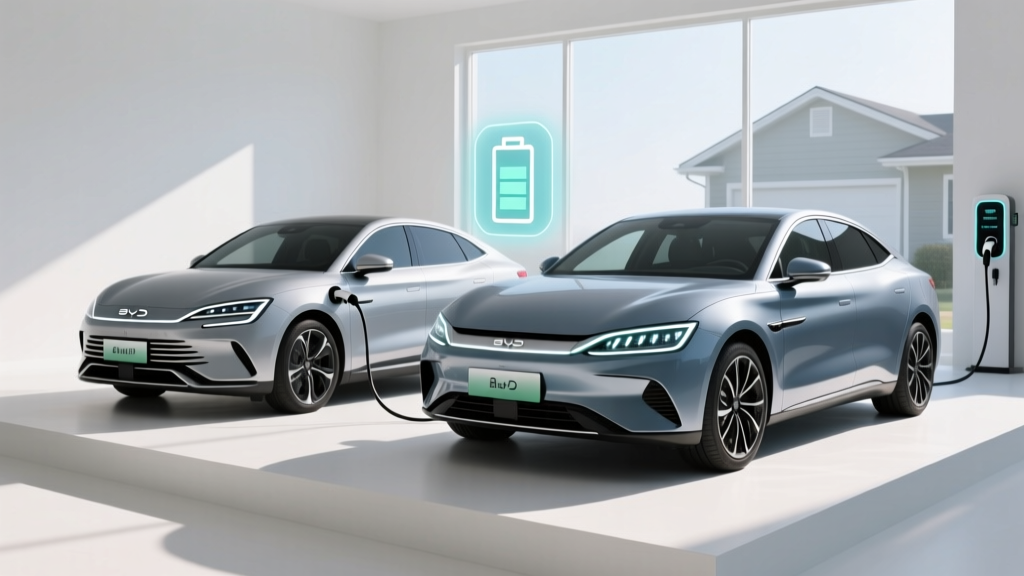
If you've followed electric vehicle news at all in the past two years, you've seen BYD — the Chinese automaker that briefly overtook Tesla as the world's top-selling EV maker. But for US-based shoppers asking are BYD cars good, the answer is layered. BYD builds genuinely competitive electric vehicles at aggressive prices globally, but whether you can actually buy and own one in the United States is an entirely different question.
This guide cuts through the hype and examines BYD's EV technology, real-world performance data from international markets, pricing, battery chemistry, and the regulatory realities that keep BYD passenger cars out of US showrooms in 2026. If you're considering importing a BYD, moving abroad, or simply want to understand how BYD stacks up against Tesla, Hyundai, and Chevrolet — here's the full picture.
BYD's EV Lineup: What They Actually Build
BYD (Build Your Dreams) produces a wide range of battery-electric vehicles (BEVs) and plug-in hybrids (PHEVs) under its Dynasty and Ocean series. The company is unique in that it manufactures its own batteries, semiconductors, and electric motors — a vertical integration strategy that keeps costs remarkably low.
Key global models include:
- BYD Seal — midsize electric sedan competing with the Tesla Model 3
- BYD Atto 3 (Yuan Plus) — compact electric crossover rivaling the Hyundai Kona Electric
- BYD Dolphin — subcompact hatchback EV
- BYD Han — flagship luxury sedan
- BYD Seal U — midsize SUV sold in Europe and Australia
- BYD Tang — three-row electric SUV
For this analysis, we'll focus primarily on the BYD Seal and BYD Atto 3, as these represent the models most frequently compared to EVs US buyers already know.
BYD Seal: Specs, Range, and Real-World Performance
The BYD Seal is the company's most globally recognized sedan, positioned squarely against the Tesla Model 3 and Hyundai Ioniq 6. Here's what the numbers look like for the Design (AWD) trim, which is the variant most widely reviewed internationally:
| Specification | BYD Seal Design (AWD) |
|---|---|
| Battery Capacity | 82.5 kWh usable (LFP — Blade Battery) |
| WLTP Range | 323 miles (520 km) |
| Estimated EPA-Equivalent Range | ~280–295 miles |
| Motor Output | 523 hp / 390 kW combined |
| Drivetrain | Dual-motor AWD |
| 0–62 mph (0–100 km/h) | 3.8 seconds |
| Max DC Fast Charge | 150 kW peak |
| 10–80% DC Charge Time | ~26 minutes |
| AC Level 2 Charging | 11 kW onboard charger |
| Length / Wheelbase | 189.0 in / 112.2 in |
| Cargo Volume | 14.1 cu ft trunk + 1.8 cu ft frunk |
| Curb Weight | 4,740 lbs |
Charging Reality: The 150 kW Ceiling
The Seal's 150 kW peak DC fast-charging rate is where competitive comparisons get pointed. The Tesla Model 3 Highland (Long Range AWD) peaks at roughly 250 kW on V3 Superchargers, and the Hyundai Ioniq 6 (Long Range AWD) sustains up to 235 kW thanks to its 800V architecture. The Seal's 400V platform limits its charging speed meaningfully on road trips.
On a 150 kW-capable charger, the Seal's charge curve holds near peak from roughly 10% to 55% state of charge (SoC), then tapers progressively. A full 10–80% session takes approximately 26 minutes — acceptable but not class-leading. For context, the Ioniq 6 achieves 10–80% in about 18 minutes on a 350 kW charger.
At home on a Level 2 (240V) connection, the Seal's 11 kW onboard charger replenishes the 82.5 kWh battery from empty to full in roughly 8 hours — standard overnight charging behavior.
BYD Blade Battery: LFP Chemistry Explained
BYD's signature technology is its Blade Battery, a lithium iron phosphate (LFP) cell arranged in a structural blade format that doubles as a chassis-stiffening element. This is significant for several reasons:
| Factor | BYD Blade (LFP) | Typical NMC Battery |
|---|---|---|
| Energy Density | Lower (~150 Wh/kg cell-level) | Higher (~230–260 Wh/kg) |
| Cycle Life | 3,000+ cycles before 80% retention | 1,500–2,000 cycles |
| Thermal Stability | Excellent — resists thermal runaway | Good — requires more active cooling |
| Cold-Weather Performance | Weaker — greater range loss below freezing | Better — less range penalty in cold |
| Cost | Lower — no cobalt or nickel | Higher — relies on critical minerals |
| Recommended Charging | Can be charged to 100% regularly | Best kept at 80% daily for longevity |
BYD claims the Blade Battery can withstand nail penetration without catching fire — a claim demonstrated in widely viewed promotional videos. Independent testing by organizations like Euro NCAP has confirmed strong safety performance in BYD vehicles equipped with the Blade Battery.
The trade-off is energy density: LFP packs are heavier and bulkier for the same kWh capacity. This is why the Seal, despite a comparable battery size to the Model 3 Long Range, carries roughly 300 additional pounds of curb weight.
BYD Atto 3 (Yuan Plus): The Compact Crossover Option
For buyers comparing against the Chevrolet Equinox EV or Hyundai Kona Electric, the Atto 3 is BYD's global compact SUV entry:
| Specification | BYD Atto 3 (60.48 kWh) |
|---|---|
| Battery Capacity | 60.48 kWh usable (LFP Blade) |
| WLTP Range | 261 miles (420 km) |
| Estimated EPA-Equivalent Range | ~225–235 miles |
| Motor Output | 201 hp / 150 kW (FWD) |
| 0–62 mph | 7.3 seconds |
| Max DC Fast Charge | 88 kW peak |
| 10–80% DC Charge Time | ~29 minutes |
| AC Level 2 Charging | 7 kW onboard |
| Cargo Volume | 15.7 cu ft (rear seats up) |
The Atto 3's 88 kW peak charging rate is its weakest competitive metric. The Kona Electric (2024+) charges at up to 100 kW, and the Equinox EV supports approximately 150 kW. For daily commuting on home charging, this matters less. For road trips, the slower DC rate adds meaningful stop time.
The US Availability Problem: Tariffs, Regulation, and Reality
Here's the core issue for American buyers: BYD does not sell passenger cars in the United States as of 2026. The company sells electric buses and commercial vehicles in the US, but its consumer car lineup is absent due to a convergence of factors:
- 100% tariff on Chinese EVs: In 2024, the US imposed a 100% import tariff on Chinese-manufactured electric vehicles, effectively doubling the landed cost of any BYD model.
- Connected vehicle ban: The US Department of Commerce has finalized rules banning the sale of connected vehicles with Chinese or Russian hardware and software, effective for model year 2027 and beyond. BYD's infotainment and telematics systems would require a complete redesign for the US market.
- No US dealer network: Even if tariffs were reduced, BYD has no established passenger vehicle dealership infrastructure in the US.
- Federal tax credit ineligibility: Under IRS §30D rules, a vehicle must undergo final assembly in North America to qualify for the up-to-$7,500 federal EV tax credit. BYD manufactures exclusively in China, Thailand, Brazil, and other non-NA facilities.
Bottom line: You cannot walk into a US dealership and buy a BYD Seal or Atto 3 today. Importing one independently is technically possible but involves navigating EPA and NHTSA compliance, the 100% tariff, and a complete lack of service infrastructure. For virtually all US buyers, BYD is a benchmark to compare against — not a purchase option.
How BYD Compares to What You Can Actually Buy
To answer "are BYD cars good" in practical terms, we need to compare them against vehicles US buyers can actually purchase, charge, and service:
| Attribute | BYD Seal AWD | Tesla Model 3 LR AWD | Hyundai Ioniq 6 LR AWD |
|---|---|---|---|
| Est. EPA-Equiv. Range | ~280–295 mi | 341 mi (EPA) | 316 mi (EPA) |
| Battery | 82.5 kWh LFP | ~75 kWh NMC | 77.4 kWh NMC |
| 0–60 mph | ~3.6 sec | 4.2 sec | 5.1 sec |
| Peak DC Charge | 150 kW | 250 kW | 235 kW |
| 10–80% Time | ~26 min | ~15 min | ~18 min |
| Global MSRP (equiv.) | ~$40,000 | $47,740 | $46,700 |
| US Availability | Not available | Yes — eligible for §30D credit | Yes — eligible for §30D credit |
| ADAS | Level 2 (basic) | Level 2 (Autopilot standard) | Level 2 (HDA2) |
BYD's advantage is price — the Seal sells for roughly $35,000–$40,000 in markets like Australia and Europe. But once the 100% US tariff is applied, that price doubles to $70,000–$80,000, obliterating any value proposition against the Model 3 or Ioniq 6.
Where BYD Excels (and Where It Falls Short)
Pros
- Industry-leading LFP battery cycle life and thermal safety
- Aggressive global pricing — best value in markets without tariffs
- Strong build quality that has improved markedly since 2022
- Vertical integration reduces supply-chain risk
- Competitive acceleration (Seal AWD: 3.8 sec 0–62)
- 100% daily charging safe with LFP chemistry
Cons
- Not available for US purchase
- Slower DC charging than Tesla, Hyundai/Kia 800V platforms
- LFP range loss in cold weather is significant
- Infotainment software lags behind Tesla and Hyundai UX
- ADAS features are basic — no advanced highway assist like FSD or BlueCruise
- No US service network, parts supply, or warranty support
- WLTP range figures overstate real-world US expectations
Who BYD Vehicles Would Suit — If You Could Buy One
In markets where BYD is available (Europe, Australia, Southeast Asia, South America), the Seal and Atto 3 serve distinct buyer profiles:
- Urban commuters with home charging: LFP's cycle-life advantage shines when you charge nightly and rarely need DC fast charging. The Atto 3's 225+ mile range covers virtually any commute.
- Warm-climate buyers: LFP's cold-weather penalty is minimized in regions where temperatures rarely drop below 40°F.
- Value-driven buyers in tariff-free markets: Where BYD's pricing isn't inflated by import duties, it undercuts competitors by $5,000–$10,000.
- Not ideal for road-trippers: 150 kW (Seal) and 88 kW (Atto 3) charging speeds add time to long-distance travel compared to 250+ kW competitors.
- Not ideal for cold-climate buyers: If you live in the northern US or Canada, LFP's winter range loss is a meaningful drawback versus NMC-equipped competitors.
Frequently Asked Questions
Are BYD cars good quality compared to Tesla and Hyundai?
BYD's build quality, particularly from 2023 onward, is competitive with mainstream brands. The Seal's interior materials, panel gaps, and ride refinement hold up well against the Model 3 and Ioniq 6. Where BYD trails is in software — infotainment responsiveness, over-the-air updates, and driver-assistance sophistication are a generation behind Tesla and Hyundai/Kia.
Why can't I buy a BYD in the United States?
Three primary barriers: a 100% US tariff on Chinese EVs (imposed in 2024), a Department of Commerce ban on Chinese connected-vehicle technology (effective MY2027+), and the absence of any BYD dealer or service network in the US. Even if you independently imported one, you'd face EPA/NHTSA compliance hurdles and zero warranty or parts support.
Does BYD qualify for the US federal EV tax credit?
No. Under IRS §30D, a vehicle must have final assembly in North America to be eligible. BYD manufactures its passenger vehicles in China, Thailand, Brazil, and Uzbekistan — none of which satisfy this requirement. Additionally, the buyer income caps ($150K single / $300K joint), MSRP caps ($55K sedans / $80K SUVs/trucks), and battery critical-mineral sourcing requirements would likely disqualify BYD even if assembly occurred in North America.
How long do BYD Blade Batteries last?
LFP chemistry gives the Blade Battery an inherent longevity advantage. BYD rates its cells for 3,000+ full charge cycles before degrading to 80% capacity. At an average of 250 miles per cycle, that equates to approximately 750,000 miles — far beyond the vehicle's mechanical lifespan. In global markets, BYD provides an 8-year / 100,000-mile (or 160,000 km) battery warranty, consistent with industry standards.
Is BYD's LFP battery better than NMC?
It depends on your priorities. LFP wins on cycle life, thermal safety, and cost. NMC wins on energy density (more range per pound) and cold-weather performance. For a daily commuter in a warm climate, LFP is arguably the better choice. For a road-tripper in Minnesota, NMC's advantages are more meaningful.
Will BYD ever sell cars in the US?
BYD executives have stated they are "studying" the US market, but the current tariff and regulatory environment makes entry economically unviable. If US-China trade relations shift substantially, BYD could potentially enter through a localized manufacturing partnership — similar to how Volvo (owned by China's Geely) manufactures in South Carolina. As of 2026, this remains speculative.
What's the closest US-available alternative to a BYD Seal?
The Tesla Model 3 Long Range AWD ($47,740 MSRP, 341 mi EPA range, 250 kW charging) is the closest functional equivalent. The Hyundai Ioniq 6 SEL AWD ($46,700, 316 mi EPA, 235 kW charging) is another strong alternative. Both qualify for the federal EV tax credit (subject to income and sourcing eligibility), bringing effective prices to roughly $40,000–$40,500 — in the ballpark of what the Seal would cost without tariffs.
The Verdict: Good Cars, Wrong Market
Are BYD cars good? The data says yes — with caveats. The Seal delivers competitive acceleration, a durable LFP battery, and solid build quality. The Atto 3 offers practical compact-SUV utility at a compelling global price. BYD's vertical integration and Blade Battery technology represent genuine engineering strengths.
But "good" only matters if you can buy, charge, service, and resell the vehicle. For US buyers in 2026, BYD's passenger EVs remain unavailable due to prohibitive tariffs, connected-vehicle regulations, and the absence of any dealer or service infrastructure. The closest you can get to the BYD experience is a Tesla Model 3 or Hyundai Ioniq 6 — both of which charge faster, carry EPA-certified range figures, qualify for the federal tax credit, and come with nationwide service support.
BYD is a company worth watching. If trade dynamics change, their US entry could reshape the market. Until then, the honest answer to "are BYD cars good" is: good enough to compete globally, but not accessible to American buyers.