The Short Answer: Yes, Every Tesla Is Fully Electric
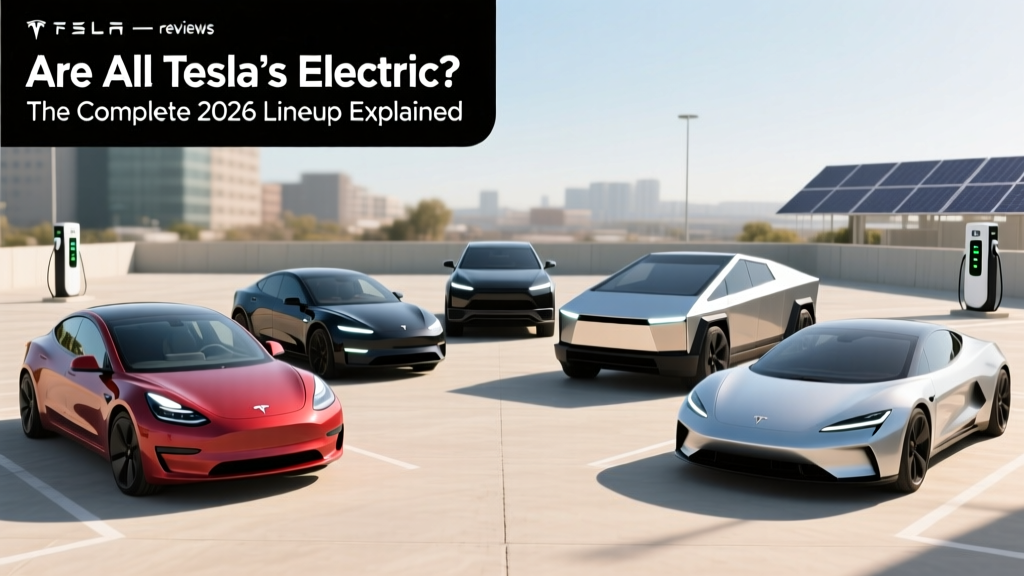
If you've landed here wondering are all Tesla's electric, the answer is an unambiguous yes. Tesla has never produced a hybrid, plug-in hybrid, or internal-combustion vehicle. Every model in the 2026 lineup — Model 3, Model Y, Model S, Model X, and Cybertruck — is a battery-electric vehicle (BEV) with zero tailpipe emissions and no gasoline engine whatsoever.
Unlike legacy automakers that sell electrified variants alongside gas models, Tesla's entire business is built on pure electric propulsion. That means no oil changes, no spark plugs, no multi-speed transmissions, and no fuel tanks. Every Tesla runs on a high-voltage lithium-ion traction battery paired with one or more electric motors.
But knowing that every Tesla is electric is only the starting point. The real question for buyers is which Tesla fits your driving needs, budget, and charging situation. Below, we break down the full 2026 lineup with the exact numbers that matter: EPA range, battery chemistry, DC fast-charge speed, pricing, and federal tax credit eligibility under current IRS §30D rules.
2026 Tesla Lineup at a Glance: Specs That Matter
| Spec | Model 3 | Model Y | Model S | Model X | Cybertruck |
|---|---|---|---|---|---|
| Body Style | Sedan | SUV (Crossover) | Luxury Sedan | Luxury SUV | Pickup Truck |
| EPA Range (max) | 363 mi (LR RWD) | 320 mi (LR AWD) | 402 mi (LR) | 335 mi (LR) | 340 mi (AWD) |
| Battery (usable, est.) | ~57 kWh (RWD) / ~75 kWh (LR) | ~75 kWh | ~95 kWh | ~95 kWh | ~123 kWh |
| Chemistry | LFP (RWD) / NMC (LR) | LFP (RWD) / NMC (LR) | NMC | NMC | NMC |
| 0–60 mph | 5.8s (RWD) / 3.1s (Plaid N/A) | 5.8s (RWD) / 4.8s (LR) | 3.1s (Plaid) | 3.8s (Plaid) | 3.9s (Cyberbeast) |
| Horsepower | 271 (RWD) / 346 (LR AWD) | 295 (RWD) / 384 (LR AWD) | 670 (LR) / 1,020 (Plaid) | 670 (LR) / 1,020 (Plaid) | 600 (AWD) / 845 (Cyberbeast) |
| Drivetrain | RWD / AWD | RWD / AWD | AWD | AWD | AWD |
| Peak DC Charge | 170 kW (RWD) / 250 kW (LR) | 170 kW (RWD) / 250 kW (LR) | 250 kW | 250 kW | 350 kW |
| 10–80% DC Time | ~28 min (RWD) / ~25 min (LR) | ~28 min (RWD) / ~25 min (LR) | ~27 min | ~28 min | ~15 min |
| Base MSRP | $38,990 (RWD) | $44,990 (RWD) | $74,990 (LR) | $79,990 (LR) | $79,990 (AWD) |
| Federal Tax Credit (§30D) | Up to $7,500 | Up to $7,500 | $0 (over MSRP cap) | $0 (over MSRP cap) | $0 (over MSRP cap) |
Sources: EPA / fueleconomy.gov, Tesla.com. Pricing and specs reflect 2026 model year as of publication. Tax credit eligibility subject to IRS §30D income, MSRP, and battery-sourcing rules.
Real-World Range: What the EPA Sticker Doesn't Tell You
Tesla's range figures are among the most efficient in the industry thanks to excellent aerodynamics, heat-pump climate control (standard on all current models), and sophisticated thermal management. The Model S Long Range leads the lineup at 402 miles EPA — one of the highest EPA ratings of any production EV sold in the U.S.
However, the chemistry split matters for daily usability. The Rear-Wheel-Drive trims of Model 3 and Model Y use lithium iron phosphate (LFP) batteries. LFP cells tolerate regular 100% charging better than NMC, meaning you can charge to full daily without the same degradation concerns. The trade-off: LFP has lower energy density (shorter range per pound) and worse cold-weather performance than the nickel manganese cobalt (NMC) packs in Long Range and Performance trims.
For buyers in northern climates, the NMC-equipped Long Range or AWD trims are worth the premium for the cold-weather range retention alone. If you live in a mild climate and charge at home nightly, the LFP RWD models offer the best value proposition in Tesla's lineup.
Charging Speed: Supercharger Network vs. Home Level 2
Tesla's charging ecosystem remains its strongest competitive moat. Every Tesla sold in 2026 uses the North American Charging Standard (NACS) connector natively — the same connector now adopted by Ford, GM, Rivian, Hyundai, and most major automakers. That means Teslas plug directly into the Supercharger network without an adapter.
| Charging Level | Power (kW) | Typical Miles Added per Hour | Notes |
|---|---|---|---|
| Level 1 (120V household) | ~1.4 kW | 3–5 mi/hr | Emergency/trickle only; not practical for daily use |
| Level 2 (240V home wall connector) | 11.5 kW (48A) | 30–44 mi/hr | Full overnight charge for any Tesla; requires 60A circuit |
| DC Fast (V3 Supercharger) | Up to 250 kW | ~1,000 mi/hr peak | Model 3/Y/S/X LR; 10–80% in ~25 min |
| DC Fast (V4 Supercharger) | Up to 350 kW | ~1,300+ mi/hr peak | Cybertruck; newer V4 stations rolling out |
A critical detail many first-time EV buyers miss: kW (kilowatts) measures charging power — the rate of energy flow — while kWh (kilowatt-hours) measures battery energy capacity. A 250 kW charger doesn't deliver 250 kW continuously; the charge curve tapers significantly above 80% State of Charge (SoC) to protect battery health. That's why manufacturers quote 10–80% times rather than 0–100%.
For home charging, Tesla's Wall Connector at 48 amps (11.5 kW) adds roughly 30–44 miles of range per hour depending on the model. A full overnight charge (8–10 hours) replenishes any Tesla in the lineup. Installation typically requires a 60-amp dedicated circuit; expect $500–$2,000 for professional electrician installation depending on your panel's capacity and distance from the charger location. If your home has a 100-amp electrical panel, a panel upgrade to 200 amps may be necessary, adding $1,500–$3,000.
On the road, Tesla's Supercharger network exceeds 6,500 stations and 60,000+ individual chargers across North America. Reliability consistently outpaces third-party networks like Electrify America and EVgo in user surveys. With route-based battery preconditioning — where the car warms the battery en route to a Supercharger for optimal charging speed — Teslas consistently achieve near-peak charge rates upon arrival.
Pricing, Trims, and Federal Tax Credit Eligibility
Tesla's pricing has fluctuated frequently over the past several years, but the 2026 lineup settles into distinct tiers:
- Model 3 RWD: $38,990 — entry point to the Tesla ecosystem
- Model 3 Long Range AWD: ~$45,490 — best range-per-dollar sedan
- Model Y RWD: $44,990 — best-selling EV in America for good reason
- Model Y Long Range AWD: ~$48,990 — family SUV sweet spot
- Model S Long Range: $74,990 — luxury performance sedan
- Model X Long Range: $79,990 — luxury family hauler with falcon-wing doors
- Cybertruck AWD: $79,990 — electric pickup with polarizing design
- MSRP caps: Sedans (Model 3, Model S) must be under $55,000; SUVs/pickups (Model Y, Model X, Cybertruck) must be under $80,000.
- Buyer income caps: Modified AGI ≤ $150,000 (single), ≤ $225,000 (head of household), ≤ $300,000 (joint).
- Battery sourcing: Increasing percentages of critical minerals and battery components must be sourced from the U.S. or FTA partners. This requirement tightens annually.
- Point-of-sale transfer: Eligible buyers can apply the credit as an immediate price reduction at purchase rather than waiting for tax filing.
In practice, the Model 3 RWD and Long Range and the Model Y RWD and Long Range are the trims most likely to qualify for the full or partial $7,500 federal credit, depending on your income and the current battery-sourcing compliance percentage. The Model S, Model X, and Cybertruck exceed the MSRP caps for their vehicle classes (or sit right at the boundary), making them ineligible for the new-vehicle credit regardless of buyer income.
For buyers who don't qualify for the federal credit due to income, check your state's EV incentive programs — many states offer rebates or tax credits with different (sometimes higher) income thresholds. These vary significantly by jurisdiction; consult your state's energy or DMV website for current programs.
Efficiency and Performance: MPGe, kWh/100mi, and 0–60
Tesla vehicles consistently rank among the most energy-efficient EVs on the market. Efficiency is measured in two ways: MPGe (miles-per-gallon-equivalent, where 33.7 kWh = 1 gallon of gasoline) and kWh per 100 miles (lower is better — think of it as the EV equivalent of "gallons per 100 miles").
| Model / Trim | Combined MPGe | kWh/100 mi | 0–60 mph |
|---|---|---|---|
| Model 3 RWD | 132 MPGe | 25 | 5.8 sec |
| Model 3 LR AWD | 125 MPGe | 27 | 4.2 sec |
| Model Y RWD | 123 MPGe | 27 | 5.8 sec |
| Model Y LR AWD | 117 MPGe | 29 | 4.8 sec |
| Model S LR | 116 MPGe | 29 | 3.1 sec |
| Model X LR | 105 MPGe | 32 | 3.8 sec |
| Cybertruck AWD | 79 MPGe | 43 | 3.9 sec (Cyberbeast) |
The Model 3 RWD's 132 MPGe combined makes it one of the most efficient EVs sold in America. For context, that translates to roughly $0.04–$0.06 per mile when charging at home on a national-average electricity rate of $0.16/kWh — compared to $0.12–$0.15 per mile for a 30-MPG gas car at $3.50/gallon.
Performance is where Tesla's electric powertrains shine regardless of trim. Even the "base" Model 3 RWD hits 60 mph in 5.8 seconds — quicker than most gas-powered sport sedans. The Model S Plaid's 1,020 horsepower and 3.1-second 0–60 time remain staggering for a four-door sedan, though the Plaid trim commands a significant premium and is a specialty order rather than a volume seller.
Interior, Cargo, and Technology
Tesla's interior philosophy is minimalist to a fault: a single central touchscreen (15.4" in Model 3/Y, 17" in Model S/X) handles virtually every function — climate, media, navigation, vehicle settings, and even the glovebox release. There is no traditional instrument cluster; speed and navigation appear on the central screen or, in the refreshed Model 3 "Highland," on a secondary rear screen for passengers.
Cargo and passenger space by model:
- Model 3: 23 cu ft trunk + front trunk (frunk); 42.2" front legroom, 35.2" rear legroom. Adequate for a compact sedan but tight in the back for tall adults on long trips.
- Model Y: 30 cu ft behind second row (76 cu ft with seats folded) + frunk; 41.8" front / 37.3" rear legroom. The Model Y's crossover form factor delivers meaningfully more cargo versatility than the Model 3, which explains its sales dominance.
- Model S: 28 cu ft trunk + frunk; 42.4" front / 35.4" rear legroom. Surprisingly practical trunk for a sedan, but rear seat space hasn't grown significantly despite the premium price.
- Model X: Up to 88 cu ft cargo (seats folded); available in 5-, 6-, or 7-seat configurations. Falcon-wing rear doors are dramatic but can be slow and problematic in tight garages.
- Cybertruck: 6.5-foot bed with 67 cu ft volume + front trunk + rear sail-area storage. Towing capacity rated at 11,000 lbs, though towing at max capacity cuts range roughly in half.
Standout tech: Tesla's software remains the industry benchmark for over-the-air (OTA) updates, navigation with real-time Supercharger routing, and the Tesla mobile app (remote preconditioning, Sentry Mode camera access, Summon). The available Full Self-Driving (Supervised) package — a $8,000 add-on or $99/month subscription — offers advanced lane changes, intersection handling, and parking automation, but it remains a SAE Level 2 driver-assist system. The driver must remain fully engaged and attentive at all times. This is not autonomous driving.
Notable drawbacks: Panel-gap quality, while improved, still lags legacy luxury brands. The lack of Apple CarPlay and Android Auto is a dealbreaker for some buyers. The all-touchscreen interface for climate and mirror adjustments frustrates traditionalists. And Tesla's service center network, while growing, can mean long wait times for body repair in less populated areas.
Warranty Coverage and Long-Term Battery Health
Tesla's warranty structure is straightforward:
- Basic Vehicle Limited Warranty: 4 years / 50,000 miles (all models)
- Battery & Drive Unit Warranty:
- Model 3 RWD: 8 years / 100,000 miles
- Model 3 LR/AWD, Model Y: 8 years / 120,000 miles
- Model S, Model X: 8 years / 150,000 miles
The battery warranty guarantees that the pack will retain at least 70% of its original capacity during the warranty period. If degradation exceeds 30%, Tesla will repair or replace the battery to bring it back above that threshold.
In practice, Tesla battery degradation has proven modest for most owners. Data aggregated from fleet reports shows typical degradation of approximately 10–12% after 100,000 miles for NMC packs, with the curve flattening significantly after the initial break-in period. LFP packs in RWD models show even less measurable degradation but start from a lower total range, so the practical impact is similar.
Out-of-warranty battery replacement remains expensive — roughly $12,000–$16,000 for a Model 3/Y pack and $18,000–$22,000+ for Model S/X, based on service estimates. However, the vast majority of Tesla batteries outlast the vehicle itself; complete pack failure is rare, and most degradation-related concerns are addressed under warranty.
Who Should Buy a Tesla — and Who Should Look Elsewhere?
Tesla Is the Right Choice If:
- You want the most reliable public charging network in North America without adapters
- You value OTA software updates that genuinely add features over time
- You're a first-time EV buyer and want the lowest-friction ownership experience
- You commute 30–80 miles daily and can charge at home overnight
- You want strong performance without a performance-car price premium (Model 3/Y trims)
Consider a Competitor If:
- You need Apple CarPlay or Android Auto (neither is available on any Tesla)
- You prefer traditional dealership service with loaner cars and walk-in appointments
- You want a luxury interior with premium materials rivaling BMW, Mercedes, or Audi (look at the BMW i4/i5, Mercedes EQE, or Genesis Electrified G80)
- You need a minivan or three-row SUV with easy third-row access (the Model X third row is cramped; consider the Kia EV9 or Rivian R1S)
- Panel gap consistency and build finish are top priorities (Porsche Taycan, Hyundai Ioniq 5/6 excel here)
The Bottom Line: Every Tesla Is Electric — But Not Every Tesla Is Right for You
To directly answer the question: yes, all Teslas are fully electric. There are no hybrids, no range extenders, and no gas options anywhere in Tesla's past, present, or announced future lineup. That singular focus on BEVs has given Tesla a significant lead in battery efficiency, charging infrastructure, and software integration.
But the best Tesla for you depends on your specific needs. The Model 3 RWD at $38,990 (potentially ~$31,490 after the federal credit) is the value champion for commuters. The Model Y Long Range remains the default recommendation for families who need cargo space and all-weather capability. The Model S is a compelling luxury performance sedan if you can accept the premium price and no tax credit. And the Cybertruck is a niche product that prioritizes attention and capability over efficiency and practicality.
Whatever you choose, charge at home whenever possible, precondition your battery before DC fast charging, and understand the real-world range variables that the EPA sticker doesn't capture. The electric-only nature of every Tesla means your ownership experience will be defined by your charging access — and for most buyers with home Level 2 charging, that experience is dramatically simpler and cheaper than gasoline ownership.
Frequently Asked Questions
Has Tesla ever made a gas car or hybrid?
No. Since its founding, Tesla has exclusively produced battery-electric vehicles. The original Roadster (2008), Model S (2012), Model X (2015), Model 3 (2017), Model Y (2020), and Cybertruck (2023) are all fully electric with no internal combustion engine or hybrid system.
Do all Teslas use the same charging connector?
Yes. All current Tesla vehicles use the NACS (North American Charging Standard) connector, which Tesla opened to other automakers in late 2022. This is the native connector for the Supercharger network. Teslas can also charge at non-Tesla J1772 Level 2 stations using the included Mobile Connector adapter, and at CCS stations using a Tesla-approved CCS adapter.
Which Tesla qualifies for the $7,500 federal tax credit?
As of 2026, the Model 3 (RWD and Long Range) and Model Y (RWD and Long Range) are the trims most likely to qualify for some or all of the $7,500 §30D credit, subject to buyer income limits ($150K single / $300K joint), battery-sourcing requirements, and point-of-sale transfer rules. The Model S, Model X, and most Cybertruck trims exceed MSRP caps and do not qualify. Always verify at IRS.gov before purchasing.
How long do Tesla batteries last?
Tesla's battery warranty covers 8 years and 100,000–150,000 miles (depending on model) with a 70% capacity retention guarantee. Real-world data from fleet reports suggests most Tesla batteries lose approximately 10–12% capacity over 100,000 miles, with degradation slowing significantly after the first 20,000–30,000 miles. Many Tesla batteries are expected to outlast 200,000+ miles before reaching the 70% threshold.
Is Tesla's Full Self-Driving actually autonomous?
No. Tesla's FSD (Supervised) and Autopilot are SAE Level 2 driver-assistance systems. They can manage steering, acceleration, and braking in many scenarios but require the driver to remain fully attentive and ready to take over at any moment. They are not self-driving. Only Level 4 systems like Waymo's robotaxi service operate without a human driver, and those are limited to specific cities and conditions.
What's the cheapest Tesla I can buy in 2026?
The Model 3 Rear-Wheel Drive at $38,990 MSRP is Tesla's entry point. If you qualify for the full $7,500 federal tax credit (income and sourcing requirements met), your effective price drops to approximately $31,490. Adding the $990 destination fee and any state fees brings the out-the-door price slightly higher. This makes the Model 3 RWD one of the most affordable long-range EVs available when the credit applies.