Why Buyers Are Searching 'Archer Aviation Tesla' in 2026
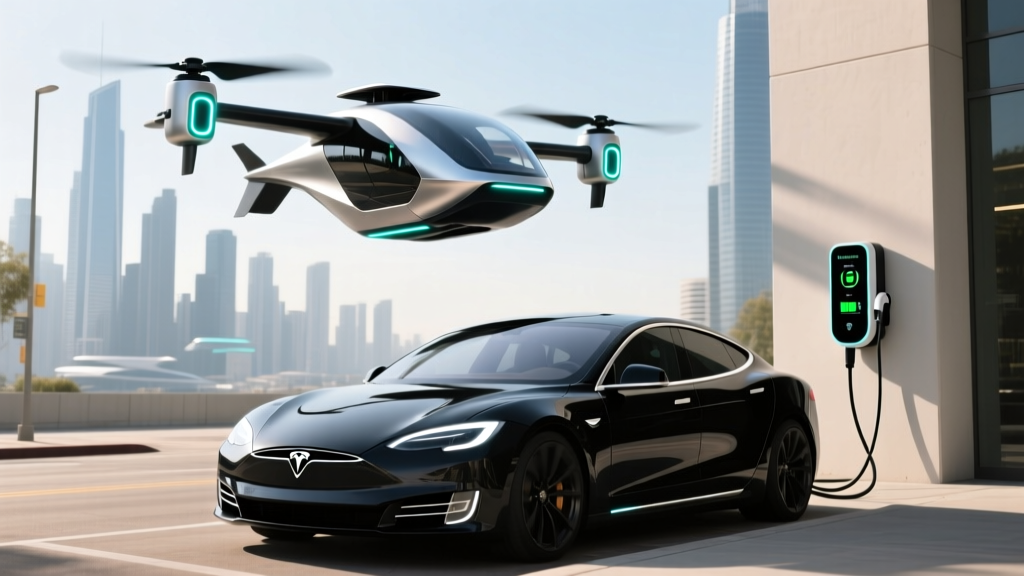
Search interest in Archer Aviation Tesla reflects a genuine question from EV-curious readers: how does the emerging eVTOL (electric vertical takeoff and landing) air-taxi sector championed by Archer Aviation stack up against Tesla's mature battery-electric vehicle platform? Both companies build battery-electric transportation, but they solve radically different problems. Tesla sells consumer EVs you can buy today — the Model 3, Model Y, Model S, Model X, and Cybertruck. Archer Aviation is building the Midnight aircraft, a piloted four-passenger eVTOL intended for short-hop urban air mobility routes operated by airline partners, not individual owners.
This profile compares the two on the metrics EV buyers actually care about: battery capacity and chemistry, energy efficiency, recharge times, price, availability, and real-world usability. The verdict up front: they are not substitutes. One moves you across town in minutes above traffic (eventually, as a ticketed service); the other moves you anywhere on the ground today as a personal vehicle you own.
What Archer Aviation Actually Builds: The Midnight eVTOL
Archer Aviation's Midnight is a piloted eVTOL aircraft designed for 20- to 50-mile urban air taxi routes — think JFK to Manhattan, or San Jose to San Francisco. It carries one pilot and up to four passengers. Archer has been flight-testing prototypes since 2023 and has been working toward FAA type certification, with commercial service launches targeted through airline partners including United Airlines. As of early 2026, Midnight is not available for consumer purchase — it is an announced, in-certification aircraft whose final production specs remain subject to FAA approval.
Because Midnight is not a consumer vehicle, it does not carry an EPA range sticker, an MSRP, or an IRS §30D tax credit. Comparing it directly to a Tesla Model Y on those terms is a category error. What we can do is line up the published engineering specs side by side to show where battery-electric technology overlaps — and where it diverges sharply between ground and air applications.
Side-by-Side: Archer Midnight vs Tesla Model Y (2026)
| Spec | Archer Midnight (announced) | 2026 Tesla Model Y LR AWD |
|---|---|---|
| Category | eVTOL aircraft (piloted) | Consumer BEV crossover |
| Availability | In certification; not on sale | On sale now |
| Usable battery capacity | ~70 kWh (announced, multiple packs) | ~78 kWh (NMC) |
| Battery chemistry | NMC (high energy density, aviation-grade) | NMC (Long Range); LFP (Standard Range) |
| Mission range | ~20 mi with reserves (announced route target) | EPA 320 mi |
| Efficiency | Not rated MPGe (aircraft cycle) | 122 MPGe combined; ~28 kWh/100 mi |
| Peak cruise speed | ~150 mph (announced) | Top speed 125 mph |
| 0-60 equivalent | N/A (vertical takeoff profile) | 4.8 sec |
| Horsepower | Multiple distributed electric motors (unpublished total) | 384 hp (dual-motor AWD) |
| Passenger capacity | 4 + 1 pilot | 5 (optional 7-seat with third row) |
| Cargo | Limited cabin stowage | 30.2 cu ft rear; 74.1 cu ft folded + 4.1 cu ft frunk |
| DC fast charge (peak kW) | Ground-based rapid turn charge (~300 kW target, unpublished) | 250 kW (Supercharger V3/V4) |
| Turnaround recharge | ~7-10 min between hops (announced target) | 10-80% in ~22 min (DCFC) |
| Home Level 2 | Not applicable (fleet depots only) | 11.5 kW (~44 mi/hr) |
| Purchase price | Not sold to consumers; airline fleet sales (~$5M/unit target) | $46,630 base (LR AWD); ~$53,000 as-tested |
| Federal §30D tax credit | Not eligible (aircraft) | Up to $7,500, subject to MSRP/income/sourcing rules |
| Warranty | Aircraft MRO program (not consumer warranty) | 8 yr / 120,000 mi battery & drive unit |
Sources: Archer Aviation Midnight, fueleconomy.gov 2026 Tesla Model Y, Tesla Model Y specs.
Real-World Range Reality Check
Tesla Model Y LR AWD: EPA 320 miles. Expect ~270-290 miles at sustained 75 mph highway driving in mild weather, and ~220-250 miles in sub-freezing winter conditions due to battery thermal losses and cabin heating. Preconditioning at a Supercharger restores much of the DC charge rate but does not recover lost range.
Archer Midnight: Archer has publicly described Midnight's target mission profile as ~20 miles plus IFR reserves — not a range figure in the automotive sense. eVTOL energy burn is dominated by vertical lift, not cruise; a 20-mile hop can consume the majority of a ~70 kWh pack when accounting for hover, climb, reserve mandates, and FAA fuel (energy) reserve rules. This is why Archer's business model is built around frequent 7-10 minute ground recharges between hops, not long-distance flight.
Battery Chemistry: Why Aviation Picks NMC and Tesla Offers Both
Archer's Midnight uses NMC (nickel manganese cobalt) cells optimized for high C-rate discharge — aviation needs massive instantaneous power during hover, which can draw 4-5x the cruise power draw. Energy density matters more in aircraft than in cars because every kilogram of battery reduces payload. NMC's higher Wh/kg advantage over LFP is decisive here, even though NMC carries a tighter thermal window and requires more aggressive battery management.
Tesla's 2026 Model Y lineup splits chemistry by trim. The Long Range and Performance variants use NMC for maximum range and power; the Standard Range RWD uses LFP (lithium iron phosphate), which is heavier per kWh but offers longer cycle life, better thermal stability, and the ability to routinely charge to 100% without accelerated degradation. For most ground-based commuters, LFP is the more durable daily-driver choice. For aviation, it is too heavy.
Charging and Turnaround: The Real Bottleneck for eVTOL
Tesla Supercharging is a solved problem in 2026: the V4 cabinet delivers up to 250-350 kW depending on site, and the Model Y LR AWD peaks at 250 kW, adding roughly 175 miles of range in 15 minutes before the charge curve tapers above 80% SoC. Home Level 2 on a 48-amp circuit (11.5 kW) recovers ~44 miles per hour, meaning a full overnight charge from 20% to 90% takes roughly 6-7 hours.
For Archer, turnaround charging is the existential engineering constraint. The announced target is a 7-10 minute ground recharge between hops to enable multiple flights per hour during peak demand. That requires depot-level DC infrastructure in the hundreds of kilowatts, dedicated vertiport power feeds, and sophisticated thermal management to prevent battery overheating across many same-day cycles. This is fleet infrastructure, not something a consumer installs at home — and it is a key reason Midnight will launch in a handful of metro corridors before it scales broadly.
Pricing, Tax Credits, and Ownership Economics
Here the comparison becomes apples-to-oranges in the strictest sense:
- Tesla Model Y LR AWD starts at $46,630 MSRP in 2026. Under current IRS §30D rules, eligible buyers may claim up to $7,500 in federal tax credit — or transfer it at point of sale to reduce the purchase price — provided they meet adjusted gross income caps ($150k single / $300k joint), the vehicle MSRP is at or below the $55,000 SUV cap (Model Y qualifies), and battery critical-mineral and component sourcing requirements are met for the specific VIN. Always confirm eligibility on irs.gov or with a tax professional before purchase, as sourcing lists update quarterly.
- Archer Midnight is not sold to consumers. Archer's announced target unit price to airline partners has been reported in the ~$5 million range, reflecting aircraft-grade certification, redundant systems, and low production volume. End users will purchase seats per flight, not aircraft — analogous to buying an airline ticket, not a Boeing 737.
Tesla Model Y Pros
- EPA 320 mi range with best-in-class Supercharger network access
- NACS connector now the North American standard; broad third-party DCFC access
- Strong efficiency (~28 kWh/100 mi) keeps per-mile cost low
- Eligible for up to $7,500 §30D credit (income/sourcing dependent)
- OTA updates, FSD Supervised (Level 2) available, strong cargo utility
Tesla Model Y Cons
- Build-quality variance still a buyer complaint vs legacy OEMs
- FSD Supervised is Level 2 driver-assist — not self-driving; driver must remain engaged
- Insurance premiums above segment average in many states
- Third-row option is cramped for adults; cargo drops sharply when deployed
Who Each Platform Actually Serves
Buy the Tesla Model Y if you need a practical daily-driver EV today: commuting, family hauling, road trips, and access to the most mature DC fast-charging network in North America. It is the default choice for buyers who want ownership, predictable per-mile cost, and a vehicle they can charge at home overnight on a Level 2 wall connector.
Watch Archer Aviation if you live in a congested metro (NYC, LA, SF Bay Area) and would pay a premium per trip to bypass surface traffic on 10-40 mile airport-to-downtown corridors. You will not own a Midnight; you will buy a seat on one operated by an airline partner, likely starting in limited routes and scaling through the late 2020s as FAA certification, vertiport buildout, and public acceptance progress.
ADAS and Autonomy: Level 2 vs Piloted Aviation
SAE Automation Levels — Clear Definitions
Tesla Autopilot and FSD (Supervised) are SAE Level 2 driver-assist systems. The driver must keep hands near the wheel, eyes on the road, and be prepared to take over at any moment. They are not self-driving. No Tesla vehicle sold to consumers is SAE Level 4.
Archer Midnight is a piloted aircraft — a human pilot is in command at all times, with redundant flight systems. Aviation autonomy is regulated by the FAA, not NHTSA, and follows a different certification path entirely. Future autonomous eVTOL concepts exist industry-wide, but Archer's near-term commercial product is piloted.
The Verdict: Different Tools for Different Miles
The "Archer Aviation vs Tesla" framing is useful only as a lens on where battery-electric technology is heading — not as a purchase decision. In 2026, Tesla sells you a proven, efficient, credit-eligible EV you can drive home today. Archer is engineering the infrastructure and certification pathway for a new category of short-hop air mobility that, if it scales, could reshape how we think about the worst 30 miles of any commute. Neither replaces the other; both depend on continued advances in NMC energy density, fast-charge thermal management, and manufacturing scale.
Frequently Asked Questions
Can I buy an Archer Midnight eVTOL in 2026?
No. Midnight is in the FAA type-certification process and is being sold to airline partners as a fleet aircraft, not to individual consumers. Announced specs remain preliminary.
Does the Tesla Model Y still qualify for the $7,500 federal EV tax credit?
Eligibility depends on your adjusted gross income, the specific VIN's battery critical-mineral and component sourcing, and the $55,000 MSRP cap for SUVs. Confirm on irs.gov and with your tax professional; the credit can be transferred at point of sale to reduce purchase price.
What is the real-world highway range of the 2026 Model Y Long Range AWD?
Expect ~270-290 miles at 75 mph in mild weather and ~220-250 miles in sub-freezing conditions. The EPA sticker is 320 miles; sustained highway speed and cold weather reduce it measurably.
How fast does the Model Y charge on a DC fast charger?
Peak rate is 250 kW on a Tesla Supercharger or NACS-equipped third-party DCFC. The 10-80% session takes roughly 22 minutes; above 80% SoC the charge curve tapers sharply to protect the pack.
Is Archer Aviation's Midnight self-flying?
No. Midnight is a piloted aircraft with a human pilot in command. It is not autonomous and is regulated under FAA rules distinct from ground-vehicle ADAS.
Which is the better buy for a daily commuter?
For any commuter who needs to own their vehicle and drive door-to-door today, the Tesla Model Y (or a comparable BEV/PHEV) is the only available option. Archer's service, when launched, will be a per-seat ticket on short metro corridors — a complement to, not a replacement for, a personal EV.