The Apple CarPlay Question Every Tesla Shopper Asks
If you're coming from a traditional automaker and searching for Apple CarPlay Tesla compatibility, here's the short answer: Tesla does not support Apple CarPlay or Android Auto in any 2026 model — not the Model 3, Model Y, Model S, Model X, or Cybertruck. Tesla uses its proprietary Linux-based infotainment platform, which integrates navigation, media, vehicle controls, and over-the-air updates into a single system that the company considers superior to phone-projection standards.
Whether that's a dealbreaker depends entirely on how deeply you rely on Apple's ecosystem. This review focuses on the 2026 Tesla Model 3 (the refreshed "Highland" generation) to give you the full picture: what you gain by staying in Tesla's walled garden, what you lose by giving up CarPlay, and whether the Model 3's range, charging, and pricing make up for the infotainment gap.
2026 Tesla Model 3: Core Specifications at a Glance
| Spec | Model 3 RWD (Base) | Model 3 Long Range AWD | Model 3 Performance |
|---|---|---|---|
| EPA Range | 272 mi | 363 mi | 315 mi |
| Battery (usable) | ~57.5 kWh (LFP) | ~75 kWh (NMC) | ~75 kWh (NMC) |
| Drivetrain | Rear-Wheel Drive | Dual-Motor AWD | Dual-Motor AWD |
| Horsepower | 271 hp | 346 hp | 510 hp |
| 0–60 mph | 5.8 sec | 4.2 sec | 2.9 sec |
| Max DC Fast Charge | 170 kW | 250 kW | 250 kW |
| 10–80% DC Time | ~28 min | ~25 min | ~25 min |
| Level 2 Home Rate | 11.5 kW (~37 mi/hr) | 11.5 kW (~37 mi/hr) | 11.5 kW (~37 mi/hr) |
| MPGe (combined) | 132 MPGe | 130 MPGe | 118 MPGe |
| Efficiency | 26 kWh/100 mi | 26 kWh/100 mi | 29 kWh/100 mi |
| Base MSRP | $38,990 | $44,990 | $52,990 |
| Battery Warranty | 8 yr / 100,000 mi | 8 yr / 120,000 mi | 8 yr / 120,000 mi |
Source: fueleconomy.gov and Tesla's official 2026 spec sheets.
Real-World Range: What the EPA Sticker Doesn't Tell You
EPA estimate: 363 miles
Real-world highway (70–75 mph, 65°F): ~290–310 miles
Real-world city/suburban (mixed, moderate climate): ~320–340 miles
Cold weather (below 30°F, highway): ~230–260 miles
The Model 3 Long Range achieves its EPA figure partly through optimistic city/regen-heavy driving cycles. At sustained highway speeds, expect a 15–20% reduction. In freezing temperatures, battery preconditioning and cabin heating can push losses to 30–35%. Plan road trips around 250 miles between Supercharger stops for a comfortable buffer.
Tesla's LFP (lithium iron phosphate) battery in the RWD trim trades some energy density for longevity and cost savings. LFP cells tolerate regular 100% charging better than NMC, which Tesla recommends keeping at 80–90% daily. The Long Range and Performance trims use NMC chemistry for higher energy density and better cold-weather performance — but you'll want to set your daily charge limit to 80% to minimize degradation.
Charging Speed: Supercharger Network vs. Home Level 2
| Charging Method | Power (kW) | Miles Added/Hour | Notes |
|---|---|---|---|
| Level 1 (120V outlet) | ~1.4 kW | ~5 mi/hr | Emergency/trickle only |
| Level 2 (240V home) | 11.5 kW | ~37 mi/hr | Full charge in 7–9 hours |
| Tesla Supercharger V3 | Up to 250 kW | ~1,000 mi/hr (peak) | 10–80% in ~25 min (LR) |
| Tesla Supercharger V4 | Up to 250 kW | ~1,000 mi/hr (peak) | Rolling out 2025–2026 |
| CCS adapter + EA/others | Up to 150–350 kW | Varies | CCS adapter sold separately (~$175) |
The Model 3's charge curve peaks early and tapers aggressively above 60% state of charge (SoC). On a V3 Supercharger, the Long Range will sustain ~250 kW only up to about 30% SoC, then step down through the 40–80% window. That 10–80% time of roughly 25 minutes is competitive, but the RWD's LFP battery caps at 170 kW — adding about 3 minutes to the same session.
Home charging at 11.5 kW requires a 60-amp dedicated circuit (48-amp continuous draw). Expect a licensed electrician to charge $500–$1,500 for installation if your panel has capacity. A 200-amp panel upgrade can add $1,500–$3,000. The IRS Residential Clean Energy Credit covers 30% of home charger equipment and installation costs (up to $1,000 credit), through at least 2032.
Infotainment Deep Dive: Tesla's OS vs. Apple CarPlay
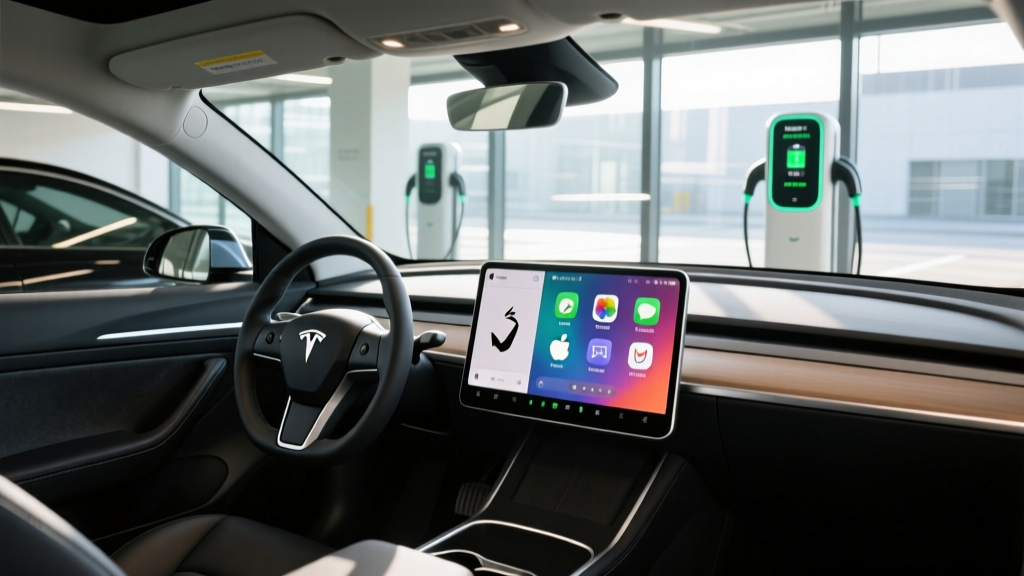
This is where the Apple CarPlay Tesla debate gets nuanced. Tesla's 15.4-inch center touchscreen runs a custom Linux-based operating system that handles everything: navigation, climate, media, vehicle settings, Sentry Mode cameras, and the owner's manual. Here's what you get — and what you don't.
What Tesla's OS does well:
- Native navigation with real-time Supercharger routing, automatic preconditioning for fast-charge stops, and live stall availability
- Spotify, Apple Music, Tidal, and YouTube built directly into the interface (no phone needed)
- Over-the-air updates that add features monthly — theater mode, new games, UI refinements
- Tesla Profile integration: seat, mirror, steering wheel, and climate preferences tied to your phone key or driver profile
- Sentry Mode and Dashcam with direct playback on the touchscreen
- Phone-as-key via Bluetooth, with no fob required
What you lose without Apple CarPlay:
- Siri voice control for texts, calls, and smart-home triggers (Tesla's voice assistant is improving but less mature)
- Familiar CarPlay UI — if you prefer Apple Maps, Waze, or specific podcast/audiobook apps not in Tesla's store
- Seamless iMessage/WhatsApp integration (Tesla shows notifications but response options are limited)
- Calendar integration that automatically navigates to your next appointment (Tesla does this partially via phone sync)
Workarounds: Many owners pair their iPhone via Bluetooth for calls and audio, then use Tesla's native apps for navigation and media. If Apple Maps is non-negotiable, you can display it on your phone while Tesla's nav handles routing — but there's no way to project it onto the Tesla screen.
Pricing, Trims, and Federal Tax Credit Eligibility
| Trim | Base MSRP | Est. Destination | Federal Credit (§30D) | Effective Price |
|---|---|---|---|---|
| Model 3 RWD | $38,990 | $1,390 | Up to $7,500* | ~$32,880 |
| Model 3 Long Range AWD | $44,990 | $1,390 | Up to $7,500* | ~$38,880 |
| Model 3 Performance | $52,990 | $1,390 | Up to $7,500* | ~$46,880 |
*§30D Federal EV Tax Credit — critical caveats:
- MSRP cap: Sedans must be ≤$55,000 MSRP (including options). The Model 3 Performance at $52,990 base qualifies, but adding premium paint, wheels, or FSD can push it over the cap.
- Buyer income caps: Modified AGI must not exceed $150,000 (single), $225,000 (head of household), or $300,000 (joint). These are 2026 thresholds — confirm at irs.gov.
- Battery sourcing: The full $7,500 requires meeting both critical-mineral ($3,750) and battery-component ($3,750) sourcing requirements. Tesla's Fremont-built Model 3 has historically qualified for the full amount, but sourcing rules tighten annually. Verify current eligibility before purchase.
- Point-of-sale transfer: You can transfer the credit to the dealer at purchase, reducing your out-of-pocket cost immediately — you don't need to wait until tax filing.
- Tax liability: The credit is non-refundable. You must have sufficient federal tax liability to claim it (or use the point-of-sale transfer, which bypasses this requirement as of 2024+).
Driving Experience, Safety, and Autopilot
The 2026 Model 3 Highland refresh brought meaningful improvements: a quieter cabin (acoustic glass all around), retuned suspension for better ride compliance, ventilated front seats, rear-seat touchscreen, and ambient lighting. The steering remains precise and the low center of gravity delivers flat cornering that belies the car's weight.
Autopilot comes standard — adaptive cruise control, lane centering, and automatic emergency braking. It's a competent SAE Level 2 driver-assist system, meaning you must keep your hands on the wheel and eyes on the road at all times. The optional Full Self-Driving (Supervised) package ($8,000 or $99/month) adds automatic lane changes, Navigate on Autopilot, and traffic-light recognition — but it remains a Level 2 system. It is not autonomous driving. Only Level 4 services like Waymo operate without a driver in the loop.
Both systems require active driver supervision. They may not detect stationary objects, construction zones, or emergency vehicles reliably. FSD behavior can be unpredictable on unmapped roads or in adverse weather. You are legally responsible for the vehicle at all times. Review NHTSA guidance on ADAS before relying on any driver-assist feature.
Safety ratings remain strong. The Model 3 earned the IIHS Top Safety Pick+ designation and a 5-star overall NHTSA rating, with top marks in every crash-test subcategory.
Cargo, Passenger Space, and Daily Practicality
| Dimension | Model 3 |
|---|---|
| Front headroom | 40.3 in |
| Front legroom | 42.7 in |
| Rear headroom | 37.8 in |
| Rear legroom | 35.2 in |
| Trunk (rear) | 21.0 cu ft |
| Frunk (front trunk) | 3.1 cu ft |
| Total cargo | 24.1 cu ft |
The Model 3 is a compact executive sedan, and rear-seat space reflects that. Two adults fit comfortably for moderate trips; three across is tight. The trunk is deep and well-shaped, and the frunk is useful for charging cables or a small bag. If you regularly haul four adults or need SUV cargo space, the Model Y is the logical step up.
Pros, Cons, and the Verdict
- Best-in-class efficiency — 26 kWh/100 mi is outstanding
- Access to Tesla's Supercharger network (25,000+ stalls in North America)
- Class-leading DC fast-charge speed (250 kW, LR/Performance)
- Continuous OTA updates add features post-purchase
- Strong resale value relative to EV competitors
- Excellent safety ratings (NHTSA 5-star, IIHS TSP+)
- Low total cost of ownership (no oil changes, minimal brake wear with regen)
- No Apple CarPlay or Android Auto — a dealbreaker for some
- Minimalist interior lacks physical buttons (climate, mirrors controlled via screen)
- No turn-signal stalk in Highland refresh (buttons on steering wheel)
- Rear seat is snug for tall passengers on long trips
- FSD ($8,000) remains a Level 2 system despite the name
- Insurance premiums run 15–25% higher than comparable gas sedans
- Build quality has improved but still inconsistent panel gaps reported
Choose the Model 3 if: You want the most efficient, best-charging EV sedan under $50K; you can charge at home; you're comfortable without CarPlay; you value the Supercharger network for road trips; and you qualify for the §30D credit.
Look elsewhere if: Apple CarPlay is a non-negotiable (consider the Hyundai Ioniq 6 or BMW i4, both of which support CarPlay); you need a spacious rear seat; you want physical buttons and stalks; or you can't install a Level 2 charger at home.
Frequently Asked Questions
Can I add Apple CarPlay to a Tesla aftermarket?
Third-party solutions like CarPlay AI Box-style adapters exist, but they require a separate display or hack into Tesla's browser — they are not reliable, not supported by Tesla, and may void your infotainment warranty. As of 2026, there is no sanctioned way to run CarPlay on a Tesla screen.
What is the real-world range of the Model 3 Long Range?
Expect ~290–310 miles on the highway at 70–75 mph in mild weather, and ~320–340 miles in mixed city driving. Cold weather (below 30°F) can drop highway range to ~230–260 miles. The EPA sticker of 363 miles assumes a mix of city and highway driving with regenerative braking recovery.
How fast does the Model 3 charge at home?
On a 240V Level 2 charger at 11.5 kW, the Model 3 adds approximately 37 miles of range per hour. A full charge from 10% to 100% takes about 7–9 hours depending on trim and battery size. Most owners charge overnight and wake up to a full battery daily.
Does the 2026 Model 3 qualify for the $7,500 federal tax credit?
All three trims fall under the $55,000 MSRP cap for sedans and have historically qualified for the full $7,500 under §30D, subject to buyer income limits and battery-sourcing requirements. The point-of-sale transfer option lets you apply the credit at purchase. Always verify current eligibility on irs.gov before committing.
Is the Model 3 worth it vs. the Hyundai Ioniq 6 or BMW i4?
The Model 3 wins on efficiency, Supercharger access, and price (especially after the tax credit). The Ioniq 6 offers Apple CarPlay, an 800V architecture for faster 10–80% charges (~18 min at 350 kW), and a more conventional interior. The BMW i4 provides a premium cabin and CarPlay but at a higher price point. If CarPlay is essential, the Ioniq 6 is the closest competitor in price and range.
Is Tesla's Autopilot self-driving?
No. Both Autopilot and FSD (Supervised) are SAE Level 2 driver-assist systems. You must remain fully engaged — hands on the wheel, eyes on the road. Tesla's camera-only approach can struggle in heavy rain, construction zones, and with stationary obstacles. The driver is always legally responsible.