Why Android Auto Still Doesn't Exist on Tesla (And What You Can Do About It)
If you've typed "android auto tesla" into a search bar hoping for good news, the short answer hasn't changed in 2026: Tesla does not support Android Auto or Apple CarPlay in any model — not the Model 3, Model Y, Model S, Model X, or the refreshed Cybertruck. Tesla's vertically integrated infotainment system runs a proprietary Linux-based OS, and the company has shown no indication of opening it to phone-projection standards.
That's a dealbreaker for some buyers and a non-issue for others. Below, we break down the practical workarounds Tesla owners actually use, then deliver a full 2026 Tesla Model 3 Long Range AWD review — range, charging, pricing, tax credits, and whether the infotainment gap matters once you're behind the wheel.
Android Auto Workarounds for Tesla Owners in 2026
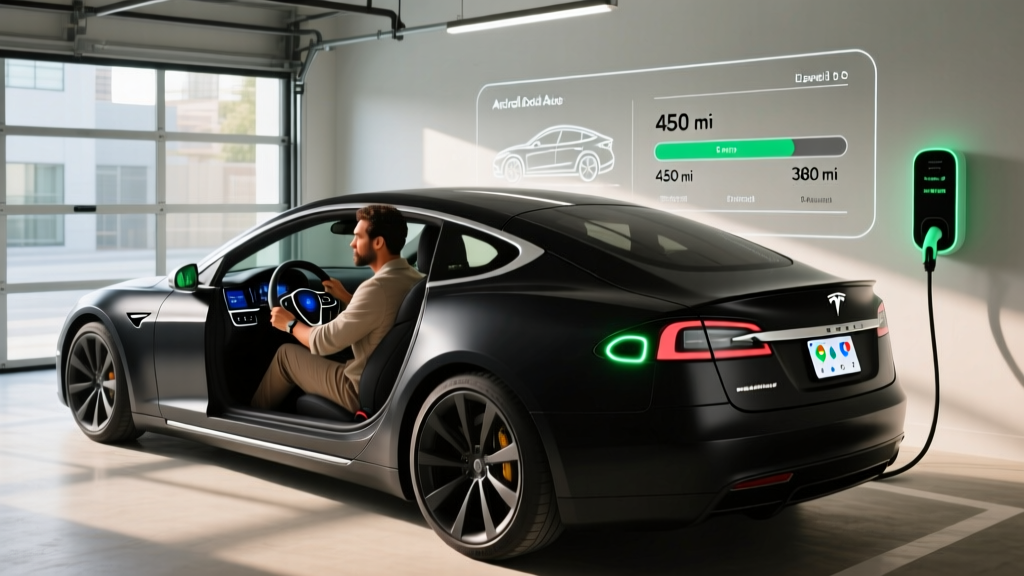
Tesla's 15.4-inch center touchscreen (Model 3 Highland and Model Y Juniper) handles navigation, music, podcasts, and phone calls natively. Here's how current owners bridge the Android Auto gap:
1. Tesla's Native Apps Cover Most Use Cases
Tesla's app catalog includes Spotify, Apple Music, Tidal, TuneIn, YouTube (parked only), Netflix (parked only), and a built-in web browser. Navigation uses Tesla's own map data with real-time traffic, Supercharger routing, and battery preconditioning — something Android Auto can't do because it doesn't integrate with the vehicle's thermal management system.
2. Bluetooth for Calls and Audio
Pair your Android phone via Bluetooth. Calls route through the car's speakers and microphone; audio streams from any app on your phone. You lose the visual interface on the car screen, but voice commands via your phone's Google Assistant still work through the Bluetooth connection.
3. Third-Party Browser-Based Hacks
Several community-developed web apps (notably TeslaAA and similar browser-based phone-mirroring tools) allow you to project a simplified Android interface through Tesla's built-in browser. These are unofficial, occasionally break with OTA updates, and require your phone to act as a hotspot. They work best for Waze or Google Maps display, though touch latency makes them better suited for passenger use than driver interaction.
4. Phone Mount (The Low-Tech Option)
A magnetic or vent-mount phone holder with Android Auto running on your phone's own screen is the simplest solution. It lacks steering-wheel controls and looks inelegant, but it's reliable and costs under $20.
2026 Tesla Model 3 Long Range AWD: Range, Battery & Real-World Efficiency
Setting the infotainment question aside, the 2026 Model 3 Long Range AWD remains one of the most efficient electric sedans on the market. Here are the numbers that matter:
| Spec | Value |
|---|---|
| EPA Range | 341 miles |
| Battery (usable) | 75 kWh, NMC (nickel manganese cobalt) |
| Efficiency | 132 MPGe combined / 25 kWh/100 mi |
| Max DC Fast Charge | 250 kW peak (V3 Supercharger) |
| 10–80% DC Charge Time | ~25 minutes |
| Level 2 Home Charge Rate | 11.5 kW (~44 mi/hr) |
| 0–60 mph | 4.2 seconds |
| Horsepower | 346 hp (dual motor) |
| Drivetrain | AWD (dual motor) |
| Cargo Volume | 23 cu ft (rear trunk) + 3.1 cu ft (frunk) |
| Rear Legroom | 35.2 inches |
| Battery/Powertrain Warranty | 8 years / 120,000 miles |
The NMC (nickel manganese cobalt) chemistry in the Long Range offers higher energy density than the LFP (lithium iron phosphate) cells in the base Model 3 RWD. The trade-off: NMC batteries benefit from daily charging limits of 80–90% to prolong longevity, while LFP batteries can be charged to 100% daily without accelerated degradation. If you charge at home every night and rarely road-trip, the base RWD's LFP pack may actually suit your habits better — though you sacrifice the dual-motor AWD and 50+ miles of range.
Charging Speed Breakdown: Supercharger Network vs. Home Level 2
Tesla's charging ecosystem remains its strongest competitive moat. Here's what charging looks like across different scenarios:
| Charging Level | Power (kW) | Miles Added per Hour | Typical Use Case |
|---|---|---|---|
| Level 1 (120V outlet) | ~1.4 kW | ~4–5 mi/hr | Emergency / overnight trickle |
| Level 2 (240V home) | 11.5 kW | ~44 mi/hr | Daily home charging |
| DC Fast (V3 Supercharger) | 250 kW peak | ~1,000 mi/hr (peak) | Road trips |
| DC Fast (V4 Supercharger) | ~250 kW (Model 3 capped) | ~1,000 mi/hr (peak) | Newer Supercharger stations |
Charging curve reality: The Model 3 Long Range peaks at 250 kW only between roughly 10–30% state of charge. Above 50%, the rate tapers significantly — expect ~100 kW at 60% and ~50 kW above 80%. This is why the 10–80% time of ~25 minutes is the meaningful metric, not the peak kW figure. The last 20% (80–100%) can add another 25–30 minutes, which is why Tesla's navigation system typically routes you to charge only to 80% on road trips.
On a Level 2 home charger (the Tesla Wall Connector on a 60-amp circuit), a full overnight charge from 20% to 90% takes about 6 hours — easily covering any daily commute. Home installation of a 240V/60A circuit typically costs $500–$2,000 depending on your electrical panel's proximity to the garage; a panel upgrade from 100A to 200A service can add $1,500–$3,000. Always consult a licensed electrician for final specs.
Since 2024, Tesla has opened its Supercharger network to non-Tesla EVs via the Magic Dock (CCS adapter) at select stations. For Tesla owners, this means more stalls are available than ever, though some popular corridors now see mixed-brand queues during peak travel.
Pricing, Trim Levels & Federal Tax Credit Eligibility
The 2026 Tesla Model 3 lineup has simplified into two main trims for the US market:
| Trim | Base MSRP | Est. After §30D Credit | §30D Eligible? |
|---|---|---|---|
| Model 3 RWD (LFP) | $38,990 | ~$31,490 | Yes (if sourcing rules met) |
| Model 3 Long Range AWD | $45,990 | ~$38,490 | Yes (if sourcing rules met) |
| Model 3 Performance | $53,990 | ~$46,490 | Yes (under $55K sedan cap) |
Federal tax credit details (IRS §30D): The up-to-$7,500 credit is now available as a point-of-sale rebate transferred to the dealer, reducing your out-of-pocket cost at purchase. However, eligibility is not automatic. Key requirements for 2026 include:
- MSRP cap: Sedans must be under $55,000 (all Model 3 trims qualify).
- Buyer income cap: Modified AGI must not exceed $150,000 (single), $225,000 (head of household), or $300,000 (joint filers).
- Battery sourcing: A percentage of critical minerals and battery components must be sourced from the US or FTA partners. These thresholds tighten annually. Check the latest eligible vehicle list at fueleconomy.gov before purchasing.
- VIN verification: Your specific vehicle's battery must meet the sourcing requirements at time of delivery. Tesla provides this info at purchase.
Consult a tax professional to confirm your personal eligibility. State incentives (California's CVRP, Colorado's tax credit, etc.) vary by jurisdiction and stack on top of federal credits — check your state's energy office for current programs.
Driving Experience, Tech & Driver Assistance
The 2026 Model 3 Highland refresh carries over the redesigned interior from the 2024 model year: ventilated front seats, ambient lighting, a rear 8-inch touchscreen for passengers, acoustic glass all around, and a significantly quieter cabin than pre-2024 models.
Infotainment & Connectivity
The 15.4-inch center screen runs Tesla's custom OS with native Spotify, Apple Music, Tidal, and podcast apps. The built-in navigation excels at EV-specific routing — it automatically factors in Supercharger locations, battery state, elevation changes, and weather when planning trips. Voice commands ("Navigate to...", "Play...") handle most tasks you'd otherwise use Google Assistant for on Android Auto.
What you don't get: Waze (though Tesla's traffic data has improved), seamless phone-calendar integration for auto-navigation to your next meeting, or the ability to mirror arbitrary phone apps to the car screen.
Driver Assistance: Autopilot & FSD (Supervised)
Autopilot (included standard) handles adaptive cruise control and lane-centering on highways competently. FSD (Supervised) is an $8,000 add-on or $99/month subscription. Its value proposition remains debated — it's impressive on well-marked highways but can be unpredictable in construction zones, heavy rain, or unmapped areas. IIHS has not awarded the Model 3 a Top Safety Pick+ designation for 2026 as of this writing; check iihs.org for updates.
Who Should Buy the 2026 Tesla Model 3 (And Who Shouldn't)
✅ Pros
- Best-in-class Supercharger network (20,000+ US stalls)
- 341-mile EPA range; among the most efficient AWD sedans
- Over-the-air updates continuously add features
- Strong resale value relative to EV market average
- 250 kW peak DC charging for fast road-trip stops
- Spacious frunk + trunk combo (26+ cu ft total)
❌ Cons
- No Android Auto or Apple CarPlay — period
- FSD (Supervised) is expensive and not truly autonomous
- Turn-signal stalks removed (buttons on steering wheel)
- Rear-seat headroom tight for passengers over 6'2"
- Insurance premiums 15–30% above segment average
- No physical HVAC controls — everything is on-screen
Decision Framework
Choose the Model 3 if: You want maximum range-per-dollar in a premium sedan, rely on road-trip charging infrastructure, and are comfortable with Tesla's screen-centric interface replacing Android Auto.
Look elsewhere if: Native phone projection is non-negotiable (consider the Hyundai Ioniq 6 or BMW i4), you want a traditional cockpit layout with physical buttons, or you need a hatchback/wagon cargo profile (the Model 3 is a sedan with a trunk, not a liftback).
2026 Tesla Model 3 vs. Key Competitors
| Metric | Tesla Model 3 LR AWD | Hyundai Ioniq 6 SEL | BMW i4 xDrive40 |
|---|---|---|---|
| EPA Range | 341 mi | 342 mi | 282 mi |
| Base MSRP | $45,990 | $46,700 | $58,295 |
| Max DC Charge | 250 kW | 350 kW | 205 kW |
| 10–80% Time | ~25 min | ~18 min | ~31 min |
| Android Auto | ❌ No | ✅ Yes | ✅ Yes |
| Charging Network | Supercharger (native) | CCS + NACS adapter avail. | CCS + NACS adapter avail. |
The Ioniq 6 matches the Model 3 on range and beats it on DC charging speed (350 kW peak with an 800V architecture), plus it has full Android Auto. The BMW i4 is pricier and shorter on range but delivers a more traditional luxury experience with phone projection. The Model 3's advantage remains the Supercharger network — still the most reliable, widespread DC fast-charging system in North America, even as competitors gain NACS adapter access.
Frequently Asked Questions
Will Tesla ever add Android Auto support?
As of 2026, Tesla has made no announcement regarding Android Auto or Apple CarPlay integration. Tesla's strategy centers on its proprietary OS, which enables deep vehicle integration (battery preconditioning, Supercharger routing, OTA updates) that phone-projection platforms can't replicate. While the automotive industry has broadly adopted Android Auto, Tesla remains the notable holdout. Don't buy a Tesla expecting this to change.
What's the real-world range of the 2026 Model 3 Long Range?
The EPA rates it at 341 miles. In real-world mixed driving, owners typically see 300–320 miles. Sustained highway speeds of 75+ mph reduce this to roughly 285–305 miles. In sub-freezing temperatures, expect 240–270 miles. Preconditioning the battery while plugged in (a feature in the Tesla app) recovers some cold-weather efficiency by warming the battery before you drive.
Does the 2026 Model 3 qualify for the $7,500 federal tax credit?
All Model 3 trims fall under the $55,000 sedan MSRP cap. However, the full $7,500 credit depends on battery critical-mineral and component sourcing requirements, which tighten each year, and your personal income (capped at $150K single / $300K joint). The credit can now be applied at point of sale. Verify current eligibility at irs.gov before purchasing.
How much does it cost to charge a Model 3 at home vs. Superchargers?
At the US average residential electricity rate of ~$0.16/kWh, a full 75 kWh charge costs roughly $12 — about 3.5 cents per mile. Supercharger pricing varies by location and time of day, typically $0.25–$0.50/kWh, or roughly 6–12 cents per mile. For comparison, a 30-MPG gas car at $3.50/gallon costs about 11.7 cents per mile. Home charging is dramatically cheaper; Supercharging is competitive with gas on a per-mile basis.
Is the Model 3 a good car for road trips?
Yes — this is where Tesla's ecosystem shines. The Supercharger network spans all major US corridors, and the car's navigation automatically plans charging stops, tells you how long to charge, and preconditions the battery for faster charging upon arrival. A typical 600-mile trip requires two 20–25 minute stops. The main limitation vs. a gas car is total trip time: add roughly 45–60 minutes of charging to a long drive.
Should I get the RWD or Long Range AWD?
The RWD ($38,990) uses an LFP battery you can charge to 100% daily, gets 272 miles EPA, and suits commuters who charge at home nightly. The Long Range AWD ($45,990) adds 69 miles of range, dual-motor AWD for snow/rain traction, and faster acceleration — worth the premium for road-trippers, cold-climate drivers, or anyone who regularly drives over 200 miles between charges.