The Android Auto Question Every Tesla Shopper Asks
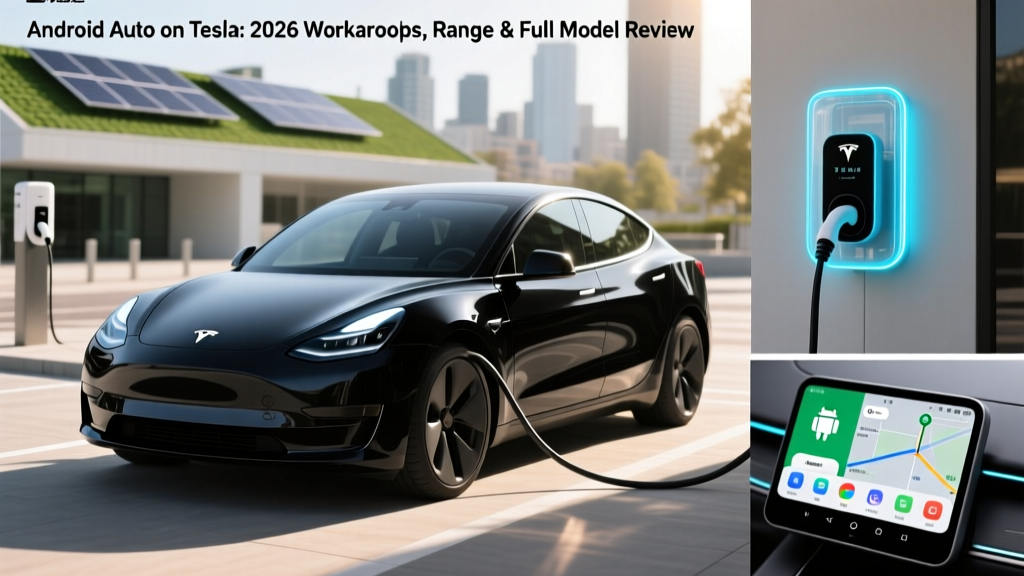
If you've spent years inside Google's ecosystem — Google Maps, Spotify, Google Assistant — switching to a Tesla can feel like stepping into a walled garden. The short answer to "Does Tesla support Android Auto?" is no. As of the 2026 model year, Tesla's proprietary infotainment system still does not natively support Android Auto or Apple CarPlay. Tesla's 15.4-inch center touchscreen runs a custom Linux-based OS with built-in navigation, streaming apps, and voice commands, but it won't mirror your phone's interface the way nearly every other automaker's system does.
That doesn't mean you're locked out of your apps. Below, we'll walk through the practical workarounds Tesla owners use to replicate the Android Auto experience, then deliver a full 2026 Tesla Model Y review — range, charging, pricing, tax credits, and whether it's still the EV to beat in the compact electric SUV segment.
How to Get Android Auto-Like Features on a Tesla
While native Android Auto integration remains absent, several approaches close the gap for 2026:
- Tesla's built-in apps: Spotify, YouTube, Netflix (parked only), Google Maps-based navigation, and a web browser are baked into the OS. For most drivers, Tesla Maps replaces Google Maps adequately, including real-time traffic and Supercharger routing.
- Bluetooth audio streaming: Any audio app on your phone — podcasts, audiobooks, music — streams over Bluetooth. Voice quality is acceptable, though not audiophile-grade.
- Phone mirroring via third-party hardware: Devices like the Carlinkit T2C or Hansshow Tesla Android box plug into the glovebox USB-C port and project a browser-based Android Auto-like interface onto the Tesla screen. Expect ~$150–$250 for the hardware, with some input lag and no steering-wheel control integration.
- Google Assistant via phone: Mount your phone on a MagSafe or vent mount and use "Hey Google" for voice queries while the Tesla screen handles navigation independently.
The honest take: most Tesla owners adapt within two weeks. Tesla Maps with live Supercharger routing is genuinely superior to Android Auto's EV routing in most scenarios. But if Android Auto is a non-negotiable dealbreaker, the Hyundai Ioniq 5, Ford Mustang Mach-E, and Kia EV6 all support it natively.
2026 Tesla Model Y: Range, Battery & Real-World Efficiency
The 2026 Tesla Model Y (refreshed "Juniper" generation) continues as one of the best-selling EVs globally. Here are the critical efficiency numbers by trim:
| Spec | Long Range RWD | Long Range AWD | Performance AWD |
|---|---|---|---|
| EPA Range | 320 mi | 308 mi | 285 mi |
| Battery (usable) | ~75 kWh | ~75 kWh | ~75 kWh |
| Chemistry | NMC (nickel manganese cobalt) | NMC | NMC |
| MPGe (combined) | 123 MPGe | 119 MPGe | 111 MPGe |
| Efficiency | 27 kWh/100mi | 28 kWh/100mi | 30 kWh/100mi |
| 0–60 mph | 5.8 sec | 4.8 sec | 3.5 sec |
| Horsepower | 295 hp | 384 hp | 456 hp |
| Drivetrain | RWD (single motor) | AWD (dual motor) | AWD (dual motor) |
Charging Speed: DC Fast, Level 2 & Home Setup
Charging remains a Tesla strong suit, thanks to the Supercharger network and the vehicle's capable onboard charger.
| Charging Level | Power | Speed / Time | Connector |
|---|---|---|---|
| Level 1 (120V household) | ~1.4 kW | ~3–4 miles/hour | NACS (native) |
| Level 2 (240V home) | 11.5 kW (48A) | ~37 miles/hour; full charge in ~8 hrs | NACS |
| DC Fast (Supercharger V4) | Peak 250 kW | 10–80% in ~22 minutes | NACS |
| DC Fast (CCS adapter) | Up to 250 kW | Varies by station; ~25 min 10–80% | CCS1 via adapter |
Charging curve reality: The Model Y peaks at 250 kW only at low state of charge (roughly 5–20%). From 20–50%, it sustains ~170–200 kW. Above 80%, charging slows dramatically to protect the battery — expect 30+ minutes for that final 20%. Plan road-trip stops around the 10–80% window for the fastest turnaround.
For home charging, Tesla's Wall Connector ($420) on a 60-amp circuit delivers the full 11.5 kW / 48 amps. A typical Level 2 home installation runs $800–$2,000 including electrician labor, depending on panel proximity and whether a 200-amp panel upgrade is needed. Always consult a licensed electrician for a site-specific quote.
Pricing, Trims & Federal Tax Credit Eligibility
The 2026 Model Y lineup has been streamlined following the Juniper refresh:
| Trim | Base MSRP | Federal Tax Credit (§30D) | Effective Price |
|---|---|---|---|
| Long Range RWD | $44,990 | Up to $7,500 (see caveats) | ~$37,490 |
| Long Range AWD | $47,990 | Up to $7,500 (see caveats) | ~$40,490 |
| Performance AWD | $52,490 | Up to $7,500 (see caveats) | ~$44,990 |
Tax credit caveats (IRS §30D, 2026 rules): The full $7,500 credit is not guaranteed for every buyer. Eligibility depends on:
- Buyer income caps: Modified AGI ≤ $150,000 (single), $225,000 (head of household), $300,000 (joint filers).
- MSRP cap: SUVs must be ≤ $80,000. All Model Y trims clear this.
- Battery sourcing: Critical minerals and battery components must meet escalating domestic-content thresholds. Tesla's US-built battery cells have largely met these requirements, but verify at the point of sale.
- Point-of-sale transfer: As of 2024+, you can transfer the credit to the dealer for an upfront price reduction, rather than waiting until tax filing.
Always confirm current eligibility on IRS.gov's clean vehicle credits page before purchasing, as sourcing rules tighten annually.
Interior, Cargo & Technology
The Juniper refresh brought meaningful interior improvements to the Model Y. The minimalist cabin now features ventilated front seats, ambient lighting, a rear-seat touchscreen, and improved sound insulation — addressing the most common complaints from pre-2025 owners.
Cargo and passenger dimensions:
- Cargo volume (rear seats up): 30.2 cu ft
- Cargo volume (rear seats folded): 72.1 cu ft
- Front trunk (frunk): 4.1 cu ft
- Rear legroom: 41.6 inches
- Front headroom: 41.0 inches
Standout tech:
- 15.4-inch center touchscreen with Tesla OS — snappy, responsive, and regularly updated OTA
- Autopilot (standard): SAE Level 2 adaptive cruise + lane centering — driver must remain engaged at all times
- Full Self-Driving (Supervised): $8,000 option, still Level 2 despite the name — requires continuous driver supervision
- Sentry Mode, Dashcam, Dog Mode, and over-the-air feature updates
- HEPA air filtration with Bioweapon Defense Mode
Warranty, Ownership Costs & Long-Term Value
Tesla's warranty structure is competitive with the EV segment:
- Basic vehicle warranty: 4 years / 50,000 miles
- Battery & drive unit: 8 years / 120,000 miles (Long Range/Performance), with a guaranteed minimum 70% capacity retention over the warranty period
- Maintenance: No scheduled service intervals. Expect to replace cabin air filters (~$50 DIY), wiper blades, and tires. No oil changes, no spark plugs.
Insurance remains a pain point: the Model Y averages $2,200–$2,800/year for full coverage depending on your state, age, and driving record — roughly 20–40% more than a comparable gas SUV. Always get an insurance quote before purchasing.
Model Y vs. Key Competitors: Is It Still the One to Beat?
The compact electric SUV segment is crowded in 2026. Here's how the Model Y stacks up:
- vs. Hyundai Ioniq 5: Ioniq 5 offers native Android Auto/CarPlay, 800V architecture (10–80% in ~18 min), and a slightly lower starting price. Model Y wins on range (320 vs. 305 mi), Supercharger access, and cargo space.
- vs. Ford Mustang Mach-E: Mach-E has Android Auto and a more engaging drive. Model Y is more efficient, has more range, and benefits from the Supercharger network.
- vs. Kia EV6: EV6's 800V charging is faster, and it supports Android Auto. Model Y still leads in software polish, OTA updates, and charging infrastructure.
Choose a competitor if: Native Android Auto/CarPlay is non-negotiable, you want the fastest possible DC charging (800V platforms), or you prefer a traditional dealer service experience.
Pros & Cons
- Class-leading 320-mile EPA range (Long Range RWD)
- Supercharger network — still the most reliable DC fast-charging ecosystem
- Spacious cargo area (72.1 cu ft) and practical frunk
- OTA updates continuously add features
- Strong efficiency (27 kWh/100mi) keeps charging costs low
- Excellent safety ratings (IIHS Top Safety Pick+)
- No Android Auto or Apple CarPlay — proprietary system only
- Insurance costs 20–40% above segment average
- FSD (Supervised) is expensive ($8,000) and still Level 2
- Panel gaps and interior fit/finish still trail legacy luxury brands
- Third-party DC charging (non-Tesla) requires a CCS adapter
Frequently Asked Questions
Will Tesla ever add Android Auto support?
There is no indication from Tesla that native Android Auto or Apple CarPlay support is planned. Elon Musk has historically stated that Tesla's in-house system offers a superior, integrated experience. Third-party hardware workarounds exist but are not officially supported.
What is the real-world range of the 2026 Model Y?
Expect 270–290 miles on the highway for the Long Range RWD (EPA 320 mi). In winter conditions below 30°F, range drops to roughly 220–250 miles. City driving with regenerative braking can actually exceed the EPA estimate, sometimes reaching 330+ miles in stop-and-go traffic at moderate temperatures. See fueleconomy.gov for official data.
How fast does the Model Y charge at home and on the road?
At home on a 240V Level 2 charger (48A), the Model Y adds ~37 miles per hour and fully charges in about 8 hours. On a Tesla Supercharger V4, it peaks at 250 kW and charges from 10–80% in roughly 22 minutes. Above 80%, the charge rate tapers significantly.
Does the 2026 Model Y qualify for the $7,500 federal tax credit?
It can, but eligibility depends on your income (AGI caps apply), the vehicle's battery sourcing compliance, and the MSRP cap ($80,000 for SUVs — all trims qualify). The credit can now be transferred at the point of sale for an instant discount. Verify current rules on IRS.gov.
Is the Tesla Model Y worth buying over the Ioniq 5 or EV6?
The Model Y is worth buying if you value range, Supercharger access, and Tesla's software ecosystem. If native Android Auto, faster 800V charging, or a traditional dealership experience matters more, the Ioniq 5 or EV6 are strong alternatives. Test-drive both before deciding.
What's the biggest drawback of owning a Tesla?
Beyond the lack of Android Auto, the most common ownership complaints are higher-than-average insurance premiums, limited third-party service options (Tesla service centers can have long wait times), and the proprietary ecosystem that makes switching brands feel like leaving an ecosystem.