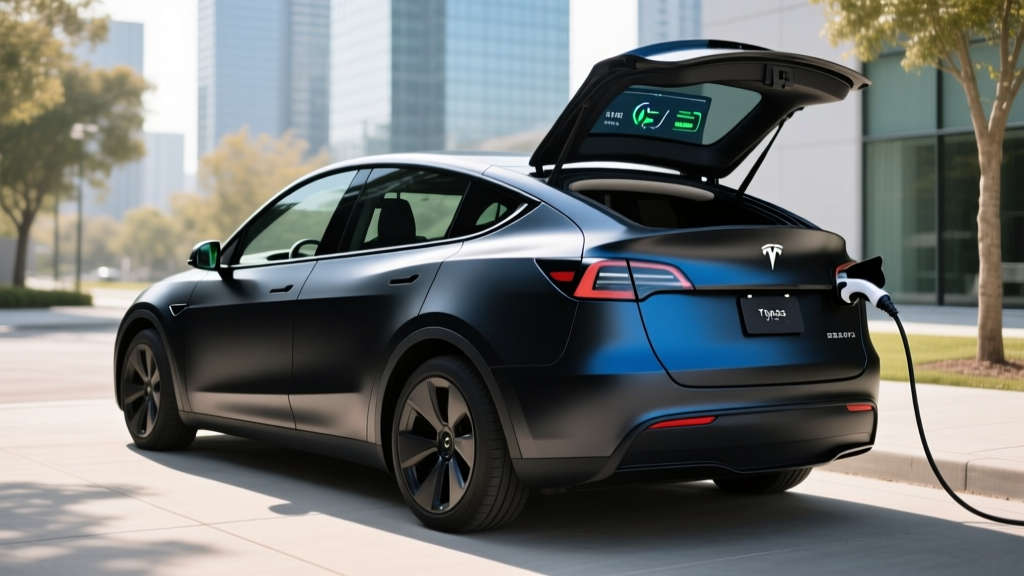
Search forums, military-base parking lots, and first-responder Facebook groups and one EV keeps showing up: the Tesla Model Y. It's become an unofficial staple among active-duty service members, veterans, nurses, and firefighters—earning the unofficial nickname "the American heroes' Tesla." The appeal is practical as much as patriotic: a U.S.-built crossover with low running costs, Supercharger access from coast to coast, and eligibility for the federal EV tax credit under IRS §30D. For 2026, Tesla's refreshed "Juniper" Model Y carries over the architecture introduced last year with minor trim and software updates. Here's the data-driven rundown buyers actually need.
Spec Snapshot: 2026 Tesla Model Y at a Glance
| Attribute | Long Range RWD | Long Range AWD | Performance |
|---|---|---|---|
| EPA range | 320 mi | 302 mi | 277 mi |
| Battery (usable) | ~75 kWh, NMC (2170 cells) | ||
| Drivetrain | Rear-motor RWD | Dual-motor AWD | Dual-motor AWD |
| Horsepower | ~346 hp | ~384 hp | ~456 hp |
| 0-60 mph | 5.8 s | 4.8 s | 3.5 s |
| Efficiency | 27 kWh/100 mi (124 MPGe) | 28 kWh/100 mi (120 MPGe) | 30 kWh/100 mi (111 MPGe) |
| Max DC fast charge | 250 kW peak (CCS via NACS adapter or native NACS at V3/V4 Superchargers) | ||
| 10-80% DC time | ~25 minutes (sustained curve dependent) | ||
| Level 2 home charge | 11.5 kW / ~44 mi per hour | ||
| Cargo (rear seats up / folded) | 34 / 76 cu ft | ||
| Base MSRP | $46,630 | $49,630 | $53,630 |
| As-tested (w/ FSD Supervised) | ~$57,000-$62,000 depending on trim and options | ||
Real-World Range: What the EPA Sticker Doesn't Tell You
EPA estimate: 320 miles (Long Range RWD) / 302 miles (Long Range AWD) / 277 miles (Performance).
Real-world expectation: Plan on ~260-280 miles at steady 70-75 mph highway speeds in mild weather. In sub-freezing winter conditions, expect a 15-25% reduction—so roughly 220-240 miles on the AWD Long Range. City/regen-heavy driving with a heat pump engaged often matches or slightly beats the EPA sticker.
Tesla's Juniper refresh added improved thermal management and a standard heat pump across the lineup, which narrows the cold-weather gap versus the pre-2025 models. Still, physics wins: at 80 mph in Montana in January, no EV delivers its sticker number. For a service member stationed at Minot AFB or a ski-town nurse commuting over a pass, budget 20% below EPA as your usable planning range.
Charging Speed and Network Access
The 2026 Model Y retains the NACS charge port natively, which unlocks the 20,000+ stall Supercharger network without an adapter. On a V3 (250 kW) or V4 Supercharger, the pack peaks near 250 kW around 10-15% SoC and tapers progressively—averaging closer to 160-170 kW across a full 10-80% session.
| Charging method | Power | Typical gain |
|---|---|---|
| Level 1 (120V household) | ~1.4 kW | ~4-5 miles per hour |
| Level 2 home (Wall Connector, 48A) | 11.5 kW | ~44 miles per hour |
| DC fast (V3 Supercharger) | 250 kW peak | 10-80% in ~25 min |
| DC fast (third-party CCS, via adapter) | Up to 150-350 kW (site dependent) | Varies; typically 20-35 min 10-80% |
For Electrify America, EVgo, or ChargePoint CCS stations, Tesla still sells a CCS adapter, though most buyers will simply rely on Superchargers—the reliability gap remains substantial, with Tesla's own network consistently posting 95%+ uptime versus roughly 80% for many third-party networks according to J.D. Power's most recent EVX Index.
Pricing, Trims, and Federal Tax Credit Eligibility
| Trim | MSRP (incl. dest.) | Est. after §30D credit |
|---|---|---|
| Long Range RWD | $46,630 | ~$39,130* |
| Long Range AWD | $49,630 | ~$42,130* |
| Performance | $53,630 | ~$46,130* |
*Credit eligibility is not automatic. Under current-year IRS §30D rules, buyers must meet:
- MSRP cap: SUVs/crossovers must be ≤$80,000 (all Model Y trims qualify).
- Income cap: AGI ≤$150,000 single / $225,000 HOH / $300,000 joint.
- Battery sourcing: Critical-mineral and battery-component thresholds phase up each year; Tesla's Austin-built packs have historically met the full $7,500, but verify at point of sale—dealers are required to report eligibility via the IRS Energy Credits Online portal.
- Point-of-sale transfer: Eligible buyers can apply the credit as an immediate rebate at purchase rather than waiting for tax filing.
Always confirm eligibility the week you buy. Sourcing rules tightened in 2025 and again in 2026, and a single supply-chain shift can flip a trim from $7,500 to $3,750 or $0.
Performance, Ride, and Daily Livability
The Long Range AWD's 4.8-second 0-60 is brisk enough to merge onto any interstate without drama, and the Performance trim's 3.5-second run is sports-sedan territory in a family crossover. Ride quality improved noticeably with Juniper's retuned dampers and added acoustic glass—cabin noise at 70 mph now measures closer to a Lexus NX than the older, crashier Model Y.
Interior dimensions remain generous: 41.8 inches of front legroom, 39.5 rear, and 34 cu ft of cargo behind the second row (76 cu ft folded). The front trunk (frunk) adds ~4.1 cu ft—enough for a charging cable kit and a soft-sided cooler. Towing is rated at 3,500 pounds for AWD trims, adequate for a small boat or utility trailer but below the Ford Mustang Mach-E's lack of a rating and far below the Rivian R1S.
Tech, Driver Assistance, and What's Missing
Every 2026 Model Y ships with a 15.4-inch front touchscreen, a second 8-inch rear screen for climate and media, ventilated front seats, and Tesla's latest HW4 Autopilot hardware. Standard Autopilot includes adaptive cruise and lane centering; Full Self-Driving (Supervised) remains a $8,000 option or $99/month subscription.
SAE automation level: Autopilot and FSD (Supervised) are Level 2 driver-assist systems. The driver must remain engaged, eyes on the road, hands available to take over at any moment. They are not self-driving. Only Level 4 robotaxi services like Waymo operate without a human driver in defined geofenced areas.
Notable drawbacks: no Apple CarPlay or Android Auto (Tesla's native infotainment is capable but polarizing), no physical buttons for climate or mirrors, and the turn-signal stalk has been removed in favor of steering-wheel buttons—a frequent complaint among new owners adjusting from traditional cars.
Pros, Cons, and Who Should Buy
Pros
- Supercharger network reliability unmatched by competitors
- Class-leading efficiency (kWh/100 mi)
- Spacious cargo area with usable frunk
- Strong §30D tax-credit eligibility on U.S.-built trims
- OTA updates continue adding features post-purchase
Cons
- Stalkless turn signals require relearning
- No Apple CarPlay/Android Auto
- FSD (Supervised) is expensive and still Level 2
- Insurance premiums run 15-30% higher than segment average
- Rear visibility relies heavily on cameras
Choose the Model Y if: You value Supercharger access for road trips, want the lowest per-mile energy cost in the segment, and qualify for the §30D credit. Ideal for military families relocating frequently (charging access is nationwide), commuters with home Level 2, and two-kid households needing 70+ cu ft of cargo.
Consider competitors if: You want physical controls and CarPlay (Hyundai Ioniq 5), need three rows (Kia EV9), or prefer a traditional dealer experience with in-person service (Ford Mustang Mach-E).
Ownership Costs, Warranty, and Longevity
Tesla covers the Model Y with a 4-year/50,000-mile basic warranty and an 8-year/120,000-mile battery and drive-unit warranty with a guaranteed minimum 70% capacity retention over that period. The NMC pack in the Long Range trims is proven; EPA data via fueleconomy.gov shows consistent efficiency across model years.
Five-year total cost of ownership typically undercuts a comparably priced gas crossover by $8,000-$12,000 when factoring the tax credit, electricity vs. gasoline (at national averages), and reduced maintenance—though higher insurance and faster-than-average depreciation partially offset the gains. Home-charging at $0.14/kWh works out to roughly 3.8 cents per mile; public DC fast charging at $0.40/kWh pushes that to ~11 cents per mile, still below most gasoline equivalents.
Frequently Asked Questions
What is the real-world range of the 2026 Tesla Model Y?
Expect 260-280 miles highway in mild weather on the Long Range AWD (EPA 302 mi). In freezing temperatures, plan on 220-240 miles. City driving with regen often matches or beats the EPA sticker.
How fast does the Model Y charge at home and on the road?
At home on a 48A Level 2 Wall Connector, it adds ~44 miles per hour (11.5 kW). On a V3 Supercharger, 10-80% takes roughly 25 minutes at a peak of 250 kW.
How much does it cost after the federal tax credit?
If you meet IRS §30D income, MSRP, and battery-sourcing requirements, the Long Range RWD drops from $46,630 to approximately $39,130 via point-of-sale transfer. Verify eligibility the week you buy—sourcing rules shift.
Does the Model Y qualify for the full $7,500 federal EV tax credit?
Historically yes, as an Austin-built SUV under the $80,000 MSRP cap. Battery sourcing requirements tighten annually; confirm with your dealer via the IRS ECO portal before signing.
Is the Model Y worth buying versus the Ioniq 5 or Mach-E?
It's the efficiency and charging-network winner. Choose the Ioniq 5 for 800V charging and CarPlay, the Mach-E for a traditional dealer experience, and the Model Y for lowest kWh/100mi and best road-trip infrastructure.
Is FSD (Supervised) self-driving?
No. It is an SAE Level 2 driver-assist system requiring continuous driver engagement. Only Waymo-style Level 4 services operate without a human driver.