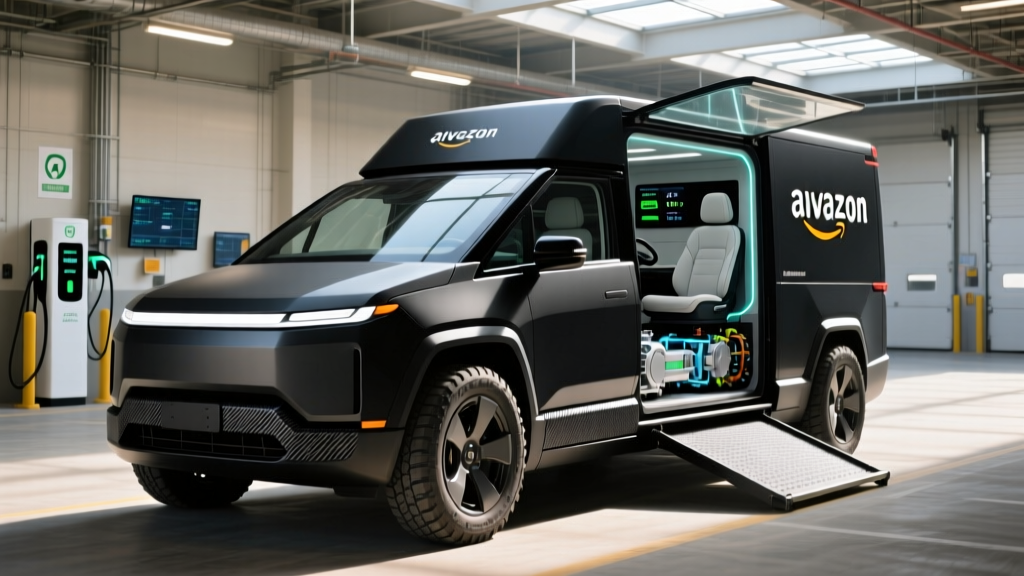
When you see a blue-and-gray delivery van pulling up to your door, you're looking at one of the most consequential electric vehicles on the road — even if you can't buy one. The Amazon trucks built by Rivian, officially known as the Rivian EDV (Electric Delivery Van), represent the largest single deployment of purpose-built electric commercial vehicles in U.S. history. With over 10,000 units delivered to Amazon as of early 2026 and a contracted total of 100,000, these vans are stress-testing EV battery and powertrain technology at a scale no consumer vehicle can match.
But for EV shoppers and industry watchers, the real question isn't what the EDV does for Amazon — it's what the EDV tells us about Rivian's engineering DNA, and how that translates to the consumer vehicles you can buy: the R1T pickup and R1S SUV. This profile breaks down every available spec on the Amazon delivery vans by Rivian, then connects those dots to Rivian's consumer lineup.
Rivian EDV at a Glance: Fleet Van Specifications
The Rivian EDV comes in three body configurations — the EDV-500, EDV-700, and EDV-900 — with numbers roughly corresponding to cargo volume in cubic feet. Amazon primarily deploys the EDV-700 for last-mile delivery routes. Here's what we know from Rivian's fleet disclosures, Amazon sustainability reports, and commercial fleet testing data:
| Spec | EDV-500 | EDV-700 | EDV-900 |
|---|---|---|---|
| Battery Capacity (usable) | ~90 kWh (est.) | ~110 kWh (est.) | ~135 kWh (est.) |
| EPA-Estimated Range | ~120 mi | ~150 mi | ~161 mi (reported) |
| Motor Configuration | Single rear motor | Single rear motor | Single rear motor |
| Horsepower | ~280 hp (est.) | ~330 hp (est.) | ~330 hp (est.) |
| Cargo Volume | ~500 cu ft | ~700 cu ft | ~900 cu ft |
| Max DC Fast Charge | ~100 kW (est.) | ~125 kW (est.) | ~125 kW (est.) |
| GVWR | ~9,500 lbs | ~12,000 lbs | ~14,000 lbs |
Important caveat: Rivian does not publish consumer-facing spec sheets for the EDV line because it's a fleet-exclusive vehicle not available for retail purchase. The figures above are compiled from Amazon's Sustainability Report, Rivian investor presentations, and fleet operator disclosures. Exact battery chemistry and capacity remain proprietary, though industry analysis points to NMC (nickel manganese cobalt) pouch cells from Samsung SDI — the same supplier Rivian uses in its consumer R1 platform.
Real-World Range: What Amazon's Routes Reveal
Real-World Fleet Range: ~120–140 miles on typical urban delivery routes with full cargo load, frequent stops, and HVAC use. In cold-weather markets (Chicago, Minneapolis, Boston), expect a 20–30% reduction, dropping effective range to ~85–115 miles.
Amazon has publicly stated that the EDV is designed for routes averaging 70–120 miles per day, which provides a comfortable buffer even in degraded conditions. The vans return to the same depot nightly for Level 2 charging, so range anxiety is mitigated by predictable, short routes and guaranteed overnight charging infrastructure.
This is a fundamentally different use case from a consumer road trip. The EDV's range is optimized for stop-and-go urban efficiency, where regenerative braking recovers significant energy. Rivian's regenerative braking system is among the most aggressive in the industry — a trait shared with the R1T and R1S that enables true one-pedal driving in city conditions. In city-heavy delivery cycles, the EDV likely achieves 1.5–2.0 kWh per mile, translating to an effective efficiency of roughly 50–65 MPGe equivalent, though the EDV does not appear on fueleconomy.gov since it's a commercial vehicle.
Charging Infrastructure: How Amazon Keeps the Fleet Moving
Rivian designed the EDV to charge primarily at Amazon depot hubs using Level 2 AC charging, with DC fast-charging capability reserved for mid-route top-ups or emergency use. Here's the charging profile based on fleet infrastructure reports:
| Charging Level | Power (kW) | Estimated Rate | Use Case |
|---|---|---|---|
| Level 1 (120V) | ~1.4 kW | Not used in fleet ops | N/A |
| Level 2 (240V depot) | ~19.2 kW | ~55–70 miles per hour of charging | Overnight depot charging (primary) |
| DC Fast Charge | ~125 kW peak | ~10–80% in approximately 50–60 min | Mid-route supplemental charging |
The ~19.2 kW Level 2 depot charging is the backbone of Amazon's fleet operation. Vans plug in after their shift and are fully replenished within 6–7 hours — well within the overnight window. Amazon has invested heavily in depot charging infrastructure, installing tens of thousands of Level 2 chargers across its delivery stations nationwide.
For the consumer reading this: Rivian's consumer vehicles (R1T Dual-Motor, R1S) support significantly faster DC charging — up to 225 kW peak on the latest 2026 R1 models with the Max battery pack, achieving a 10–80% charge in roughly 30 minutes. The EDV's more modest charge speed reflects its design priority: durability and cycle-life longevity over peak charge speed, since the vans charge slowly overnight anyway.
What the EDV Tells Us About Rivian's Consumer Vehicles
The Amazon contract was Rivian's financial lifeline during its most vulnerable years, and the engineering lessons from building 10,000+ commercial vans directly inform the R1T and R1S you can actually buy. Here's the translation:
Battery Durability Under Extreme Cycling
The EDV fleet accumulates some of the highest cycle counts of any EV on the road — daily deep discharges followed by full recharges, 5–6 days per week, in every climate. Rivian's battery management system (BMS) has been validated across millions of fleet miles. This same BMS architecture carries over to the R1 platform, giving consumer buyers confidence in long-term battery health. Rivian's battery warranty on the R1T and R1S covers 8 years or 175,000 miles (whichever comes first), with a capacity retention threshold of 70% — one of the more generous terms in the industry.
Thermal Management Expertise
Operating vans in Phoenix summers and Minnesota winters forced Rivian to develop a robust liquid-cooled thermal management system. The R1T and R1S benefit from this directly, with active battery preconditioning for DC fast charging and cabin heat pump availability on newer model years. In cold-weather testing, Rivian's consumer vehicles have shown better-than-average range retention compared to competitors lacking equivalent thermal systems.
Software-Defined Vehicle Architecture
Amazon's fleet management requires real-time telematics, remote diagnostics, and over-the-air (OTA) updates at massive scale. Rivian built this capability into the EDV and carries the same OTA-first philosophy to its consumer vehicles. R1 owners receive regular feature updates, performance improvements, and bug fixes — much like Tesla's OTA model, though Rivian's update cadence has historically been more measured.
Rivian R1T and R1S: The Consumer Vehicles You Can Buy
Since the EDV isn't available to consumers, here's how Rivian's purchasable lineup stacks up for the 2026 model year:
| Spec | 2026 R1T Dual-Motor (Standard Battery) | 2026 R1S Dual-Motor (Standard Battery) |
|---|---|---|
| Battery Capacity | ~92 kWh usable (LFP) | ~92 kWh usable (LFP) |
| EPA Range | ~270 mi | ~260 mi |
| Max DC Fast Charge | ~200 kW peak | ~200 kW peak |
| 10–80% DC Charge Time | ~28 min | ~28 min |
| Level 2 Charge Rate | 11.5 kW (~25 mi/hr) | 11.5 kW (~24 mi/hr) |
| Horsepower | 533 hp | 533 hp |
| 0–60 mph | ~4.5 sec | ~4.6 sec |
| Drivetrain | Dual-Motor AWD | Dual-Motor AWD |
| Base MSRP | $69,900 | $74,900 |
| EPA Efficiency | ~73 MPGe / 46 kWh/100mi | ~69 MPGe / 49 kWh/100mi |
| Towing Capacity | 11,000 lbs | 7,700 lbs |
| Battery Warranty | 8 yr / 175,000 mi | 8 yr / 175,000 mi |
Max Pack upgrade: The available Max battery pack (~141 kWh, NMC chemistry) pushes R1T range to approximately 420 miles EPA and R1S range to roughly 400 miles EPA, with DC fast-charge capability up to 225 kW peak.
Federal Tax Credit Eligibility for Rivian Consumer Vehicles
The Amazon EDV is purchased by a commercial fleet and doesn't qualify for the consumer §30D federal tax credit. But for retail buyers of the R1T and R1S, here's the current eligibility picture under IRS §30D rules:
| Requirement | R1T Eligibility | R1S Eligibility |
|---|---|---|
| MSRP Cap ($80,000 for trucks/vans, $80,000 for SUVs) | Base trims qualify; Max Pack and Quad-Motor trims may exceed cap | Base trims qualify; higher trims may exceed $80,000 cap |
| Buyer Income Cap (AGI) | $300K joint / $225K HoH / $150K single | $300K joint / $225K HoH / $150K single |
| Battery Component Sourcing | Must meet North American assembly + critical mineral thresholds (varies by model year) | Same sourcing requirements |
| Max Potential Credit | Up to $7,500 | Up to $7,500 |
| Point-of-Sale Transfer | Available — reduces purchase price at dealer | Available — reduces purchase price at dealer |
Critical nuance: Rivian's battery sourcing and component origin determine whether a specific vehicle qualifies for the full $7,500, partial $3,750, or no credit at all. These sourcing requirements tighten annually. Always verify eligibility for your specific VIN using the IRS's official tool at fueleconomy.gov before finalizing a purchase. A tax professional should confirm your AGI eligibility as well.
Pros, Cons, and the Bottom Line
Pros (Rivian Platform — Consumer R1T/R1S)
- Proven fleet durability: The EDV fleet validates Rivian's powertrain and BMS across millions of real-world commercial miles — a data advantage few EV startups possess.
- Best-in-class utility: The R1T's gear tunnel, 11,000-lb tow rating, and integrated camp kitchen options make it the most versatile electric pickup available.
- Strong OTA software: Regular feature additions and performance improvements keep the vehicle current post-purchase.
- Generous battery warranty: 8 years / 175,000 miles with a 70% retention threshold exceeds many competitors.
- Expanding charging: Rivian now supports NACS (Tesla Supercharger network access via adapter), dramatically improving road-trip charging options.
Cons (Rivian Platform — Consumer R1T/R1S)
- Premium pricing: At $69,900+ base (and $85,000+ for Max Pack configurations), the R1T/R1S isn't accessible to budget-conscious buyers.
- Highway efficiency drops: The boxy truck/SUV shape hurts aerodynamic efficiency at 75+ mph, cutting real-world range notably below EPA estimates on road trips.
- Insurance costs: Rivian insurance premiums run 20–40% higher than comparable ICE vehicles, per industry averages — factor this into total ownership cost.
- Service center availability: Rivian's service network is expanding but remains sparse outside major metro areas. Mobile service covers some gaps, but major repairs require a service center visit.
- EDV isn't for sale: If you wanted the Amazon van itself for a camper conversion or commercial use, you're out of luck — it's Amazon-exclusive under the current contract.
Who Should Buy a Rivian (and Who Should Look Elsewhere)
The R1T is ideal for: Outdoor enthusiasts who need a capable truck for towing boats, trailers, or campers; tech-forward buyers who want an adventure vehicle with genuine off-road chops (Rivian's quad-motor tank turns are class-leading); and early adopters comfortable with a younger brand's service network.
The R1S is ideal for: Families who want three-row seating, strong safety ratings, and electric daily driving with the option for weekend adventure towing. The R1S competes most directly with the Tesla Model X and the upcoming electric SUVs from legacy brands.
Look elsewhere if: Your budget tops out below $60,000 (consider the Chevy Equinox EV or Hyundai Ioniq 5); you need proven nationwide dealer service (Toyota, Hyundai, or Ford have broader networks); or you primarily drive highway miles and want maximum range per dollar (the Hyundai Ioniq 6 or Tesla Model 3 offer superior highway efficiency).
Frequently Asked Questions
Can I buy the Amazon Rivian delivery van for personal use?
No. The Rivian EDV is built exclusively for Amazon under a 100,000-vehicle contract. Rivian has not announced plans to sell the EDV to other fleets or retail customers. Amazon's exclusivity window extends through at least 2026, though Rivian has signaled interest in offering commercial variants to other fleet buyers in the future.
What is the real-world range of the Rivian EDV-700?
The EDV-700 achieves approximately 120–140 miles on typical loaded urban delivery routes, against an estimated EPA-equivalent range of ~150 miles. Cold weather and heavy cargo loads push range toward the lower end. Amazon designs routes to stay within this envelope, ensuring vans return to the depot with charge to spare.
How fast does the Rivian EDV charge?
The EDV charges primarily via ~19.2 kW Level 2 depot chargers overnight (adding roughly 55–70 miles of range per hour). DC fast-charging peaks at approximately 125 kW, achieving a 10–80% charge in roughly 50–60 minutes. This is slower than Rivian's consumer vehicles, reflecting the fleet's overnight-charge-first design philosophy.
Does the Rivian R1T qualify for the $7,500 federal tax credit?
It depends on the specific trim, your income, and current battery-sourcing rules. Base Dual-Motor R1T models priced under the $80,000 MSRP cap can qualify, provided the buyer's AGI falls under IRS thresholds ($300K joint / $150K single) and the vehicle meets critical-mineral and battery-component sourcing requirements for the model year. Verify your specific VIN at fueleconomy.gov before purchasing.
Is Rivian a reliable brand compared to Tesla or legacy automakers?
Rivian's reliability data is still maturing — the company began consumer deliveries in 2022. However, the EDV fleet provides an unusually large real-world durability dataset for a young automaker. Early R1T/R1S owners report high satisfaction with build quality and powertrain reliability, though software bugs and service-center wait times remain common complaints. JD Power and Consumer Reports reliability scores for Rivian are improving year-over-year but still trail established brands like Toyota and Hyundai.
What battery chemistry does Rivian use?
Rivian uses LFP (lithium iron phosphate) chemistry for its Standard battery pack, which offers excellent cycle life and thermal stability at the cost of lower energy density. The Max battery pack uses NMC (nickel manganese cobalt) chemistry for higher energy density and longer range. LFP packs can be charged to 100% daily without accelerated degradation concerns — a practical advantage for daily drivers. NMC packs benefit from an 80% daily charge limit for longevity, with 100% reserved for road trips.