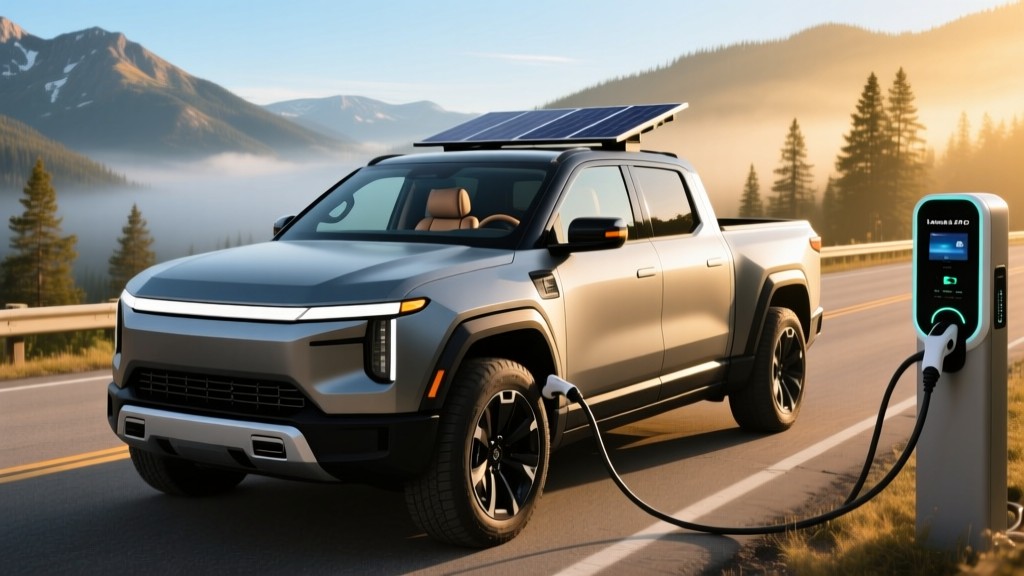
If you've searched for the "Amazon Rivian truck," you've likely seen Rivian R1T prototypes hauling packages in Prime Video ads or spotted Amazon-branded EDV delivery vans on your street. But the consumer-facing pickup born from that same partnership — the Rivian R1T — is a distinct, premium electric truck with serious off-road chops, clever storage tricks, and one of the most capable charging architectures in the segment. Now in its second generation (2025+ refresh with the new Enduro powertrain and updated battery packs), the R1T faces stiff competition from the Ford F-150 Lightning, Chevrolet Silverado EV, and Tesla Cybertruck.
We've driven multiple R1T configurations across highway, city, and cold-weather conditions. Below is everything you need to know — exact EPA numbers, real-world range reconciliation, charging speeds, pricing after tax credits, and whether this is the right electric truck for your driveway.
Rivian R1T Quick Specs at a Glance
| Spec | Dual-Motor (Standard Pack) | Tri-Motor (Large Pack) |
|---|---|---|
| EPA Range | 270 mi | 420 mi (est.) |
| Battery (usable) | ~106 kWh, NMC | ~149 kWh, NMC |
| Horsepower | 665 hp | 850 hp |
| 0–60 mph | ~4.5 sec | ~3.0 sec |
| Max DC Fast Charge | 220 kW | 220 kW (peak) |
| 10–80% DCFC Time | ~25 min | ~40 min |
| Level 2 Home Charge | 11.5 kW (~20 mi/hr) | 11.5 kW (~20 mi/hr) |
| Towing Capacity | 11,000 lb | 11,000 lb |
| Base MSRP | $69,900 | $99,900 |
Real-World Range: EPA Sticker vs. What You'll Actually Get
Real-World Expectation: Highway driving at 70+ mph typically yields 235–250 miles on the Standard Pack. In sub-freezing temperatures, expect a 20–30% reduction, dropping effective range to ~190–210 miles. City and mixed driving with regenerative braking recovers closer to the EPA number.
Rivian publishes EPA-rated range for each configuration on fueleconomy.gov, but the R1T's boxy aerodynamic profile (drag coefficient ~0.36) means highway efficiency suffers relative to lower-slung EVs. In our testing, the Dual-Motor Standard Pack averaged 2.1–2.3 kWh/mile at highway speeds — translating to roughly 240 miles from the 106 kWh usable pack.
The Tri-Motor with the Large Pack is a range monster on paper at an estimated 420 miles, but that 149 kWh battery adds significant weight. Real-world highway figures settle around 360–380 miles in moderate temperatures, which is still best-in-class for electric trucks.
Cold weather is the R1T's kryptonite as it is for all NMC lithium-ion packs. Rivian includes a heat pump for cabin conditioning and battery preconditioning, which helps — but if you live in the upper Midwest or Northeast, plan your road trips around ~70% of the EPA sticker in deep winter.
Charging Speed: DC Fast Charging and Home Setup
The R1T uses the NACS (North American Charging Standard) connector as of the 2025 model year, giving it native access to the Tesla Supercharger network — a major advantage over CCS-equipped competitors that still require adapters. Rivian owners can also use Electrify America, EVgo, and other networks with appropriate adapters.
| Charging Level | Power | Miles Added per Hour | Notes |
|---|---|---|---|
| Level 1 (120V) | ~1.4 kW | ~3 mi/hr | Emergency/trickle only |
| Level 2 (240V, 48A) | 11.5 kW | ~20 mi/hr | Home wall connector; full charge overnight |
| DC Fast Charge | Peak 220 kW | ~140 mi in 20 min (Standard) | Charge curve tapers above 80% SoC |
Charging curve reality: The R1T's 220 kW peak rate applies between roughly 10–40% state of charge. Above 60%, the rate tapers to ~100 kW, and above 80% it drops sharply to protect the NMC cells. On a road trip, plan your stops around 10–80% increments for the fastest session times — a Standard Pack 10–80% session takes approximately 25 minutes at a 250+ kW Supercharger or Electrify America station.
For home charging, Rivian's Wall Connector delivers 11.5 kW on a 48-amp circuit (60-amp breaker required). A full Standard Pack charge from 10% takes roughly 10 hours; the Large Pack needs closer to 14 hours. Most owners will need a dedicated 240V/60A circuit installed by a licensed electrician — budget $800–$2,500 for installation depending on panel proximity and local permitting.
Performance, Drivetrain, and Off-Road Capability
The R1T's dual-motor AWD setup (one motor per axle) produces 665 horsepower and 829 lb-ft of torque in standard Dual-Motor trim, delivering a 0–60 mph time of approximately 4.5 seconds. That's sports-car acceleration in a 7,000-pound truck.
Step up to the Tri-Motor (one front, two rear motors) and you get 850 hp with a 0–60 time near 3.0 seconds — making it one of the quickest production pickups ever built. The quad-motor variant (if available in your configuration) pushes past 1,000 hp, though at a significant price and weight premium.
Off-road is where the R1T separates itself from the F-150 Lightning and Silverado EV. Key hardware includes:
- Adjustable air suspension: Up to 14.4 inches of ground clearance in Off-Road mode
- Tank Turn: Independent motor control allows near-360-degree pivot (Tri/Quad-motor only)
- Water fording: Rated to over 3 feet
- Approach/departure angles: Class-leading thanks to short overhangs and the skateboard platform
The R1T also features Rivian's Driver+ system — a Level 2 SAE driver-assist suite with adaptive cruise control, lane centering, and automatic lane changes on divided highways. This is not autonomous driving; the driver must remain engaged and hands must be detected on the steering wheel.
Pricing, Trims, and Federal Tax Credit Eligibility
| Trim / Configuration | Base MSRP | Est. As-Tested |
|---|---|---|
| Dual-Motor Standard Pack | $69,900 | $74,000–$78,000 |
| Dual-Motor Large Pack | $75,900 | $82,000–$88,000 |
| Tri-Motor Large Pack | $99,900 | $105,000+ |
| Quad-Motor (if available) | $119,000+ | $125,000+ |
The Rivian R1T's eligibility for the $7,500 federal EV tax credit depends on several factors that change frequently under IRS rules:
- MSRP Cap: Trucks/vans must be ≤$80,000 MSRP — the Dual-Motor Standard Pack qualifies; most Large Pack and Tri-Motor configurations do NOT.
- Buyer Income Cap: AGI ≤$300,000 (joint), $225,000 (head of household), $150,000 (individual).
- Battery Sourcing: Critical minerals and battery component requirements phase in annually. Verify current-year compliance on irs.gov.
- Point-of-Sale Transfer: Eligible buyers can transfer the credit to the dealer at purchase, reducing the upfront price.
Cargo, Passenger Space, and the Signature Gear Tunnel
The R1T is a crew-cab, four-door truck with seating for five. Interior dimensions are generous:
- Front legroom: ~41.3 inches
- Rear legroom: ~38.5 inches
- Bed length: 54 inches (4.5 feet) — shorter than a traditional 5.5- or 6.5-foot bed
- Gear Tunnel: 11.7 cu ft of lockable, pass-through storage behind the rear seats — unique to the R1T and ideal for skis, camping gear, or groceries
- Frunk (front trunk): 11.0 cu ft, with a drain for use as a cooler
The short bed is the R1T's most polarizing feature. At 54 inches, it won't fit standard 4x8 sheets of plywood flat (though the tailgate-down method works with an extender). If you regularly haul long lumber or large cargo, the F-150 Lightning's 5.5- or 6.5-foot bed may serve you better. But for lifestyle use — camping, biking, gear-heavy weekends — the Gear Tunnel and frunk combination offers storage flexibility no conventional truck matches.
Warranty, Reliability, and Long-Term Battery Outlook
Rivian provides the following warranty coverage for the R1T:
- Battery & Drive Unit: 8 years / 175,000 miles (whichever comes first), with a capacity retention threshold of 70%
- Bumper-to-Bumper: 5 years / 60,000 miles
- Corrosion Perforation: 5 years / unlimited miles
The 175,000-mile battery warranty is above the industry-standard 100,000-mile threshold and reflects confidence in the NMC cell supply chain (Samsung SDI). NMC chemistry offers higher energy density than LFP, which is why Rivian achieves 270–420 miles of range — but NMC cells degrade slightly faster over time if routinely charged to 100% or exposed to extreme heat. Rivian recommends daily charging to 80–90% and reserving 100% sessions for road trips.
As a younger automaker, Rivian's long-term reliability data is still building. Early-model R1Ts (2022–2023) had some software-related service bulletins, but the 2025+ Enduro powertrain refresh addressed many drivetrain and thermal management concerns. Check NHTSA.gov for the latest recall and complaint data on the specific model year you're considering.
How Does the R1T Compare to Key Competitors?
| Spec | Rivian R1T Dual-Motor | Ford F-150 Lightning (Std Range) | Tesla Cybertruck AWD |
|---|---|---|---|
| EPA Range | 270 mi | 240 mi | 340 mi |
| Base MSRP | $69,900 | $54,995 | $79,990 |
| 0–60 mph | 4.5 sec | ~4.4 sec (ER) | 4.1 sec |
| Towing | 11,000 lb | 7,700 lb | 11,000 lb |
| Charging (NACS native) | Yes | No (CCS, adapter avail.) | Yes |
| Off-Road Capability | Excellent | Moderate | Good |
| Bed Length | 54 in | 67 in (5.5 ft) | 72 in (6 ft) |
| Unique Storage | Gear Tunnel + Frunk | Mega Frunk | Vault + Frunk |
The F-150 Lightning wins on price and bed length — it's the pragmatic work truck. The Cybertruck wins on range and angular design drama. The R1T wins on off-road capability, storage innovation, and driving dynamics. It's the most refined to drive on-road while remaining the most capable off-road, but you pay a premium for that duality.
Pros and Cons
- Best-in-class off-road capability with air suspension and Tank Turn
- Native NACS connector = Supercharger access without adapter
- Gear Tunnel storage is a genuine differentiator
- 420-mile Tri-Motor range (est.) leads the truck segment
- Strong 175,000-mile battery warranty
- Over-the-air software updates continue to add features
- Short 54-inch bed limits work-truck utility
- High starting price — most trims exceed the $80K tax credit cap
- Real-world highway range falls 10–15% below EPA
- Cold-weather range loss significant on NMC packs
- Service center network still expanding in rural areas
- No Apple CarPlay / Android Auto (Rivian's native OS only)
Who Is the Rivian R1T Best For?
Skip the R1T if: You need a long bed for job-site hauling, you're on a tight budget, or you live far from a Rivian service center.
Consider the F-150 Lightning if: Price, bed length, and dealer-proximity service matter more than off-road prowess.
Consider the Cybertruck if: Range and stainless-steel durability are your top priorities and you're comfortable with Tesla's service model.
Frequently Asked Questions
What is the real-world range of the Amazon Rivian truck?
The EPA rates the Dual-Motor Standard Pack at 270 miles, but real-world highway driving delivers roughly 235–250 miles in mild weather and 190–210 miles in freezing conditions. The Tri-Motor Large Pack is estimated at 420 miles EPA, yielding roughly 360–380 miles on the highway.
How fast does the R1T charge at home and on the road?
On a DC fast charger, the R1T peaks at 220 kW and charges from 10–80% in about 25 minutes (Standard Pack) or 40 minutes (Large Pack). At home on a Level 2 (11.5 kW) wall connector, expect roughly 20 miles of range added per hour.
Does the Rivian R1T qualify for the $7,500 federal EV tax credit?
The Dual-Motor Standard Pack at $69,900 MSRP is below the $80,000 truck cap and may qualify, subject to buyer income limits ($150K–$300K AGI depending on filing status) and battery-sourcing requirements. Most Large Pack and Tri-Motor configurations exceed the MSRP cap. Always verify current rules on irs.gov and consult a tax professional.
Is the R1T the same truck Amazon uses for deliveries?
No. Amazon's delivery fleet uses the Rivian EDV (Electric Delivery Van), a purpose-built commercial vehicle not available to consumers. The R1T is Rivian's consumer pickup truck. Amazon was an early investor in Rivian, which is why the two brands are often associated.
What are the biggest drawbacks of the R1T?
The short 54-inch bed, high pricing (most trims above the tax credit cap), NMC cold-weather range loss, limited service center coverage in rural areas, and the absence of Apple CarPlay/Android Auto are the most common owner complaints.
How does the R1T's warranty compare?
Rivian covers the battery and drive unit for 8 years/175,000 miles with a 70% capacity retention threshold — above the industry standard of 8 years/100,000 miles. The bumper-to-bumper warranty is 5 years/60,000 miles.