Quick Answer: What Are Amazon's Electric Vans?
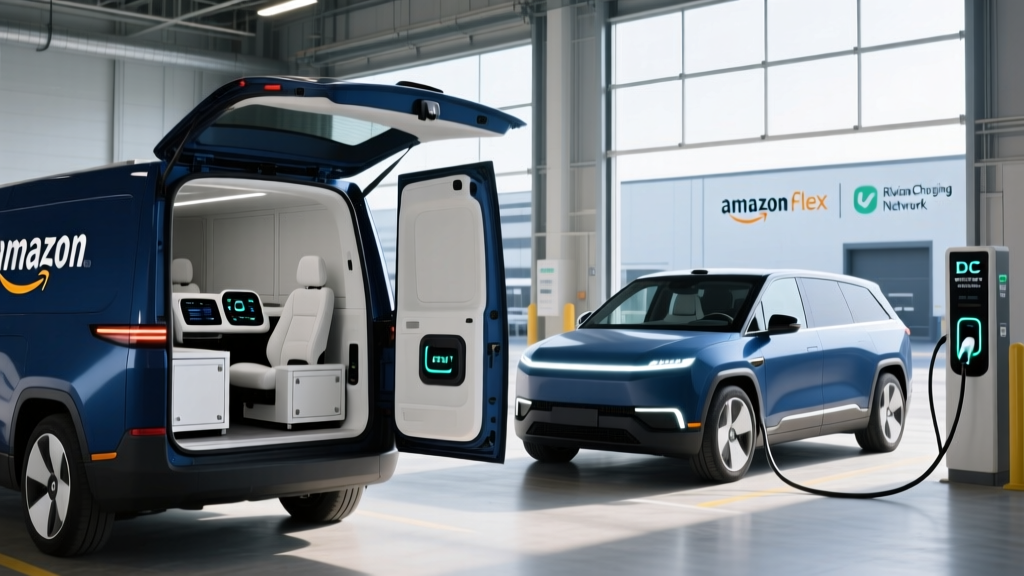
Amazon's electric vans are custom-built delivery vehicles called the Rivian EDV (Electric Delivery Van), designed exclusively for Amazon's last-mile delivery network. Built on Rivian's commercial platform at their Normal, Illinois factory, the EDV comes in three sizes — 500, 700, and 900 cubic feet of cargo volume — with an EPA-estimated range of approximately 150 miles on a single charge. Amazon has deployed over 10,000 EDVs across U.S. metro areas as of early 2026, part of a 100,000-van order placed in 2019. These vans are not available for consumer purchase; they operate exclusively within Amazon's delivery fleet through contracted Delivery Service Partners (DSPs).
The Rivian EDV: Specs, Battery, and Real-World Range
The EDV shares core skateboard architecture with the Rivian R1T and R1S but is engineered for a fundamentally different duty cycle: stop-and-go urban routes averaging 80-120 miles per day with 150+ stops. Here's what we know from fleet operator reports and Rivian's commercial disclosures:
| Specification | EDV-500 | EDV-700 | EDV-900 |
|---|---|---|---|
| Cargo Volume | ~500 cu ft | ~700 cu ft | ~900 cu ft |
| Battery Capacity (usable) | ~105 kWh (NMC lithium-ion) | ||
| EPA-Est. Range | ~150 miles (varies by configuration) | ||
| Real-World Range (loaded, urban) | ~120–140 miles | ||
| Peak DC Fast Charge | ~115 kW (CCS1) | ||
| 10–80% DC Charge Time | ~45 minutes | ||
| Level 2 Charging | ~11.5 kW (overnight depot charging) | ||
| Motors | Single rear motor, ~250 hp | ||
| Payload Capacity | ~2,500 lbs | ~3,200 lbs | ~3,800 lbs |
How the EDV Compares to Gas Delivery Vans (Cost Breakdown)
The business case for Amazon's electric vans rests on total cost of ownership (TCO), not sticker price. Commercial EVs carry higher upfront costs but dramatically lower operating expenses. Here's how the EDV stacks up against the gas-powered Mercedes-Benz Sprinter and Ford Transit — the legacy workhorses of last-mile delivery — based on fleet operator data and DOE commercial vehicle analyses:
| Cost Factor | Rivian EDV (Electric) | Gas Van (Transit/Sprinter) |
|---|---|---|
| Estimated Vehicle Cost | ~$70,000–$85,000 (fleet) | ~$40,000–$52,000 |
| Fuel/Energy Cost per Mile | ~$0.10–$0.16 (commercial electricity) | ~$0.22–$0.30 (gasoline at ~$3.40/gal, 14 MPG) |
| Annual Fuel/Energy (20,000 mi/yr) | ~$2,000–$3,200 | ~$4,400–$6,000 |
| Maintenance per Year | ~$800–$1,200 | ~$2,000–$3,500 |
| Oil Changes | None | 3–4 per year (~$300–$500) |
| Brake Wear | Minimal (regen braking) | Replacement every 30–50k mi |
| Estimated 5-Year TCO | ~$95,000–$115,000 | ~$100,000–$130,000 |
The crossover point where the EDV becomes cheaper than a gas van typically arrives around year 3 to 4 of operation, depending on local electricity rates and route density. Amazon's scale — and its ownership stake in Rivian — accelerates this payback through negotiated pricing and dedicated depot charging infrastructure.
Charging Infrastructure: How Amazon Keeps the Fleet Running
One of the most instructive aspects of Amazon's electric van deployment is how it sidesteps the public charging reliability problem entirely. EDVs don't rely on Electrify America or EVgo. Instead, Amazon has invested heavily in depot-based Level 2 charging across its delivery station network.
Here's how the charging workflow operates:
- Overnight Level 2 Charging: Each EDV plugs into an 11.5 kW Level 2 charger at its home depot after completing its route. A full charge from 10% to 100% takes approximately 9–10 hours, aligning perfectly with overnight downtime.
- Depot Infrastructure: Amazon has installed tens of thousands of Level 2 chargers at delivery stations nationwide, often requiring utility service upgrades to 480V three-phase power. Industry estimates peg Amazon's charging infrastructure investment at over $2 billion through 2025.
- DC Fast Charging (Limited Use): The EDV supports ~115 kW DC fast charging via CCS1, but Amazon primarily uses this as a midday top-up option for longer or unexpected routes, not as a daily charging method. A 10–80% session takes roughly 45 minutes.
- Route-Range Matching: Amazon's routing algorithms assign EDVs to routes that fit within their battery envelope, typically capping daily assignments at 80–120 miles to preserve a safety buffer.
This depot-charging model is the commercial equivalent of home charging for consumer EVs: predictable, controlled, and far cheaper per kWh than public DC fast charging. Commercial electricity rates at depot locations average $0.08–$0.14/kWh, compared to $0.30–$0.50/kWh at public DC fast chargers.
What Amazon's Van Strategy Means for Consumer EV Buyers
You can't buy an EDV for personal use, but Amazon's fleet deployment offers several data points relevant to consumer EV shoppers:
Battery Durability at Scale
The EDV fleet represents one of the largest real-world stress tests of NMC battery packs in commercial service. Rivian's battery warranty covers 8 years/175,000 miles for commercial vehicles, with a capacity retention threshold of 70%. Early fleet data (vans deployed in 2022–2023) suggests degradation of approximately 8–12% over the first 100,000 miles — consistent with or slightly better than consumer EV averages for NMC packs in high-cycle use. This is encouraging data for buyers of Rivian's consumer vehicles (R1T, R1S) that share similar cell chemistry and thermal management.
The Stop-and-Go Efficiency Advantage
Delivery vans average 8–12 MPG in gas form because they idle constantly and accelerate from a stop hundreds of times per day. The EDV flips this disadvantage into an advantage: regenerative braking captures kinetic energy at every stop, and electric motors don't idle. The EDV achieves roughly 2.0–2.5 kWh/mile in urban delivery use, translating to an effective 50–60 MPGe — a massive efficiency gain over gas equivalents in the same duty cycle. This is the same physics that makes consumer EVs like the Tesla Model Y or Hyundai Ioniq 5 exceptionally efficient in city driving.
Commercial EV Tax Credits
The EDV qualifies for the IRS §30D clean vehicle credit structure, though Amazon's fleet purchases are handled through the commercial clean vehicle credit (§45W) rather than the consumer credit. For small business owners considering their own electric commercial vans (like the Ford E-Transit or BrightDrop Zevo), the §45W credit offers up to $7,500 for vehicles under 14,000 lbs GVWR and up to $40,000 for heavier vehicles, with different sourcing and eligibility rules than the consumer §30D credit. Consult a tax professional for your specific situation.
Common Misconceptions About Amazon's Electric Vans
| Myth | Fact |
|---|---|
| "Amazon's vans are self-driving." | The EDV is a SAE Level 1 vehicle with standard driver-assist features (AEB, lane keeping). A human driver operates every van. Amazon's DSP drivers are behind the wheel at all times. |
| "The vans can't handle cold weather." | They operate year-round in Minneapolis, Chicago, and Boston. Range drops 20–30% in winter, so Amazon adjusts route lengths. The vans include battery thermal management to precondition the pack. |
| "Amazon is Rivian's only customer." | While Amazon holds an exclusivity period on the EDV design, Rivian's commercial van platform is expanding. In 2025, Rivian announced it would begin offering a commercial van to other fleet operators, though the exact EDV configuration remains Amazon-exclusive. |
| "Electric vans are slower and less capable." | The EDV's single rear motor delivers ~250 hp with instant torque, making it quicker off the line than a loaded gas Transit in urban driving. Payload capacity (up to ~3,800 lbs for the EDV-900) is competitive with gas equivalents. |
| "The 150-mile range isn't enough." | Average daily delivery routes run 80–120 miles. The 150-mile EPA range (with nightly depot charging) provides adequate buffer for most routes. Amazon assigns gas vans to outlier long routes. |
Decision Framework: What This Means for Your EV Purchase
If you're a consumer evaluating EVs based on Amazon's fleet data, here's how to apply the lessons:
Choose an EV with depot-style home charging if: You have a garage or driveway where you can install a Level 2 charger (240V, 30–50 amp circuit). This is the consumer equivalent of Amazon's overnight depot charging — predictable, cheap ($0.10–$0.16/kWh on residential rates), and sufficient for daily driving. Budget $500–$2,500 for a home Level 2 installation depending on panel capacity and run length.
Consider a PHEV instead if: You lack reliable home or workplace charging access, frequently drive routes exceeding 200 miles in a day, or live in an extreme cold climate where EV range loss is a daily concern. Vehicles like the Toyota RAV4 Prime (42 miles electric-only, 38 MPG gas) bridge the gap.
Choose a long-range BEV (300+ miles EPA) if: You regularly road-trip, live in a charging-desert region, or cannot install home charging but have access to workplace or public DC fast charging. The extra battery buffer compensates for cold-weather loss and highway inefficiency.
If you're a small fleet operator considering electric commercial vans: The Ford E-Transit (126-mile EPA range, ~$55,000 base) and BrightDrop Zevo 600 (272-mile range, ~$75,000+) are available now. The economics mirror Amazon's: higher upfront cost, lower per-mile operating cost, with TCO crossover at year 3–4 for high-utilization routes under 150 miles/day. Depot charging is essential — budget $3,000–$8,000 per Level 2 charger installed, plus potential utility service upgrades.
FAQ: Amazon's Electric Vans
Can I buy an Amazon Rivian EDV for personal use?
No. The EDV is built exclusively for Amazon under a contractual agreement. Rivian has indicated plans to offer a commercial van to other fleet operators starting in 2025–2026, but the specific EDV design (including the distinctive curved windshield and integrated shelf system) remains Amazon-exclusive. Consumers interested in a Rivian should look at the R1T pickup or R1S SUV.
How many Amazon electric vans are on the road?
As of early 2026, Amazon has deployed over 10,000 EDVs across the United States, with the highest concentrations in major metro areas like Los Angeles, Chicago, New York, Seattle, and Dallas. The original 2019 order was for 100,000 vans by 2030, though deployment pace has varied with Rivian's production capacity and Amazon's route electrification timeline.
Do Amazon's electric vans charge at public charging stations?
Rarely. The vast majority of ED charging happens overnight at Amazon delivery station depots using dedicated Level 2 chargers. Public DC fast charging (via CCS1 at ~115 kW) is available as a contingency for unexpected mid-day top-ups, but it's not part of the standard daily workflow. This depot model is significantly cheaper per kWh than public charging.
What happens if an EDV runs out of charge on a route?
Amazon's routing software is designed to prevent this by matching route distance to battery capacity with a safety buffer. If a van does deplete its battery, Amazon dispatches a tow to the nearest depot or charger. Fleet operators report this is rare — occurring in well under 1% of routes — and is usually caused by extreme cold combined with an unexpectedly long route or excessive HVAC usage.
Are Amazon's electric vans made by Rivian or Amazon?
The EDV is designed collaboratively but manufactured entirely by Rivian at its Normal, Illinois production facility. Amazon provided extensive input on the vehicle's ergonomics, cargo layout, and driver experience based on its DSP drivers' feedback. Rivian owns the underlying skateboard platform and battery technology. Amazon holds a significant equity stake in Rivian, though the two companies' financial relationship has evolved since the original 2019 investment.
How does the EDV's efficiency compare to gas delivery vans?
Gas-powered delivery vans like the Ford Transit and Mercedes-Benz Sprinter typically achieve 12–16 MPG in stop-and-go urban delivery use. The EDV consumes approximately 2.0–2.5 kWh per mile, which translates to roughly 50–60 MPGe. At commercial electricity rates of $0.10–$0.14/kWh, the EDV's energy cost per mile is approximately half that of a gas van at current fuel prices.
Sources: Rivian commercial vehicle disclosures, U.S. DOE fueleconomy.gov, IRS Clean Vehicle Credits, fleet operator reports. Specifications are based on publicly available data and may vary by model year and configuration.