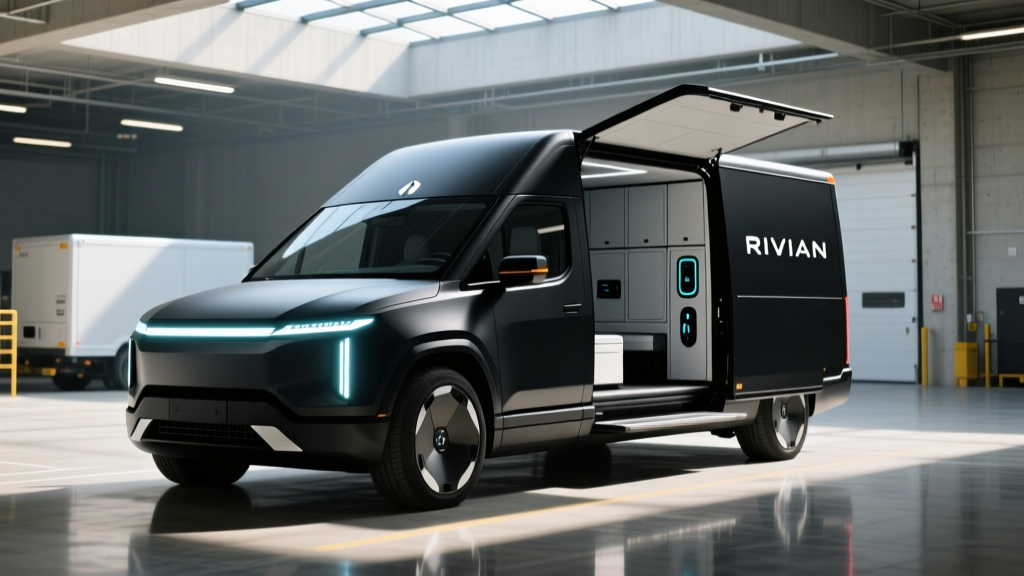
If you've spotted a boxy, bright-blue electric van zipping through your neighborhood with an Amazon smile on the grille, you've probably searched for the Amazon Rivian van name. Officially, it's the Rivian EDV — short for Electric Delivery Van — and it comes in three body lengths: the EDV-500, EDV-700, and EDV-900. Amazon holds an exclusive commercial agreement on the EDV through 2030, so this isn't a van you can walk into a dealership and buy. But as the most visible commercial EV on U.S. roads — over 20,000 deployed as of early 2026 — it deserves a serious technical profile.
Below, we break down the EDV-700 (the most common Amazon configuration) with the same rigor we apply to consumer EVs: real-world range, charging curves, battery chemistry, and the powertrain specs that matter when a van is hauling 500+ packages a day.
Spec Sheet: Rivian EDV-700 at a Glance
| Attribute | Value |
|---|---|
| EPA-Estimated Range | ~150 miles (EDV-700) |
| Battery Capacity (Usable) | ~140 kWh, NMC lithium-ion |
| Max DC Fast Charge Rate | 150 kW (peak) |
| 10–80% DC Charge Time | ~50 minutes |
| Level 2 AC Charge Rate | ~19.2 kW (~30 miles/hr) |
| Motor / Drivetrain | Single rear motor, RWD |
| Horsepower / Torque | ~275 hp / ~350 lb-ft |
| 0–60 mph | ~7.0 seconds (unladen) |
| Cargo Volume | ~560 cu ft (EDV-700) |
| Payload Capacity | ~2,500 lbs |
| Efficiency | ~2.0 kWh/mile (loaded, mixed route) |
| Warranty (Battery/Powertrain) | 8 years / 150,000 miles |
| Base MSRP (Fleet) | Not publicly listed; est. $100,000–$120,000 |
Note: Because the EDV is sold exclusively through fleet contracts, Rivian does not publish consumer MSRPs. Pricing estimates reflect industry reporting and comparable Class 2b/3 commercial EVs.
Real-World Range: What 150 EPA Miles Actually Means on a Route
Real-World Expectation: 110–130 miles fully loaded in mixed urban/suburban stop-and-go; 90–110 miles in cold weather (below 32°F) or sustained 65+ mph highway segments.
The EDV-700's ~150-mile EPA figure sounds modest next to a consumer SUV, but delivery vans live in a different efficiency universe. A fully loaded EDV-700 weighs north of 9,000 lbs GVWR, with a slab-sided aerodynamic profile that punishes highway driving. In practice, Amazon's DSPs (Delivery Service Partners) report typical daily route distances of 80–120 miles, which keeps the van comfortably within its buffer even on a cold January morning in Chicago.
Cold-weather range loss is real and documented. Rivian's thermal management system uses a liquid-cooled/heated battery pack, but NMC chemistry still sheds 20–30% range in sub-freezing temperatures, per fueleconomy.gov EV technology guidance. Amazon mitigates this by depot-charging overnight in climate-controlled facilities and by using route-optimization software that factors in state-of-charge (SoC) and weather.
Battery Chemistry and Degradation: 140 kWh of NMC
The EDV-700 uses a large-format NMC (nickel manganese cobalt) lithium-ion pack with approximately 140 kWh of usable capacity. Rivian has not publicly confirmed the cell supplier for the EDV line, though industry reporting points to Samsung SDI large-format prismatic cells.
Why NMC over LFP? Energy density. The EDV needs to pack maximum range into a chassis that already sacrifices payload to battery weight. NMC offers roughly 20–30% higher energy density than LFP at the pack level, which matters when every extra pound of battery cuts into the 2,500-lb payload ceiling.
Degradation on commercial vans is accelerated by high cycle counts — DSPs typically run the EDV six days a week, 48+ weeks a year. Rivian's 8-year/150,000-mile battery warranty guarantees at least 70% capacity retention over that period, consistent with Rivian's published warranty framework. Early fleet data from Amazon's 2023–2024 deployments suggests roughly 4–6% annual degradation under heavy use, which tracks with NMC behavior in high-cycle commercial duty.
Charging Speed: DC Fast, Level 2, and the Depot Reality
| Charging Level | Power (kW) | Miles Added per Hour | Notes |
|---|---|---|---|
| Level 1 (120V) | ~1.4 kW | ~0.7 mi/hr | Not practical for fleet use |
| Level 2 (240V AC) | ~19.2 kW | ~30 mi/hr | Primary depot overnight charging |
| DC Fast Charge | 150 kW (peak) | ~150 mi/hr (peak) | 10–80% in ~50 min; tapers above 80% |
The EDV uses a CCS1 connector for DC fast charging, not NACS. Amazon's depot chargers are predominantly Level 2 (19.2 kW AC), which replenishes the 140 kWh pack from 20% to 100% in roughly 6 hours — ideal for overnight turnaround. DC fast charging at 150 kW peak is available for mid-route top-ups, but the charge curve tapers significantly above 80% SoC to protect the NMC cells. Expect 10–80% in about 50 minutes under optimal thermal conditions, with the final 20% taking an additional 30+ minutes.
One underappreciated detail: the EDV's large battery means even a "slow" 19.2 kW Level 2 connection delivers meaningful range per hour (~30 miles), because the charge rate relative to pack size (C-rate) is gentle. This is easier on long-term battery health than frequent DC fast charging, which is why Amazon's depot strategy leans heavily on overnight L2.
Performance and Drivetrain: Single-Motor RWD Built for Torque
The EDV-700 uses a single rear-mounted permanent-magnet motor producing approximately 275 hp and 350 lb-ft of torque, driving the rear wheels. Unlike Rivian's consumer R1T and R1S (which offer dual- and quad-motor AWD), the EDV is strictly RWD — a deliberate choice to reduce cost, weight, and mechanical complexity in a vehicle that never sees off-road duty.
The 0–60 mph time of roughly 7.0 seconds (unladen) is irrelevant for a delivery van, but low-end torque matters for merging onto highways with a full load. The EDV's instant electric torque makes it noticeably quicker off the line than the gas-powered Mercedes-Benz Sprinter or Ram ProMaster it replaces on Amazon routes. Regenerative braking is aggressive — DSP drivers report near-one-pedal driving in stop-and-go urban neighborhoods, which reduces brake wear substantially.
Cargo Space, Dimensions, and the Three EDV Variants
Rivian builds the EDV in three lengths, all on the same skateboard-style platform:
- EDV-500: ~210 inches long, ~360 cu ft cargo volume — used for dense urban routes
- EDV-700: ~260 inches long, ~560 cu ft cargo volume — the most common Amazon configuration
- EDV-900: ~305 inches long, ~770 cu ft cargo volume — deployed on suburban/rural routes with bulkier packages
The EDV-700's cargo area is roughly 10 feet long, 6 feet wide (between wheel wells), and over 6 feet tall — enough for a driver to stand upright and walk through the van. A full-height bulkhead separates the cargo area from the cab, and the passenger-side curb-access door is extra-wide for rapid package retrieval. Amazon reports the EDV-700 handles roughly 500–700 packages per load on a typical delivery day.
Pricing, Tax Credits, and Why You Can't Buy One (Yet)
| Item | Detail |
|---|---|
| Estimated Fleet Unit Price | $100,000–$120,000 |
| Consumer MSRP | Not available (Amazon exclusivity through 2030) |
| IRS §30D Federal Tax Credit | Up to $7,500 for qualifying commercial purchasers (subject to battery sourcing & critical-mineral rules) |
| Commercial Clean Vehicle Credit (§45W) | Up to $7,500 for vehicles under 14,000 lbs GVWR; up to $40,000 for heavier classes — fleet operators may claim this instead of §30D |
| Consumer Availability | None currently; Rivian has signaled a consumer van variant post-2027 |
The Amazon Rivian van isn't purchasable by individual consumers. Amazon's exclusivity deal runs through at least 2030, and Rivian's Normal, Illinois factory dedicates a full production line to EDV output. However, the IRS §30D clean vehicle credit and the parallel §45W commercial credit do apply to fleet purchasers, offsetting up to $7,500–$40,000 per unit depending on GVWR and battery-sourcing compliance.
For consumers hoping for a Rivian van of their own: Rivian CEO RJ Scaringe has confirmed that a consumer-oriented van (potentially on a smaller, lower-cost platform) is in long-term planning, but no production timeline, pricing, or specs have been announced. Any "Rivian consumer van" article citing a price or release date before 2027 is speculative.
Standout Tech and Notable Drawbacks
Strengths
- Purpose-built for delivery: Low step-in height, walk-through bulkhead, curb-side access door — all designed with DSP driver input
- Driver-focused cockpit: 15.3-inch infotainment screen, integrated route navigation, 360-degree camera system
- ADAS suite: Forward collision warning, automatic emergency braking, lane-keeping assist (SAE Level 1 — driver must remain fully engaged)
- Regen braking: Near-one-pedal operation in urban stop-and-go reduces brake wear and energy consumption
- Fleet telematics: Real-time SoC, route optimization, and predictive maintenance via Rivian's fleet software platform
Drawbacks
- Not available to consumers: Amazon exclusivity blocks individual purchase through at least 2030
- Range limited to ~150 miles: Sufficient for last-mile but impractical for regional or long-haul routes
- Cold-weather range loss: 20–30% reduction in sub-freezing temps, requiring route planning adjustments
- CCS1 connector: As the industry shifts to NACS, CCS infrastructure may see relative underinvestment
- Heavy curb weight: ~7,500 lbs empty, reducing payload margin and increasing tire wear
Who the Rivian EDV Suits (and Who Should Look Elsewhere)
The EDV is engineered for one use case: high-frequency, last-mile delivery in urban and suburban environments. If you operate a delivery fleet under contract with Amazon (or anticipate Rivian opening EDV sales to other fleets post-2030), the EDV-700 offers lower per-mile energy cost (~$0.08–$0.12/mile depending on utility rates), dramatically less brake and drivetrain maintenance than a gas Sprinter, and a driver experience that reduces fatigue over a 10-hour shift.
If you're a consumer looking for a personal electric van for road trips, camping conversions, or family hauling — the EDV is not your vehicle. Watch for Rivian's anticipated consumer van announcement (likely post-2027), and in the meantime, consider the Ford E-Transit (126-mile EPA range, available to consumers and fleets) or the upcoming Canoo Lifestyle Vehicle if and when it reaches production.
Frequently Asked Questions
What is the official Amazon Rivian van name?
The van is officially called the Rivian EDV (Electric Delivery Van). It comes in three sizes: EDV-500, EDV-700, and EDV-900. The EDV-700 is the most widely deployed variant in Amazon's fleet.
What is the real-world range of the Rivian EDV-700?
The EPA-estimated range is approximately 150 miles. In real-world delivery use with a full load, expect 110–130 miles in moderate weather and 90–110 miles in freezing temperatures or sustained highway driving.
How fast does the EDV charge at home and on DC fast chargers?
At Level 2 (19.2 kW AC), the EDV adds about 30 miles of range per hour, fully charging overnight in ~6 hours from 20%. On a 150 kW DC fast charger, 10–80% takes approximately 50 minutes, with significant taper above 80%.
Can I buy a Rivian EDV as a private consumer?
No. Amazon holds exclusive rights to the EDV through at least 2030. Rivian has hinted at a consumer van variant for the future, but nothing has been formally announced with pricing or a release date.
Does the Rivian EDV qualify for the federal EV tax credit?
Fleet purchasers may qualify for up to $7,500 under the IRS §30D credit or up to $40,000 under the §45W Commercial Clean Vehicle Credit, depending on GVWR and battery-sourcing compliance. Individual consumers cannot currently purchase the EDV, so personal credit eligibility is moot. Consult a tax professional for current-year rules, as IRS credit requirements change annually.
What battery chemistry does the EDV use?
The EDV-700 uses an NMC (nickel manganese cobalt) lithium-ion pack with approximately 140 kWh of usable capacity. NMC was chosen for its higher energy density, which is critical in a heavy commercial vehicle where payload capacity is at a premium.
Is the Rivian EDV self-driving?
No. The EDV's driver-assistance features (forward collision warning, lane-keeping, AEB) are classified as SAE Level 1 — the driver must remain fully engaged and in control at all times. There is no autonomous or Level 4 capability.