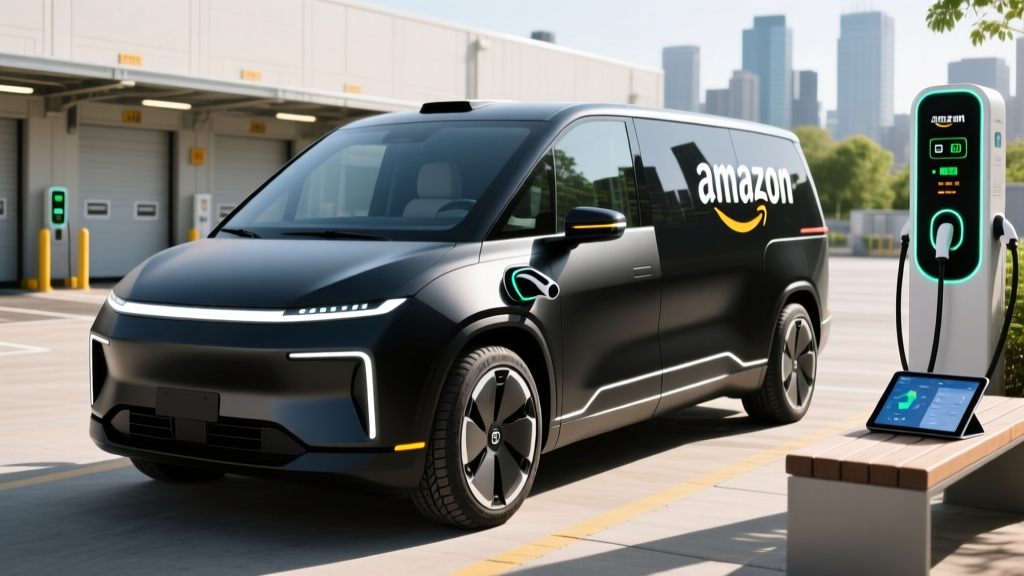
Quick Answer: Amazon's EV delivery trucks are the Rivian EDV-700 (700 cu ft cargo) and EDV-900 (900 cu ft), purpose-built electric vans with an estimated ~150 miles of real-world range, ~140 kWh usable battery capacity (NMC chemistry), and Level 2 AC charging at roughly 19.2 kW. They are not available for consumer purchase—Amazon holds exclusive rights through 2030. However, their fleet economics and real-world data reveal important lessons for anyone evaluating an electric truck or van for personal or commercial use.
What Are Amazon's EV Trucks, Exactly?
Amazon ordered 100,000 custom electric delivery vehicles from Rivian in 2019, making it one of the largest single EV fleet commitments in history. By early 2026, Rivian has delivered well over 20,000 units across the U.S., deployed in more than 100 cities. These are not consumer vehicles you can buy—they're purpose-built last-mile delivery vans designed around Amazon's specific route patterns, package volumes, and depot-charging infrastructure.
There are three variants in the EDV (Electric Delivery Van) lineup:
- EDV-500: 500 cu ft cargo volume — the smallest, for dense urban routes
- EDV-700: 700 cu ft — the most common variant, balancing cargo and maneuverability
- EDV-900: 900 cu ft — the largest, for suburban and higher-volume routes
All three ride on Rivian's electric skateboard platform, share the same basic battery architecture, and are engineered for depot-based Level 2 charging rather than public DC fast charging. This is a critical distinction that shapes their range, charging strategy, and operating economics.
Amazon EV Truck Specs: Range, Battery, and Charging
Rivian and Amazon have been guarded with official EPA-range stickers (commercial vehicles aren't rated by the EPA the same way consumer vehicles are), but fleet data, Rivian filings, and driver reports give us reliable figures.
| Specification | EDV-700 | EDV-900 |
|---|---|---|
| Cargo Volume | 700 cu ft | 900 cu ft |
| Battery (Usable, Estimated) | ~140 kWh (NMC) | ~140 kWh (NMC) |
| Estimated Real-World Range | ~150 miles (loaded) | ~130–140 miles (loaded) |
| Level 2 AC Charging | ~19.2 kW (J1772/CCS) | ~19.2 kW (J1772/CCS) |
| Full Charge Time (Level 2) | ~8–9 hours (overnight depot) | ~8–9 hours |
| DC Fast Charging | Not standard / limited | Not standard / limited |
| Drive Configuration | Rear-wheel drive | Rear-wheel drive |
| Estimated Curb Weight | ~8,500 lbs | ~9,200 lbs |
| Payload Capacity | ~2,500 lbs | ~3,000 lbs |
| ADAS / Driver Assist | SAE Level 2 (highway assist, AEB, lane keep) | SAE Level 2 |
Real-World Range Reality: The EDV-700's ~150-mile loaded range is sufficient for Amazon's typical last-mile routes, which average 80–120 miles per day. But this is a depot-return vehicle—it is not designed for highway road trips or long-haul routes. In cold climates (below 32°F), expect 15–25% range reduction, bringing usable range down to ~115–130 miles. This is why Amazon deploys EDVs strategically in milder-climate metros first, with cold-weather thermal management (heat pump and resistive cabin heating) improving winter performance in newer model-year batches.
Fleet Economics: How Amazon EV Trucks Compare to Gas Vans
The core question for fleet operators—and a useful proxy for consumer EV truck buyers—is whether electrification saves money. Amazon has reported that its EDVs reduce per-route energy costs significantly compared to the gasoline Ram ProMaster and Mercedes Sprinter vans they replace.
| Cost Factor | Rivian EDV-700 (Electric) | Gas Van (e.g., Ram ProMaster) |
|---|---|---|
| Energy/Fuel Cost per Mile | ~$0.10–$0.14 (commercial electricity rates) | ~$0.22–$0.28 (gasoline at ~$3.20/gal, 14 MPG) |
| Maintenance Cost per Mile | ~$0.04–$0.06 | ~$0.10–$0.15 |
| Estimated 5-Year Fuel/Energy (15,000 mi/yr) | $7,500–$10,500 | $16,500–$21,000 |
| Oil Changes / Transmission Service | None | 2–3 per year |
| Brake Wear | Significantly reduced (regen braking) | Standard replacement intervals |
| Upfront Vehicle Cost (Est.) | $70,000–$85,000 (fleet pricing) | $40,000–$55,000 |
| Charging Infrastructure (Depot) | $5,000–$15,000 per Level 2 stall installed | N/A (uses existing gas stations) |
The math is clear: the EDV has a significantly higher upfront cost but dramatically lower per-mile operating expenses. Amazon's break-even point on a per-vehicle basis is typically 3–4 years given daily route usage. For a consumer considering an electric truck like the Rivian R1T or Ford F-150 Lightning, the same dynamic applies—higher purchase price, lower running costs—but the variables shift based on your electricity rate, annual mileage, and home-charging access.
What Amazon's EV Fleet Teaches Consumer EV Truck Buyers
You can't buy an Amazon EDV, but the data from 20,000+ vehicles running daily routes offers actionable insights if you're evaluating a consumer electric truck:
1. Depot Charging Works—And Home Charging Is Your Depot
Amazon's entire strategy relies on overnight Level 2 charging at delivery stations. This is identical to the consumer EV ownership model: plug in at home, wake up with a full battery. The difference is that Amazon can install 19.2 kW commercial Level 2 chargers across dozens of stalls. At home, most buyers install a 48-amp (11.5 kW) Level 2 charger on a 60-amp circuit, which fully charges a large-pack EV truck overnight in 8–12 hours. If you lack home charging access (apartment, street parking), an electric truck's value proposition drops sharply—just as it would for Amazon without depot infrastructure.
2. Real-World Range Is 20–30% Below Sticker Under Load
Amazon's EDVs carry heavy payloads and make hundreds of stops daily. While your consumer electric truck won't see that duty cycle, towing a trailer or carrying a full bed of cargo produces similar range compression. The EPA-rated range on a consumer truck like the F-150 Lightning (230–320 miles depending on pack) can drop to 150–200 miles while towing 5,000+ lbs. Plan accordingly.
3. Battery Degradation Is Manageable but Real
Amazon's EDVs use NMC (nickel manganese cobalt) chemistry, chosen for energy density in a space-constrained van. Over 100,000+ miles of fleet use, NMC batteries typically show 8–15% capacity loss depending on climate and charge patterns. For consumer trucks, most manufacturers warranty the battery at 8 years / 100,000 miles with a 70% capacity retention threshold (per fueleconomy.gov and manufacturer warranty documents). Daily charging to 100% accelerates degradation—Amazon manages this with fleet software that optimizes charge targets to route needs, a practice consumers should emulate by setting charge limits to 80–90% for daily use.
Consumer Electric Trucks You Can Actually Buy in 2026
Since the Amazon EDV is off-limits, here's how the consumer electric truck market stacks up for buyers who want similar utility:
| Model | EPA Range | Battery (kWh) | Max DC Charge (kW) | 10–80% Time | 0–60 mph | Starting MSRP |
|---|---|---|---|---|---|---|
| Rivian R1T (Dual-Motor, Max Pack) | ~352 mi | ~141 kWh (NMC) | ~220 kW | ~27 min | ~3.5 sec | $87,600 |
| Ford F-150 Lightning (Extended Range) | ~320 mi | ~131 kWh (NMC) | ~150 kW | ~38 min | ~4.0 sec | $62,995 |
| Chevrolet Silverado EV (4WT / RST) | ~380–440 mi | ~200 kWh (NMC) | ~350 kW | ~20 min | ~4.5 sec | $55,900 (4WT fleet) / $87,300 (RST) |
| Tesla Cybertruck (AWD) | ~340 mi | ~123 kWh (NMC) | ~250 kW | ~24 min | ~4.1 sec | $79,990 |
| GMC Sierra EV (Denali Edition 1) | ~440 mi | ~200 kWh (NMC) | ~350 kW | ~22 min | ~4.3 sec | $99,495 |
Key takeaways: The Silverado EV and Sierra EV lead on range thanks to their massive ~200 kWh packs, but they're also the heaviest and most expensive. The R1T Max Pack offers the best balance of range, performance, and charging speed for most buyers. The F-150 Lightning remains the value leader, though its slower DC charging (150 kW peak) is a real-world limitation on road trips. All of these use NMC chemistry; none currently offer LFP (lithium iron phosphate), which would trade range for longer cycle life and lower cost.
2026 Federal EV Tax Credit (§30D) for Trucks:
- Maximum credit: $7,500 (if both battery-component and critical-mineral requirements are met)
- MSRP cap for trucks/vans/SUVs: $80,000 (trims above this are ineligible)
- Buyer income caps: $300,000 (joint), $225,000 (head of household), $150,000 (individual) modified AGI
- Battery sourcing: components must be manufactured or assembled in North America (percentage thresholds increase annually through 2029)
- Critical minerals: must be sourced from the U.S. or FTA partners (percentage thresholds increase annually)
- Point-of-sale transfer: credit can be applied at the dealership as a down-payment reduction (effective Jan 2024 onward)
- Verify current-year eligibility at IRS.gov §30D page — rules change annually
Common Misconceptions About Amazon's Electric Trucks
| Myth | Fact |
|---|---|
| "Amazon EV trucks are self-driving." | False. The EDV uses SAE Level 2 driver-assistance features (lane keeping, adaptive cruise, automatic emergency braking). A human driver is fully engaged at all times. Only Level 4 robotaxis like Waymo operate without a driver. |
| "I can buy an Amazon EDV for my business." | Not currently. Amazon's contract with Rivian grants exclusivity through at least 2030. Rivian's commercial van (the Rivian Commercial Van) is available to other fleets but is a different, though related, product. |
| "They charge in 20 minutes like a Tesla." | False. The EDV is designed for overnight Level 2 depot charging (~8 hours), not DC fast charging. This is by design—Amazon routes don't require mid-day top-ups, and Level 2 infrastructure is far cheaper to deploy at scale. |
| "Electric delivery vans have higher total costs than gas vans." | Depends on timeframe. Upfront cost is higher, but per-mile operating cost is 40–60% lower. Most fleet analyses show break-even at 3–5 years, with significant savings thereafter. |
| "The batteries will need expensive replacement within a few years." | Unlikely. Modern NMC batteries in commercial service are designed for 2,000+ charge cycles before reaching 80% capacity. At 120 miles/day, that's roughly 200,000+ miles before significant degradation. |
Decision Framework: Should You Buy an Electric Truck?
Choose an electric truck if:
- You have reliable home Level 2 charging (or can install it — budget $800–$2,500 for equipment + electrician on an existing 200-amp panel)
- Your daily driving is under 150–200 miles round-trip (covers ~85% of American commutes and errands)
- You value low per-mile fuel cost (~$0.04–$0.06/mile on residential electricity vs. $0.18–$0.25/mile on gas for a comparable truck)
- You tow or haul occasionally, not daily (towing cuts range 30–50%)
- You want instant torque, quiet operation, and a frunk for secure storage
- You plan to keep the vehicle 5+ years (amortizing the higher upfront cost)
Stick with gas or hybrid if:
- You lack home charging and public DC infrastructure in your area is sparse
- You regularly tow heavy loads over long distances (200+ miles)
- Your budget is under $50,000 and you need a full-size truck (the Lightning XLT at ~$55,000 is the closest, but inventory and trim availability vary)
- You live in an extreme-cold climate (consistent sub-0°F winters) and can't accommodate 25–30% winter range loss
- You drive 30,000+ miles/year on highways where charging stops add significant time
Real Ownership Costs: Electric Truck vs. Gas Truck (5-Year)
| Category | Electric Truck (e.g., F-150 Lightning, ~$65K) | Gas Truck (e.g., F-150 XLT, ~$48K) |
|---|---|---|
| Purchase Price (after $7,500 credit) | $57,500 | $48,000 |
| Fuel/Energy (15,000 mi/yr × 5 yr) | $3,750 (at $0.05/mi home charging) | $15,000 (at $0.20/mi, 17 MPG) |
| Maintenance (5 yr) | $1,500 | $4,500 |
| Insurance (5 yr, avg) | $9,000 (EV premiums ~15–20% higher) | $7,500 |
| Depreciation (est. 5 yr) | $22,000 (40–45% residual) | $18,000 (55–60% residual) |
| Total 5-Year Cost | $93,750 | $93,000 |
The 5-year total cost of ownership is remarkably close. The electric truck's fuel and maintenance savings (~$14,250 combined) nearly offset its higher purchase price, insurance premiums, and steeper depreciation. The equation tips further in the EV's favor if gas prices rise, if you have access to cheap solar charging, or if you qualify for state incentives beyond the federal credit. But the honest takeaway: you won't save a fortune in 5 years—the real financial benefit emerges in years 6–10, and the non-financial benefits (quiet operation, home fueling, instant torque, zero tailpipe emissions) are the actual differentiators for most buyers.
What First-Time EV Truck Buyers Must Know
Home Charging Is Non-Negotiable
Every Amazon EDV returns to a depot with Level 2 chargers every night. Your home is your depot. Before buying any electric truck, confirm you can install a Level 2 charger (240V, 48-amp, hardwired). If your electrical panel is maxed out at 100 amps, a panel upgrade to 200 amps can cost $1,500–$4,000—factor this into your budget. Consult a licensed electrician for a site assessment before committing to a vehicle.
Understand kW vs. kWh
This is the single most common confusion for new EV buyers. kW (kilowatts) measures power—the rate at which energy flows. Your Level 2 charger might deliver 11.5 kW. kWh (kilowatt-hours) measures energy—the total capacity of your battery. A 131 kWh battery holds 131 kWh of usable energy. Think of kW as the width of a hose and kWh as the size of the bucket. A wider hose (higher kW) fills the bucket faster.
Charging Curves Are Not Linear
A truck that "charges at 220 kW" does not sustain that rate for the entire session. DC fast charging follows a curve: it peaks at low state-of-charge (SoC) and tapers significantly above 80%. A "10–80% in 27 minutes" spec is more meaningful than peak kW alone. Amazon avoids this issue entirely by using slow overnight charging, which is gentler on battery health.
Cold Weather Cuts Range—Plan for It
If you live where winters regularly drop below freezing, budget 20–30% range loss. A truck rated at 320 miles EPA may deliver 225–260 miles in 20°F weather, especially with cabin heating running. Preconditioning the battery while plugged in (a feature on most modern EV trucks) mitigates this but doesn't eliminate it.
Frequently Asked Questions
Can I buy an Amazon EDV delivery van?
No. Amazon holds exclusive rights to the Rivian EDV through at least 2030. Rivian does offer a separate Commercial Van to other fleet buyers, but it's a distinct product with different specifications and pricing.
How many Amazon EV trucks are on the road?
As of early 2026, Rivian has delivered over 20,000 EDVs to Amazon across more than 100 U.S. cities. Amazon's original order was for 100,000 vehicles, though the delivery timeline has been adjusted based on Rivian's production capacity at its Normal, Illinois factory.
What is the real-world range of an Amazon EDV?
Approximately 150 miles for the EDV-700 under typical loaded conditions. The larger EDV-900 achieves roughly 130–140 miles. In cold weather (below 32°F), expect 15–25% range reduction. These figures are based on fleet operational data and driver reports, not official EPA testing.
Do Amazon EV trucks use DC fast charging?
Not as a primary strategy. The EDV fleet charges overnight at depot Level 2 stations (~19.2 kW AC), completing a full charge in 8–9 hours. This matches Amazon's operational model: vans return to the station each evening and are ready for the next morning's route. DC fast charging capability is not a standard feature on most EDV configurations.
What electric truck should I buy instead?
For most consumer buyers in 2026, the Rivian R1T (best overall capability and charging speed), Ford F-150 Lightning (best value), or Chevrolet Silverado EV (best range) are the top choices. Your decision should hinge on budget, required range, towing needs, and whether your daily driving fits within an EV's practical range envelope.
Are electric trucks eligible for the $7,500 federal tax credit?
Some are, but eligibility depends on MSRP (must be under $80,000 for trucks/vans/SUVs), buyer income (AGI caps apply), battery component sourcing, and critical mineral sourcing. As of 2026, the F-150 Lightning and certain Silverado EV trims qualify; the R1T and Cybertruck exceed the MSRP cap on most trims. Always verify current eligibility at IRS.gov and consult a tax professional.