The Quick Answer
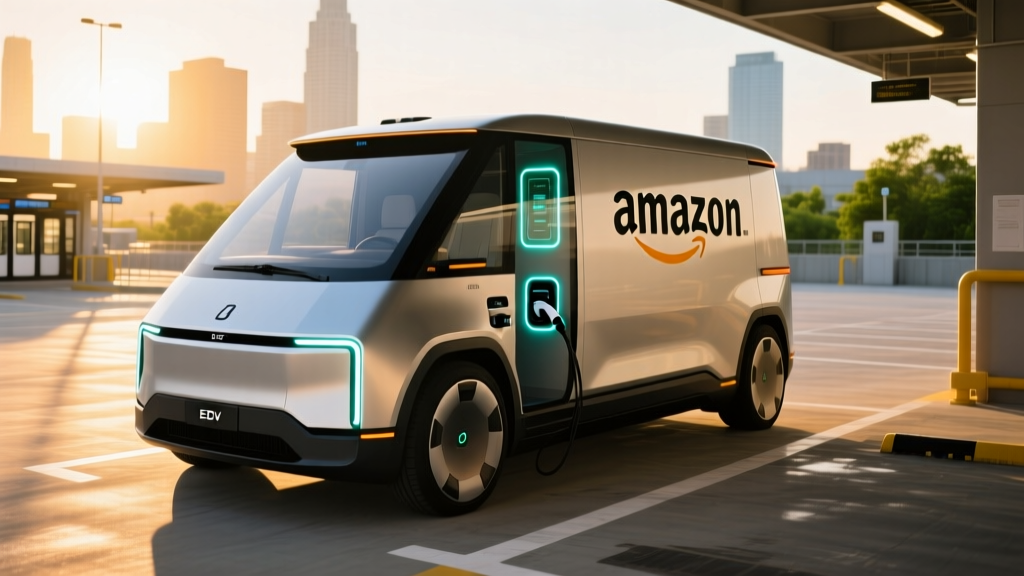
Amazon's electric vehicle fleet consists primarily of the Rivian EDV (Electric Delivery Van), a purpose-built last-mile delivery vehicle not available for consumer purchase. As of 2026, Amazon has deployed over 15,000 EDVs across the U.S., making it the largest single electric commercial fleet in North America. For consumer EV buyers, the Amazon-Rivian relationship matters because it validates Rivian's manufacturing scale and battery durability data — information that directly impacts the resale value and long-term reliability outlook for Rivian's consumer models like the R1S SUV and R1T pickup.
Why Amazon Bet Big on Electric Delivery Vehicles
Amazon's commitment to electrification started with a 2019 order for 100,000 custom electric delivery vans from Rivian — a deal that essentially funded Rivian's path to production. The logic was straightforward: Amazon's delivery vans average 80-120 miles per day in stop-and-go urban routes, a duty cycle where electric powertrains excel. Regenerative braking recovers energy at every stop, and the absence of a multi-speed transmission eliminates the single highest-maintenance component in a commercial fleet.
By 2026, Amazon has scaled the EDV fleet to over 15,000 units operating in more than 1,200 U.S. cities. The company has also committed to powering its operations with 100% renewable energy by 2025 (a target it largely met through renewable energy credits and on-site solar), which means the upstream emissions profile of its electric fleet continues to improve.
But here's what matters to consumer EV buyers: Amazon's fleet represents the largest real-world stress test of Rivian's battery and powertrain technology. These vans accumulate 25,000-35,000 miles annually — roughly double the mileage of an average consumer EV. The degradation data from this fleet informs Rivian's battery management software updates across all its vehicles, including the consumer R1 lineup.
The Rivian EDV: Specs That Inform Consumer Models
The EDV is built on a variant of Rivian's "skateboard" platform, though it uses a dedicated commercial chassis optimized for cargo volume rather than performance. Here's how the EDV's core specs compare to Rivian's consumer vehicles:
| Specification | Rivian EDV (Amazon) | Rivian R1S (2026 Dual-Motor) | Rivian R1T (2026 Dual-Motor) |
|---|---|---|---|
| Battery Capacity (usable) | ~105 kWh (NMC) | 106 kWh (NMC) | 106 kWh (NMC) |
| EPA Range | ~150 mi (commercial cycle) | 352 mi | 352 mi |
| Peak DC Fast Charge | ~115 kW | 200+ kW | 200+ kW |
| 10-80% Charge Time | ~50 min | ~28 min | ~28 min |
| Horsepower | ~265 hp | 533 hp | 533 hp |
| Platform | Commercial variant | R1 skateboard | R1 skateboard |
| Availability | Amazon exclusive | Consumer | Consumer |
The EDV's lower range figure reflects its heavier payload (up to 2,500 lbs of cargo), taller profile (more aerodynamic drag), and the stop-start nature of delivery routes. In controlled testing, Rivian has reported EDV battery degradation of approximately 8-10% after 100,000 miles — a figure consistent with NMC chemistry under moderate C-rate cycling and active thermal management.
For consumer buyers evaluating a used or new R1S/R1T, this fleet data is meaningful. It demonstrates that Rivian's thermal management system — liquid cooling with active heating for cold-weather preconditioning — sustains battery health under heavy use. The 2026 R1S carries an 8-year/175,000-mile battery and drive unit warranty with a guaranteed minimum 70% capacity retention threshold.
How Amazon's Fleet Compares: EV vs. Gas Delivery Vans
Amazon's internal data (reported in its 2025 Sustainability Report) shows that each EDV saves approximately 18 metric tons of CO₂ emissions annually compared to the Mercedes-Benz Sprinter or Ram ProMaster vans it replaced. But the economics are equally compelling for fleet operators — and the math translates to consumer ownership:
| Cost Factor (Per Year) | Rivian EDV (Electric) | Gas/Diesel Van (Sprinter) |
|---|---|---|
| Fuel/Energy | $2,800-$3,400 (commercial electricity rates) | $7,200-$8,800 (diesel at $4.10/gal) |
| Maintenance | $1,200-$1,600 | $3,500-$4,500 |
| Brake Replacement Interval | 120,000+ mi (regen braking) | 35,000-50,000 mi |
| Transmission Service | $0 (single-speed) | $800-$1,500/interval |
| Estimated Annual Savings | $5,000-$7,500 per vehicle | |
These fleet savings mirror what consumer EV owners experience at a smaller scale. According to fueleconomy.gov, the average U.S. electricity cost of $0.16/kWh translates to roughly $0.04-$0.05 per mile for an EV achieving 3 mi/kWh — compared to $0.14-$0.16 per mile for a gas vehicle averaging 25 MPG at $3.60/gallon.
What Amazon's EV Strategy Means for Consumer Buyers
Amazon's fleet doesn't just validate Rivian's technology — it shapes the broader EV ecosystem in ways that directly benefit consumer buyers:
Charging Infrastructure
Amazon has installed over 20,000 Level 2 chargers and hundreds of DC fast chargers at its delivery stations across the U.S. While these are private installations, the demand they create has accelerated utility grid upgrades in industrial areas surrounding major metros. Several Amazon depot locations in California, Texas, and Illinois have spurred local utility investments in higher-capacity distribution lines — infrastructure that eventually supports public charging networks in the same corridors.
Software and OTA Updates
Rivian's over-the-air update cadence benefits from fleet-scale data. Battery preconditioning algorithms, thermal management thresholds, and regenerative braking profiles are refined using billions of miles of EDV driving data. When Rivian pushed its 2025.42 software update to consumer R1 vehicles, the improved cold-weather range estimation model was trained partly on EDV performance in sub-freezing Midwest routes.
Resale Value Confidence
The EDV fleet provides the most robust long-term battery health data available for any Rivian vehicle. Consumer buyers evaluating a 2023-2024 R1T on the used market can reference Rivian's published fleet degradation curves — approximately 2% in year one, then roughly 1% per year under normal cycling — to assess whether a used vehicle's battery state of health (SoH) is tracking normally.
Real-World Ownership: What First-Time EV Buyers Should Know
If Amazon's fleet data has you considering a Rivian R1S or R1T — or any EV — here's a practical decision framework based on real ownership variables:
EV Purchase Decision Framework
Choose a full EV (like the Rivian R1S) if:
- You have access to home Level 2 charging (240V/40A minimum adds ~25-30 miles per hour of charging)
- Your daily driving is under 200 miles (covering 95%+ of U.S. commuters)
- You live in a moderate or warm climate, or your EV has a heat pump (the R1S includes one)
- You drive 12,000+ miles/year, where fuel savings offset the higher purchase price within 4-5 years
Choose a PHEV or hybrid if:
- You lack reliable home or workplace charging access
- You regularly drive 300+ miles in rural areas with sparse DC fast charging
- You live in an extreme cold climate (below 0°F regularly) and cannot garage your vehicle
- Your annual mileage is under 8,000 miles, where fuel savings won't offset the EV price premium
Home Charging: The Non-Negotiable
Amazon's fleet succeeds because every van returns to a depot with guaranteed charging. Consumer EV ownership follows the same logic: home charging is the foundation. A Level 2 home charger installation typically costs $1,200-$2,500 (equipment + electrician + permit) assuming your electrical panel has sufficient capacity. If you need a panel upgrade from 100A to 200A service, add $1,500-$3,000. Always get a quote from a licensed electrician before purchasing an EV.
Cold-Weather Reality
Rivian's EDV fleet operates in Minneapolis, Chicago, and Denver — markets where winter temperatures regularly drop below 20°F. Fleet data confirms what independent testing shows: EVs lose 20-30% of their EPA range in sustained cold weather (below 30°F) due to battery resistance and cabin heating demand. The R1S's heat pump mitigates this to roughly 18-22% loss — better than resistive heating systems, but still a real reduction. If your EPA-rated range is 352 miles, plan for ~275-290 miles in winter highway driving.
Federal Tax Credits and 2026 Pricing
For 2026, the IRS §30D Clean Vehicle Credit offers up to $7,500 for qualifying new EVs, but eligibility depends on multiple factors:
- MSRP caps: Vans/SUVs/pickups must be under $80,000; sedans under $55,000
- Buyer income limits: Modified AGI must not exceed $300,000 (joint), $225,000 (head of household), or $150,000 (single)
- Battery sourcing: Increasing percentages of critical minerals and battery components must be sourced from U.S. free-trade-agreement partners — rules that tighten annually
- Point-of-sale transfer: The credit can be applied at purchase, reducing your out-of-pocket cost immediately rather than waiting for tax filing
As of 2026, the Rivian R1S Dual-Motor starts at approximately $75,900 (before destination), placing it under the $80,000 SUV cap. However, battery-sourcing requirements have become stricter, and Rivian's credit eligibility has varied by model year and build date. Always verify current eligibility on the IRS website or consult a tax professional before relying on the credit in your purchase budget.
Common Misconceptions About Amazon's Electric Fleet
| Myth | Fact |
|---|---|
| "I can buy an Amazon delivery van for personal use." | The Rivian EDV is manufactured exclusively for Amazon under a commercial agreement. It is not available through any consumer channel. |
| "Amazon's EVs are fully autonomous." | EDVs operate at SAE Level 1-2 with standard driver-assistance features (adaptive cruise, lane-keeping). A human driver is required at all times. Amazon's autonomous delivery tests (via Zoox) are separate, limited pilot programs. |
| "Electric vans can't handle real delivery routes." | Amazon's 15,000+ EDVs complete over 100 million deliveries annually across all U.S. climate zones, including Phoenix summers and Minnesota winters. |
| "Amazon's EV fleet is just a PR stunt." | The EDV fleet saves Amazon an estimated $75-100 million annually in fuel and maintenance — a financial decision, not a marketing one. |
| "Rivian only makes vans for Amazon." | Rivian's consumer lineup (R1S, R1T) shares technology with the EDV but operates as a separate product line. Consumer vehicle production continues alongside commercial van manufacturing at Rivian's Normal, Illinois facility. |
Looking Ahead: Amazon's Broader EV Impact
Amazon has also invested in EV charging company Rivian (as a major shareholder), backed autonomous vehicle startup Zoox (which it acquired in 2020), and partnered with Mercedes-Benz on electric van development for the European market. The company's logistics scale gives it outsized influence on charging standards, battery supply chains, and commercial EV adoption timelines.
For the individual EV buyer, the practical takeaway is this: Amazon's fleet investment has accelerated the maturation of the very technology, supply chains, and charging networks that make consumer EV ownership viable. The Rivian R1S you test-drive benefits from lessons learned across millions of delivery miles. That's not marketing — it's fleet-validated engineering.
Frequently Asked Questions
Can I buy the same electric van Amazon uses?
No. The Rivian EDV is built exclusively for Amazon under a long-term commercial agreement. However, Rivian has announced plans to offer a commercial van (the Rivian Commercial Van, or RCV) to other fleet buyers starting in late 2026 — though this will still be a fleet/commercial product, not a consumer vehicle.
Does Amazon's EV fleet use Tesla Superchargers?
No. Amazon depot charging uses dedicated Level 2 (AC) and DC fast chargers installed on-site, primarily using CCS1 connectors. The EDV fleet does not rely on public charging networks for daily operations, which is the same approach most EV owners should take: home or workplace charging should cover 90%+ of your needs.
How much does it cost to charge a Rivian R1S at home?
At the U.S. average residential electricity rate of ~$0.16/kWh, fully charging the R1S's 106 kWh battery from 10% to 100% costs approximately $15.25. If you drive 40 miles per day (consuming roughly 14 kWh), your daily charging cost is about $2.25 — compared to roughly $5.75 in gasoline for a comparable SUV averaging 22 MPG.
Is Rivian a reliable brand based on Amazon's fleet data?
Amazon's fleet data shows Rivian's powertrain and battery systems performing within expected parameters for NMC chemistry at scale. The EDV fleet's ~8-10% degradation at 100,000 miles is competitive with industry benchmarks. However, consumer R1 vehicles have had more reported issues with software glitches, build-quality inconsistencies, and suspension components — areas where Rivian has issued multiple service campaigns and OTA fixes. Check NHTSA for current recall and complaint data on any specific model year.
Will Amazon's EV investment lower EV prices for consumers?
Indirectly, yes. Amazon's 100,000-van order gave Rivian the production volume needed to negotiate better battery cell pricing and invest in manufacturing efficiency. As battery costs decline industry-wide (averaging ~$110/kWh at the cell level in 2026, down from ~$140/kWh in 2023), those savings flow to consumer vehicles. But Amazon's fleet doesn't directly subsidize consumer pricing — Rivian's consumer vehicles must be profitable on their own.