Quick Answer: Amazon's electric delivery vans are built by Rivian and known as the Electric Delivery Van (EDV). As of early 2026, Amazon has deployed over 15,000 EDVs across the U.S., with a target of 100,000 by 2030. The EDV-700 (the mid-size variant) offers an EPA-estimated 150 miles of range, a 120 kWh NMC battery pack, and DC fast charging from 10–80% in roughly 40 minutes at 150 kW peak. These vans are not available for consumer purchase — they are exclusive to Amazon's logistics network — but their scale is reshaping commercial EV infrastructure, battery supply chains, and used-fleet resale markets that will eventually reach everyday buyers.
What Are Amazon's Electric Vans?
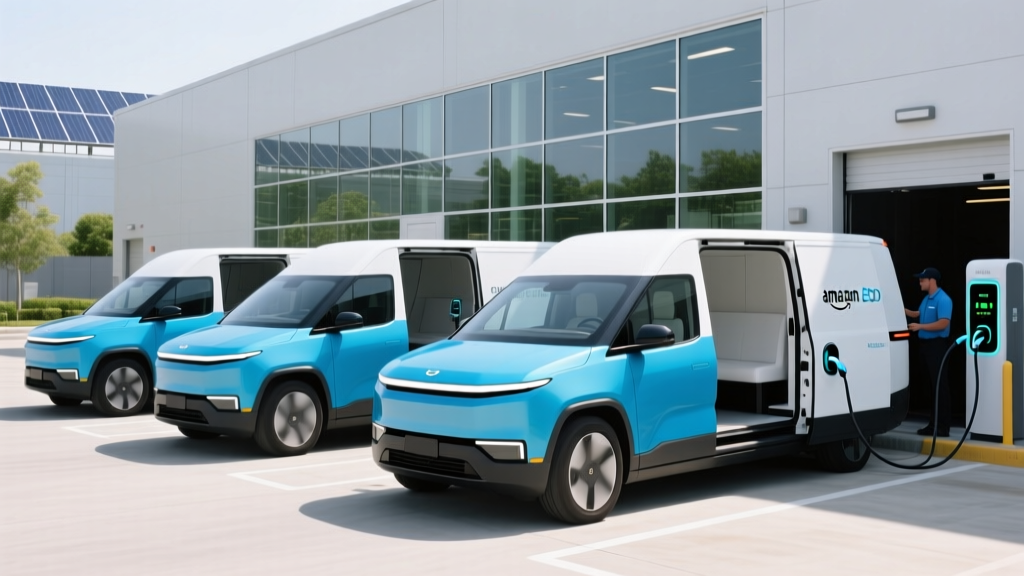
Amazon's electric vans are purpose-built commercial delivery vehicles manufactured by Rivian Automotive under an exclusive agreement signed in 2019. The fleet consists of three variants:
- EDV-500: Compact van, ~500 cubic feet of cargo volume, ~150 miles EPA range
- EDV-700: Mid-size van, ~700 cubic feet of cargo volume, ~150 miles EPA range
- EDV-900: Large van, ~900 cubic feet of cargo volume, ~120 miles EPA range (heavier payload reduces range)
All three share Rivian's commercial-grade skateboard platform with a liquid-cooled NMC (nickel manganese cobalt) lithium-ion battery pack rated at approximately 120 kWh of usable capacity. The electric motor produces roughly 250 kW (335 horsepower) and delivers peak torque of 420 lb-ft to the rear wheels. The EDV-700, the most common variant, accelerates from 0–60 mph in approximately 7.5 seconds — brisk for a 7,500-pound delivery vehicle.
Amazon began deploying EDVs in late 2022, starting in Los Angeles and Baltimore. By 2026, the fleet has expanded to over 100 metro areas, supported by Amazon's investment in depot-level charging infrastructure — a critical detail for anyone studying commercial EV adoption.
EDV Specs: Range, Battery, and Charging
| Specification | EDV-500 | EDV-700 | EDV-900 |
|---|---|---|---|
| EPA Range | ~150 mi | ~150 mi | ~120 mi |
| Battery (usable) | ~120 kWh NMC | ~120 kWh NMC | ~120 kWh NMC |
| Peak DC Charge Rate | 150 kW | 150 kW | 150 kW |
| 10–80% DC Charge Time | ~40 min | ~40 min | ~40 min |
| Level 2 Charge Rate | ~11.5 kW | ~11.5 kW | ~11.5 kW |
| Motor Output | 250 kW / 335 hp | 250 kW / 335 hp | 250 kW / 335 hp |
| Cargo Volume | ~500 cu ft | ~700 cu ft | ~900 cu ft |
| GVWR | ~7,000 lbs | ~7,500 lbs | ~9,500 lbs |
Real-World Range Note: The EPA-estimated 150 miles for the EDV-700 assumes moderate temperatures and mixed driving. In real-world delivery operations — frequent stops, idling with HVAC running, heavy payloads, and cold-weather routes — effective range drops to approximately 100–120 miles. Amazon mitigates this by routing vans on circuits that return to depots well before depletion, with overnight Level 2 charging topping them up for the next shift.
Charging infrastructure is depot-based. Amazon has installed thousands of Level 2 chargers at its delivery stations, typically at 11.5 kW per stall. This means a full overnight charge (0–100%) takes roughly 10–11 hours — perfectly suited to a van that returns to base each evening. DC fast charging is available for mid-day top-ups but is rarely needed in standard delivery operations.
Amazon Electric Vans vs. Gas Delivery Vans: Cost Comparison
The business case for Amazon's electric fleet hinges on total cost of ownership (TCO). Here's how the EDV compares to a conventional gas-powered delivery van like the Ford Transit or Ram ProMaster on key operating metrics:
| Cost Factor | Rivian EDV-700 (Electric) | Ford Transit 350 (Gas) |
|---|---|---|
| Estimated Purchase Price | ~$65,000–$75,000* | ~$48,000–$55,000 |
| Fuel / Energy Cost per Mile | ~$0.10–$0.14 (at $0.12/kWh depot rate) | ~$0.22–$0.28 (at $3.50/gal, 14 MPG) |
| Annual Fuel/Energy (15,000 mi) | ~$1,500–$2,100 | ~$3,300–$4,200 |
| Annual Maintenance | ~$800–$1,200 | ~$2,000–$3,000 |
| Estimated 5-Year TCO | ~$95,000–$110,000 | ~$100,000–$120,000 |
| Federal Commercial EV Credit | Up to $7,500 (§45W) | $0 |
*EDV pricing is not publicly disclosed; estimates based on commercial EV industry benchmarks and IRS §45W commercial clean vehicle credit documentation.
The math favors electric on operating costs: roughly $0.10–$0.14 per mile for electricity versus $0.22–$0.28 for gasoline. Maintenance savings are significant — no oil changes, no transmission fluid, regenerative braking extends pad life, and the single-speed reduction gear has fewer wear components than an automatic transmission. Over five years and 75,000 miles, the EDV can save an estimated $8,000–$15,000 in fuel and maintenance despite a higher upfront purchase price.
Amazon also benefits from the IRS §45W commercial clean vehicle credit, which offers up to $7,500 for qualifying commercial EVs with a GVWR under 14,000 pounds. Unlike the consumer §30D credit, §45W has no MSRP cap or buyer income limit, though it does require the vehicle to be deployed in a U.S. business fleet.
Why This Matters for Consumer EV Buyers
You can't buy an Amazon EDV — Rivian's contract with Amazon includes an exclusivity clause that prevents sales to other fleets until at least late 2026, and even then consumer sales are not planned. So why should a regular EV shopper care about Amazon's electric vans?
1. Battery supply chain scale. Amazon's order of 100,000 vans represents one of the largest single-vehicle battery commitments in history. This volume drives Rivian's battery procurement, which in turn accelerates cost reductions across their consumer lineup (the R1T pickup and R1S SUV). When Rivian achieves battery cost parity, consumers benefit.
2. Charging infrastructure buildout. Amazon is installing depot chargers at a pace that rivals public networks. While these are private installations, the electrical grid upgrades, utility partnerships, and permitting precedents they create lower barriers for commercial and eventually public charging in the same metro areas.
3. Used-fleet trickle-down. As early EDVs reach end-of-lease or retirement (projected starting 2028–2029), converted commercial EVs may enter secondary markets — think of how retired police cruisers and government fleet vehicles eventually reach private buyers. Custom upfitters could transform EDVs into camper vans or small-business work trucks.
4. Proof of EV reliability at scale. Amazon's vans operate 6 days a week in extreme conditions — Phoenix summers, Minneapolis winters, stop-and-go urban routes. The fleet's real-world durability data validates (or challenges) EV powertrain longevity claims that apply to consumer vehicles sharing similar components.
What First-Time EV Buyers Should Learn from Fleet Adoption
Amazon's EDV deployment reveals practical lessons that apply directly to consumer EV ownership:
| Common Misconception | What the Fleet Data Shows |
|---|---|
| "150 miles of range isn't enough" | Amazon's vans average 80–120 miles per day. Most daily driving — personal or commercial — falls well within moderate-range EVs. The key is predictable routes and reliable home/depot charging. |
| "EVs can't handle cold weather" | EDVs operate year-round in Chicago, Detroit, and Minneapolis. Cold weather reduces range by 15–30%, but depot charging and route planning compensate. Consumer EVs with heat pumps (like the Hyundai Ioniq 5 or Tesla Model Y) see smaller losses. |
| "EV batteries won't last" | Rivian warranties the EDV battery for 8 years/200,000 miles with a minimum 70% capacity retention threshold. Real-world fleet data through 2025 shows average degradation of approximately 8–12% after 100,000 miles of heavy use — well within warranty. |
| "Charging takes too long" | Amazon charges overnight at Level 2 — no driver time lost. For consumers with home Level 2 chargers, the same principle applies: you charge while you sleep, and the car is always "full" each morning. |
Decision Framework: Should Fleet EV Growth Influence Your Purchase?
Choose a Rivian consumer vehicle (R1T/R1S) if:
- You want to support a company with proven fleet-scale manufacturing and battery expertise
- You need a 300+ mile range SUV/pickup with strong DC fast charging (R1S: peak 220 kW, 10–80% in ~21 min)
- You qualify for the §30D federal tax credit (income limits apply: $150K single / $300K joint; vehicle MSRP caps: $55K cars / $80K SUVs/trucks)
Look at other EVs if:
- You need a more affordable entry point — the Rivian R1S starts around $79,900 before incentives
- You want a vehicle available immediately without waitlists
- You prioritize LFP battery chemistry for maximum longevity (Rivian uses NMC; consider Tesla Model Y Standard Range or Ford Mustang Mach-E Select for LFP options)
Consider a commercial EV (Ford E-Transit, BrightDrop Zevo) if:
- You run a small business or delivery operation
- You can claim the §45W commercial clean vehicle credit
- Your routes are predictable and under 120 miles daily
The Bigger Picture: Amazon's Climate Pledge and EV Industry Impact
Amazon's 100,000-van order is part of its Climate Pledge to reach net-zero carbon by 2040. The EDV fleet alone is projected to eliminate an estimated 4 million metric tons of CO₂ annually once fully deployed. But the ripple effects extend beyond Amazon:
- Utility grid upgrades: Depot charging at 100+ stalls per site requires significant grid capacity, pushing utilities to invest in distribution infrastructure that benefits surrounding communities.
- Second-life batteries: When EDV packs degrade below fleet requirements (~70% capacity), they enter second-life applications — stationary storage, grid balancing — accelerating the circular battery economy.
- Competitive pressure: UPS has ordered 10,000 electric vans from Workhorse and Arrival (now restructured), while FedEx has partnered with BrightDrop (GM's commercial EV brand). The entire last-mile delivery sector is electrifying, and consumer EV buyers benefit from the R&D spillover.
Frequently Asked Questions
Can I buy an Amazon electric delivery van?
No. The Rivian EDV is built exclusively for Amazon under a contractual exclusivity agreement. Rivian has indicated it may offer a commercial van to other fleets after the exclusivity period ends (expected late 2026 or later), but there are no plans for a consumer version.
What is the real-world range of Amazon's Rivian EDV?
The EPA-estimated range is approximately 150 miles for the EDV-500 and EDV-700, and about 120 miles for the heavier EDV-900. In real-world delivery operations with frequent stops, heavy payloads, and climate control running, effective range is typically 100–120 miles. Amazon plans routes to stay within this envelope.
How much does it cost to charge the EDV vs. fueling a gas van?
At typical commercial electricity rates of $0.10–$0.14 per kWh, charging the EDV's 120 kWh battery from 0–100% costs approximately $12–$17. A comparable gas van with a 25-gallon tank at $3.50/gallon costs $87.50 to fill. Per-mile energy cost: ~$0.12 for electric vs. ~$0.25 for gas.
What battery chemistry does the Rivian EDV use?
The EDV uses NMC (nickel manganese cobalt) lithium-ion cells in a liquid-cooled pack. NMC offers higher energy density than LFP (lithium iron phosphate), which is important for packaging 120 kWh into a van chassis. The trade-off is slightly faster long-term degradation compared to LFP, though Rivian's 8-year/200,000-mile battery warranty mitigates this.
Does Amazon's EDV qualify for federal tax credits?
Yes, but under the commercial credit, not the consumer one. The IRS §45W commercial clean vehicle credit provides up to $7,500 for qualifying commercial EVs under 14,000 lbs GVWR. This credit has no MSRP cap or buyer income limit, but it applies to business fleet purchases, not individual consumers.
Will Amazon's electric vans eventually be available used?
Possibly, but not soon. Early EDVs deployed in 2022–2023 are still mid-lifecycle. If Amazon follows typical fleet rotation (5–7 years), the first used EDVs could reach secondary markets around 2028–2030. Custom upfitters may convert them for small-business or camper use.
How does the EDV compare to the Ford E-Transit?
The Ford E-Transit is the EDV's closest public-market competitor. The E-Transit offers 126 miles of EPA range, a 68 kWh battery, and starts around $55,000 — making it accessible to small businesses. The EDV has a larger battery (120 kWh), more range (~150 mi), and more cargo volume, but it's exclusive to Amazon and likely costs $65,000–$75,000 per unit.