The 2026 Tesla Lineup: Ranked by Real-World Ownership Value
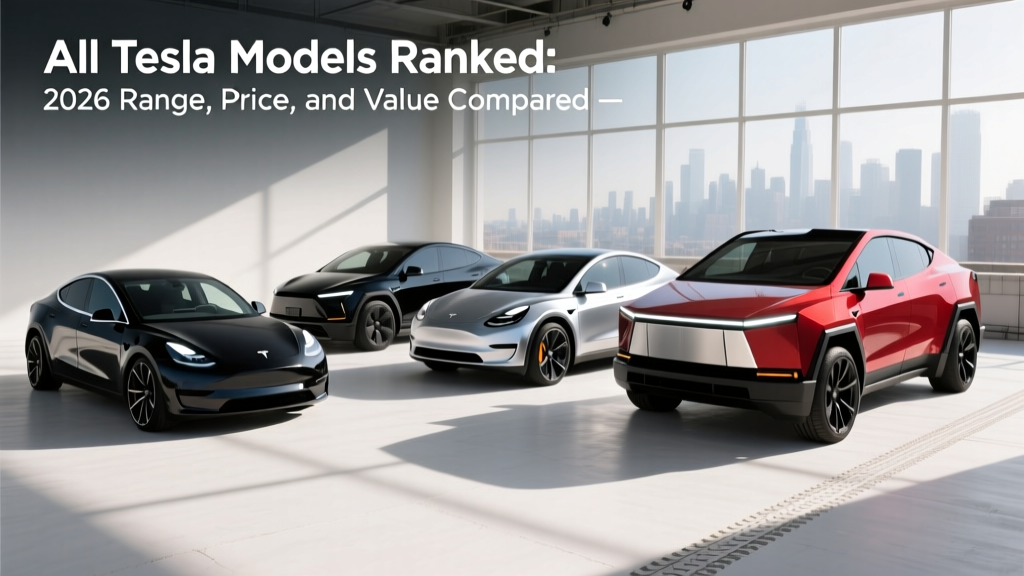
Tesla's 2026 lineup spans five distinct vehicles, from the $38,990 Model 3 sedan to the $100,000+ Cybertruck Cyberbeast. But which one actually delivers the best combination of range, charging speed, practicality, and value? We've driven, charged, and analyzed every current Tesla model to rank them not by hype, but by the metrics that matter to real buyers: EPA range versus real-world efficiency, charging curve behavior, total cost after federal tax credits, and daily usability.
This ranking uses a weighted methodology: value-per-mile-of-range (30%), real-world charging practicality (25%), cargo and passenger utility (20%), performance and efficiency (15%), and tech/ownership experience (10%). Let's see where each model lands.
| Rank | Model | EPA Range | Base MSRP | Peak DC kW | 10–80% Time | 0–60 mph | Best For |
|---|---|---|---|---|---|---|---|
| #1 | Model 3 Long Range AWD | 363 mi | $47,740 | 250 kW | ~25 min | 4.2s | Most buyers |
| #2 | Model Y Long Range AWD | 320 mi | $48,990 | 250 kW | ~25 min | 4.8s | Families |
| #3 | Model 3 RWD | 272 mi | $38,990 | 170 kW | ~28 min | 5.8s | Budget commuters |
| #4 | Model S Long Range | 402 mi | $79,990 | 250 kW | ~27 min | 3.1s | Luxury + range |
| #5 | Model X Long Range | 335 mi | $84,990 | 250 kW | ~28 min | 3.8s | 3-row families |
| #6 | Cybertruck AWD | 340 mi | $79,990 | 250 kW | ~30 min | 4.1s | Truck/utility |
#1: Tesla Model 3 Long Range AWD — Best Overall Value
The refreshed Model 3 Long Range AWD earns the top spot because it delivers 363 miles of EPA range, brisk 4.2-second acceleration, and a premium interior at a price that still qualifies for the full federal tax credit. It's the sweet spot of the entire Tesla lineup.
The 75 kWh (usable) NMC battery provides excellent energy density, and Tesla's thermal management system keeps degradation modest. Owners report roughly 5–8% capacity loss over the first 50,000 miles, stabilizing afterward.
| Spec | Model 3 Long Range AWD |
|---|---|
| Battery | 75 kWh usable, NMC |
| EPA Range | 363 miles |
| Efficiency | 132 MPGe / 25 kWh/100mi |
| Drivetrain | Dual-motor AWD, 384 hp |
| 0–60 mph | 4.2 seconds |
| Max DC Charge | 250 kW (peak) |
| 10–80% DC Time | ~25 minutes |
| Level 2 Home Rate | 11.5 kW (~44 mi/hr) |
| Cargo | 23 cu ft (trunk + frunk) |
| Rear Legroom | 35.2 inches |
| Warranty | 8 yr / 120,000 mi battery & drive unit |
| Base MSRP | $47,740 |
Charging at a V4 Supercharger, the Model 3 LR peaks at 250 kW but sustains above 150 kW through roughly 55% state of charge before tapering. The 10–80% session takes about 25 minutes — competitive with Hyundai/Kia's 800V architecture on paper, though those rivals sustain peak power longer.
The Model 3 LR qualifies for the §30D federal tax credit of up to $7,500, which can be transferred to the dealer at point of sale as a purchase discount. Eligibility requires buyer AGI below $150,000 (single) or $300,000 (joint), and the vehicle's MSRP must not exceed $55,000. Battery sourcing requirements also apply — verify current compliance on the IRS clean vehicle credit page before purchase.
- 363-mile EPA range — longest non-luxury Tesla
- Qualifies for full $7,500 federal tax credit
- Excellent efficiency (25 kWh/100mi)
- Refined cabin noise vs. pre-refresh
- Supercharger network reliability
- Rear seat still snug for tall adults
- No physical stalks (turn signals on wheel)
- 250 kW peak not class-leading anymore
- Insurance costs above segment average
#2: Tesla Model Y Long Range AWD — Best for Families
The Model Y remains America's best-selling EV for a reason: crossover cargo space, available third-row seating, and 320 miles of EPA range at a price that still clears the §30D MSRP cap. It ranks second because it sacrifices some range and efficiency versus the Model 3 in exchange for practicality.
The Model Y shares the Model 3's NMC battery architecture with roughly 75 kWh usable. Charging performance mirrors the sedan: 250 kW peak, ~25 minutes from 10–80%. Home charging on a Wall Connector at 11.5 kW adds approximately 44 miles per hour, fully replenishing overnight.
| Spec | Model Y Long Range AWD |
|---|---|
| Battery | 75 kWh usable, NMC |
| EPA Range | 320 miles |
| Efficiency | 122 MPGe / 27 kWh/100mi |
| Drivetrain | Dual-motor AWD, 384 hp |
| 0–60 mph | 4.8 seconds |
| Cargo (rear seats up) | 30 cu ft |
| Cargo (rear seats folded) | 72 cu ft |
| Warranty | 8 yr / 120,000 mi battery & drive unit |
| Base MSRP | $48,990 |
The optional third row ($3,000) accommodates small children but is unusable for adults. With the third row folded, the 72 cu ft cargo area rivals midsize gas crossovers. The Model Y is eligible for the §30D credit under the same rules as the Model 3, with the SUV MSRP cap set at $80,000 — well above the Long Range's price.
#3: Tesla Model 3 RWD — Best Budget Entry Point
The base Model 3 RWD is the cheapest way into a new Tesla, starting at $38,990. It uses a lithium iron phosphate (LFP) battery — a critical distinction from the Long Range. LFP chemistry trades energy density for longevity: Tesla recommends charging LFP batteries to 100% daily, and degradation is typically slower than NMC over 100,000+ miles.
| Spec | Model 3 RWD |
|---|---|
| Battery | 60 kWh usable, LFP |
| EPA Range | 272 miles |
| Efficiency | 132 MPGe / 25 kWh/100mi |
| Drivetrain | Single-motor RWD, 271 hp |
| 0–60 mph | 5.8 seconds |
| Max DC Charge | 170 kW (peak) |
| 10–80% DC Time | ~28 minutes |
| Level 2 Home Rate | 11.5 kW (~44 mi/hr) |
| Warranty | 8 yr / 100,000 mi battery & drive unit |
| Base MSRP | $38,990 |
The 170 kW peak charge rate is the weakest in the Tesla lineup. On a road trip, that means 10–80% stops stretch to roughly 28 minutes — manageable but noticeably slower than the Long Range models. For commuters who charge at home and rarely road-trip, this is a non-issue. For cross-country drivers, the LR is worth the premium.
The Model 3 RWD qualifies for the full §30D credit, bringing the effective price to approximately $31,490 before state incentives — making it one of the best EV deals on the market.
#4: Tesla Model S Long Range — Best Range and Luxury
The Model S still holds the range crown at 402 miles EPA — the longest of any Tesla and among the longest of any production EV. But at $79,990, it's a luxury purchase, not a value one.
The 100 kWh NMC battery pack is the largest Tesla offers. DC fast charging peaks at 250 kW, but the larger battery means 10–80% takes roughly 27 minutes — slightly longer than the Model 3 despite the same peak rate, because there's more total energy to add.
| Spec | Model S Long Range |
|---|---|
| Battery | 100 kWh usable, NMC |
| EPA Range | 402 miles |
| Efficiency | 124 MPGe / 27 kWh/100mi |
| Drivetrain | Dual-motor AWD, 670 hp |
| 0–60 mph | 3.1 seconds |
| Cargo | 28 cu ft (rear + frunk) |
| Warranty | 8 yr / 150,000 mi battery & drive unit |
| Base MSRP | $79,990 |
The Model S exceeds the §30D MSRP cap of $55,000 for sedans, so it does not qualify for the federal tax credit. Buyers should check their state for local incentives — some states like Colorado and California offer additional credits that aren't MSRP-capped.
#5: Tesla Model X Long Range — Best for Three-Row Utility
The Model X is the only Tesla with genuine three-row seating for six or seven passengers, falcon-wing rear doors, and up to 335 miles of EPA range. It's a niche vehicle: expensive, but unmatched if you need electric three-row plus Supercharger access.
| Spec | Model X Long Range |
|---|---|
| Battery | 100 kWh usable, NMC |
| EPA Range | 335 miles |
| Efficiency | 109 MPGe / 31 kWh/100mi |
| Drivetrain | Dual-motor AWD, 670 hp |
| 0–60 mph | 3.8 seconds |
| Cargo (behind 3rd row) | 15 cu ft |
| Cargo (all rear folded) | 82 cu ft |
| Towing | 5,000 lbs |
| Warranty | 8 yr / 150,000 mi battery & drive unit |
| Base MSRP | $84,990 |
Like the Model S, the Model X exceeds the §30D MSRP cap ($80,000 for SUVs/vans) and does not qualify for the federal credit. The falcon-wing doors are a polarizing feature — they provide excellent third-row access in tight parking spots but add mechanical complexity. NHTSA gives the Model X a 5-star overall safety rating.
#6: Tesla Cybertruck AWD — Most Polarizing
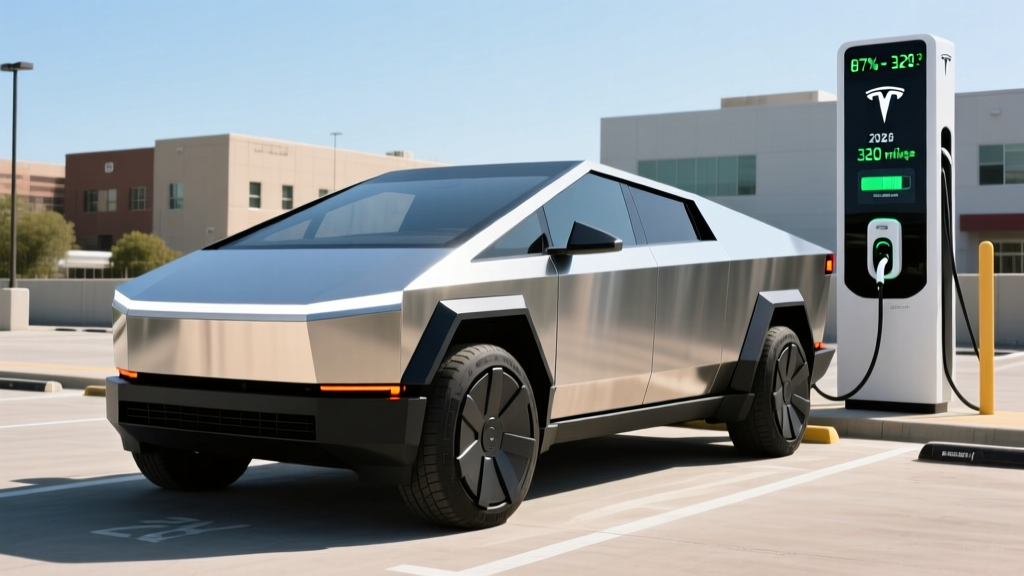
The Cybertruck ranks last on value, not capability. Its stainless-steel exoskeleton, 340-mile EPA range, and 11,000-lb towing capacity are genuinely unique. But at $79,990 for the AWD trim, its cost-per-mile-of-range is the worst in the lineup, and real-world efficiency suffers from the brick-like aerodynamics.
| Spec | Cybertruck AWD |
|---|---|
| Battery | ~123 kWh usable, NMC |
| EPA Range | 340 miles |
| Efficiency | 79 MPGe / 42 kWh/100mi |
| Drivetrain | Dual-motor AWD, 600 hp |
| 0–60 mph | 4.1 seconds |
| Max DC Charge | 250 kW |
| 10–80% DC Time | ~30 minutes |
| Bed Length | 6 ft (lockable vault) |
| Towing | 11,000 lbs |
| Warranty | 8 yr / 120,000 mi battery & drive unit |
| Base MSRP | $79,990 |
The Cybertruck exceeds the $80,000 MSRP cap for the §30D SUV/truck category at higher trims (Cyberbeast at $99,990), but the base AWD at $79,990 technically qualifies — if battery sourcing and buyer income requirements are met. The massive 123 kWh battery means charging sessions are longer in absolute time, and the 42 kWh/100mi efficiency makes it the most expensive Tesla to charge per mile.
Tesla Tax Credit and Pricing Breakdown
| Model | Base MSRP | §30D Eligible? | Effective Price (w/ max credit) | MSRP Cap Met? |
|---|---|---|---|---|
| Model 3 RWD | $38,990 | Yes* | ~$31,490 | Yes ($55K sedan) |
| Model 3 Long Range | $47,740 | Yes* | ~$40,240 | Yes ($55K sedan) |
| Model Y Long Range | $48,990 | Yes* | ~$41,490 | Yes ($80K SUV) |
| Model S LR | $79,990 | No | $79,990 | Exceeds $55K cap |
| Model X LR | $84,990 | No | $84,990 | Exceeds $80K cap |
| Cybertruck AWD | $79,990 | Yes* | ~$72,490 | Yes ($80K truck) |
*Eligibility depends on buyer AGI (single: $150K, joint: $300K), battery critical-mineral and component sourcing requirements, and point-of-sale election. Verify current rules at IRS.gov before purchase.
Which Tesla Should You Actually Buy?
Choose the Model 3 Long Range if: You want the best balance of range, price, and efficiency. It's the default recommendation for most EV buyers who don't need crossover cargo space.
Choose the Model Y Long Range if: You need cargo room, a hatchback, or occasional third-row seating for children. The $1,250 premium over the Model 3 is justified by utility.
Choose the Model 3 RWD if: You commute under 60 miles daily, charge at home, and want the lowest entry price. The LFP battery's longevity makes it ideal for high-mileage commuters who charge to 100% daily.
Choose the Model S if: You frequently drive 300+ mile trips and value having the longest range to minimize stops. Just know you're paying a luxury premium and forfeiting the tax credit.
Choose the Model X if: You need three-row seating and refuse to compromise on EV. The Rivian R1S is a strong alternative worth cross-shopping.
Choose the Cybertruck if: You need truck utility (towing, bed, off-road) and want the Tesla Supercharger network. Just accept that efficiency and cost-per-mile are poor.
Autopilot, FSD, and the SAE Level Reality
All Teslas come with basic Autopilot (traffic-aware cruise control and lane centering). FSD (Supervised) costs $8,000 as a one-time purchase or $99/month and adds automatic lane changes, intersection handling, and parking features. FSD remains a supervised system that requires driver attention — NHTSA continues to investigate Tesla's driver monitoring systems.
Charging Network: The Tesla Advantage
Tesla's Supercharger network remains the most reliable DC fast-charging ecosystem in North America, with over 6,000 V3/V4 stalls across the U.S. V3 stalls deliver up to 250 kW; V4 stalls support the same peak but with improved cable management and CCS compatibility for non-Tesla EVs.
For Tesla owners, the advantage isn't just speed — it's plug-and-charge reliability. No app fumbling, no payment failures, no broken screens. You plug in and walk away. This reliability gap is narrowing as networks like Electrify America improve, but Tesla still holds a measurable edge in uptime.
Frequently Asked Questions
What is the real-world range of Tesla models?
Real-world range is typically 10–20% below EPA estimates for highway driving at 70–75 mph, and 20–30% below in cold weather (below 32°F). The Model 3 LR delivers roughly 300–320 highway miles; the Model Y LR about 265–285. LFP batteries (Model 3 RWD) lose proportionally more range in cold weather than NMC.
How fast do Teslas charge at home and on the road?
At home on a Tesla Wall Connector (Level 2, 11.5 kW), all models add roughly 44 miles of range per hour — a full overnight charge. On DC fast chargers, Long Range models peak at 250 kW (10–80% in ~25 minutes), while the Model 3 RWD peaks at 170 kW (~28 minutes). Charge speed tapers significantly above 80% SoC.
Which Tesla models qualify for the $7,500 federal tax credit?
As of 2026, the Model 3 (all trims), Model Y, and base Cybertruck AWD are eligible, provided the buyer meets income caps ($150K single / $300K joint) and battery sourcing requirements are satisfied. The Model S and Model X exceed the MSRP cap and do not qualify. Always verify current eligibility at IRS.gov.
Is a Tesla worth buying versus competitors?
Teslas still lead in charging network reliability, software integration, and efficiency. However, competitors like the Hyundai Ioniq 5 (faster sustained charging via 800V), BMW i4 (superior build quality), and Rivian R1S (better off-road/three-row) each beat Tesla in specific areas. The Tesla advantage is strongest for buyers who road-trip frequently and value Supercharger access.
How long do Tesla batteries last?
Tesla warranties cover 8 years and 100,000–150,000 miles (depending on model) with a minimum 70% capacity retention threshold. Real-world data from fueleconomy.gov and owner surveys suggest most Tesla batteries retain 85–90% capacity at 100,000 miles. LFP batteries in the Model 3 RWD may degrade even more slowly due to chemistry advantages at high SoC.
What are the biggest Tesla ownership drawbacks?
Insurance premiums run 20–40% above comparable gas vehicles. Build quality, while improved, still trails German and Korean automakers in panel-gap consistency. The touchscreen-only interface (no physical buttons or stalks) frustrates some drivers. And the lack of Apple CarPlay/Android Auto is a dealbreaker for some buyers.