Quick Answer: Should You Buy an All Electric Volkswagen?
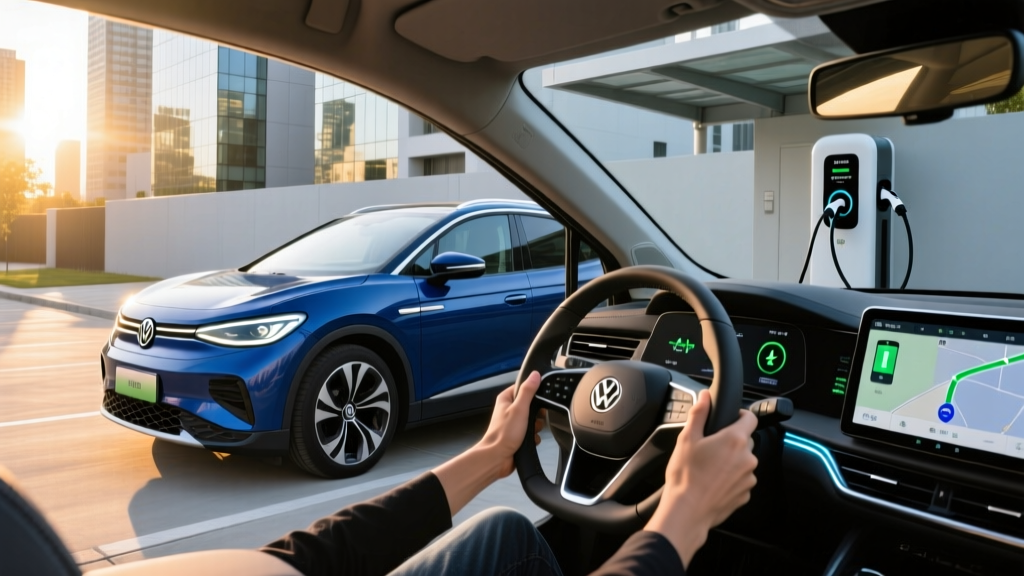
The 2026 Volkswagen ID.4 is a practical electric compact SUV starting around $42,995 with an EPA-estimated 291 miles of range (Pro trim, 82 kWh usable battery). It's best for buyers who want a conventional-feeling crossover with competitive DC fast charging (peak 170 kW, 10–80% in ~30 minutes) and who have access to home Level 2 charging. It falls short on highway efficiency and real-world cold-weather range (expect ~220–240 miles in winter). Compared to the Hyundai Ioniq 5 or Tesla Model Y, it trades cutting-edge tech and efficiency for a lower entry price and a familiar driving experience. The federal §30D tax credit of up to $7,500 may apply depending on your income, the vehicle's MSRP, and battery-sourcing requirements — check current IRS rules before purchasing.
The 2026 Volkswagen ID.4 Lineup at a Glance
Volkswagen's all-electric strategy in the U.S. currently centers on the ID.4 crossover. The ID. Buzz (electric minivan) joined the lineup for the 2025 model year, but the ID.4 remains VW's volume EV play. Here's what the 2026 ID.4 lineup looks like:
| Trim | Battery (usable kWh) | EPA Range | Drivetrain | HP | 0–60 mph | Peak DC Charge | Base MSRP |
|---|---|---|---|---|---|---|---|
| Pro | 82 kWh (NMC) | 291 mi | RWD | 282 | 7.7 sec | 170 kW | ~$42,995 |
| Pro S | 82 kWh (NMC) | 285 mi | RWD | 282 | 7.7 sec | 170 kW | ~$47,995 |
| Pro S Plus (AWD) | 82 kWh (NMC) | 263 mi | AWD | 335 | 5.4 sec | 170 kW | ~$52,495 |
All trims use an 82 kWh usable lithium-ion NMC (nickel manganese cobalt) battery pack. Volkswagen includes an 8-year/100,000-mile high-voltage battery warranty with a 70% capacity retention guarantee, which is industry-standard.
Real-World Range: What the EPA Sticker Doesn't Tell You
EPA Estimate: 291 miles (Pro RWD)
Real-World Expectation: 250–270 miles on mixed highway driving at 70–75 mph; 220–240 miles in freezing temperatures; as low as 200 miles in heavy mountain driving with HVAC running.
The ID.4's combined efficiency rating sits at approximately 104 MPGe (or about 32 kWh/100 miles) for the Pro RWD, per fueleconomy.gov. That's competitive but not class-leading — the Hyundai Ioniq 5 Long Range achieves roughly 114 MPGe, and the Tesla Model Y Long Range hits around 122 MPGe.
What this means practically: if your daily commute is under 60 miles round-trip and you can charge at home overnight, you'll rarely think about range. But if you regularly drive 200+ miles between charges on highway trips, you'll need to plan one DC fast-charging stop — and understand how the charge curve affects your travel time.
Charging Speed and Infrastructure Reality
The ID.4 supports a peak DC fast-charge rate of 170 kW on 82 kWh models. In real-world testing at a 150+ kW Electrify America or compatible station, expect a 10–80% charge in approximately 28–32 minutes. The charge curve tapers noticeably above 80% — going from 80–100% can add another 20+ minutes. This is normal physics for NMC batteries, but it matters on road trips.
| Charging Level | Power | Miles Added per Hour | Typical Use Case |
|---|---|---|---|
| Level 1 (120V) | ~1.4 kW | ~4–5 mi/hr | Emergency/overnight trickle (not practical for daily use) |
| Level 2 (240V, 32A) | ~7.7 kW | ~25–28 mi/hr | Home overnight charging — full charge in ~10 hours |
| Level 2 (240V, 48A) | ~11.5 kW | ~37–40 mi/hr | Upgraded home charger — full charge in ~7 hours |
| DC Fast Charge | Up to 170 kW | ~200+ mi in 30 min | Road trips (10–80% in ~30 min) |
Connector note: The 2026 ID.4 comes with a CCS1 connector. Volkswagen has announced a transition to NACS (Tesla-style) for future models, but current ID.4 owners rely on the CCS/Electrify America network or use adapters for Tesla Superchargers. VW's partnership with Electrify America historically included complimentary charging periods — verify current promotions with your dealer.
Preconditioning matters: The ID.4 supports battery preconditioning for DC fast charging when you navigate to a charger in the infotainment system. In cold weather, preconditioning warms the battery to optimize charge speed. Without it, a cold battery at 20°F might only accept 50–70 kW instead of the full 170 kW, stretching your stop to 45+ minutes.
Cost Breakdown: ID.4 vs a Comparable Gas SUV
Let's compare the all electric Volkswagen ID.4 Pro against a popular gas alternative — the Volkswagen Tiguan — over 5 years of ownership. This assumes 12,000 miles/year, $3.50/gallon gas, and $0.14/kWh home electricity (national averages).
| Cost Factor | 2026 ID.4 Pro | 2026 Tiguan SE (Gas) |
|---|---|---|
| Base MSRP | $42,995 | $32,500 |
| Est. Federal Tax Credit (§30D) | Up to $7,500* | $0 |
| Effective Purchase Price | ~$35,495 | $32,500 |
| 5-Year Fuel/Energy Cost (60,000 mi) | ~$2,772 (home charging) | ~$8,400 (26 MPG combined) |
| 5-Year Maintenance (est.) | ~$1,200 | ~$3,500 |
| 5-Year Insurance (est.) | ~$9,000 | ~$7,500 |
| 5-Year Total Cost (excl. depreciation) | ~$48,467 | ~$51,900 |
*The §30D federal tax credit has income caps ($150K single / $300K joint), MSRP caps ($55K for SUVs), and battery-sourcing/critical-mineral requirements that change annually. Verify current eligibility on irs.gov or with a tax professional. Point-of-sale transfer is available if eligible.
The ID.4 wins on energy and maintenance costs — you save roughly $7,900 on fuel and maintenance over five years. However, EV insurance premiums tend to run 15–25% higher than gas equivalents, partially offsetting those savings. Depreciation is another variable: EV resale values have been volatile, though they've stabilized somewhat as the market matures.
EV vs Gas vs Hybrid: Which Powertrain Fits Your Life?
Not everyone should buy an all electric Volkswagen. Here's a practical decision framework:
Choose the ID.4 (all-electric) if:
- You have reliable home Level 2 charging (garage or driveway with 240V access)
- Your daily driving is under 100 miles round-trip
- You want the lowest per-mile operating cost
- You're comfortable planning DC fast-charge stops on road trips 2–3 times per year
- You qualify for the §30D tax credit, bringing effective price close to a gas alternative
Choose a PHEV (e.g., Toyota RAV4 Prime) if:
- You lack home charging but want some electric-only driving (42 miles EPA electric range)
- You take frequent long road trips and don't want to plan charging stops
- You want EV-like daily commuting with gas-engine flexibility
Choose a gas vehicle if:
- You live in an apartment with no charging access and rely on street parking
- Your budget is strictly under $30,000
- You regularly tow heavy loads or drive in extreme remote areas with no charging infrastructure
Common Misconceptions About the All Electric Volkswagen
| Myth | Fact |
|---|---|
| "The ID.4's battery will need expensive replacement in a few years." | VW's battery warranty covers 8 years/100,000 miles at 70% capacity. Real-world data from older EVs shows NMC batteries typically retain 85–90% capacity after 100K miles with normal use. Full replacements are rare and covered under warranty. |
| "I can charge it at any Tesla Supercharger." | The 2026 ID.4 uses CCS1. Tesla has opened some Superchargers to non-Tesla EVs via Magic Dock adapters, but coverage is limited. Your primary fast-charging network will be Electrify America, EVgo, and other CCS-compatible providers. |
| "It charges as fast as competitors." | At 170 kW peak, the ID.4 charges slower than the Hyundai Ioniq 5 (peak 240 kW, 10–80% in ~18 min) or the Kia EV6 (peak 240 kW). Expect ~30 minutes for 10–80% vs ~18 minutes for the Hyundai/Kia 800V platforms. |
| "Electricity is always cheaper than gas." | Home charging at $0.14/kWh is dramatically cheaper. But public DC fast charging at $0.40–0.55/kWh can approach or exceed the per-mile cost of a fuel-efficient gas car. Home charging access is the key economic factor. |
| "I'll get 291 miles no matter what." | EPA estimates assume mild conditions. Sustained 75 mph highway driving reduces range ~15%. Cold weather (below 32°F) can reduce range 20–30%. Mountain driving with elevation changes compounds the loss further. |
First-Time EV Buyer Checklist: What You Need Before Purchasing
If this is your first electric vehicle, here's what to sort out before signing paperwork:
- Home charging assessment: Do you have a garage, carport, or driveway with access to a 240V outlet (like a dryer outlet)? A Level 2 home charger installation typically costs $800–$2,500 (equipment + licensed electrician + permit), depending on your electrical panel's capacity. If you need a 200-amp panel upgrade, add $1,500–$3,000. This is non-negotiable for practical EV ownership.
- Electrical panel check: Have a licensed electrician evaluate your panel before buying. Most homes with 100-amp service can add a 32-amp Level 2 circuit, but older homes or those with heavy existing loads (electric heat, hot tub, EV + dryer + oven) may need upgrades.
- Public charging map review: Open the Electrify America, EVgo, and PlugShare apps. Are there reliable DC fast chargers along your common road-trip routes? If you live in a rural area or frequently travel through charging deserts (parts of the Midwest, rural Mountain West), this matters significantly.
- Tax credit verification: The §30D credit has specific battery-sourcing and critical-mineral requirements that change yearly. A vehicle that qualified in 2024 may not qualify in 2026. Check the latest list on irs.gov and confirm with your tax advisor.
- Insurance quote: Get an insurance quote for the ID.4 before purchasing. EV premiums average 15–25% higher than equivalent gas vehicles due to higher repair costs and battery replacement risk.
- Test drive with regen in mind: The ID.4 offers adjustable regenerative braking (via steering-wheel paddles) but does not offer true one-pedal driving to a complete stop like some competitors. Test the regen settings to see if the braking feel suits you.
How the ID.4 Compares to Key Rivals
| Spec | 2026 VW ID.4 Pro | 2026 Hyundai Ioniq 5 SEL | 2026 Tesla Model Y LR |
|---|---|---|---|
| EPA Range | 291 mi | 303 mi | 330 mi |
| Battery (usable) | 82 kWh NMC | 77.4 kWh NMC | ~75 kWh (NMC/LFP variant) |
| Peak DC Charge | 170 kW | 240 kW (800V) | 250 kW |
| 10–80% Time | ~30 min | ~18 min | ~22 min |
| 0–60 mph | 7.7 sec | 7.4 sec | 5.0 sec |
| MPGe (combined) | 104 | 114 | 122 |
| Base MSRP | ~$42,995 | ~$44,500 | ~$47,990 |
| Connector | CCS1 | CCS1/NACS | NACS |
The ID.4's advantage is its lower starting price and VW's traditional dealership experience. The Ioniq 5 and Model Y both charge faster and deliver better efficiency, but at higher base prices. If DC fast-charging speed is a priority for frequent road trips, the Ioniq 5's 800-volt architecture is a meaningful advantage — 12 fewer minutes per stop adds up on a 1,000-mile journey.
Frequently Asked Questions
Does the all electric Volkswagen ID.4 qualify for the $7,500 federal tax credit?
Eligibility depends on current-year §30D rules including your adjusted gross income (must be under $150K single / $300K joint filers), the vehicle's MSRP (must be under $55,000 for SUVs), and battery-component/critical-mineral sourcing requirements. These sourcing rules tighten annually. Check the current eligibility list on irs.gov before purchasing. If eligible, you can transfer the credit to the dealer as a point-of-sale discount.
How long does it take to charge the ID.4 at home?
On a Level 2 charger at 32 amps (7.7 kW), a full charge from empty takes approximately 10–11 hours. On a 48-amp charger (11.5 kW), it takes roughly 7–8 hours. Most owners charge overnight and start each morning with a full battery — the practical equivalent of a gas car's "full tank" every day.
How does the ID.4 handle in cold weather?
Expect 20–30% range reduction in sustained sub-freezing temperatures. The ID.4 uses a heat pump for cabin heating (standard on most trims), which is more efficient than resistive heating and helps mitigate some range loss. Battery preconditioning before DC fast charging is essential in cold weather to avoid painfully slow charge speeds.
Is the ID.4 self-driving?
No. The ID.4 comes with Volkswagen's IQ.DRIVE suite, which includes adaptive cruise control, lane-keeping assist, and emergency braking. This is an SAE Level 2 driver-assistance system — you must keep your hands on the wheel and remain fully engaged at all times. It is not autonomous driving.
What's the ID.4's towing capacity?
The AWD ID.4 is rated to tow up to 2,700 pounds — enough for a small utility trailer or a pair of dirt bikes, but not a camper or boat. The RWD models are rated at 2,200 pounds. Towing significantly reduces range; expect a 30–40% reduction when towing near maximum capacity.
What happens if the battery degrades?
VW's high-voltage battery warranty guarantees at least 70% capacity retention for 8 years or 100,000 miles. If the battery falls below that threshold within the warranty period, VW will repair or replace it at no cost. Outside of warranty, a full battery replacement is estimated at $12,000–$18,000, though module-level repairs may cost significantly less. Real-world degradation for NMC batteries with proper care (avoiding frequent 100% charges and DC fast charging exclusively) is typically 10–15% over the first 100,000 miles.
Final Verdict: Who Should Buy the All Electric Volkswagen ID.4?
Buy the ID.4 if you want a mainstream electric SUV from a traditional automaker, have home charging access, prioritize a lower entry price over maximum range or charging speed, and your daily driving fits comfortably within ~250 real-world miles.
Look elsewhere if you need the fastest DC charging (choose the Ioniq 5 or EV6), the longest range (Model Y or Ioniq 5 Long Range), or if you lack home charging and need maximum public-charging flexibility (NACS-equipped vehicles have broader Supercharger access).