The Short Answer: No All-Electric Toyota Highlander Exists Yet
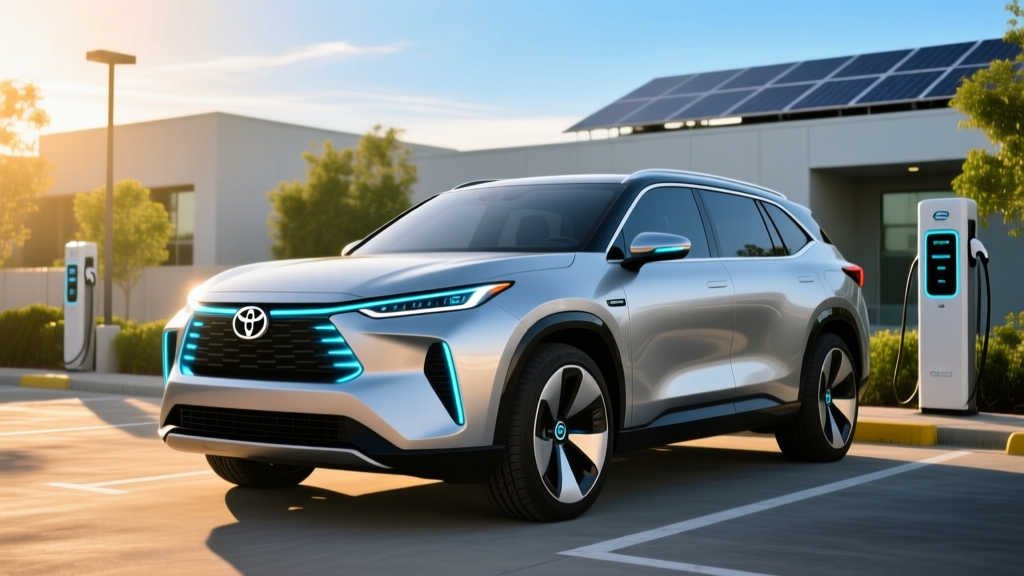
As of 2026, Toyota does not sell an all-electric Toyota Highlander. The Highlander nameplate remains exclusively a gasoline V6 and conventional hybrid (HEV) — there is no plug-in hybrid (PHEV) or battery-electric (BEV) version available. Toyota's electric 3-row SUV offering is the bZ4X (a 2-row EV) and the newly expanded Grand Highlander Hybrid, but neither is a pure electric Highlander.
If you want a 3-row electric family SUV today, you'll need to look at alternatives like the Kia EV9, Hyundai Ioniq 9, or Rivian R1S. We break down the real costs, ranges, and ownership math below so you can decide whether to wait for Toyota or switch brands.
Why Toyota Hasn't Electrified the Highlander
Toyota's electrification strategy has been notably cautious compared to competitors. The company has repeatedly cited diverse global market needs, battery supply constraints, and a multi-pathway approach (HEV, PHEV, BEV, hydrogen) as reasons for its slower BEV rollout. The bZ4X, launched for the 2023 model year, remains Toyota's only mass-market BEV in the US — and it's a compact 2-row crossover with an EPA-estimated 252 miles of range at best.
The current-generation Highlander (introduced for 2020, refreshed since) rides on Toyota's TNGA-K platform, which was engineered primarily for ICE and hybrid powertrains. Converting it to a dedicated BEV architecture would require significant reengineering. Toyota has announced plans for a next-generation electric SUV lineup by the late 2020s, but no specific Highlander EV has been confirmed with a production date.
For buyers who specifically want a Toyota badged 3-row SUV with some level of electrification, the options in 2026 are:
- Toyota Highlander Hybrid (HEV): 2.5L 4-cylinder hybrid, EPA-estimated 36 MPG combined, no plug, no electric-only driving, starting around $41,000 MSRP.
- Toyota Grand Highlander Hybrid (HEV): Larger 3-row, 2.4L turbo hybrid MAX or standard hybrid, EPA-estimated 36 MPG combined (standard hybrid), starting around $45,000 MSRP.
Neither qualifies for the federal §30D EV tax credit because neither is a plug-in vehicle.
The Closest Alternatives to an Electric Highlander
If the goal is a 3-row electric SUV that seats six or seven, offers at least 270+ miles of range, and fits a family-hauler budget, here's how the top 2026 competitors compare:
| Spec | Kia EV9 (LR RWD) | Hyundai Ioniq 9 (LR) | Rivian R1S (Dual) | Toyota Highlander Hybrid |
|---|---|---|---|---|
| Powertrain | BEV | BEV | BEV | HEV (gas) |
| EPA Range | 304 mi | ~310 mi (est.) | ~340 mi | N/A (~560 mi on 17.9-gal tank) |
| Battery (usable kWh) | 99.8 kWh (NMC) | ~110 kWh (NMC, est.) | ~106 kWh (NMC) | N/A |
| Peak DC Fast Charge | 210 kW | ~220 kW (est.) | ~220 kW | N/A |
| 10–80% DC Charge Time | ~24 min | ~24 min (est.) | ~22 min | N/A |
| 0–60 mph | 8.2 sec (RWD) | ~7.5 sec (est.) | ~5.0 sec | ~7.8 sec (Hybrid) |
| Horsepower | 215 hp (RWD) | ~215 hp (est.) | 533 hp | 243 hp (hybrid net) |
| Seating | 6 or 7 | 6 or 7 | 7 | 7 or 8 |
| Starting MSRP | $54,900 | $55,000 (est.) | $75,900 | $41,070 |
| Federal Tax Credit (§30D) | Up to $7,500* | Up to $7,500* | Up to $7,500* | $0 |
| Battery Warranty | 10 yr / 100,000 mi | 10 yr / 100,000 mi | 8 yr / 120,000 mi | 10 yr / 150,000 mi (hybrid sys.) |
*Federal §30D credit eligibility depends on MSRP caps ($80,000 for SUVs), buyer income limits ($300K MFJ / $150K single), and battery critical-mineral sourcing requirements. Always verify current eligibility at IRS.gov before purchasing.
Real Costs: EV vs. Gas 3-Row SUV Over 5 Years
The purchase price of an electric 3-row SUV is significantly higher than a Highlander Hybrid, but the operating costs can close that gap. Here's a realistic 5-year / 75,000-mile ownership comparison between the Kia EV9 (as the closest Highlander-sized EV alternative) and the Toyota Highlander Hybrid:
| Cost Category | Kia EV9 (LR RWD) | Toyota Highlander Hybrid |
|---|---|---|
| Base MSRP | $54,900 | $41,070 |
| Federal Tax Credit (§30D) | -$7,500 (if eligible) | $0 |
| Effective Purchase Price | $47,400 | $41,070 |
| Home Charging Install (Level 2) | $800–$2,000 | $0 |
| Fuel/Energy Cost (75K mi) | $2,800–$4,500* | $6,750** |
| Maintenance (5 yr) | $1,200–$1,800 | $3,000–$4,000 |
| Insurance (5 yr avg.) | $9,500–$12,000 | $7,500–$9,500 |
| Estimated Depreciation | $18,000–$22,000 | $12,000–$15,000 |
| Approx. 5-Yr Total | $78,900–$87,700 | $68,320–$73,570 |
*EV energy cost assumes 70% home charging at $0.14/kWh and 30% DC fast charging at $0.40/kWh. Efficiency ~3.0 mi/kWh.
**Gas cost assumes 36 MPG combined, $3.25/gal national average. Actual costs vary by region and driving.
The EV still costs more over five years primarily due to higher upfront price and steeper depreciation, but the gap narrows to roughly $8,000–$15,000 when you factor in the tax credit, fuel savings, and lower maintenance. For owners who keep vehicles 8–10 years, the math improves further as EVs have fewer mechanical components to fail.
Real-World Ownership: What First-Time EV Buyers Must Know
If you're coming from a gas Highlander and considering your first EV, the transition involves more than just swapping fuel types. Here are the practical realities no spec sheet tells you:
Home Charging Is the Make-or-Break Factor
Over 80% of EV charging happens at home. A Level 2 home charger (240V, 32–48 amps) adds roughly 25–35 miles of range per hour of charging and can fully replenish a 100 kWh battery overnight. Installation costs range from $500 for a simple NEMA 14-50 outlet near your panel to $2,500+ if you need a panel upgrade from 100A to 200A service. If you cannot install home charging (apartment living, street parking, HOA restrictions), owning a large-battery EV becomes significantly less convenient and more expensive, as you'll rely on public DC fast charging at $0.30–$0.50/kWh.
EPA Range vs. Real-World Range
The EPA range sticker is a best-case blended estimate. In real-world conditions, expect:
- Highway driving (70+ mph): 10–15% less than EPA. A 304-mile EV9 might deliver 260–275 miles on a road trip.
- Cold weather (below 32°F): 20–30% range reduction due to battery chemistry and cabin heating. That same EV9 could drop to 210–240 miles in a January Midwest winter.
- Towing: Expect 40–50% range loss when towing near max capacity. EVs are heavy and towing is energy-intensive.
According to fueleconomy.gov, efficiency also varies by driving style. Aggressive acceleration and high speeds consume disproportionately more energy in an EV than in a gas car due to aerodynamic drag scaling with velocity squared.
DC Fast Charging Isn't Always "Fast"
A vehicle's peak charge rate (say, 210 kW) is only sustained for a portion of the session. Lithium-ion batteries taper charge speed as they fill to protect cell longevity. A typical session from 10% to 80% at a 350 kW-capable station might average 130–150 kW even though the peak is higher. Above 80%, charging slows dramatically — going from 80% to 100% can take as long as the 10%–80% segment. Plan road-trip stops around 10%–80% windows for the best time efficiency.
Common Misconceptions About Electric 3-Row SUVs
| Myth | Fact |
|---|---|
| "EV batteries need replacing every few years." | Modern NMC and LFP batteries are warrantied for 8–10 years / 100,000+ miles. Data from fleet operators shows average degradation of 5–10% over 100,000 miles. Full replacement is rare and costs $8,000–$18,000 if out of warranty. |
| "An electric SUV can't handle family road trips." | A 300-mile-range EV with 20-minute 10–80% charging adds ~25 minutes per stop — comparable to a gas stop with kids, food, and bathroom breaks. Planning apps like A Better Routeplanner make this straightforward. |
| "EVs are worse in cold weather." | EVs lose range in cold (20–30%), but they start instantly, don't need warm-up idling, and can precondition the cabin while plugged in. A heat pump (standard on many 2026 EVs) reduces heating energy draw by 30–50%. |
| "I'll save $10,000+ immediately by going electric." | Upfront EV costs are higher. Savings accrue over 5–8 years through lower fuel and maintenance costs. The break-even point depends heavily on local electricity rates, gas prices, and annual mileage. |
| "Toyota makes an electric Highlander I just can't find." | Toyota has not announced or produced an all-electric Highlander. The bZ4X is their only US BEV, and it seats five. Any listing claiming otherwise is either a hybrid or misinformation. |
Should You Wait for Toyota or Buy an EV Now?
Use this framework to decide your next move:
Buy a 3-row EV now (Kia EV9, Hyundai Ioniq 9, Rivian R1S) if:
- You have home charging access (garage, driveway with 240V outlet potential)
- Your daily driving is under 250 miles round-trip
- You want to lock in current §30D tax credit eligibility before potential legislative changes
- You're spending $55,000+ and want zero tailpipe emissions for family transport
- You drive in a region with reliable public DC fast charging (Electrify America, Tesla Supercharger network with NACS adapter, EVgo)
Stick with the Toyota Highlander Hybrid (or Grand Highlander Hybrid) if:
- You cannot install a Level 2 charger at home
- You regularly tow more than 3,500 lbs (EV range drops severely under tow load)
- Your budget is firmly under $45,000
- You frequently drive in extreme cold (below 0°F) on long rural routes with sparse charging
- You prefer Toyota's long-term reliability track record and dealer network over newer EV brands
Wait for a potential Toyota electric 3-row SUV if:
- You're committed to the Toyota brand and don't need a new vehicle within 2–3 years
- You want a dedicated EV platform with Toyota's hybrid-system expertise applied to battery management
- Current EV pricing is outside your comfort zone and you expect battery costs to decline further
Frequently Asked Questions
Will Toyota ever make an all-electric Highlander?
Toyota has announced a broad EV expansion plan targeting 30 BEV models globally by 2030, and a 3-row electric SUV for the US market is widely expected. However, as of 2026, no electric Highlander has been officially confirmed with a nameplate, production date, or specs. Industry analysts expect Toyota's next-gen electric SUVs to arrive in the 2027–2029 timeframe on a dedicated EV platform.
Does the Toyota bZ4X qualify as a Highlander replacement?
No. The bZ4X is a compact 2-row crossover with 252 miles of EPA range, 72.8 kWh of usable battery, and seating for five. It starts around $43,000. It's closer in size to a RAV4 than a Highlander and cannot serve as a 3-row family hauler.
What's the cheapest 3-row electric SUV available in 2026?
The Kia EV9 starts at $54,900 for the Light RWD trim, making it the most affordable 3-row BEV in the US market. After the $7,500 federal tax credit (if eligible), the effective price drops to approximately $47,400 — still above a Highlander Hybrid but competitive with mid-trim gas 3-row SUVs once fuel savings are factored in.
How much does it cost to charge a 3-row EV at home?
Charging a ~100 kWh battery from empty to full at the US average residential rate of $0.16/kWh costs approximately $16. For 15,000 miles of annual driving at 3.0 mi/kWh efficiency, you'd use about 5,000 kWh per year, costing roughly $800. The equivalent gas Highlander Hybrid at 36 MPG and $3.25/gal would cost about $1,354 annually in fuel — a savings of ~$550/year with home charging.
Are electric SUVs safe for families?
Yes. EVs undergo the same NHTSA and IIHS crash testing as gas vehicles. The low-mounted battery pack gives EVs a lower center of gravity, reducing rollover risk. Many 2026 EVs earn IIHS Top Safety Pick+ ratings. The Kia EV9, for example, earned Top Safety Pick+ for the 2024–2025 model years.
What happens if I buy an EV and the battery degrades?
All major manufacturers warranty their EV batteries for at least 8 years / 100,000 miles against capacity loss below 70% of original. Real-world data from sources like Recurrent Auto shows most modern EV batteries retain 90–95% capacity at 100,000 miles. If degradation does exceed the warranty threshold, the manufacturer replaces or repairs the battery at no cost.