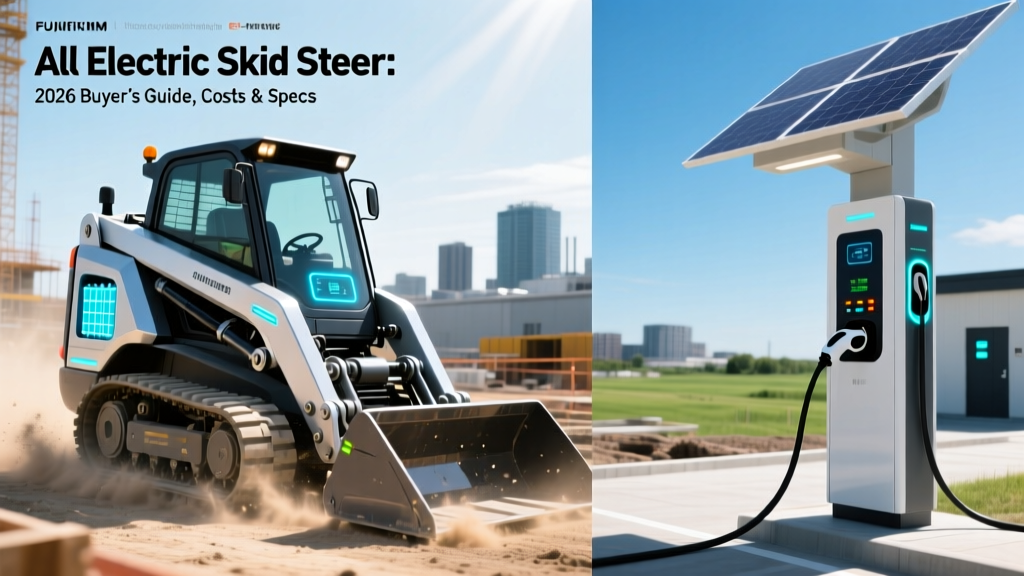
Should You Buy an All Electric Skid Steer in 2026?
The short answer: An all electric skid steer makes financial and operational sense if you work primarily indoors, in noise-restricted zones, or on job sites with access to 240V or DC fast charging — and if your daily duty cycle stays under 6–8 hours of mixed use. Expect to pay 30–50% more upfront than a comparable diesel unit, but recoup that premium in 2–4 years through eliminated diesel costs, near-zero powertrain maintenance, and indoor usability. If you run 10+ hours daily in remote locations without grid power, diesel still wins.
The compact equipment market has shifted. Manufacturers like Volvo CE (ECR25 Electric), Bobcat (T7X concept, now evolving into production models), and Green Machine Equipment have pushed battery-electric compact track loaders and skid steers from trade-show curiosities to real job-site tools. But buying heavy equipment isn't like buying a passenger EV — the metrics, charging infrastructure, and total cost of ownership (TCO) calculations are fundamentally different.
This guide breaks down the exact specs, costs, and ownership realities of going electric in the skid steer segment, using current 2026 pricing and available production models.
Current All Electric Skid Steer Models and Specs
Unlike passenger EVs, electric skid steers don't have EPA range stickers. The relevant metrics are battery capacity (kWh), continuous runtime under load, charge time, and operating capacity (lbs). Here's how the leading 2026 models compare:
| Specification | Volvo ECR25 Electric | Green Machine GME 4000E | Diesel Baseline (Comparable) |
|---|---|---|---|
| Battery Capacity | 20 kWh (LFP) | 40 kWh (LFP) | N/A (diesel tank: ~15 gal) |
| Continuous Runtime | 4–6 hours (mixed duty) | 6–8 hours (mixed duty) | 8–12 hours |
| Operating Capacity | ~1,600 lbs | ~2,000 lbs | 1,600–2,100 lbs |
| Charge Time (240V L2) | ~6 hours (0–100%) | ~8 hours (0–100%) | Refuel: ~5 minutes |
| Charge Time (DC Fast) | ~1 hour (0–80%) | ~1.5 hours (0–80%) | N/A |
| Peak Power Output | ~24 kW | ~45 kW | ~55–74 HP diesel |
| Base MSRP (2026) | ~$62,000 | ~$85,000 | ~$42,000–$55,000 |
| Battery Warranty | 5 years / 5,000 hours | 5 years / 5,000 hours | Powertrain: 2–3 years |
Key terminology: In electric equipment, kWh (kilowatt-hours) measures the battery's total energy capacity — think of it like the diesel tank size. kW (kilowatts) measures the rate of power delivery or charging speed — analogous to horsepower or fuel flow rate. A 40 kWh battery charged at 20 kW takes roughly 2 hours; at 5 kW (a standard 240V outlet), it takes about 8 hours.
Most production electric skid steers use LFP (lithium iron phosphate) battery chemistry rather than the NMC chemistry common in passenger EVs. LFP sacrifices some energy density for dramatically longer cycle life (3,000–5,000+ cycles vs. 1,000–2,000 for NMC), better thermal stability, and no cobalt or nickel sourcing concerns. For equipment that charges daily and operates in hot environments, LFP is the correct engineering choice.
Diesel vs Electric Skid Steer: Real Cost Comparison
The purchase price gap is real — and it's the first objection every fleet manager raises. But TCO tells a different story for the right use case.
| Cost Category (5-Year / 10,000 Hours) | Electric Skid Steer | Diesel Skid Steer |
|---|---|---|
| Purchase Price | $75,000 | $48,000 |
| Fuel / Energy | $4,200 (avg. $0.14/kWh) | $22,500 (avg. $4.50/gal diesel) |
| Engine Maintenance (oil, filters, DEF, belts) | $0 | $8,500 |
| Hydraulic System Maintenance | $2,000 (reduced — electric motors replace some hydraulics) | $5,500 |
| Downtime Cost (est.) | $1,500 | $4,000 |
| Estimated Resale Value | -$25,000 | -$18,000 |
| Net 5-Year Cost | $57,700 | $70,000 |
The electric unit breaks even around year 3 in this scenario. The savings come from three places:
- Energy cost: Electricity at $0.14/kWh delivers equivalent work at roughly 1/5 the cost of diesel at $4.50/gallon. An electric skid steer consuming ~6 kWh per hour of mixed work costs $0.84/hour to "fuel"; a diesel unit burning 1.2 gallons/hour costs $5.40/hour.
- Maintenance elimination: No engine oil changes, no fuel filters, no DEF fluid, no exhaust aftertreatment (DPF/SCR), no fan belts. Electric motors have one moving part. This isn't a marginal savings — it's the elimination of the single largest maintenance category on a diesel machine.
- Downtime reduction: Fewer scheduled maintenance intervals and no surprise engine-related failures mean more billable hours.
Important caveat: These numbers assume you have access to grid power at your shop or job site. If you're running a remote land-clearing operation miles from the nearest transformer, the cost of bringing in a generator or temporary power pole ($3,000–$15,000+) can erase your energy savings entirely. Know your sites.
Charging Infrastructure: What You Actually Need
This is where most first-time electric equipment buyers underestimate the complexity. Unlike a passenger EV that charges overnight at home, a skid steer may need mid-shift charging on a job site.
| Charging Method | Power (kW) | Time to Full (40 kWh Battery) | Infrastructure Required |
|---|---|---|---|
| Standard 120V Outlet | ~1.5 kW | ~27 hours | None — standard outlet |
| 240V Single-Phase (Level 2) | ~7–10 kW | ~4–6 hours | 30–50A dedicated circuit; $500–$2,000 install |
| 480V Three-Phase | ~20–30 kW | ~1.5–2 hours | Industrial service; $2,000–$8,000 install |
| DC Fast Charger (CCS) | ~30–50 kW | ~45–80 min (0–80%) | Dedicated DC unit; $15,000–$40,000+ equipment + install |
Practical recommendation: For most contractors, a 240V/50A circuit at the shop is the minimum viable setup. Plug in at end of shift, fully charged by morning. If you need mid-day top-ups on site, a portable Level 2 unit that connects to a generator-set or temporary power panel is the realistic solution. DC fast charging is typically only justified for large fleets running multiple machines in shifts.
One ownership reality that passenger EV guides rarely address: job site power is often unreliable. Voltage drops on long extension runs, shared circuits with other equipment, and temporary power panels that aren't up to code can all slow charging or trip breakers. Budget for a qualified electrician to assess your most common job sites, not just your shop.
Real-World Runtime: What the Spec Sheet Doesn't Tell You
Manufacturer runtime claims assume "mixed duty" — a blend of travel, lift, dig, and idle. Your actual runtime depends heavily on your work profile:
- Light duty (material handling, grading, travel): Expect 80–100% of rated runtime. Electric motors are efficient at partial load.
- Heavy duty (continuous digging, trenching, high-flow hydraulic attachments): Expect 50–70% of rated runtime. Sustained high-load work drains batteries fast — just as it burns diesel fast.
- Cold weather (below 32°F / 0°C): Expect 15–30% runtime reduction. LFP chemistry is more cold-resistant than NMC, but battery internal resistance still increases, and you may need to power a cab heater. Some units offer battery preconditioning — use it.
- Hot weather (above 95°F / 35°C): LFP handles heat better than NMC, but sustained operation in extreme heat accelerates long-term degradation. Battery thermal management systems vary by manufacturer — ask specifically about active cooling.
The honest math: if your crew regularly runs 10-hour shifts with heavy hydraulic attachments in cold climates, a single-charge electric skid steer will not complete the shift. You'll need either a mid-shift charge window (30–60 minutes), a second battery pack (if the manufacturer offers swappable packs), or you should stay with diesel for that specific machine.
Common Misconceptions About Electric Skid Steers
| Myth | Fact |
|---|---|
| "Electric skid steers don't have enough power for real work." | Electric motors deliver peak torque at 0 RPM — no turbo lag, no power band. A 45 kW electric drivetrain can match a 74 HP diesel in breakout force for short bursts. Sustained heavy digging is where diesel still has an edge in runtime, not instantaneous power. |
| "The battery will need replacing in 3 years." | LFP batteries in current production units are rated for 3,000–5,000+ full charge cycles before reaching 80% capacity. At one cycle per day, that's 8–13+ years before significant degradation. Battery warranties typically cover 5 years / 5,000 hours with a 70–80% capacity retention guarantee. |
| "I can't use hydraulic attachments." | Most electric skid steers retain auxiliary hydraulic circuits powered by electric-driven hydraulic pumps. Flow rates may be slightly reduced vs. diesel at peak demand, but standard attachments (augers, breakers, grapples) work normally. Verify GPM requirements with the manufacturer. |
| "There are no incentives for electric construction equipment." | While the federal §30D tax credit applies to on-road vehicles, many states and utility districts offer separate incentive programs for off-road electric equipment. EPA's clean construction programs and local air quality district grants (especially in California's CARB districts, Texas TCEQ, and Northeast states) can offset 25–50% of purchase cost. Check your state's clean air fund. |
| "Electric means zero maintenance." | Near-zero powertrain maintenance, yes. But you still maintain tracks/wheels, pins and bushings, hydraulic fluid and filters (if equipped), the cooling system, and the battery thermal management system. Grease points don't disappear because the engine did. |
Decision Framework: Is an All Electric Skid Steer Right for You?
Choose an all electric skid steer if:
- You work indoors (warehouses, food processing, demolition inside structures) — zero exhaust emissions is a safety requirement, not a bonus.
- You operate in noise-restricted environments (residential neighborhoods, hospitals, schools, night work) — electric units run 10–15 dB quieter than diesel.
- Your daily runtime needs are under 6–8 hours of mixed duty, or you have a predictable mid-shift charging window.
- You have reliable 240V+ power at your shop or most job sites.
- You plan to keep the machine 4+ years (the TCO break-even point).
- Your local air quality district or utility offers off-road electrification incentives.
Stick with diesel (or wait) if:
- You regularly run 10+ hour shifts with heavy hydraulic attachments and no charging infrastructure on site.
- Your work is predominantly remote (land clearing, rural utility, agriculture) with no grid access.
- You need to run high-flow hydraulic attachments (60+ GPM) continuously — electric hydraulic pumps are improving but still lag diesel-driven systems at the top end.
- You plan to sell the machine within 2–3 years (the upfront premium won't be recouped).
- You operate in extreme cold (below 0°F / -18°C) for extended periods — battery runtime drops significantly and charging slows.
First-Time Buyer Checklist
If you're evaluating your first electric skid steer, work through these items before signing a purchase order:
- Audit your duty cycle. Track hours worked per day, attachment types used, and peak vs. average load for two weeks. Compare against manufacturer runtime data for your specific work profile.
- Survey your power access. Check amperage available at your shop panel. Call an electrician for a quote on a dedicated 240V/50A circuit if you don't have one. For job sites, identify temporary power options.
- Request a demo under YOUR conditions. Don't rely on a dealer-lot demonstration. Get the machine on your site, with your attachments, in your weather. Measure actual kWh consumption per hour.
- Calculate YOUR TCO. Use your actual diesel consumption (gallons/hour × hours/year × $/gallon) and your local electricity rate ($/kWh). Plug in your maintenance cost history. The break-even timeline is specific to your operation.
- Research incentives. Contact your state's clean air fund, your local utility's commercial electrification program, and your equipment dealer's finance department. Some manufacturers bundle incentive applications with purchase.
- Clarify battery end-of-life. Ask the manufacturer: What is the replacement cost after warranty? Is there a battery refurbishment or trade-in program? What is the expected residual value of the machine at 5,000 hours?
Frequently Asked Questions
Can I charge an electric skid steer from a standard job site generator?
Technically yes, but it's slow and defeats much of the economic purpose. A typical 10 kW portable generator delivers roughly 8 kW of usable continuous power to a charger, meaning a 40 kWh battery takes 5+ hours to fill — and you're burning diesel to make electricity at an effective cost of $0.40–$0.70/kWh (vs. $0.10–$0.18/kWh from the grid). Generators make sense as emergency backup, not daily charging strategy.
How does cold weather affect an all electric skid steer?
Expect 15–30% runtime reduction below freezing, and potentially more below 0°F. LFP chemistry is more cold-tolerant than NMC, but it's not immune to physics. Charging also slows in cold temperatures — preconditioning the battery (if the unit supports it) before plugging in restores charge speed. Some manufacturers offer battery heating systems that draw from grid power while plugged in, preserving runtime for actual work.
What happens when the battery reaches end of life?
Current LFP batteries in electric skid steers are rated for 3,000–5,000+ cycles to 80% capacity. At one full cycle per working day, that's roughly 12–20 years before the battery holds less than 80% of original capacity. The machine may be retired for other reasons before the battery is truly "dead." When replacement is needed, expect costs of $8,000–$18,000 depending on capacity — but LFP recycling infrastructure is maturing, and residual value programs are emerging.
Are there federal tax credits for electric construction equipment?
The federal §30D Clean Vehicle Credit applies to on-road vehicles meeting specific MSRP, income, and battery sourcing requirements — it does not cover off-road construction equipment like skid steers. However, the IRA's electrification provisions include separate programs for commercial and industrial equipment, and many state-level programs specifically target off-road diesel replacement. The EPA's clean construction initiatives and your state's air quality management district are the best starting points.
How does the resale value of an electric skid steer compare to diesel?
This is still an open question in 2026 — the used electric equipment market is thin. Early indicators suggest that well-maintained electric units with documented battery state-of-health hold value comparably to diesel, particularly among buyers who need indoor-capable equipment. However, the smaller pool of potential buyers can mean longer time-to-sale. As more fleets electrify and battery health reporting standardizes, this market will mature.
The all electric skid steer is no longer experimental — it's a viable production tool for the right operation. The key is matching the machine's capabilities honestly to your specific duty cycle, power access, and financial timeline, rather than buying on principle alone.