Quick Answer: Is an All Electric Semi Truck Viable in 2026?
Yes — but only for specific duty cycles. The leading all electric semi truck models in 2026 (Tesla Semi, Freightliner eCascadia, Volvo VNR Electric, Peterbilt 579EV) deliver between 150 and 500 miles of EPA-estimated range with battery packs from 200 to 900 kWh. They cost 2–3× more upfront than diesel equivalents ($250,000–$400,000 before incentives), but can save $30,000–$80,000 per truck per year in fuel and maintenance on regional and drayage routes under 300 miles. Long-haul routes exceeding 400 miles remain impractical due to charging time and infrastructure gaps. Federal IRC §45W commercial clean vehicle credits (up to $40,000 for Class 8 trucks) and state voucher programs like California's HVIP significantly narrow the purchase-price gap.
The 2026 All Electric Semi Truck Landscape: Who's Selling What
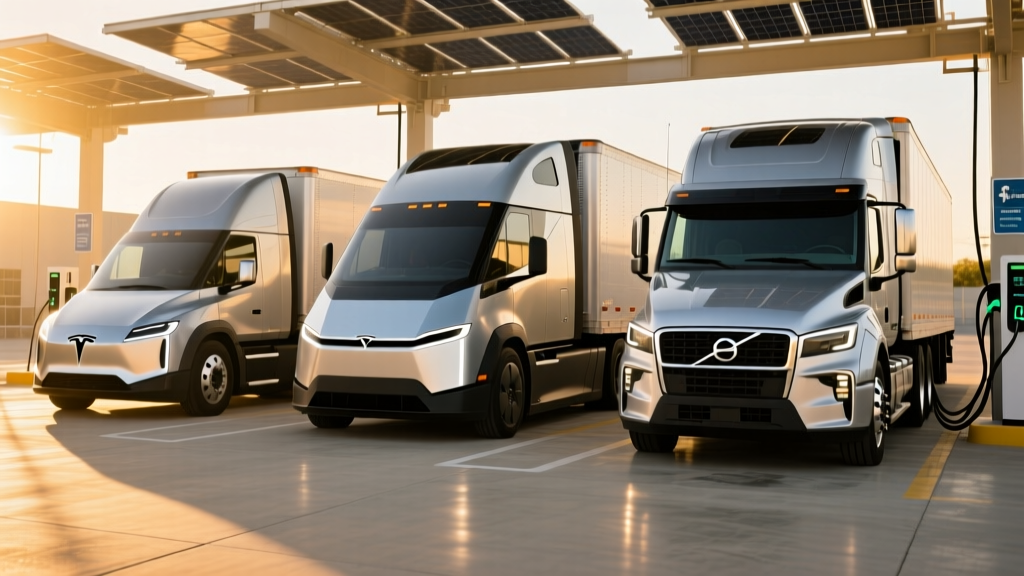
The Class 8 electric semi market has matured past the early-adopter phase. As of the 2026 model year, four primary OEMs are delivering production vehicles at meaningful scale, each with distinct range, payload, and charging characteristics. Here is how the major platforms stack up against each other and against a baseline diesel.
| Spec | Tesla Semi (2026) | Freightliner eCascadia | Volvo VNR Electric | Peterbilt 579EV | Diesel Baseline (Cascadia DD15) |
|---|---|---|---|---|---|
| EPA Est. Range (loaded) | 500 mi (est.) | 230 mi | 275 mi | 150 mi | ~1,200 mi (twin tanks) |
| Battery Capacity (usable) | ~900 kWh (LFP/NMC) | 438 kWh (NMC) | 565 kWh (NMC) | 396 kWh (NMC) | N/A — diesel |
| Peak DC Charge Rate | 1,000 kW (Megacharger) | 350 kW (CCS2) | 250 kW (CCS2) | 350 kW (CCS2) | ~15 min (diesel fill) |
| 10–80% Charge Time (loaded) | ~30 min | ~90 min | ~90 min | ~80 min | N/A |
| Motor Power | ~1,000+ hp (tri-motor) | ~470 hp (eAxle) | ~455 hp (dual eAxle) | ~670 hp (dual motor) | ~400–505 hp |
| GCWR (max) | 82,000 lbs | 82,000 lbs | 82,000 lbs | 82,000 lbs | 80,000 lbs |
| Payload Penalty vs. Diesel | ~5,000–7,000 lbs | ~4,000 lbs | ~4,500 lbs | ~4,200 lbs | Baseline |
| Base MSRP (approx.) | $250,000–$290,000 | $300,000–$350,000 | $330,000–$380,000 | $310,000–$360,000 | $130,000–$170,000 |
| Warranty (battery/powertrain) | 8 yr / 1,000,000 mi | 5 yr / 300,000 mi (battery) | 5 yr / 300,000 mi | 5 yr / 300,000 mi | 5 yr / 500,000 mi (engine) |
Note: Tesla Semi range figures are manufacturer-estimated; independent EPA testing for Class 8 tractors differs from light-duty procedures. Real-world range varies significantly with payload, grade, speed, and ambient temperature. Sources: Freightliner eCascadia specs, Volvo VNR Electric.
Electric Semi vs. Diesel: Total Cost of Ownership
The purchase price of an all electric semi truck is the headline shock — often 2–3× the cost of a comparable diesel day cab. But fleet procurement decisions hinge on total cost of ownership (TCO) over the vehicle's service life, typically 5–7 years or 500,000–750,000 miles. The economics shift dramatically when you account for fuel, maintenance, incentives, and residual value.
| Cost Category | All Electric Semi (e.g., eCascadia) | Diesel Equivalent |
|---|---|---|
| Purchase Price (after incentives) | $210,000 (after $40K §45W + $50K HVIP) | $150,000 |
| Fuel/Energy (5 years, 300,000 mi) | $60,000 ($0.20/mi @ depot charging) | $180,000 ($0.60/mi @ $4.50/gal, 5 mpg) |
| Maintenance (5 years) | $15,000 | $45,000 |
| Charging Infrastructure (allocated per truck) | $30,000–$60,000 | $0 |
| Insurance (5 years) | $40,000 | $35,000 |
| DEF / Exhaust Aftertreatment | $0 | $8,000 |
| Total 5-Year Cost | $355,000–$385,000 | $418,000 |
| Cost Per Mile | $1.18–$1.28 | $1.39 |
The math works best for high-utilization regional routes where trucks return to a depot nightly. Depots with negotiated commercial electricity rates ($0.08–$0.15/kWh) can charge for roughly $0.15–$0.25 per mile — a fraction of diesel's $0.55–$0.75 per mile at 2026 fuel prices. Maintenance savings are substantial: no oil changes, no DPF/SCR regeneration, no transmission fluid, and regenerative braking that extends brake life by 2–3×.
The flip side is infrastructure cost. Installing a single 350 kW CCS2 depot charger can run $80,000–$150,000 per stall, including transformer upgrades, trenching, and utility demand charges. Fleets of 10+ trucks often require dedicated medium-voltage utility service, adding $200,000–$500,000 in grid interconnection costs with lead times of 12–24 months.
Range Reality: What the Sticker Doesn't Tell You
Range is the single most scrutinized spec on any all electric semi truck, and it's where marketing claims diverge most sharply from operational reality. Several factors compress real-world range below published estimates:
Real-World Range Adjustments for Class 8 Electric Semis
- Fully loaded at 80,000 lbs GCW: Expect 70–85% of published range. A 230-mile rated eCascadia delivers ~165–195 miles at max weight.
- Cold weather (below 20°F): Battery internal resistance increases and cab heating draws significant energy. Add a 20–35% range reduction on top of load penalty.
- Sustained highway speeds (70+ mph): Aerodynamic drag dominates at Class 8 speeds. Efficiency drops 15–25% compared to 55–60 mph cruise.
- Mountain grades: Ascending a 6% grade at full load can consume energy at 3–4× the flat-rate. Regenerative braking recovers some energy on descent, but net range still drops significantly on hilly routes.
- Charge curve taper: The published 10–80% charge time assumes starting at low SoC. Charging from 80–100% can take as long as 10–80%, so operational planning should target 80% ceiling for fastest turnaround.
For context, the Freightliner eCascadia's 230-mile EPA-estimated range is realistic for a partially loaded truck on a flat route at moderate speeds. Fleet operators planning routes should model their worst-case scenario — full load, winter, highway speeds — and add a 15–20% reserve margin. If that worst case exceeds your route distance, the truck is viable. If not, you need either a mid-route charging stop or a different platform.
Charging Infrastructure: The Real Bottleneck
Unlike light-duty EVs that can piggyback on a growing public charging network, Class 8 electric semis require purpose-built infrastructure. The constraints are physical, electrical, and temporal.
| Level | Power (kW) | Connector | Miles Added per Hour | Typical Use Case |
|---|---|---|---|---|
| Depot Level 2 (AC) | 19–80 kW | J1772 / Type 2 | ~10–40 mi/hr | Overnight charging (8–12 hr dwell) |
| Depot DC Fast | 120–350 kW | CCS2 | ~60–180 mi/hr | Opportunity charging, shift turnover |
| Megawatt Charging (MCS) | 600–1,200 kW | MCS connector (emerging) | ~300–600 mi/hr | En-route highway corridor charging |
| Tesla Megacharger | ~1,000 kW | Proprietary (Tesla Semi only) | ~500+ mi/hr | Tesla Semi dedicated network |
The dominant model in 2026 remains depot-based overnight charging at Level 2 or low-power DC. A truck with a 438 kWh battery charging at 40 kW AC needs roughly 10 hours to go from 10–100% SoC — fine for a single-shift operation where the truck returns by 7 PM and departs at 5 AM. For two-shift or continuous operations, fleets are installing 150–350 kW DC chargers that can replenish 60–80% in 60–90 minutes during driver changeover.
The Megawatt Charging System (MCS) standard, developed by CharIN, is the industry's answer to the long-haul charging gap. Pilot corridors along I-5 in California and I-80 in the Midwest are operational as of 2026, but coverage remains sparse. Full MCS deployment at truck stops nationwide is a 2028–2030 timeline at best. Until then, public charging for Class 8 trucks is a patchwork of utility-funded pilot sites and OEM-specific networks.
Incentives and Tax Credits: Narrowing the Price Gap
The economics of an all electric semi truck hinge significantly on available incentives, which are layered across federal, state, and utility programs:
Federal IRC §45W Commercial Clean Vehicle Credit
- Credit amount: Up to $40,000 for vehicles with GVWR over 14,000 lbs (Class 8 qualifies)
- Calculation: Lesser of 30% of vehicle cost or the incremental cost over a comparable ICE vehicle, capped at $40,000
- Domestic content: Vehicle must be assembled in North America; battery components and critical minerals have phase-in sourcing requirements through 2026–2027
- Transferability: Beginning 2024, commercial buyers can transfer the credit to the dealer/manufacturer for a point-of-sale price reduction
- No per-manufacturer cap: Unlike the consumer §30D credit, §45W has no manufacturer volume phase-out
- Reference: See IRS §45W guidance for full eligibility details — consult a tax professional for your fleet's specific situation
State programs can stack on top. California's Hybrid and Zero-Emission Truck and Bus Voucher Incentive Project (HVIP) offers $45,000–$120,000 per Class 8 electric truck depending on fleet size and drayage eligibility. New York, New Jersey, and several other states have similar (though smaller) voucher programs. Combined with utility make-ready incentives that cover 50–100% of charging infrastructure costs, some fleets are achieving near-parity TCO from day one on qualifying routes.
Common Misconceptions About Electric Semis
| Myth | Fact |
|---|---|
| "Electric semis can't pull full loads." | All major platforms are rated for 82,000 lbs GCWR. The payload penalty is real (4,000–7,000 lbs of battery weight) but within legal axle-weight limits for most freight. Weight-sensitive commodities (e.g., liquids, aggregates) may lose payload revenue. |
| "Batteries won't last the life of the truck." | Class 8 battery packs are designed for 1,000,000+ mile service life with NMC chemistry at conservative C-rates. Tesla warranties its Semi battery for 1 million miles. Degradation to ~80% capacity is expected at 600,000–800,000 miles — still viable for shorter routes. |
| "Charging takes too long for freight logistics." | For depot-based single-shift operations, overnight Level 2 charging is sufficient. For multi-shift, 350 kW DC opportunity charging during mandated 30-minute driver rest breaks (FMCSA HOS rules) recovers 100–150 miles. MCS at 1 MW+ can add 300+ miles in 20 minutes. |
| "The grid can't handle fleet charging." | A 20-truck depot charging at 350 kW simultaneously draws ~7 MW — equivalent to a small neighborhood. This requires utility coordination and often a dedicated feeder line. Lead times of 12–24 months for grid upgrades are the real bottleneck, not generation capacity. |
| "Electric semis are zero-emission everywhere." | Tailpipe emissions are zero, but lifecycle emissions depend on grid mix. Charging in a coal-heavy region (e.g., Wyoming, West Virginia) reduces but does not eliminate the carbon advantage. In California or the Pacific Northwest, the reduction is 75–90% vs. diesel. |
Decision Framework: Which Fleets Should Go Electric Now
Buy an All Electric Semi Truck If:
- Your routes are under 250 miles round-trip with predictable daily patterns (drayage, regional distribution, port operations, refuse, beverage delivery)
- You have depot access with 8+ hours of overnight dwell time and the ability to install charging infrastructure (or lease from a charging-as-a-service provider)
- You operate in a state with strong incentives (CA, NY, NJ, WA, OR, CO) that bring net purchase cost within 30–40% of diesel
- Your fleet faces regulatory mandates (California's Advanced Clean Fleets rule, CARB drayage requirements, or corporate ESG commitments from shippers like Amazon, Walmart, UPS)
- Your freight is weight-tolerant — you don't lose significant revenue from a 4,000–7,000 lb payload reduction
Wait or Choose Diesel/Hydrogen If:
- Your routes exceed 350 miles with no mid-route charging infrastructure available
- You operate in extreme cold climates (northern MN, MT, AK) where range reduction compounds route-length issues
- Your freight is weight-critical and the battery payload penalty directly cuts revenue per load
- You lack depot charging access and operate in regions with no public MCS/CCS2 truck charging
- Your utility cannot provide adequate grid service within your operational timeline (2+ year upgrade lead time)
Frequently Asked Questions
What is the cheapest all electric semi truck available in 2026?
The Tesla Semi is positioned as the lowest-cost entry at approximately $250,000 for the 300-mile variant and $290,000 for the 500-mile variant — before incentives. However, production volume and delivery timelines remain constrained. The Freightliner eCascadia, at $300,000–$350,000, is the most widely available and serviceable platform through the Daimler Truck dealer network.
How much does it cost to charge an electric semi truck?
At a commercial depot rate of $0.10/kWh, fully charging a 438 kWh eCascadia battery costs roughly $44. At 2.0 kWh/mile consumption, that's $0.20 per mile — compared to $0.60 per mile for diesel at $4.50/gallon and 5 mpg. Annual energy savings of $20,000–$35,000 per truck are typical for 60,000-mile/year regional routes. Public DC fast charging is significantly more expensive ($0.30–$0.60/kWh), so depot charging is critical to the economic case.
Can electric semi trucks handle cold weather?
They can, but with meaningful range penalties. At 0°F, expect 25–35% range loss from combined battery inefficiency and cab/climate-system heating. Battery thermal management systems (liquid heating/cooling) mitigate but don't eliminate this. Fleets in cold climates should spec larger battery packs or plan shorter routes in winter. Preconditioning the battery while still plugged in recovers some efficiency.
What happens when the battery degrades?
Class 8 electric semi batteries are engineered for gradual degradation rather than sudden failure. Typical NMC chemistry at conservative charge/discharge rates retains 80–85% capacity after 500,000–800,000 miles. A truck that started with 230 miles of range may have 175–185 miles at 600,000 miles — still viable for many drayage routes. Full battery replacement costs $80,000–$150,000 depending on pack size, but is rarely needed within the truck's first service life. Most OEMs warrant batteries at 70–80% capacity retention for 5 years/300,000 miles (Tesla: 8 years/1,000,000 miles).
Do I need a special license or training to operate an electric semi?
No. A standard Class A CDL covers electric semi operation. However, drivers benefit from training on regenerative braking behavior (which can be aggressive and requires adaptation), SoC management, route planning around charge stops, and preconditioning procedures. Maintenance technicians need high-voltage certification (typically OEM-provided) for any work on the battery or power electronics.
Is hydrogen fuel cell a better option for long-haul trucking?
Hydrogen fuel cell trucks (e.g., Toyota Kenworth T680 FCEV, Nikola Tre FCEV) offer 500+ mile range and 15–20 minute refueling — advantages for long-haul. However, hydrogen fuel costs $15–$30/kg (equivalent to $0.40–$0.80/mile), and fueling stations are extremely scarce outside Southern California. For most fleets in 2026, battery-electric is the more practical and cost-effective zero-emission option for routes under 300 miles, while hydrogen remains a niche play for specific long-haul corridors with established fueling.