The Quick Answer: Is an All Electric Porsche Worth It?
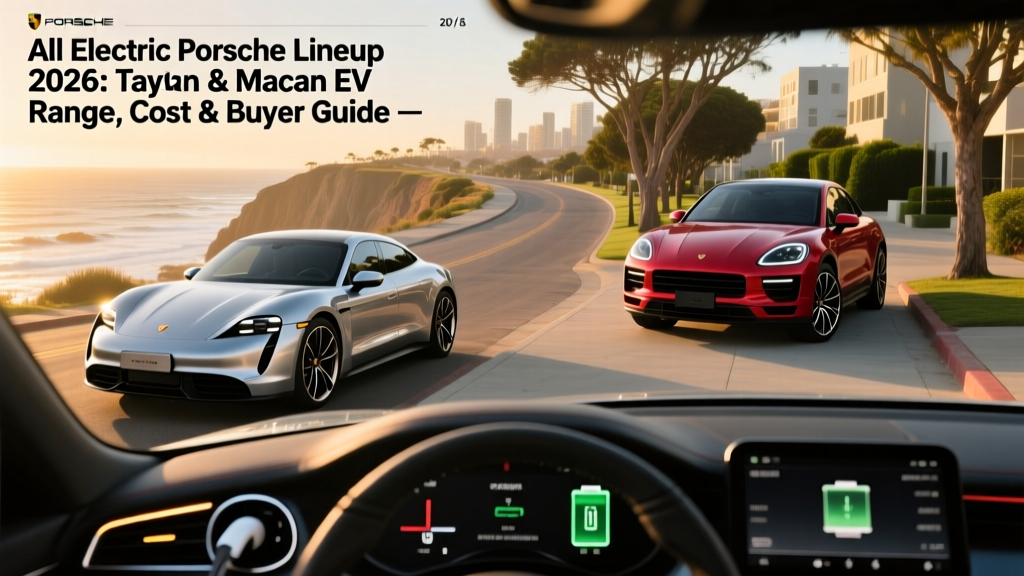
Porsche currently sells two all-electric models in the U.S.: the Taycan sedan/cross-turismo (starting ~$92,000) and the Macan EV (starting ~$78,800). Both use an 800-volt architecture enabling some of the fastest DC charging in the industry — the Taycan peaks at 320 kW and can add 10-80% in roughly 18 minutes on a capable charger. Real-world range varies from 225 to 318 miles (EPA) depending on trim and wheel size. Neither qualifies for the $7,500 federal §30D tax credit due to MSRP caps and battery sourcing rules. Total five-year ownership cost runs $85,000–$120,000+ depending on trim, insurance, and whether you charge at home or rely on public DC fast charging.
The 2026 All Electric Porsche Lineup at a Glance
Porsche's electrification strategy has narrowed to two production EVs available now, with the Cayenne EV expected later. Here's how the current lineup breaks down by the numbers that matter most.
| Spec | 2025 Taycan (Base) | 2025 Taycan 4S | 2025 Taycan Turbo GT | 2025 Macan EV (Base) | 2025 Macan 4 EV |
|---|---|---|---|---|---|
| Base MSRP | $91,900 | $106,900 | $230,000 | $78,800 | $89,600 |
| Battery (usable kWh) | 82.3 kWh (NMC) | 97.0 kWh (NMC) | 97.0 kWh (NMC) | 95.0 kWh (NMC) | 95.0 kWh (NMC) |
| EPA Range | 225 mi | 283 mi | 269 mi | 288 mi | 270 mi |
| Peak DC Charge Rate | 320 kW | 320 kW | 320 kW | 270 kW | 270 kW |
| 10–80% DCFC Time | ~18 min | ~18 min | ~18 min | ~21 min | ~21 min |
| Level 2 Rate (kW) | 11 kW | 11 kW | 11 kW | 11 kW | 11 kW |
| 0–60 mph | 4.5 sec | 3.4 sec | 2.1 sec | 5.1 sec | 4.3 sec |
| Horsepower | 402 hp | 590 hp (launch) | 1,019 hp (launch) | 335 hp | 402 hp (launch) |
| Drivetrain | RWD | AWD | AWD | RWD | AWD |
| Battery Warranty | 8 yr / 100k mi | 8 yr / 100k mi | 8 yr / 100k mi | 8 yr / 100k mi | 8 yr / 100k mi |
Real-World Range vs. EPA Sticker
Porsche's EPA numbers are conservative compared to some rivals, but real-world conditions still matter. Expect highway driving at 75 mph to reduce range by 10–15% versus the EPA combined figure. In cold weather (below 32°F), plan for 20–30% range loss unless you precondition the battery while plugged in. The Taycan 4S with the larger 97 kWh pack and 19-inch wheels is the range sweet spot — owners report 260–270 miles on mixed highway trips. The base Taycan's 225-mile EPA figure means realistic highway range closer to 190–200 miles in winter, which demands route planning on trips beyond 150 miles.
Charging Speed: Where Porsche's 800V Architecture Pays Off
Porsche uses an 800-volt battery architecture (most competitors run 400V), which enables higher charge rates with less heat buildup and thinner, lighter wiring. The updated Taycan's peak 320 kW charge rate is among the fastest of any production EV sold in the U.S.
Here's the critical nuance: peak kW is not sustained kW. The 320 kW figure applies roughly between 10% and 30% state of charge. The charge curve tapers progressively — by 60% SoC you'll see roughly 180–200 kW, and above 80% it drops below 50 kW to protect the battery. That's why the industry standard metric is 10–80% time, not peak rate.
| Charging Level | Power (kW) | Miles Added per Hour | Typical Use Case |
|---|---|---|---|
| Level 1 (120V household) | ~1.4 kW | ~4–5 mi/hr | Emergency/overnight trickle |
| Level 2 (240V home) | 11 kW (max) | ~32–38 mi/hr | Daily home charging (~8 hr for full) |
| DC Fast Charge (Taycan) | Up to 320 kW | ~600+ mi/hr (peak) | Road trips; 10–80% in ~18 min |
| DC Fast Charge (Macan EV) | Up to 270 kW | ~500+ mi/hr (peak) | Road trips; 10–80% in ~21 min |
Connector note: Porsche uses the NACS (Tesla-style) connector starting with 2025 model-year vehicles, giving native access to Tesla Superchargers (V3 and V4). CCS adapters are available for Electrify America and other networks. Porsche also includes three years of complimentary 30-minute charging sessions at Electrify America stations.
All Electric Porsche vs. Gas Porsche: Cost & Performance Comparison
Buyers cross-shopping an all electric Porsche against a gas Cayenne or Panamera need to see the numbers side by side. The EV wins on acceleration and running cost; the gas car wins on upfront price and long-distance flexibility in charging-sparse regions.
| Metric | 2025 Taycan 4S (EV) | 2025 Panamera 4 (Gas) | 2025 Macan 4 EV | 2025 Macan S (Gas) |
|---|---|---|---|---|
| MSRP | $106,900 | $103,900 | $89,600 | $69,300 |
| 0–60 mph | 3.4 sec | 4.7 sec | 4.3 sec | 4.6 sec |
| Fuel/Energy Cost per Mile | ~$0.045 (home) / ~$0.14 (DCFC) | ~$0.17 (premium gas) | ~$0.045 (home) / ~$0.14 (DCFC) | ~$0.16 (premium gas) |
| Annual Fuel/Energy (12k mi) | $540 (home) / $1,680 (DCFC) | $2,040 | $540 (home) / $1,680 (DCFC) | $1,920 |
| Estimated Annual Maintenance | ~$400 | ~$900 | ~$400 | ~$850 |
| Estimated Annual Insurance | ~$3,200 | ~$2,800 | ~$2,600 | ~$2,200 |
| EPA Efficiency | 83 MPGe combined | 21 MPG combined | 84 MPGe combined | 21 MPG combined |
Energy costs based on $0.15/kWh home electricity and $0.48/kWh average DCFC. Gas costs based on $4.25/gal premium. Actual costs vary by region and driving pattern. Source: fueleconomy.gov
Five-Year Ownership Cost Breakdown
Here's what five years actually costs for the two most popular all electric Porsche configurations, assuming 12,000 miles per year and predominantly home charging.
| Cost Category (5 Years) | Taycan 4S | Macan 4 EV |
|---|---|---|
| Purchase Price (MSRP) | $106,900 | $89,600 |
| Federal Tax Credit (§30D) | $0 (exceeds MSRP cap) | $0 (exceeds MSRP cap) |
| State Incentives | Varies — check local programs | Varies — check local programs |
| Home Charger Install (Level 2) | $1,200–$2,500 | $1,200–$2,500 |
| Energy/Fuel (60,000 mi total) | $2,700–$8,400 | $2,700–$8,400 |
| Maintenance (5 years) | ~$2,000 | ~$2,000 |
| Insurance (5 years) | ~$16,000 | ~$13,000 |
| Estimated Depreciation | ~$48,000 | ~$38,000 |
| Total 5-Year Cost | ~$129,500–$186,500 | ~$107,500–$153,500 |
Key takeaway: Insurance is a major line item — Porsche EVs carry premiums 15–25% higher than their gas counterparts due to repair costs and parts pricing. Get quotes before purchasing. Depreciation on the Taycan has been steep (45–55% over five years based on current resale data), though the Macan EV is too new for long-term resale tracking.
Federal Tax Credit & Incentive Reality
§30D Federal Tax Credit: Why Porsche EVs Don't Qualify
- MSRP Cap: Sedans (Taycan) must be under $55,000; SUVs/trucks (Macan) under $80,000. The Macan EV base starts at $78,800 — technically under the SUV cap, but once options push it over $80,000, eligibility is lost.
- Battery Sourcing: Even if MSRP qualifies, the battery must meet critical-mineral and component sourcing thresholds set by the IRS under §30D. Porsche's supply chain currently does not meet these thresholds.
- Buyer Income Cap: AGI must not exceed $150K (single) / $300K (joint) — likely a non-issue for Porsche buyers, but still a legal requirement.
- Point-of-Sale Transfer: If eligible, the credit can be transferred to the dealer at purchase for an immediate price reduction. Currently not applicable to Porsche EVs.
State incentives may apply. Some states (California, Colorado, Massachusetts, and others) offer their own EV rebates or tax credits that have no MSRP cap. Check your state's energy office or DMV for current programs. These can range from $1,000 to $5,000+ depending on jurisdiction and income.
Real-World Ownership: What First-Time Porsche EV Buyers Must Know
Home Charging Is Nearly Mandatory
Charging a Taycan or Macan EV exclusively on public DC fast chargers costs roughly 3x more per mile than home Level 2 charging ($0.14/mi vs. $0.045/mi). Over 12,000 annual miles, that's a $1,140 annual premium. If you cannot install a Level 2 charger at home (apartment living, older electrical panel), factor in the time cost of 2–3 public charging sessions per week and the higher energy cost before committing.
Electrical panel note: Both Porsche EVs accept up to 11 kW on Level 2, which requires a 60-amp circuit (48-amp continuous draw). Many homes need a panel upgrade from 100A to 200A service to support this — budget $2,000–$4,000 for that upgrade if needed. Consult a licensed electrician for your specific situation.
Cold Weather Demands Strategy
Porsche's liquid-cooled battery thermal management is effective, but physics is physics. In sustained sub-freezing temperatures:
- Expect 20–30% range reduction
- DC fast charging will be slower until the battery warms — always use preconditioning (set a departure time or navigate to a charger in the PCM infotainment system) to warm the pack before arriving
- Regenerative braking is limited when the battery is cold — plan for more friction-brake use in the first 10–15 minutes of driving
Charging Network Reliability
With the NACS connector (2025+ models), Porsche owners gain native access to Tesla Superchargers — currently the most reliable public charging network in the U.S. with over 99% uptime. Electrify America and EVgo are expanding but still suffer from occasional downtime. For road trips, the Porsche Charging Planner in the navigation system will route you through working chargers and precondition the battery automatically.
Myths vs. Facts About All Electric Porsche Ownership
| Myth | Fact |
|---|---|
| "The battery will need replacing in 5 years and cost $30K" | Porsche warranties the battery for 8 years/100,000 miles with a minimum 70% capacity retention threshold. NMC chemistry in modern thermal-managed packs typically degrades 1–2% per year. A full replacement (if ever needed out of warranty) runs $18,000–$25,000, but most packs outlast the car's ownership cycle. |
| "EVs are slower than gas Porsches" | The Taycan Turbo GT hits 0–60 in 2.1 seconds — faster than any production Porsche 911. Instant torque delivery means real-world acceleration feels even quicker than the numbers suggest. |
| "I can't take a Porsche EV on road trips" | With 10–80% charging in ~18 minutes and NACS Supercharger access, a 500-mile trip requires one 20-minute stop. The Porsche Charging Planner handles routing. The limitation is charging-desert regions (rural Montana, parts of the Dakotas) — plan those routes carefully. |
| "EVs cost more to maintain" | EVs have no engine oil, spark plugs, timing belts, or transmission fluid. Brake pad life is extended 2–3x thanks to regenerative braking. Typical annual maintenance is $300–$500 vs. $800–$1,200 for a gas Panamera. |
| "I'll save $7,500 on taxes" | Neither the Taycan nor most Macan EV trims qualify for the federal §30D credit due to MSRP caps and battery sourcing requirements. Check IRS qualifying vehicle lists before assuming eligibility. |
Decision Framework: Which All Electric Porsche Is Right for You?
Choose the Taycan 4S if:
- You prioritize driving dynamics and sedan styling over cargo space
- You want the best range in the lineup (283 mi EPA with the Performance Battery Plus)
- You regularly drive spirited back roads and value the lower center of gravity
- Your budget accommodates $107K+ before options
Choose the Macan 4 EV if:
- You need SUV practicality (cargo space, easier ingress/egress, higher seating position)
- You want the most affordable entry into an all electric Porsche (~$89,600)
- Daily driving involves school runs, groceries, and weekend trips more than canyon carving
- You want AWD capability with 402 hp and a sub-4.5-second 0–60
Choose the base Taycan (RWD) if:
- You live in a mild climate and don't need AWD
- You want the lowest MSRP entry ($91,900) and are okay with 225 miles of range
- Your daily commute is under 100 miles round-trip with home charging
Wait if:
- You need three rows of seating — the Cayenne EV is announced but not yet available
- You cannot install home Level 2 charging and your area has sparse public DCFC infrastructure
- You plan to regularly tow — the Macan EV is rated for 4,400 lbs, but range drops significantly under load
Frequently Asked Questions
What is the real-world range of the Taycan 4S on a road trip?
On a 75-mph highway drive in 70°F weather, expect roughly 250–265 miles from the 97 kWh Performance Battery Plus before needing to charge. In winter conditions (30°F), plan for 200–220 miles. Always keep a 10–15% buffer for charger availability.
Does the Macan EV use the same platform as the gas Macan?
No. The Macan EV rides on the PPE (Premium Platform Electric) architecture co-developed with Audi, featuring 800V capability. The gas Macan uses the MLB Evo platform. They share no structural components, though interior design language is similar.
Can I charge a Porsche EV at a Tesla Supercharger?
Yes, if your Porsche is a 2025 or newer model year with the native NACS charge port. Earlier model-year Taycans with CCS ports can use a CCS-to-NACS adapter (sold by Porsche and third parties) for Supercharger access, though charge rates may be limited by the adapter.
How long does the battery last before needing replacement?
Porsche warrants the high-voltage battery for 8 years or 100,000 miles with a guaranteed minimum of 70% state of health. Independent data from Recurrent Auto shows modern NMC packs with active thermal management typically retain 85–90% capacity at 100,000 miles. Full replacement is rare and typically only needed after severe damage or extreme degradation well beyond the warranty period.
Is Porsche's ADAS system self-driving?
No. Porsche's InnoDrive and Active Lane Keeping are SAE Level 2 driver-assistance systems. The driver must remain fully engaged, keep hands on or near the wheel, and monitor the road at all times. This is not comparable to Waymo's Level 4 robotaxi service. Porsche does not currently market or sell any autonomous driving capability.
What does home charging installation cost for a Porsche EV?
A typical Level 2 home installation (Porsche Mobile Charger Connect or a third-party unit like ChargePoint Home Flex) on a 60-amp circuit costs $1,200–$2,500 including the charger ($500–$700), electrician labor ($500–$1,500), and permits ($50–$200). If your home needs a panel upgrade from 100A to 200A service, add $2,000–$4,000. Always get a quote from a licensed electrician before purchasing.
How does Porsche EV insurance compare to gas models?
Expect to pay 15–25% more for insurance on a Taycan or Macan EV versus the gas equivalent. Average annual premiums range from $2,400–$3,600 depending on trim, driving record, and state. Higher repair costs for collision damage to the battery enclosure and specialized body panels drive the premium. Always get quotes from at least three insurers before finalizing your purchase.