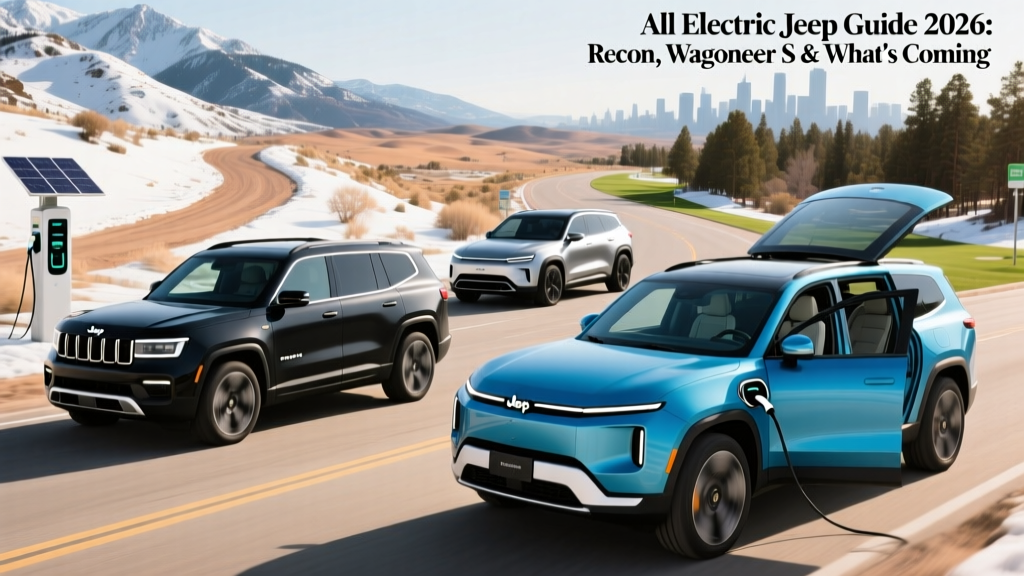
The Quick Answer: Is There an All Electric Jeep You Can Buy Right Now?
Yes. For the 2025-2026 model years, Jeep sells two fully electric models in the U.S.: the Jeep Recon (a boxy, off-road-oriented SUV on Stellantis' STLA Large BEV platform) and the Wagoneer S (a performance-luxury fastback SUV on the STLA Large platform). Both use NMC battery chemistry, offer standard all-wheel drive, and target between 300 and 400 miles of EPA-estimated range depending on trim. The Wrangler 4xe and Grand Cherokee 4xe remain plug-in hybrids, not fully electric. If you want a zero-tailpipe-emissions Jeep today, the Recon and Wagoneer S are your only options — and neither qualifies cleanly for the full $7,500 federal §30D tax credit due to battery-sourcing rules as of 2026.
The 2026 All Electric Jeep Lineup at a Glance
Jeep's electric strategy has been a slow burn. After years of concept teasers, two production BEVs are now on dealer lots, with more planned. Here is exactly what you can order today, plus what Stellantis has announced for the near future.
| Spec | Jeep Recon | Wagoneer S |
|---|---|---|
| Platform | STLA Large BEV | STLA Large BEV |
| Battery (usable, est.) | ~100 kWh NMC | ~100 kWh NMC |
| EPA Range (est.) | ~320–350 mi | ~380–400 mi |
| Drivetrain | AWD (dual motor) | AWD (dual motor) |
| Horsepower | ~600 hp (top trim) | ~600 hp (Launch Edition) |
| 0–60 mph | ~4.0 sec (est.) | ~3.4 sec (Launch Edition) |
| Peak DC Fast Charge | ~175 kW | ~175 kW |
| 10–80% DC Charge Time | ~28 min (est.) | ~28 min (est.) |
| Level 2 Charge Rate | 11.5 kW | 11.5 kW |
| Charging Port | NACS (Tesla-compatible) | NACS (Tesla-compatible) |
| Starting MSRP | ~$55,000 | ~$65,995 (Launch Ed.) |
| Battery Warranty | 8 yr / 100,000 mi | 8 yr / 100,000 mi |
Note: Stellantis has released preliminary specs; final EPA certification figures may vary by trim. Always verify on fueleconomy.gov before purchasing.
Real-World Range: What the EPA Sticker Won't Tell You
The EPA range estimates for the Recon and Wagoneer S look competitive on paper, but real-world conditions matter — especially for a brand whose buyers expect to drive into remote terrain and cold climates.
Range Reality Check
Jeep Recon (EPA est. ~330 mi): Expect roughly 270–290 miles on a highway road trip at 70–75 mph. In sub-freezing temperatures (below 32°F), plan for 220–250 miles of usable range. The Recon's boxy shape creates higher aerodynamic drag than a sleek crossover, which hits efficiency hardest at highway speeds.
Wagoneer S (EPA est. ~390 mi): The more aerodynamic fastback shape helps. Expect 310–340 miles highway, and roughly 260–290 miles in winter cold. Its lower drag coefficient makes it the better road-trip choice of the two.
Neither vehicle has been independently verified for range by third-party testers as of early 2026, so treat these projections as estimates based on platform physics, battery size, and comparable STLA Large vehicles. Both use liquid-cooled NMC battery packs with active thermal management, which helps mitigate extreme cold losses compared to passively cooled packs — but NMC chemistry still loses 20–30% of capacity in sustained sub-zero driving, per AAA's EV range testing.
Charging the All Electric Jeep: Speeds, Connectors, and Home Setup
Jeep has standardized on the NACS (North American Charging Standard) connector for both models, meaning native access to the Tesla Supercharger network — the most reliable public DC fast-charging network in North America. No adapter is required.
| Level | Power | Miles of Range Added per Hour | Typical Use Case |
|---|---|---|---|
| Level 1 (120V) | ~1.4 kW | ~4–5 mi/hr | Emergency / trickle only |
| Level 2 (240V, 48A) | 11.5 kW | ~35–40 mi/hr | Daily home / workplace charging |
| DC Fast Charge | Peak ~175 kW | ~250+ mi in 30 min | Road trips, highway corridors |
The Charging Curve Reality
The ~175 kW peak charge rate is not sustained across the entire session. Like most NMC packs, the Recon and Wagoneer S will charge fastest between roughly 10–50% state of charge (SoC), then taper significantly. Expect the 10–80% session to take around 28 minutes at a 250 kW or higher Supercharger or Electrify America station, but a session from 80–100% can add another 20–25 minutes. For road trips, plan stops around the 10–80% window to minimize time at the charger.
Home Charging Installation Costs
To get the full 11.5 kW Level 2 charge rate at home, you need a 240V, 60-amp dedicated circuit with a hardwired or NACS-equipped Level 2 charger (such as the ChargePoint Home Flex or Tesla Wall Connector). Here is what that typically costs:
| Component | Low Estimate | High Estimate |
|---|---|---|
| Level 2 Charger (hardware) | $400 | $750 |
| Electrician labor (standard install) | $600 | $1,500 |
| Permit / inspection | $50 | $300 |
| Electrical panel upgrade (if needed) | $1,500 | $4,000 |
| Total (no panel upgrade) | $1,050 | $2,550 |
| Total (with panel upgrade) | $2,550 | $6,550 |
Always get a quote from a licensed electrician before committing to a purchase. Homes with older 100-amp panels often need an upgrade to 200 amps to support a 60-amp EV circuit alongside existing loads.
Jeep Recon vs. Gas Wrangler: The Ownership Cost Comparison
Many Recon shoppers are cross-shopping the gas-powered Jeep Wrangler, the brand's iconic off-roader. Here is how the costs stack up over five years and 75,000 miles of driving.
| Cost Category | Jeep Recon (EV) | Jeep Wrangler (Gas, 4dr) |
|---|---|---|
| Purchase Price (base MSRP) | $55,000 | $35,495 |
| Federal Tax Credit (§30D) | $0–$3,750* | $0 |
| Energy/Fuel (75,000 mi) | $4,500–$6,000** | $9,800–$11,500*** |
| Maintenance (5 yr) | $1,200–$1,800 | $3,500–$4,500 |
| Insurance (5 yr avg.) | $9,500–$12,000 | $7,500–$9,500 |
| Estimated Depreciation | $22,000–$27,000 | $14,000–$17,000 |
| 5-Year Total (approx.) | $68,000–$95,000 | $52,000–$68,000 |
*As of 2026, the Recon may qualify for $0–$3,750 under §30D depending on critical-mineral and battery-component sourcing compliance. The full $7,500 credit is unlikely due to Stellantis' supply chain. Verify current eligibility at IRS.gov §30D.
**Assumes 70% home charging at $0.15/kWh, 30% public DC at $0.40/kWh, and 3.0 mi/kWh efficiency.
***Assumes 22 MPG combined and $3.40/gallon national average.
The takeaway: the Recon costs more upfront and depreciates faster in dollar terms, but fuel and maintenance savings recoup roughly $5,000–$8,000 over five years. The Wrangler remains cheaper to own overall unless you drive high annual miles (20,000+), charge almost entirely at home, and keep the vehicle beyond five years.
Federal Tax Credit: What You Actually Qualify For
The §30D Clean Vehicle Credit remains one of the most confusing parts of buying an EV. Here is the current framework for 2026:
- MSRP Cap: SUVs must be priced at or below $80,000. Both Recon and Wagoneer S base trims qualify, but fully loaded Wagoneer S trims may exceed the cap.
- Buyer Income Cap: Modified AGI must not exceed $150,000 (single), $225,000 (head of household), or $300,000 (joint).
- Battery Component Sourcing: Battery components must not be manufactured by a "foreign entity of concern" (FEOC) — effectively banning Chinese-sourced components. This has been the primary disqualifier for many Stellantis vehicles.
- Critical Minerals: A percentage of critical minerals must be sourced from the U.S. or free-trade-agreement countries. This percentage requirement increases annually.
- Point-of-Sale Transfer: If eligible, you can transfer the credit to the dealer at purchase for an immediate price reduction rather than waiting for a tax refund.
As of early 2026, most Jeep EVs qualify for $0 to $3,750 (the critical-minerals half of the credit), but not the full $7,500, due to battery-component sourcing that does not yet fully meet FEOC requirements. This is subject to change as Stellantis adjusts its supply chain. Always confirm eligibility by VIN on the IRS portal before signing paperwork, and consult a tax professional if your situation is complex.
Common Misconceptions About the All Electric Jeep
| Myth | Fact |
|---|---|
| "An electric Jeep can't off-road." | Electric motors deliver instant torque at zero RPM, which is actually advantageous for rock crawling. The Recon includes Selec-Terrain modes, electronic locking differentials, and a front disconnecting stabilizer bar on the Overland/Trail Rated trims. The battery's low center of gravity improves stability on side slopes. |
| "I'll get the full $7,500 tax credit." | Unlikely in 2026. Battery-sourcing rules limit most Jeep EVs to $0–$3,750. The Wrangler 4xe PHEV may qualify for more depending on the model year and sourcing updates. |
| "The battery will need replacing in 5 years." | NMC batteries in liquid-cooled packs typically retain 85–90% capacity after 100,000 miles. Jeep's 8-year/100,000-mile battery warranty covers capacity below 70%. Full replacement costs, if ever needed, are estimated at $12,000–$18,000 — but most packs outlast the vehicle. |
| "I can charge it on any public charger." | The NACS port means native Tesla Supercharger compatibility, which is excellent. However, older Electrify America and EVgo stations with CCS-only cables will require a CCS-to-NACS adapter (included with some models, ~$200 aftermarket). |
| "It's just as cheap to own as a gas Wrangler." | Not for most buyers. The Recon's higher purchase price, steeper depreciation, and pricier insurance offset fuel savings unless you drive 15,000+ miles annually and charge mostly at home. |
Who Should Buy the All Electric Jeep — And Who Shouldn't
Decision Framework: Is the All Electric Jeep Right for You?
Choose the Jeep Recon if:
- You want an EV that looks and feels like a traditional Jeep — upright, rugged, removable roof panels, and genuine off-road hardware.
- You have reliable Level 2 home charging and drive fewer than 250 miles between charges.
- You value instant torque and one-pedal driving on trails over long-range road-trip efficiency.
- You're willing to pay a $15,000–$20,000 premium over a gas Wrangler for lower running costs and zero tailpipe emissions.
Choose the Wagoneer S if:
- You want a premium electric SUV with strong range (~400 mi EPA) and quick DC charging for frequent road trips.
- You prioritize on-road performance (3.4-sec 0–60) over off-road capability.
- You're cross-shopping the BMW iX, Mercedes EQE SUV, or Tesla Model X and want Jeep brand identity.
Stick with a Wrangler 4xe or Grand Cherokee 4xe (PHEV) if:
- You lack home charging access or frequently drive in areas with sparse public charging infrastructure.
- You regularly tow heavy loads (the 4xe PHEVs offer more established towing ratings).
- Your budget is under $45,000 and you need a vehicle this year.
Wait if:
- You want a compact electric Jeep — Stellantis has hinted at a smaller STLA Medium-based Jeep EV, but it is not yet announced for the U.S. market with confirmed specs.
- You need a three-row electric Jeep. Neither the Recon nor Wagoneer S offers a third row. The Grand Cherokee 4xe PHEV remains the only electrified three-row option.
Frequently Asked Questions
Is the Jeep Wrangler available as a fully electric vehicle?
No. As of 2026, the Wrangler is only available as a gas model or the 4xe plug-in hybrid (which pairs a 2.0L turbo engine with a 17 kWh battery for ~25 miles of electric-only range). Jeep has not announced a fully electric Wrangler. If you want a BEV with Jeep off-road DNA, the Recon is the closest equivalent.
How long does it take to charge the Jeep Recon at home?
On a 240V Level 2 charger delivering the full 11.5 kW, a depleted ~100 kWh battery takes approximately 9–10 hours from 0–100%. In practice, most owners plug in at 20–30% SoC and wake up to a full charge in 7–8 hours — well within an overnight window.
Can the Jeep Recon tow?
Stellantis has indicated the Recon will offer towing capability, but official SAE J2807 tow ratings had not been published as of early 2026. Expect a rating in the 3,500–5,000 lb range based on platform capability, which is competitive with the Wrangler but less than a body-on-frame truck. Always confirm the specific tow rating for your trim before purchasing for towing use.
Does the all electric Jeep qualify for state incentives too?
Possibly. Many states offer additional rebates or tax credits beyond the federal §30D credit — for example, California's CVRP, Colorado's state EV credit, and various utility company rebates. These vary by state, income, and vehicle price, and change frequently. Check your state's energy office or fueleconomy.gov's incentives tool for current programs in your area.
What happens if the battery degrades?
Jeep covers the battery pack for 8 years or 100,000 miles against capacity loss below 70% of original. Real-world data from comparable NMC packs (Stellantis STLA platform, Hyundai E-GMP) suggests most packs retain 88–92% capacity at 100,000 miles with normal use. Avoid routinely charging to 100% or letting the battery sit at 0% for extended periods to maximize longevity. If replacement is ever needed out of warranty, expect $12,000–$18,000 including labor — though battery prices continue to decline year over year.
Is the Jeep Recon Trail Rated?
Jeep has stated that the Recon will earn the brand's Trail Rated badge on specific trims, meaning it passes standardized tests for traction, ground clearance, maneuverability, articulation, and water fording. The Trail Rated Recon is expected to feature electronic locking axles, a front sway-bar disconnect, and Selec-Terrain drive modes including a Rock setting. Final Trail Rated certification details should be confirmed on Jeep's official spec sheets before purchase.