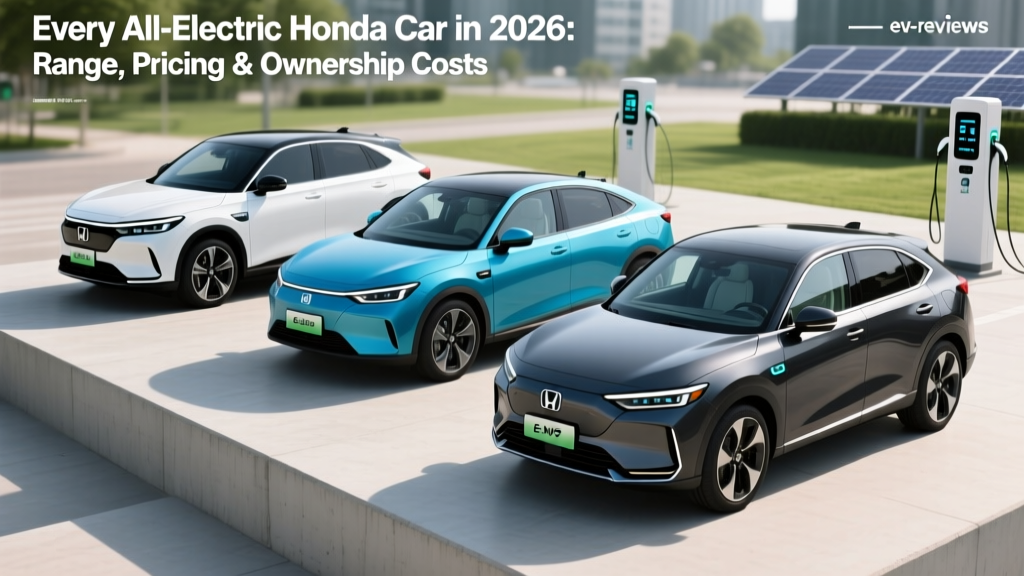
The quick answer: Honda currently sells one all electric Honda car in the U.S. market — the Honda Prologue. For the 2026 model year, the Prologue is a midsize electric SUV offering up to 303 miles of EPA-estimated range (FWD Elite trim), a 85 kWh usable NMC battery, and DC fast charging that peaks at approximately 155 kW (10–80% in ~27 minutes). Pricing starts at $48,795 for the base EX trim before any incentives, and federal §30D tax credit eligibility depends on your income, the vehicle's battery sourcing, and current-year IRS rules. A plug-in hybrid CR-V is expected to join Honda's electrified lineup later, but as of early 2026, the Prologue remains Honda's sole all-electric offering.
Honda's EV Lineup: What's Actually Available Right Now
Honda's path to electrification has been cautious compared to rivals like Hyundai or Tesla. The Honda Prologue, which debuted for the 2024 model year, is built on General Motors' Ultium platform — the same architecture underpinning the Chevrolet Blazer EV and Cadillac Lyriq. This partnership gave Honda a faster route to market than developing a bespoke platform from scratch, but it also means the Prologue shares fundamental hardware with GM products rather than carrying Honda's traditional engineering DNA.
For 2026, Honda has announced the upcoming Honda 0 Series — a next-generation family of EVs built on a proprietary Honda platform with thinner batteries and a lower center of gravity. The first production model (expected to be a sedan) is slated for late 2026 or 2027 delivery. Until those vehicles arrive, the Prologue is the only all electric Honda car you can walk into a dealership and buy today.
| Spec | EX (FWD) | Touring (FWD) | Elite (FWD) | Elite (AWD) |
|---|---|---|---|---|
| EPA Range | 296 mi | 303 mi | 303 mi | 283 mi |
| Battery (usable) | 85 kWh NMC | 85 kWh NMC | 85 kWh NMC | 85 kWh NMC |
| Motor Output | 213 hp / 236 lb-ft | 213 hp / 236 lb-ft | 213 hp / 236 lb-ft | 288 hp / 325 lb-ft |
| 0–60 mph | ~8.1 sec | ~8.1 sec | ~8.1 sec | ~6.1 sec |
| Peak DC Charge Rate | 155 kW | 155 kW | 155 kW | 155 kW |
| 10–80% DC Fast Charge | ~27 min | ~27 min | ~27 min | ~27 min |
| Level 2 (240V) Rate | 11.5 kW | 11.5 kW | 11.5 kW | 11.5 kW |
| MPGe (combined) | 95 MPGe | 97 MPGe | 97 MPGe | 89 MPGe |
| Starting MSRP | $48,795 | $53,095 | $57,495 | $59,095 |
| Battery/Powertrain Warranty | 8 years / 100,000 miles | |||
Source: fueleconomy.gov and Honda Newsroom. Real-world range will vary — expect ~250–270 miles on sustained highway driving at 70+ mph and 15–30% reduction in freezing temperatures.
Prologue vs. Gas CR-V: The Real Cost Comparison
Many shoppers cross-shopping an all electric Honda car are also looking at the gas-powered Honda CR-V, Honda's best-selling vehicle. Here's how the numbers stack up over five years of ownership, assuming 15,000 miles per year and $0.14/kWh for home charging (national average for residential electricity):
| Cost Category | Prologue EX (FWD) | CR-V EX AWD (Gas) |
|---|---|---|
| Base MSRP | $48,795 | $36,045 |
| Estimated Federal Tax Credit (§30D) | Up to $7,500* | $0 |
| Effective Purchase Price | ~$41,295 | $36,045 |
| Energy/Fuel (5 yr / 75,000 mi) | ~$4,725 (home L2) | ~$9,750 ($3.50/gal, 28 MPG avg) |
| Maintenance (5 yr) | ~$1,800 | ~$3,600 |
| Insurance (5 yr avg) | ~$10,500 | ~$8,500 |
| 5-Year Total (est.) | ~$58,320 | ~$57,895 |
*§30D credit eligibility depends on buyer income caps ($150K single / $300K joint), MSRP limits, and battery critical-mineral sourcing requirements per IRS guidelines. Always verify with a tax professional. Insurance estimates vary by state, driving record, and carrier — EV premiums are typically 15–25% higher than equivalent ICE vehicles.
The takeaway: at current pricing, the Prologue reaches near cost-parity with a well-equipped gas CR-V over five years, driven primarily by fuel and maintenance savings. If you qualify for the full $7,500 credit and can charge primarily at home, the Prologue pulls ahead. If you're a low-mileage driver without home charging access, the gas CR-V remains the cheaper path.
Charging the Prologue: Speed, Connectors, and Real-World Reality
The Prologue uses a CCS1 connector for DC fast charging and a J1772 inlet for Level 2 AC charging. (Honda has not yet announced a NACS migration timeline for the Prologue, unlike some competitors adopting Tesla's North American Charging Standard.)
Charging curve reality: The Prologue's 155 kW peak DC fast-charge rate is available only between approximately 10–35% state of charge. Above 50% SoC, the rate tapers to roughly 90–100 kW, and above 80% it drops below 40 kW. This is normal for NMC battery chemistry but means the advertised 10–80% time of ~27 minutes assumes optimal battery preconditioning and a charger capable of sustaining the peak rate. At Electrify America or EVgo stations, expect real-world 10–80% sessions closer to 30–35 minutes depending on ambient temperature and station load.
| Level | Power | Miles Added per Hour | Use Case |
|---|---|---|---|
| Level 1 (120V) | ~1.4 kW | ~3–4 mi/hr | Emergency / overnight trickle |
| Level 2 (240V, 48A) | 11.5 kW | ~30–33 mi/hr | Home / workplace daily charging |
| DC Fast Charge | Up to 155 kW | ~150+ mi in 20 min (10–50% SoC) | Road trips, rapid top-ups |
Home charging setup: Most Prologue owners will want a Level 2 home charger (240V, 48-amp circuit on a 60-amp breaker) for overnight replenishment. A full charge from empty at 11.5 kW takes roughly 7.5–8 hours, meaning you can easily wake up to a full battery every morning. Expect to pay $600–$1,200 for a quality Level 2 EVSE (ChargePoint Home Flex, Emporia J1772, or similar) and $500–$2,000 for professional electrical installation, depending on whether your panel needs an upgrade. Always get a quote from a licensed electrician before purchasing equipment.
Prologue vs. the Competition: Where It Stands
The Prologue competes in the midsize electric SUV segment against well-established rivals. Here's how the key numbers compare:
| Metric | Honda Prologue Elite FWD | Hyundai Ioniq 5 SEL | Tesla Model Y Long Range | Ford Mustang Mach-E Premium |
|---|---|---|---|---|
| EPA Range | 303 mi | 303 mi | 320 mi | 290 mi |
| Battery (usable) | 85 kWh NMC | 77.4 kWh NMC | ~78 kWh NMC | 75.7 kWh NMC |
| Peak DC Charge | 155 kW | 240 kW (350 kW capable) | 250 kW | 150 kW |
| 10–80% DC Time | ~27 min | ~18 min | ~22 min | ~30 min |
| 0–60 mph | ~8.1 sec | ~7.2 sec | ~4.8 sec | ~5.1 sec |
| Starting MSRP | $57,495 (Elite) | $46,650 (SEL) | $46,630 (LR) | $43,895 (Premium) |
| Connector | CCS1 | NACS (2026) | NACS | NACS (2025+) |
Sources: fueleconomy.gov, manufacturer press sites. Pricing reflects base MSRPs for comparable trims and may not include destination charges or incentives.
The Prologue's advantages are straightforward: Honda's reputation for build quality, a comfortable and quiet ride, and strong safety ratings (the Prologue earned IIHS Top Safety Pick status). Its disadvantages are equally clear — the 155 kW peak charge rate is the slowest in this comparison, the CCS1 connector means no direct Tesla Supercharger access without an adapter (and Honda has not yet confirmed adapter availability), and pricing sits at the premium end of the segment.
Tax Credit Eligibility: Can You Claim §30D on the Prologue?
The federal EV tax credit under IRS §30D remains one of the most significant factors in EV purchase decisions. Here's the current eligibility framework for the Prologue:
- MSRP cap: The Prologue qualifies as an SUV under IRS classification, meaning the MSRP cap is $80,000. All current trims fall under this threshold.
- Buyer income cap: Adjusted gross income must not exceed $150,000 (single), $225,000 (head of household), or $300,000 (married filing jointly).
- Battery sourcing: The credit is split into two $3,750 halves — one for critical minerals and one for battery component assembly. Because the Prologue uses GM's Ultium battery (assembled in the U.S.), it has historically qualified for at least a partial credit, but exact eligibility depends on the model year's mineral sourcing percentages. Always verify on fueleconomy.gov before purchasing.
- Point-of-sale transfer: You can transfer the credit to the dealer at purchase, reducing your out-of-pocket cost immediately rather than waiting to claim it on your tax return.
- One vehicle per VIN: The credit applies once per vehicle and cannot be claimed if the car was previously titled.
Critical caveat: Battery sourcing requirements tighten annually. A Prologue that qualifies for the full $7,500 in early 2026 may see partial eligibility as supply chains shift. Confirm your specific vehicle's VIN eligibility with the dealer and cross-reference the IRS clean vehicle credit database before signing paperwork.
Myths vs. Facts: Common Misconceptions About the Prologue
| Myth | Fact |
|---|---|
| "The Prologue has 300+ miles of range no matter how you drive it." | The 303-mile EPA figure is a combined cycle. Sustained 75+ mph highway driving reduces range to approximately 250–270 miles. In sub-freezing weather with cabin heating, expect 210–240 miles. |
| "I can charge at any Tesla Supercharger." | The Prologue has a CCS1 port. As of early 2026, Honda has not provided a NACS adapter or confirmed Supercharger network access. You're limited to CCS-compatible networks (Electrify America, EVgo, ChargePoint, etc.). |
| "EVs cost more to insure because batteries are fragile." | Insurance premiums are 15–25% higher primarily because EVs have higher repair costs after collisions (specialized labor, battery safety protocols), not because batteries are unreliable. The Prologue's 8-year/100,000-mile battery warranty covers capacity loss below the stated threshold. |
| "The battery will need replacement in 5 years." | NMC batteries in liquid-cooled packs like the Prologue's typically degrade 8–12% over 100,000 miles based on industry data. GM/Honda's warranty guarantees minimum capacity retention (typically 60–70% of original) for 8 years/100,000 miles. Full battery replacement, if needed out of warranty, runs $12,000–$18,000 but is statistically rare within the first decade. |
| "I don't need a home charger — public charging is fine." | Public DC fast charging costs $0.30–$0.48/kWh nationally, making it 2–3x more expensive per mile than home Level 2 charging at $0.14/kWh. Relying exclusively on public charging erases most of the Prologue's fuel-cost advantage over a gas CR-V. |
Decision Framework: Is the Prologue the Right All Electric Honda Car for You?
Choose the Honda Prologue if:
- You want Honda-brand ownership with an all-electric powertrain and prioritize ride comfort and cabin quietness over performance metrics.
- You have reliable Level 2 home charging access and drive under 250 miles per day (covering ~95% of American daily commutes).
- You qualify for the §30D tax credit, bringing the effective purchase price closer to a loaded gas CR-V.
- You value IIHS Top Safety Pick ratings and Honda's dealer/service network.
- You primarily use CCS-compatible charging networks in your region.
Look elsewhere if:
- You need Tesla Supercharger access for road trips — consider the Hyundai Ioniq 5, Tesla Model Y, or Ford Mach-E (all with NACS connectors for 2026).
- Fast DC charging speed is a top priority — the Prologue's 155 kW peak is the slowest in its class; the Ioniq 5's 240+ kW capability adds ~150 miles in 15 minutes vs. the Prologue's ~100 miles in the same window.
- You're on a strict budget — the Prologue EX at $48,795 is significantly more expensive than the Ioniq 5 SE ($42,600) or Chevy Equinox EV ($33,600) before incentives.
- You live in an apartment without charging access and your area lacks reliable public DC infrastructure.
- You want a true Honda-engineered EV — wait for the Honda 0 Series vehicles expected in 2027+.
What First-Time EV Buyers Should Know Before Purchasing
If the Prologue would be your first electric vehicle, here are the practical ownership realities that spec sheets don't cover:
Preconditioning matters. The Prologue's battery thermal management system works best when you precondition the battery before a DC fast-charging session. Use the navigation system to route to a charger — this triggers battery warming, which can cut your 10–80% charge time by 5–8 minutes in cold weather.
Regenerative braking is adjustable, not one-pedal. Unlike some EVs, the Prologue offers multiple regen levels via steering-wheel paddles but does not provide true one-pedal driving that brings the car to a complete stop. Plan to use the friction brake pedal at stoplights.
Your electrical panel may need upgrading. A Level 2 charger requires a dedicated 60-amp circuit. If your home's main panel is already near capacity (common in older homes with 100-amp service), an electrician may recommend a panel upgrade costing $1,500–$3,000 before installation can proceed. Get this assessment done before ordering your Prologue.
Tire wear accelerates. The Prologue's instant torque and heavier curb weight (~4,800 lbs) wear through tires 20–30% faster than a gas CR-V. Budget for tire replacement every 30,000–40,000 miles instead of the 50,000+ you may be used to.
Will Honda release more all electric cars beyond the Prologue?
Yes. Honda's 0 Series lineup, built on a proprietary dedicated EV platform, is expected to begin production in late 2026 for the Japanese market, with U.S. models following in 2027–2028. These vehicles are anticipated to offer improved charging speeds, lighter weight, and Honda's own ADAS technology. Additionally, a second Ultium-based SUV (potentially a 3-row model) may arrive before the 0 Series.
How does the Prologue compare to the Honda CR-V Hybrid?
The CR-V Hybrid (non-plug-in) achieves approximately 40 MPG combined at a starting price of ~$36,000 — significantly cheaper upfront than the Prologue. Over five years at 15,000 miles/year, the CR-V Hybrid's fuel cost is roughly $7,000 (vs. $4,725 for the Prologue on home charging). The Prologue wins on per-mile energy cost and zero tailpipe emissions, but the CR-V Hybrid is the lower-risk, lower-cost choice if home charging is unavailable.
Does the Prologue qualify for state EV rebates?
State incentives vary by jurisdiction and change frequently. California's CVRP program, Colorado's state credit, and various utility rebates may stack on top of the federal §30D credit. Check your state's energy office website and your local utility's EV program page for current amounts. Always confirm eligibility before relying on state incentives in your purchase decision.
What happens if the Prologue's battery degrades significantly?
Honda covers the high-voltage battery for 8 years or 100,000 miles (whichever comes first) against defects and excessive capacity loss. Industry data on Ultium-platform vehicles suggests typical degradation of approximately 8–12% over the first 100,000 miles, meaning a 303-mile Prologue might deliver ~265–278 miles when new-equivalent conditions are met. Out-of-warranty replacement is expensive ($12,000–$18,000) but rarely needed in the vehicle's first decade.
Can I tow with the Honda Prologue?
The Prologue has a maximum towing capacity of 1,500 pounds (with the factory-installed hitch). This is sufficient for a small utility trailer or a couple of dirt bikes but not adequate for most boat trailers or campers. Towing also reduces range by approximately 30–50% depending on trailer weight and aerodynamics.