The Quick Answer
An all-electric home pairs rooftop solar (or a green utility plan), a heat pump, an induction stove, and a battery-electric vehicle charged primarily at home. For a typical two-car household driving ~24,000 combined miles per year, switching from two gas cars to two EVs and from a gas furnace/water heater to electric saves roughly $2,500–$4,200 per year after a Level 2 home charger install (~$800–$2,200) and before federal credits. The breakeven on the EV premium is typically 3–5 years, depending on local electricity rates, gas prices, and whether you qualify for the §30D clean vehicle credit.
What "All-Electric Home" Actually Means for Your Car
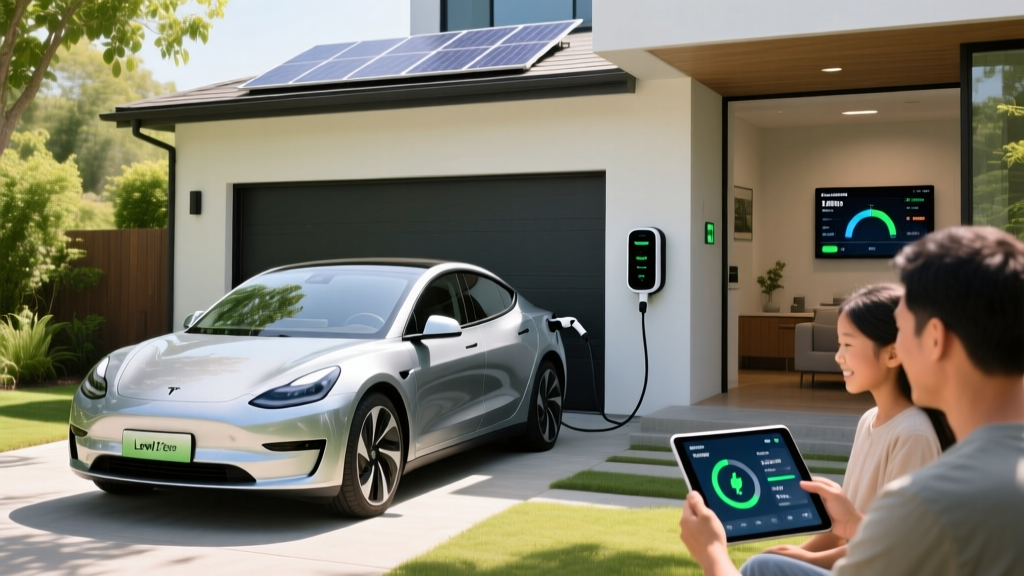
The phrase all-electric home usually describes a residence that has eliminated on-site fossil fuel combustion: no natural gas furnace, no propane water heater, no gas stove. For transportation, that philosophy extends into the garage. You charge a battery-electric vehicle (BEV) overnight on a 240-volt Level 2 circuit, powered either by a rooftop solar array, a community solar subscription, or your utility's grid mix — which, according to the U.S. Energy Information Administration, was roughly 43% renewables and nuclear nationally in 2025 and climbing.
The practical implication: your "fuel" cost becomes a line item on your electric bill rather than a trip to the gas station, and your transportation emissions fall in lockstep with your grid's decarbonization. Pair that with a heat pump and induction range, and a typical all-electric home eliminates 8–12 tons of CO₂ per year versus a gas-and-gasoline baseline.
EV vs Gas vs Hybrid: The Numbers That Matter
Before committing an all-electric home to a BEV, compare the three realistic drivetrains on the metrics that hit your wallet.
| Metric | BEV (e.g., Hyundai Ioniq 6 SE) | HEV (e.g., Toyota Camry Hybrid) | Gas (e.g., Honda Accord 1.5T) |
|---|---|---|---|
| Base MSRP | $38,650 | $29,995 | $28,990 |
| EPA Combined Efficiency | 140 MPGe / 24 kWh/100mi | 52 MPG | 30 MPG |
| Energy Cost per Mile (nat'l avg) | $0.042 (home L2 @ $0.17/kWh) | $0.067 ($3.50/gal) | $0.117 ($3.50/gal) |
| 5-Year Fuel/Energy | $5,040 | $8,040 | $14,040 |
| 5-Year Maintenance (est.) | $1,800 | $3,200 | $4,100 |
| Federal Tax Credit (§30D) | Up to $7,500* | Up to $1,000 (§30D hybrid) | $0 |
| Estimated 5-Year Total | ~$45,490 | ~$49,235 | ~$51,130 |
*§30D eligibility depends on MSRP caps ($55k cars / $80k SUVs), buyer income limits, and battery critical-mineral sourcing. Verify at IRS.gov before purchase. Point-of-sale transfer is available through registered dealers.
The BEV wins on operating cost by a wide margin, but only if you can charge at home. Without Level 2 access, you're paying DC fast-charging rates of $0.35–$0.55/kWh on networks like Electrify America — which erases most of the fuel-cost advantage versus a hybrid.
Real Costs: Purchase, Charging, Maintenance, Insurance
Budgeting an EV into an all-electric home requires four line items most buyers underestimate.
| Line Item | BEV | Gas Car | Notes |
|---|---|---|---|
| Level 2 Charger Hardware | $400–$700 | $0 | Emporia Vue, ChargePoint Home Flex, Wallbox Pulsar Plus |
| Electrical Install (240V/50A) | $600–$2,200 | $0 | Higher if panel upgrade to 200A needed ($1,500–$3,500) |
| Electricity (12,000 mi/yr) | $480–$720 | — | Assumes 3–4 mi/kWh, $0.12–$0.20/kWh |
| Gasoline (12,000 mi/yr) | — | $1,400–$1,800 | At 25–30 MPG, $3.50/gal |
| Insurance (avg) | $2,100–$2,700 | $1,600–$2,100 | EVs cost 15–25% more to insure (repair costs, parts) |
| Maintenance | $300–$450 | $700–$1,100 | No oil, filters, spark plugs; brake pads last longer via regen |
| Tire Replacement | Every 25–35k mi | Every 40–55k mi | EV weight + instant torque wear tires faster; budget $900–$1,400/set |
The hidden gotcha: many all-electric homes built before 2000 have 100-amp electrical panels. Adding a 50-amp EV circuit, a heat pump, and an induction range can exceed panel capacity. Budget for a 200-amp service upgrade or a smart load-management device (e.g., Emporia Smart Load Center) that throttles the charger when the heat pump kicks on.
Home Charging: The Make-or-Break of an All-Electric Home
Level 2 home charging is what makes EV ownership effortless. Here's what you actually get:
- Level 1 (120V, 1.4 kW): ~4 miles of range per hour. Fine for PHEVs; too slow for a 300-mile BEV driven daily.
- Level 2 (240V, 7.7–11.5 kW): 25–45 miles per hour. Fully replenishes a 77 kWh battery overnight in 7–10 hours.
- DC Fast Charging (public, 150–350 kW): 10–80% in 18–30 minutes on capable vehicles (Hyundai Ioniq 5 peaks at 240 kW, ~18 min 10–80%). Reserve for road trips; daily DC charging accelerates battery wear slightly.
Real-world charging curve reality: peak kW ratings are marketing numbers. A 350-kW-capable vehicle only sustains peak rate from roughly 10–40% state of charge, then tapers. On a long road trip, average throughput matters more than the badge number.
Common Misconceptions — Myth vs Fact
| Myth | Fact |
|---|---|
| "EV batteries need replacing every 5 years." | Modern NMC and LFP packs are warrantied for 8 years/100,000 miles at ≥70% capacity retention. Real-world data from Recurrent Auto shows median degradation of ~12% after 100k miles. |
| "The grid can't handle everyone going electric." | Most charging happens overnight at 3–11 kW, when grid demand is low. A single BEV adds roughly the load of a central AC unit. |
| "EVs don't work in cold climates." | Cold reduces range 20–35% at 20°F due to battery chemistry and cabin heating. A heat pump (standard on Tesla, Hyundai, many 2026 models) cuts that penalty roughly in half. Preconditioning while plugged in preserves range. |
| "An all-electric home means I can never drive far." | The 2026 BEV median EPA range is 280–330 miles. The DC fast-charging network (Tesla Supercharger, now open to NACS-equipped Fords, Rivians, and GMs) covers U.S. interstates comprehensively. |
| "I'll get the full $7,500 tax credit." | §30D has MSRP caps, buyer income limits ($150k single / $300k joint), and strict battery-mineral sourcing. Many popular models qualify for $3,750 or $0 depending on build date. Always check the IRS qualified list. |
Decision Framework: Is an EV Right for Your All-Electric Home?
Choose a BEV if…
- You can install a Level 2 charger at home (garage, carport, or driveway with conduit).
- Your daily driving is under 80 miles round-trip (covers ~92% of U.S. commutes).
- You want the lowest per-mile operating cost and qualify for at least partial §30D credit.
- You have a second vehicle or are comfortable planning road-trip charging stops.
Choose a PHEV (e.g., Toyota RAV4 Prime, 42 mi EV range) if…
- You lack reliable home charging (apartment, street parking).
- You regularly tow or drive 400+ miles in remote regions with sparse DC infrastructure.
- You want electric commuting but zero range anxiety.
Stick with a Hybrid (HEV) if…
- Your budget is strictly under $30,000 and you can't absorb the EV premium.
- You live in a region with extreme cold AND no home charging — the worst-case combo for BEVs.
First-Time EV Buyer Checklist
- Audit your electrical panel. Hire a licensed electrician to confirm spare capacity for a 50-amp circuit. Get a written quote including permit.
- Measure your real commute and weekly mileage. Multiply by 1.4 to account for cold weather and highway driving, then compare to EPA range.
- Verify §30D eligibility for the exact VIN you're buying — credit amounts change quarterly based on battery sourcing rules.
- Test-drive for regen feel. One-pedal driving is a huge quality-of-life feature; confirm the car offers adjustable regen (Tesla, Hyundai, BMW do; some others don't).
- Get insurance quotes BEFORE purchase. EV premiums vary wildly by insurer and ZIP code — sometimes 30% higher, sometimes comparable.
- Download the charger apps you'll use on road trips (Tesla, EVgo, Electrify America, PlugShare) and create accounts before your first long trip.
Frequently Asked Questions
Can my solar panels charge my EV for free?
Effectively, yes — but timing matters. A 10 kW solar array in a sunny U.S. climate produces roughly 12,000–15,000 kWh per year, enough to cover a typical household plus one EV driven 12,000 miles. To actually use solar electrons for charging, you need to charge during daylight hours or pair with a home battery (e.g., Tesla Powerwall 3, 13.5 kWh). Net metering lets you "bank" daytime production against nighttime charging, but policies vary by utility.
Does an all-electric home increase my property value?
Data from Zillow and Lawrence Berkeley National Lab suggests homes with solar and EV-ready wiring sell for 3–5% more, and homes with owned solar systems sell faster. A documented Level 2 charger install is a low-cost differentiator when you list.
What happens during a power outage?
Your EV stops charging — but if you spec a vehicle with V2H (vehicle-to-home) capability, such as the Ford F-150 Lightning or Hyundai Ioniq 5 with the appropriate bidirectional charger, the truck can back-feed your home for 3–10 days of essential loads on a full 98–131 kWh battery. This is a genuine resilience upgrade over a gas car, which can't power your refrigerator.
Should I buy LFP or NMC battery chemistry?
LFP (lithium iron phosphate, used in base Tesla Model 3/Y, some Ford and Rivian packs) offers longer cycle life, better thermal safety, and lower cost — but ~10% less energy density and worse cold-weather performance. NMC (most Hyundai, Kia, GM, BMW packs) gives more range per kWh. For an all-electric home with daily Level 2 charging, LFP is an excellent fit because you can charge to 100% daily without accelerated degradation.