The Short Answer: Toyota Doesn't Make an All-Electric Highlander Yet
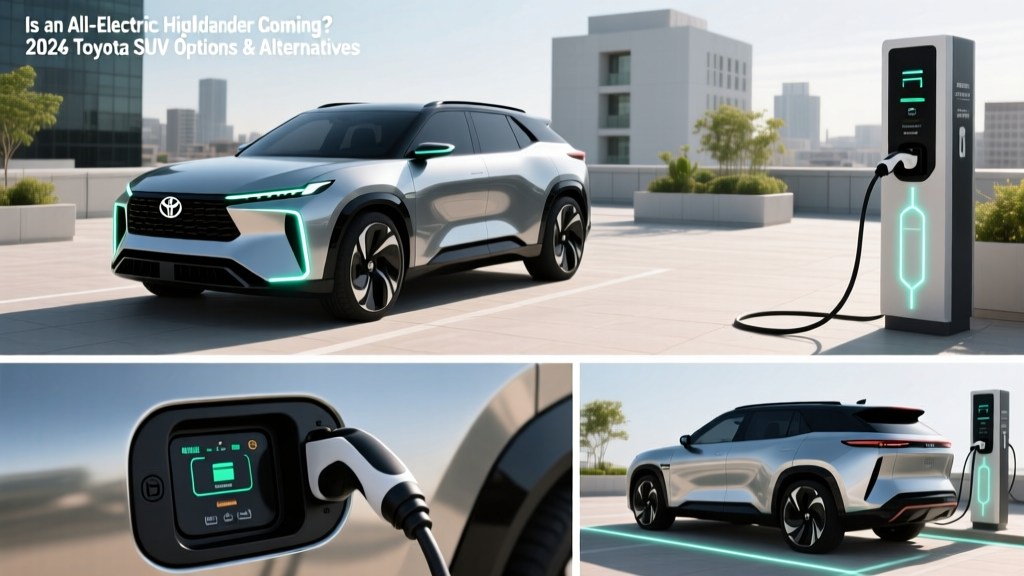
As of the 2026 model year, Toyota does not sell an all-electric Highlander. The Highlander nameplate continues exclusively as a gasoline V6 model and a hybrid (HEV). Toyota's three-row electric SUV offering is currently limited to the bZ4X (a midsize two-row crossover) and the upcoming, larger three-row EV expected to wear a new nameplate, not "Highlander."
If you specifically want a three-row Toyota-family EV today, the closest options are the Grand Highlander Hybrid (36 MPG combined, no plug), or stepping outside Toyota to competitors like the Kia EV9 (300-mile EPA range, three rows) or Volkswagen ID.4 with optional third row.
What Toyota Actually Offers in 2026
The 2026 Toyota Highlander and Grand Highlander remain popular family haulers, but neither is a plug-in vehicle. Here's how they stack up against the EVs buyers cross-shop them with:
| Model | Powertrain | EPA Range / MPG | Seating | Base MSRP |
|---|---|---|---|---|
| Toyota Highlander Hybrid | HEV (no plug) | 36 MPG combined | 7-8 | $40,220 |
| Toyota Grand Highlander Hybrid | HEV (no plug) | 36 MPG combined | 7-8 | $45,120 |
| Toyota bZ4X | BEV (71.4 kWh) | 252 mi EPA | 5 | $38,465 |
| Kia EV9 (Land) | BEV (77.4 kWh) | 270 mi EPA | 6-7 | $54,900 |
| Volkswagen ID.4 (w/ 3rd row) | BEV (82 kWh) | 275 mi EPA | 7 | $43,000 |
The EPA's fueleconomy.gov database confirms no electric Highlander variant exists in current filings. Toyota's EV strategy has prioritized smaller crossovers first, with larger three-row electric SUVs still in the announced/preliminary stage.
Why Toyota Hasn't Electrified the Highlander
Toyota's cautious approach to full EVs in the family-SUV segment stems from several factors:
- Hybrid dominance: The Highlander Hybrid sells well without requiring buyers to change fueling habits or install home chargers.
- Battery cost and weight: A three-row EV needs a 90-110 kWh battery to deliver 300+ miles, adding $12,000-$18,000 in cell costs and 1,200+ lbs of weight.
- Charging infrastructure gaps: Toyota has cited NHTSA and industry data showing rural charging deserts as a barrier for large family vehicles used for road trips.
- Hydrogen bet: Toyota continues investing in fuel-cell technology (Mirai) as a zero-emission alternative, though infrastructure remains limited to California.
Real Costs: Highlander Hybrid vs. EV Competitors
For buyers weighing a gas-hybrid Highlander against a three-row EV, the math depends heavily on your driving patterns, electricity rates, and home-charging access.
| Cost Factor | Highlander Hybrid | Kia EV9 (Home Charging) | Kia EV9 (Public DC Only) |
|---|---|---|---|
| Purchase Price (base) | $45,120 | $54,900 | $54,900 |
| Federal Tax Credit (§30D) | $0 | Up to $7,500* | Up to $7,500* |
| Fuel/Energy (5 years) | $8,400 (gas at $3.50/gal, 36 MPG) | $4,200 ($0.14/kWh avg) | $7,500 ($0.40/kWh DC avg) |
| Maintenance (5 years) | $2,800 | $1,200 | $1,200 |
| Insurance (5 years) | $7,500 | $8,800 | $8,800 |
| Total 5-Year Cost | $63,820 | $61,600 | $64,900 |
*§30D credit eligibility depends on buyer income (≤$150k single / $300k joint), vehicle MSRP (≤$80k SUVs), and battery sourcing requirements. Confirm via IRS.gov or a tax professional. Point-of-sale transfer available at participating dealers.
Key takeaway: If you can charge at home, a three-row EV like the EV9 breaks even or saves money over five years despite a higher sticker price. If you rely solely on public DC fast charging, the cost advantage disappears.
What First-Time EV Buyers Need to Know
If you're considering stepping from a Highlander Hybrid into an EV for the first time, these realities matter:
Home Charging Is Non-Negotiable for Cost Savings
Level 2 home charging (240V, 7-11 kW) adds 25-40 miles per hour of charging and costs $0.10-$0.20/kWh in most U.S. regions. A full home install runs $800-$2,500 including equipment, electrician labor, and permits. If your home lacks a 240V outlet or your electrical panel needs an upgrade (common in homes built before 2000), costs can reach $3,500-$5,000.
Without home charging, you'll rely on public DC fast chargers, which cost 2-4x more per kWh and require 20-40 minute stops. For a family SUV used for school runs and errands, this becomes impractical quickly.
Cold Weather Cuts Range 20-35%
If you live in the northern U.S. or mountain states, expect a 270-mile EPA-rated EV to deliver 180-215 miles in sub-freezing temperatures. Battery chemistry (NMC vs. LFP) and the presence of a heat pump (standard on EV9, optional on ID.4) affect this, but physics is unforgiving. A Highlander Hybrid's range is unaffected by cold.
Charging Speed: Peak kW ≠ Sustained kW
EVs advertise "peak 240 kW" charging, but that rate only applies between 10-50% state of charge. Above 80%, charging slows dramatically to protect battery health. A "10-80% in 18 minutes" claim assumes ideal conditions (preconditioned battery, warm weather, uncrowded charger). Real-world 10-80% times are often 25-35 minutes on road trips.
Decision Framework: Should You Wait or Buy Now?
Buy a Highlander Hybrid NOW if:
- You lack reliable home-charging access (apartment, street parking, older home with 100A panel).
- You regularly drive 400+ miles in a single day (rural road trips, towing).
- You live in a region with extreme cold (sub-0°F winters) and limited DC charging infrastructure.
- You need a vehicle immediately and can't wait 12-18 months for Toyota's announced three-row EV.
Buy a three-row EV (EV9, ID.4, or wait for Toyota) if:
- You can install a Level 2 home charger and your daily driving is under 150 miles.
- You want to eliminate oil changes, transmission service, and emissions testing.
- You qualify for the §30D tax credit (income and sourcing requirements met).
- You're willing to plan road trips around 20-30 minute charging stops every 2-3 hours.
Common Misconceptions About an Electric Highlander
| Myth | Fact |
|---|---|
| "The all-electric Highlander is available now." | Toyota has not released an EV Highlander. The bZ4X is a two-row midsize crossover, not a three-row family hauler. |
| "EVs cost more to own than hybrids." | With home charging and tax credits, EVs can break even or save $2,000-$4,000 over five years. Without home charging, hybrids win. |
| "EV batteries need replacement every 5 years." | Modern NMC and LFP batteries retain 85-90% capacity after 100,000 miles. Toyota, Kia, and VW warrant batteries for 8 years/100,000 miles minimum. |
| "I can't tow with an EV." | The Kia EV9 tows up to 5,000 lbs (AWD). The Highlander Hybrid tows 3,500 lbs. EVs actually deliver instant torque for trailer starts, though range drops 30-50% while towing. |
What's Coming: Toyota's Three-Row EV Plans
Toyota has announced a larger, three-row electric SUV for the U.S. market, expected to arrive as a 2027 or 2028 model. Details remain preliminary:
- Platform: Likely an extended version of the bZ architecture, possibly co-developed with Subaru.
- Battery: Estimated 90-110 kWh (NMC chemistry), targeting 300-350 miles EPA range.
- Charging: Expected to adopt NACS (Tesla Supercharger) connector by 2027, per Toyota's 2023 announcement.
- Pricing: Industry estimates place it at $55,000-$65,000 base MSRP before incentives.
Until this vehicle launches, buyers seeking a Toyota-badged three-row EV will need to wait or look to competitors.
Frequently Asked Questions
Is Toyota discontinuing the Highlander?
No. The gasoline and hybrid Highlander continue for 2026. Toyota has not announced an end date for the nameplate, though the larger Grand Highlander has cannibalized some sales since 2024.
Can I convert my Highlander to electric?
Aftermarket EV conversions exist but cost $25,000-$50,000, void all factory warranties, and are not street-legal in all states. This is not a practical path for most buyers.
Does the Toyota bZ4X have a third row?
No. The bZ4X is a two-row, five-passenger crossover. It competes with the Hyundai Ioniq 5 and Ford Mustang Mach-E, not the Highlander.
What's the best three-row EV for families in 2026?
The Kia EV9 offers the best combination of range (270-300 miles), charging speed (10-80% in 24 minutes at 210 kW peak), interior space, and value. The Rivian R1S is more capable off-road but starts at $75,900. The VW ID.4 with third row is cheaper ($43k) but the third row is best for children only.
Will Toyota's three-row EV qualify for the $7,500 tax credit?
It depends on battery sourcing and your income. Under current §30D rules, the vehicle must meet critical-mineral and battery-component requirements, and your AGI must be ≤$150k (single) or $300k (joint). Check IRS.gov closer to the vehicle's launch date.