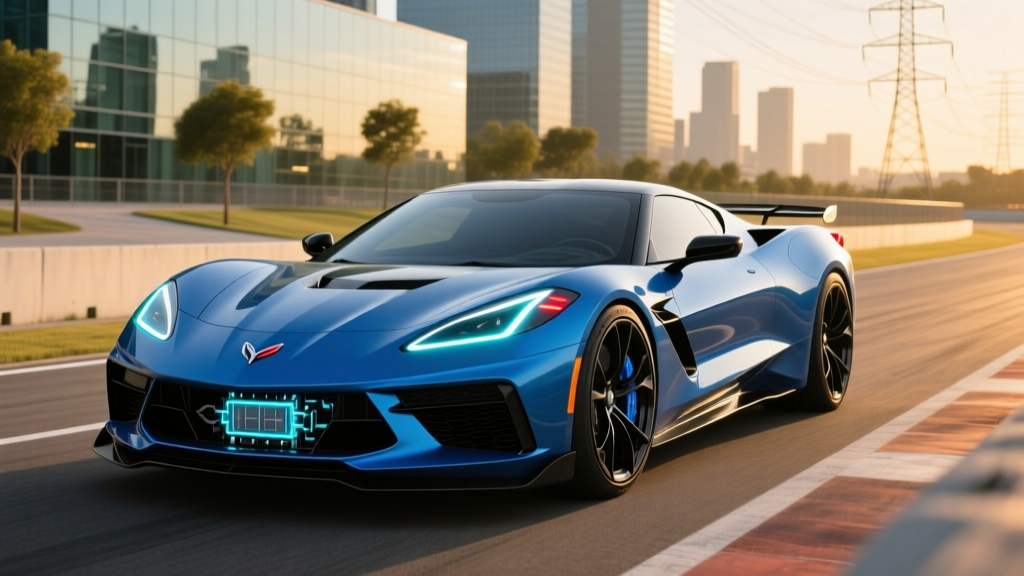
The short answer: As of early 2026, Chevrolet has not officially confirmed full specifications or a firm on-sale date for an all-electric Corvette. However, GM has confirmed an electrified Corvette is in development, and multiple reports point to a Ultium-based electric powertrain arriving as early as the 2026–2027 model year. Expected targets include 300+ miles of EPA range, 0–60 mph under 3.0 seconds, and a starting price in the $80,000–$100,000 range. Until GM publishes final specs, treat all figures below as preliminary estimates based on Ultium platform capabilities and insider reporting.
Why an All-Electric Corvette Is Happening
GM's commitment to an all-electric future by 2035 makes the Corvette's electrification inevitable. The current C8 Stingray and Z06 are engineering benchmarks, but tightening global emissions regulations and GM's own Ultium battery investment (over $35 billion committed through 2025) mean the next-generation Corvette will almost certainly carry electrons instead of — or alongside — gasoline.
What's notable is that GM executives, including former President Mark Reuss, have publicly stated the Corvette brand will survive the EV transition and that electrification could actually enhance its performance credentials. An electric motor's instant torque delivery and the packaging freedom of a skateboard-style Ultium platform could yield a Corvette with a lower center of gravity, more cargo space, and all-wheel-drive capability that no mid-engine V8 could match.
Estimated Specs: What Ultium Can Deliver in a Sports Car
While final numbers aren't published, we can extrapolate from the Ultium platform's known capabilities — the same architecture underpinning the Cadillac Lyriq, GMC Hummer EV, and Chevrolet Blazer EV. Here's what a performance-tuned Ultium variant in a Corvette-sized package could realistically achieve:
| Specification | Estimated (Preliminary) | Notes |
|---|---|---|
| Platform | GM Ultium (BEV3 variant) | Rear-drive or dual-motor AWD |
| Battery Capacity | ~100 kWh usable | Ultium large-format pouch cells, NMC chemistry |
| EPA Range (est.) | 300–350 miles | Performance tuning may prioritize power over efficiency |
| Real-World Range (highway, 75 mph) | ~250–280 miles | Aerodynamic drag at speed; expect 15–20% loss |
| Peak DC Fast Charge | ~250–350 kW | 800V architecture possible; 10–80% in ~20 min |
| Level 2 Charge Rate | 11.5–19.2 kW | Full charge overnight (~6–9 hours) |
| Horsepower | 600–800 HP (AWD) | Dual-motor; single-motor RWD variant likely lower |
| 0–60 mph | < 3.0 seconds (AWD) | Instant torque; launch control enabled |
| Drivetrain | RWD standard / AWD optional | Torque vectoring likely on AWD |
| Curb Weight (est.) | ~4,200–4,500 lbs | Battery mass; offset by low CG |
| Starting MSRP (est.) | $80,000–$100,000 | Before any incentives |
Real-world range reality check: The EPA sticker might say 330 miles, but sports car driving changes the math. Aggressive acceleration, sustained highway speeds above 75 mph, and cold-weather battery chemistry all reduce range. Expect 250–280 miles on a spirited highway run and potentially under 220 miles in sub-freezing temperatures. This is physics, not a flaw — every EV loses range in these conditions.
Electric Corvette vs. Gas C8 Stingray: The Numbers
The natural comparison is the current C8 Corvette Stingray. Here's how an electric variant stacks up against the V8 we know today:
| Metric | C8 Stingray (2025) | All-Electric Corvette (Est.) |
|---|---|---|
| Powertrain | 6.2L V8, 8-speed DCT | Dual electric motor, single-speed |
| Horsepower | 490 HP (495 w/Z51) | 600–800 HP |
| 0–60 mph | 2.9 sec (Z51) | < 3.0 sec (AWD est.) |
| Fuel/Range | ~370 mi (18.5 gal tank, 15/27 MPG) | ~300–350 mi (EPA est.) |
| MPGe / Efficiency | 19 MPG combined | ~95–110 MPGe (est.) |
| "Fuel" Cost per Mile | ~$0.18/mi (gas at $3.50/gal) | ~$0.04–0.06/mi (home charging) |
| Annual Fuel/Energy Cost | ~$2,160 (12,000 mi/yr) | ~$480–$720 (home L2, 12,000 mi/yr) |
| Starting MSRP | $68,300 (2025 1LT coupe) | $80,000–$100,000 (est.) |
| Maintenance (annual avg.) | ~$600–$900 | ~$200–$400 |
| Federal Tax Credit (§30D) | Not eligible | Up to $7,500 (if eligible) |
The electric Corvette would almost certainly cost more upfront but save $1,200–$1,500 annually on energy alone, plus lower maintenance costs. Over a 5-year ownership period, that's $6,000–$7,500 in fuel savings — meaningful, but unlikely to fully offset a higher purchase price.
Charging the Electric Corvette: What Owners Will Face
Sports car owners don't typically rack up massive mileage, which works in the electric Corvette's favor. Most daily driving will fall well within the battery's range, making home charging the primary refueling method.
| Charging Level | Power | Miles Added per Hour | Use Case |
|---|---|---|---|
| Level 1 (120V outlet) | ~1.4 kW | ~4–5 miles/hr | Emergency/top-up only |
| Level 2 (240V, home) | 11.5–19.2 kW | ~35–55 miles/hr | Daily charging; full overnight |
| DC Fast Charge | 250–350 kW (peak) | ~150+ miles in 10 min | Road trips; 10–80% in ~18–22 min |
Home charging is essential. A Level 2 home charger (240V, 48-amp circuit) will replenish a depleted 100 kWh battery in roughly 5–8 hours — plug in after an evening drive, wake up full. Expect to spend $800–$1,500 on a quality Level 2 unit (ChargePoint Home Flex, Emporia Vue, or Grizzl-E) and $500–$2,000 on professional electrical installation, depending on whether your panel needs an upgrade to support a 60-amp circuit.
DC fast charging caveat: Peak kW rates are never sustained for an entire session. A 350 kW peak will taper significantly above 80% state of charge to protect battery longevity. Plan road-trip stops around the 10–80% sweet spot — roughly 20 minutes at a functioning 350 kW station — and use PlugShare or A Better Routeplanner to pre-plan.
Real Costs of Ownership: Beyond the Sticker Price
| Cost Category | C8 Stingray (Gas) | All-Electric Corvette (Est.) | 5-Year Difference |
|---|---|---|---|
| Purchase Price | $68,300 | $90,000 (est. mid-trim) | +$21,700 (EV) |
| Federal Tax Credit | $0 | Up to $7,500* | –$7,500 (EV) |
| Fuel/Energy (5 yr) | $10,800 | $3,000 | –$7,800 (EV) |
| Maintenance (5 yr) | $3,750 | $1,500 | –$2,250 (EV) |
| Insurance (5 yr avg.) | $12,000 | $14,000 (est.) | +$2,000 (EV) |
| Home Charger Install | $0 | $1,500 | +$1,500 (EV) |
| Total 5-Year Cost | $94,850 | $102,500 | +$7,650 (EV) |
*Federal §30D tax credit eligibility depends on buyer income limits ($150K single / $300K joint MAGI), vehicle MSRP caps ($80K for cars — a potential issue if the EV Corvette exceeds this), battery sourcing requirements, and point-of-sale transfer availability. Always verify current rules at IRS.gov and consult a tax professional.
The MSRP cap is a real concern. Under §30D, sedans and sports cars must have an MSRP at or below $55,000 to qualify for the credit. If the all-electric Corvette starts at $80,000+, it will almost certainly exceed this cap and be ineligible for the federal credit. This is a structural disadvantage versus electric SUVs and trucks, which carry an $80,000 MSRP cap. Buyers should plan their budgets accordingly — do not assume a $7,500 offset.
Common Misconceptions About an Electric Corvette
| Myth | Fact |
|---|---|
| "An EV can't feel like a real Corvette." | Electric motors deliver instant, linear torque with no gear shifts. The 0–60 experience will be at least as visceral as a V8, though the sound will be different. GM has hinted at synthetic audio profiles. |
| "The battery will need replacing in 5 years." | Modern NMC Ultium batteries are warrantied for 8 years/100,000 miles with a capacity retention guarantee (typically 70%+). Real-world degradation data from GM's existing Ultium fleet suggests 10–15% loss over 150,000+ miles. |
| "I'll never be able to take it on a road trip." | With 300+ miles of range and 20-minute DC fast-charge stops, a 500-mile trip requires one 20-minute stop. The EPA's fueleconomy.gov site and A Better Routeplanner make trip planning straightforward. |
| "It'll weigh too much to handle." | A ~4,400-lb EV with a floor-mounted battery has a lower center of gravity than a mid-engine C8. Weight distribution near 50/50 and torque-vectoring AWD can offset mass. The Porsche Taycan (4,900+ lbs) proves heavy EVs can handle. |
| "I can charge it anywhere." | Public DC fast-charging infrastructure is growing but uneven. Rural areas and some highway corridors remain charging deserts. Home Level 2 charging is strongly recommended as the primary refueling method. |
Decision Framework: Should You Wait for the Electric Corvette?
Wait for the all-electric Corvette if:
- You have reliable home Level 2 charging access (garage or driveway with 240V circuit)
- You want maximum acceleration and instant torque over engine sound and tradition
- Your daily driving is under 200 miles and road trips are occasional
- You're comfortable with an $80,000+ starting price and likely ineligibility for the federal tax credit
- You value lower running costs and less maintenance over the visceral V8 experience
Buy the current gas C8 Stingray or Z06 if:
- You live in an apartment or lack home charging access
- Engine sound, mechanical engagement, and shift feel are core to your sports car experience
- You frequently drive in remote areas with limited charging infrastructure
- You want a proven platform with established resale value and parts availability
- Your budget is closer to $70,000–$85,000 and you want to buy now
Consider a plug-in hybrid Corvette (if GM offers one) if:
- You want electric-only commuting (30–50 miles) with gas-powered range for road trips
- You're not ready to commit to full EV ownership but want some electric driving benefits
- Home charging is available but public charging access is limited in your area
What First-Time EV Buyers Should Know Before Committing
If the all-electric Corvette would be your first EV, several ownership realities deserve attention:
1. Home charging is non-negotiable for satisfaction. Relying solely on public charging for a sports car you want to drive spontaneously will lead to frustration. Budget $1,500–$3,000 for a quality Level 2 home installation. If your electrical panel is maxed out, a panel upgrade can add $1,500–$3,500.
2. Cold weather reduces range by 20–30%. NMC battery chemistry slows in freezing temperatures, and cabin heating draws significant energy. A 330-mile EPA range becomes roughly 230–260 miles in sustained sub-30°F driving. Battery preconditioning (warming the pack before charging) helps, but winter range loss is unavoidable physics.
3. Insurance will likely cost more. EVs generally carry 15–25% higher insurance premiums than comparable gas vehicles due to higher repair costs, specialized parts, and battery replacement risk. Get quotes before purchasing.
4. Battery warranty is your safety net. GM's Ultium batteries carry an 8-year/100,000-mile warranty covering defects and excessive capacity loss. This is federally mandated minimum coverage. Read the fine print — "excessive" is typically defined as dropping below 70% of original capacity.
5. Depreciation is uncertain. EV depreciation has been volatile. Early adopters of luxury EVs have seen steep drops, while popular mainstream models hold value better. The Corvette brand carries strong resale cachet, but the EV variant's long-term depreciation is impossible to predict until real market data accumulates.
Frequently Asked Questions
When will the all-electric Corvette go on sale?
GM has not announced a firm release date. Industry reporting suggests a reveal could come in 2026 with deliveries beginning in late 2026 or the 2027 model year. Until GM makes an official announcement with confirmed specs, all timelines are speculative.
Will there be a hybrid Corvette before the full EV?
Strong possibility. GM's Corvette engineering team has acknowledged exploring a hybrid variant — potentially an EREV (extended-range electric vehicle) or a performance PHEV similar to the Corvette E-Ray, which already pairs a small electric motor with the V8. A more powerful PHEV could bridge the gap between the current C8 and a full EV.
Will the electric Corvette qualify for the $7,500 federal tax credit?
Almost certainly not. The §30D credit caps MSRP at $55,000 for sedans and sports cars (non-SUVs/trucks/vans). With an estimated starting price of $80,000+, the electric Corvette will exceed this threshold. Always check current rules at IRS.gov, as legislation could change.
How does the electric Corvette compare to the Tesla Roadster or Porsche Taycan?
The Tesla Roadster (announced but repeatedly delayed) claims 0–60 under 2.0 seconds and 620 miles of range at a $200,000+ price. The Porsche Taycan starts around $92,000, offers 246–318 EPA miles depending on trim, and delivers proven handling. The electric Corvette would likely slot between them in price while aiming for the handling pedigree of the Porsche and the straight-line fury of the Tesla.
Can I charge the electric Corvette on Tesla Superchargers?
By 2026–2027, virtually all new GM EVs ship with the NACS (North American Charging Standard) connector, giving native access to Tesla's Supercharger network — the most reliable DC fast-charging network in the US. This is a significant advantage over CCS-equipped vehicles that require adapters.
What happens to the Corvette's iconic V8 sound?
GM has not detailed its audio strategy, but expect synthetic sound profiles — similar to Porsche's Electric Sport Sound or Hyundai's e-N Active Sound. Whether this satisfies Corvette purists is debatable. Some EV sports car owners disable synthetic sound entirely and enjoy the raw acceleration silence.