The Honest Answer About All Electric Campers in 2026
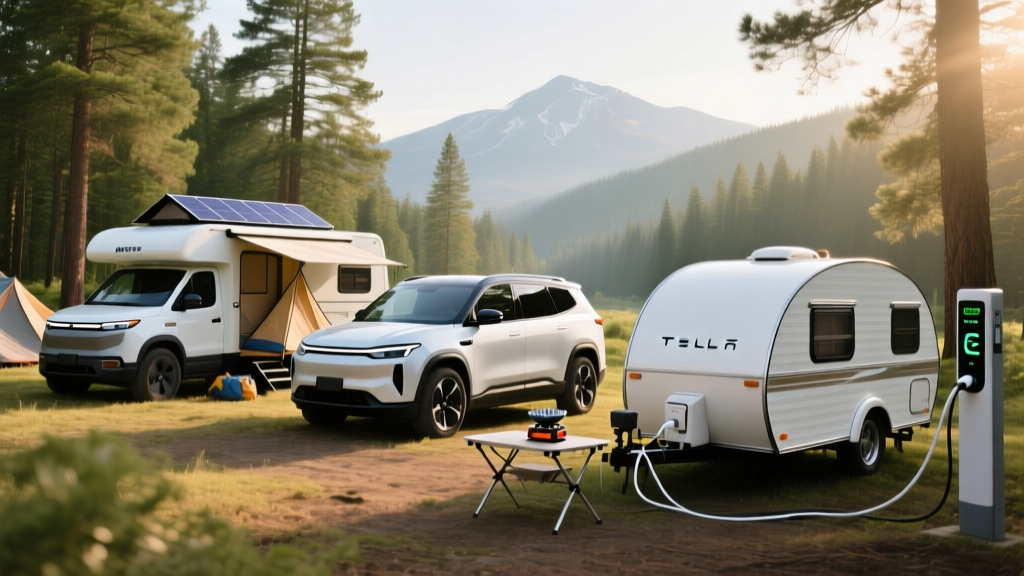
Short answer: There is currently no mass-produced, all-in-one "all electric camper" you can drive off a lot like a traditional Class A/B/C motorhome. What does exist are electric trucks paired with camper shells or trailers, and a handful of electric camper vans from specialty converters. If you want an electric camping setup today, you're building it from two pieces: an EV tow vehicle or van platform, plus a living module.
The all electric camper space in 2026 remains fragmented but increasingly viable — especially for weekend warriors with home charging and routes within 200 miles of basecamp. The math works differently than a gas-powered RV, and the tradeoffs are significant. Let's break down exactly what's available, what it costs, and who this actually makes sense for.
What Electric Vehicles Can Actually Serve as Campers?
When shoppers search for an "all electric camper," they're typically imagining one of three configurations. Here's what the market actually offers:
Electric Trucks + Camper Shell or Trailer
This is the most accessible all electric camper setup right now. The tow vehicles are production-ready; the camper modules bolt on or hitch up.
| EV Platform | Battery (kWh) | EPA Range (Unloaded) | Towing Capacity | Est. Range While Towing | Base MSRP |
|---|---|---|---|---|---|
| Ford F-150 Lightning (Ext. Range) | 131 kWh (NMC) | 320 mi | 10,000 lbs | ~140-170 mi | $76,995 |
| Rivian R1T (Dual Max Pack) | 141 kWh (NMC) | 352 mi | 11,000 lbs | ~160-190 mi | $87,600 |
| Chevrolet Silverado EV (4WT) | 200 kWh (NMC) | 450 mi | 10,000 lbs | ~200-240 mi | $72,900 |
| Tesla Cybertruck (AWD) | 123 kWh (est.) | 340 mi | 11,000 lbs | ~150-180 mi | $79,990 |
The critical number here isn't unloaded EPA range — it's towing range. Aerodynamic drag from a trailer or camper shell increases energy consumption by 40-60%. A truck rated at 320 miles unloaded may deliver just 140-170 miles while pulling a 5,000-lb travel trailer. According to fueleconomy.gov, real-world efficiency under load can drop from ~2.0 kWh/mi to 3.5+ kWh/mi.
Electric Camper Vans (Specialty Conversions)
A few upfitters have begun converting electric van platforms into livable camper vans. These are low-volume and expensive:
- Winnebago e-RV (Concept/Limited): Based on the Ford E-Transit chassis with a 68 kWh battery and ~126-mile EPA range. Winnebago has shown prototypes but hasn't committed to full production as of early 2026. The range makes it viable only for campground-to-campground hops under 80 miles.
- Thor Industries / Harbinger Electric Chassis: Thor (parent of Airstream) has partnered with Harbinger Motors on a purpose-built electric RV platform with a 155 kWh battery. Production units are expected in late 2026 or 2027 — currently announced, not available.
- Lightship L1 (Aerodynamic Travel Trailer): Not a motorhome, but worth noting — Lightship's solar-equipped travel trailer includes a proprietary battery pack (80 kWh) that can power its own axle, reducing tow-vehicle range loss by an estimated 40%. Starting around $125,000, with deliveries in limited numbers.
Why No All-In-One Electric Motorhome Yet?
Class A motorhomes weigh 20,000-40,000 lbs and need 300+ miles of range. That would require battery packs of 400-600+ kWh — adding thousands of pounds and $60,000+ in battery cost alone. The physics and economics don't work yet. Solid-state batteries may eventually change this, but not before 2028 at the earliest.
All Electric Camper vs. Gas RV: Real Cost Comparison
Let's compare two realistic setups: a Ford F-150 Lightning with a pop-up truck camper versus a comparable gas truck (Ford F-150 with 3.5L EcoBoost) and the same camper. We'll model 12,000 miles/year over 5 years, with 30% of driving done while towing or loaded.
| Cost Factor | F-150 Lightning + Camper Shell | F-150 EcoBoost (Gas) + Camper Shell |
|---|---|---|
| Vehicle Purchase (MSRP) | $76,995 | $58,000 |
| Camper Shell / Module | $8,000 | $8,000 |
| Federal §30D Tax Credit (if eligible) | -$7,500* | $0 |
| Effective Purchase Price | $77,495 | $66,000 |
| Fuel/Energy Cost (5 yr, 60,000 mi) | $5,400 (home L2 @ $0.14/kWh) | $14,400 (@ $3.60/gal, 16 mpg combined loaded) |
| Maintenance (5 yr) | $2,200 | $4,800 |
| Insurance (5 yr, avg) | $12,000 | $8,500 |
| 5-Year Total Cost of Ownership | $97,095 | $93,700 |
*Federal §30D tax credit eligibility depends on battery sourcing requirements, your modified adjusted gross income (single: $150K cap, joint: $300K), and MSRP caps ($80,000 for trucks). Check current rules at IRS.gov — these change frequently.
The EV setup costs roughly $3,400 more over five years, even with $9,000 in fuel savings. The gap narrows if you have solar or cheap utility rates, and widens if you rely on public DC fast charging at $0.40-$0.60/kWh.
Real-World Ownership: What First-Time EV Camper Buyers Must Know
Buying an all electric camper isn't like buying a gas RV. The infrastructure and planning requirements are fundamentally different.
Home Charging Is Nearly Mandatory
Public charging while camping is extremely limited. Most campgrounds offer 30-amp or 50-amp shore power (120V/240V), which translates to Level 1 or slow Level 2 charging — adding 3-15 miles of range per hour. If your campsite has a 50-amp NEMA 14-50 outlet, you can charge at up to 11.5 kW, adding roughly 35-45 miles per hour in an F-150 Lightning.
At home, you'll need a Level 2 charger (240V, 40-80 amp) to fully replenish a large truck battery overnight. Installation costs vary:
| Home Charging Setup | Equipment Cost | Electrician + Permit | Total Range |
|---|---|---|---|
| NEMA 14-50 Outlet (40A) | $0-$500 | $500-$1,500 | $500-$2,000 |
| Hardwired Level 2 (48A-80A) | $400-$800 | $800-$2,500 | $1,200-$3,300 |
| Panel Upgrade (if needed) | $0 | $2,000-$5,000 | $2,000-$5,000 |
If you live in an apartment or lack dedicated parking, an all electric camper becomes dramatically less practical. Daily public DC charging at $0.48/kWh national average (per the U.S. DOE) erases most fuel savings.
Route Planning Replaces Spontaneity
Towing with an EV requires planning around DC fast chargers every 120-160 miles. Not all charging stations accommodate trailers — you may need to unhitch or find pull-through sites. Networks like Tesla Supercharger, Electrify America, and EVgo are adding pull-through stalls, but coverage remains spotty in rural and mountain regions.
DC fast charging speeds for these trucks:
- F-150 Lightning: Peak 150 kW, 15-80% in ~41 minutes
- Rivian R1T: Peak 200+ kW, 10-80% in ~30 minutes (NACS-equipped 2025+ models)
- Silverado EV: Peak 350 kW (on 800V architecture), 10-80% in ~20 minutes
- Cybertruck: Peak 250 kW, 10-80% in ~28 minutes
These are peak rates — sustained charging curves taper significantly above 80% State of Charge. Plan for 45-60 minute stops when towing, not the 20 minutes manufacturers advertise for unloaded passenger driving.
Cold Weather Compounds the Problem
Lithium-ion batteries lose 15-30% of their range in freezing temperatures, even with active thermal management. Add a camper shell's aerodynamic penalty, and a 320-mile truck might deliver just 110-130 miles in January conditions. If you camp primarily in summer, this matters less. If you ski-camp in winter, it's a dealbreaker for longer routes.
Common Misconceptions About Electric Campers
| Myth | Fact |
|---|---|
| "You can't tow with an EV — the range drops to zero." | Range drops 40-60%, not to zero. A 320-mi truck still delivers 140-170 mi while towing — enough for many campgrounds with planned charging stops. |
| "Electric campers save money immediately." | Upfront cost is $15,000-$25,000 higher. Fuel savings take 5-7+ years to close the gap depending on mileage, electricity rates, and tax credit eligibility. |
| "Campgrounds have EV chargers." | Almost none do as of 2026. You'll rely on shore-power outlets (slow Level 2 at best) and must plan DC fast-charger stops en route. |
| "You can use the truck battery to power the camper." | Yes — the F-150 Lightning's Pro Power Onboard offers up to 9.6 kW of vehicle-to-load (V2L) output, enough to run camper AC, lights, and a fridge for days. This is a genuine advantage over gas trucks. |
| "The tax credit makes EVs cheaper than gas." | The §30D credit is up to $7,500, but battery-sourcing rules, income caps, and MSRP limits disqualify many buyers. Consult a tax professional. |
Decision Framework: Is an All Electric Camper Right for You?
Choose an all electric camper setup if:
- You have home Level 2 charging (or can install it)
- Most camping trips are within 150 miles of home or a known DC fast charger
- You value V2L capability — powering camp lights, fridge, and devices directly from the truck battery without a generator
- You already plan to buy a full-size electric truck and want dual-purpose use
- You camp primarily in moderate climates (above 30°F)
Stick with a gas or diesel camper for now if:
- You boondock in remote areas far from charging infrastructure
- You regularly tow over mountain passes in winter (range loss compounds altitude + cold + grade)
- You lack reliable home charging access
- You need 300+ miles of loaded range without 45-minute charging stops
- You want a full Class A/B/C motorhome with integrated living space — no electric option exists yet
Battery Warranty and Longevity Considerations
If you're investing $80,000+ in an EV platform as a camping vehicle, battery longevity matters. Here's what the major warranties cover:
- Ford F-150 Lightning: 8 years / 100,000 miles, minimum 70% capacity retention
- Rivian R1T: 8 years / 175,000 miles, minimum 70% retention
- Chevrolet Silverado EV: 8 years / 100,000 miles, minimum 60% retention (verify current terms)
- Tesla Cybertruck: 8 years / 120,000 miles, minimum 70% retention
Frequent DC fast charging and consistently charging to 100% accelerate degradation. For daily-use EVs, this is manageable. For a truck you're loading to capacity and fast-charging at high kW every camping weekend, expect slightly faster degradation — perhaps 12-18% capacity loss over 5 years versus 8-12% for lighter-duty use.
Battery replacement cost for a 130-200 kWh pack currently runs $15,000-$30,000 out of warranty. This is a worst-case scenario, but it's a real financial risk for second owners buying used.
Frequently Asked Questions
Can I live in an all electric camper full-time?
Not practically in 2026. No electric motorhome offers the range, payload, and living space needed for full-time RVing with frequent relocation. Electric truck + camper setups work for weekend and part-time use. If you're stationary at a campground with shore power, the electric truck's V2L capability actually excels — you can power your living setup without running a generator.
How much does it cost to charge an electric truck while camping?
At a public DC fast charger ($0.48/kWh average), replenishing a 131 kWh F-150 Lightning from 15-80% costs roughly $41. At a campground 50-amp outlet (Level 2, ~$0.14/kWh if metered), a full charge costs about $18. Compare this to $60-$90 for a tank of gas in an equivalent loaded F-150 EcoBoost. The savings are real but depend on charging access.
Will the Lightship L1 or other electric trailers solve the range problem?
Partially. Self-propelled trailers like the Lightship L1 use their own battery and axle to offset tow-vehicle energy consumption, potentially restoring 30-40% of lost range. However, at $125,000+, they're a premium product. Watch for more options as companies like PEV (Polye) and others develop similar platforms through 2027.
Do electric trucks qualify for the $7,500 federal tax credit?
Some do, but eligibility is complex. Under current IRS §30D rules, the vehicle must meet battery-component and critical-minerals sourcing requirements, the buyer's income must fall under caps ($150K single / $300K joint), and the truck MSRP must not exceed $80,000. The F-150 Lightning has qualified in certain trims; the Rivian R1T has faced sourcing-related restrictions. Always verify current eligibility at IRS.gov before purchasing.
What about hydrogen or hybrid campers as an alternative?
Hydrogen fuel-cell RVs don't exist in production. However, plug-in hybrid (PHEV) trucks like the forthcoming Ram 1500 Ramcharger (EREV) could offer a compelling middle ground — 100+ miles of electric range for daily driving with a gas range-extender for long towing trips. If range anxiety is your primary barrier, watch the EREV truck segment closely through 2026-2027.
The all electric camper isn't a single product you can buy today — it's a system you assemble from an EV platform and a living module, with careful attention to your route, charging access, and climate. For the right use case (weekend trips, home charging, moderate weather), it delivers genuine advantages: zero tailpipe emissions at campsite, silent operation, and V2L power that eliminates the generator. For remote boondocking or cross-country towing, gas and diesel remain the pragmatic choice. The gap will narrow as battery energy density improves and charging infrastructure reaches more rural corridors — but in 2026, honesty about the limitations is the best planning tool you have.