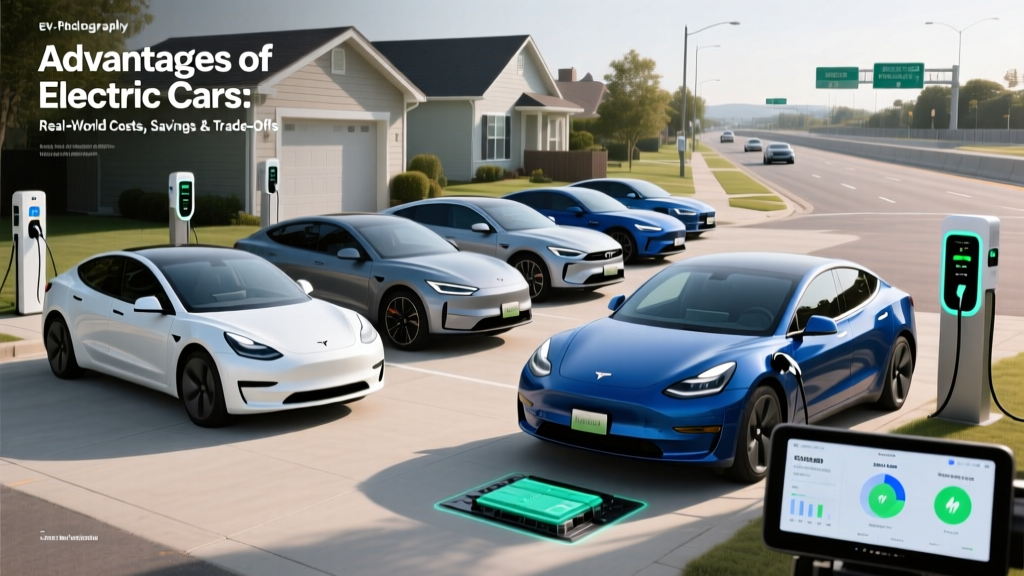
The advantages of electric cars center on lower per-mile energy costs, reduced maintenance, instant torque, and zero tailpipe emissions — but the real-world picture depends heavily on your driving patterns, home charging access, and local electricity rates. A typical EV owner charging at home saves $800–$1,200 annually versus a comparable gas car, while paying more upfront and potentially more for insurance. Federal tax credits of up to $7,500 (via IRS §30D) can narrow the purchase-price gap, though eligibility hinges on income caps, MSRP limits, and battery-sourcing requirements that shift yearly.
This guide breaks down every advantage — and limitation — with exact numbers from the EPA, manufacturer specs, and real-world ownership data so you can decide whether an EV fits your budget and lifestyle.
What Are the Core Advantages of Electric Cars?
Quick Answer: The five primary advantages of electric cars are: (1) lower fuel cost per mile ($0.04–$0.06/mi at home vs $0.12–$0.16/mi for gas), (2) fewer moving parts and lower maintenance ($0.06/mi vs $0.10/mi), (3) instant torque and smooth acceleration, (4) zero tailpipe emissions, and (5) eligibility for up to $7,500 in federal tax credits on qualifying models. Real-world range now routinely exceeds 250–300+ EPA miles on mainstream models.
Let's quantify each advantage with data rather than marketing claims.
1. Energy Cost: Electricity vs Gasoline
The most measurable advantage is the cost to "fuel" an EV. Using the U.S. average residential electricity rate of roughly $0.16/kWh (EIA, early 2026) and a mainstream EV efficiency of 3.0 miles/kWh (approximately 112 MPGe), the cost per mile charging at home is about $0.053/mile.
Compare that to a comparable gas car averaging 28 MPG combined at $3.30/gallon: $0.118/mile. That's a per-mile savings of roughly 55%, translating to about $975 saved per year at 15,000 miles driven.
Important caveats: public DC fast charging costs significantly more — typically $0.35–$0.55/kWh, which can push per-mile costs to $0.12–$0.18, erasing much of the savings if you rely exclusively on public chargers. Home charging access is the single biggest variable in EV economics.
2. Maintenance: Fewer Parts, Lower Costs
Battery-electric vehicles eliminate oil changes, spark plugs, timing belts, exhaust systems, and multi-speed transmissions. Regenerative braking dramatically extends brake pad life — many EV owners report original pads at 80,000+ miles.
According to fueleconomy.gov, EVs cost approximately $0.061/mile to maintain versus $0.101/mile for internal combustion vehicles — a savings of about $600/year at 15,000 miles. Over a 10-year ownership period, that's $6,000 back in your pocket.
3. Performance: Instant Torque and One-Pedal Driving
Electric motors deliver peak torque from 0 RPM. A Tesla Model 3 Long Range (346 hp, EPA 341 mi) hits 0–60 mph in 4.2 seconds; a Hyundai Ioniq 6 SE Long Range (225 hp, EPA 361 mi) does it in 5.1 seconds. Even non-performance EVs feel quicker than their gas equivalents in city driving because there's no transmission lag or turbo spool-up.
Regenerative braking enables one-pedal driving in most models, where lifting off the accelerator slows the car substantially — reducing brake wear and making stop-and-go traffic less fatiguing.
EV vs Gas vs Hybrid: A Data-Driven Comparison
The advantages of electric cars shift depending on what you compare them against. Here's how a mainstream EV, a conventional hybrid, and a gas-only compact SUV stack up in 2026 using representative models:
| Metric | EV (Tesla Model Y LR) | Hybrid (Toyota RAV4 Hybrid) | Gas (Honda CR-V EX) |
|---|---|---|---|
| Base MSRP | $44,990 | $33,800 | $34,050 |
| EPA Range / Tank | 320 mi (EPA) | 580 mi (14.5 gal × 40 MPG) | 437 mi (14.0 gal × 31 MPG) |
| Energy Cost / Mile | $0.053 (home charging) | $0.083 (40 MPG × $3.30/gal) | $0.106 (31 MPG × $3.30/gal) |
| Annual Fuel/Energy (15k mi) | $795 | $1,245 | $1,590 |
| Maintenance / Year (est.) | $915 | $1,200 | $1,515 |
| Fed. Tax Credit (§30D) | Up to $7,500* | $0 | $0 |
| 5-Year Total Energy + Maint. | $8,550 | $12,225 | $15,525 |
*§30D credit eligibility depends on buyer income (≤$150k single / $300k joint), MSRP caps ($55k sedans / $80k SUVs/trucks), and battery critical-mineral sourcing. Verify at irs.gov. Credit can be transferred to the dealer as a point-of-sale discount.
The EV's higher MSRP is partially offset by the tax credit and dramatically lower running costs. Over five years, the Model Y saves roughly $6,975 in energy and maintenance versus the gas CR-V — and about $3,675 versus the RAV4 Hybrid. Break-even on the purchase premium typically occurs between years 3 and 5, depending on local electricity rates and annual mileage.
Real Costs of EV Ownership: The Full Picture
The advantages of electric cars only matter if the total cost of ownership works for your budget. Here's an honest breakdown.
| Cost Category | EV (Annual Est.) | Gas Car (Annual Est.) | Notes |
|---|---|---|---|
| Purchase Price (avg. mainstream) | $40,000–$50,000 | $30,000–$40,000 | EV premium narrowing; credits help |
| Energy/Fuel | $795 | $1,590 | Based on 15k mi/yr, home charging |
| Maintenance | $915 | $1,515 | No oil, fewer brake jobs on EV |
| Insurance | $1,800–$2,400 | $1,500–$1,900 | EVs cost 15–25% more to insure on average |
| Home Charger Install (one-time) | $800–$2,500 | $0 | Level 2, 240V; panel upgrade may add $1,500+ |
| Depreciation (5-year avg.) | 45–55% | 40–50% | EV depreciation has improved but still lags |
Where EVs Cost More
Honesty requires naming the disadvantages too. EVs typically carry higher insurance premiums (repair costs, battery replacement risk, and specialized labor drive rates 15–25% above comparable gas models). Depreciation, while improving, still tends to be steeper — particularly as rapid model-year price cuts by manufacturers can erode resale values. And if you lack home charging, reliance on public DC fast chargers at $0.40–$0.55/kWh can push energy costs close to or above gasoline.
Battery Longevity: The Big Question
Modern EV batteries (NMC and LFP chemistries) are engineered for 1,000–2,000+ charge cycles with 70–80% capacity retention. Federal law mandates a minimum warranty of 8 years / 100,000 miles for battery capacity (typically guaranteed above 70% state of health). Real-world data from fleet operators and long-term owners shows most EV batteries degrade 1–2% per year under normal use — meaning a 300-mile EV might offer 255–270 miles of range at year 10.
Full battery replacement costs range from $8,000 to $18,000 depending on the model and pack size, though replacements outside warranty remain uncommon for vehicles under 150,000 miles.
Charging in the Real World: What First-Time Buyers Must Know
Charging logistics are where the advantages of electric cars either materialize or collapse. Here's the hierarchy:
| Charging Level | Power (kW) | Miles Added / Hour | Use Case |
|---|---|---|---|
| Level 1 (120V outlet) | 1.2–1.9 kW | 3–5 mi/hr | Overnight top-up; viable for <40 mi/day commutes |
| Level 2 (240V home) | 7.2–11.5 kW | 25–44 mi/hr | Daily charging; full overnight refill |
| DC Fast Charge | 50–350 kW | 150–800+ mi/hr (peak) | Road trips; 10–80% in 18–35 min |
A crucial concept: kW (kilowatts) measures charging power — the rate of energy delivery. kWh (kilowatt-hours) measures battery capacity — the total energy stored. A 75 kWh battery charged at 7.2 kW takes roughly 10.4 hours from empty to full.
Home Charging Is the Economic Linchpin
Most EV owners do 80–90% of their charging at home. A Level 2 home charger (typically $300–$700 for the unit) installed on an existing 240V circuit costs $500–$1,500 total. If your electrical panel needs an upgrade to 200A, add $1,500–$3,000. This investment pays for itself within 1–3 years through fuel savings alone.
If you live in an apartment, rely on street parking, or lack access to a dedicated circuit, EV ownership becomes significantly more challenging — though workplace charging and expanding public Level 2 networks are improving this equation.
Cold Weather and Highway Range: The Honest Numbers
EPA range estimates are measured under controlled conditions. Real-world range varies:
- Highway driving (75+ mph): Expect 85–90% of EPA range due to aerodynamic drag.
- Cold weather (below 32°F): Range drops 15–30% due to battery chemistry and cabin heating demands. EVs with heat pumps (standard on Hyundai/Kia E-GMP models, Tesla since 2021) recover 5–10% of that loss.
- DC fast charging taper: Peak charge rates (e.g., 250 kW) are sustained only between roughly 10–50% state of charge. Above 80%, charging slows dramatically to protect battery health — plan road-trip stops around 10–80% charges for efficiency.
Common EV Misconceptions: Myths vs Facts
| Myth | Fact (with Data) |
|---|---|
| "EV batteries need replacing every few years" | Federal warranty mandates 8 yr/100k mi coverage at ≥70% capacity. Real-world data shows 1–2% annual degradation; most packs outlast 150k+ miles. |
| "EVs are worse for the environment because of electricity generation" | Even on coal-heavy grids, EVs produce fewer lifetime emissions than gas cars (Union of Concerned Scientists). On clean grids, the advantage is 3–5×. Battery recycling infrastructure is scaling rapidly. |
| "Charging takes too long" | Home Level 2 charging happens while you sleep — effectively zero active time. DC fast charging adds 150–200 miles in 15–20 minutes on modern 800V architectures (Hyundai/Kia/Porsche). |
| "The grid can't handle EVs" | Most EVs charge overnight during off-peak hours. Smart charging and V2G (vehicle-to-grid) technology actually help stabilize grid demand. Utilities are upgrading distribution capacity proactively. |
| "EVs don't have enough range for road trips" | Multiple 2026 models exceed 300+ EPA miles. The Tesla Supercharger network (now NACS-standard, open to Ford, GM, Rivian, and others) covers all major U.S. highway corridors with 150–250 kW stalls every 150–200 miles. |
| "Tax credits are gone or I don't qualify" | The §30D credit remains available for 2026 on qualifying models, with point-of-sale transfer allowed. Check income caps ($150k single/$300k joint), MSRP caps ($55k cars/$80k SUVs), and battery sourcing at irs.gov. |
Decision Framework: Is an EV Right for You?
Choose an EV (BEV) if:
- You have access to home or workplace Level 2 charging
- Your daily driving is under 200 miles (covers 95%+ of U.S. drivers)
- You drive 12,000+ miles/year (higher mileage = faster payback on fuel savings)
- You want to minimize maintenance visits and per-mile energy costs
- You qualify for federal or state tax credits that narrow the purchase gap
Choose a PHEV (plug-in hybrid) if:
- You lack reliable home charging but want some electric-only driving
- You frequently take 400+ mile road trips and want zero range anxiety
- Your daily commute is under 30–40 miles (covered by PHEV electric range)
- Examples: Toyota RAV4 Prime (42 mi electric), Jeep Wrangler 4xe (22 mi electric)
Choose a conventional hybrid (HEV) if:
- You have no charging access whatsoever
- You want maximum range flexibility with no plug-in behavior changes
- Your budget doesn't accommodate the EV purchase premium
- Examples: Toyota Camry Hybrid (52 MPG combined), Honda CR-V Hybrid (40 MPG)
Wait or reconsider if:
- You regularly tow heavy loads (towing cuts EV range 40–50%)
- You live in extreme cold and drive 300+ miles between charging stops
- You live in a charging desert with no planned infrastructure investment
Frequently Asked Questions
How much does it really cost to charge an EV at home?
At the U.S. average of $0.16/kWh and an EV averaging 3.0 mi/kWh, a full charge of a 75 kWh battery costs about $12 and provides roughly 225 real-world miles. For a driver covering 15,000 miles/year, annual home charging costs approximately $795 — compared to $1,590 for a 31 MPG gas car at $3.30/gallon.
Do EVs really save money long-term?
Yes, for most owners with home charging. Over 5 years and 75,000 miles, a typical EV saves $3,500–$5,000 in combined fuel and maintenance versus a gas car. The break-even point against the higher purchase price usually falls between years 3–5, accelerated by the $7,500 federal tax credit where eligible.
What happens if I can't charge at home?
Public-only charging is viable but more expensive and less convenient. DC fast charging at $0.40–$0.55/kWh pushes per-mile costs to $0.13–$0.18 — close to gasoline. If home charging isn't possible, consider a PHEV (which can run on gas when needed) or investigate workplace charging, apartment-complex Level 2 installations, and whether your utility offers off-peak public charging discounts.
How long do EV batteries actually last?
Based on fleet data and long-term owner reports, modern EV batteries lose approximately 1–2% of capacity per year. At year 10, expect 80–90% of original range. Federal law requires manufacturers to warranty the battery for at least 8 years/100,000 miles against dropping below ~70% capacity. Full replacements ($8,000–$18,000) are uncommon before 150,000+ miles.
Are electric cars reliable in winter?
EVs start and run reliably in cold weather — there's no engine to crank or oil to warm. The trade-off is range: expect a 15–30% reduction below freezing due to battery chemistry and cabin heating. Preconditioning the battery while plugged in (a feature on most modern EVs) recovers some efficiency. Models with heat pumps handle cold more efficiently than those using resistive heaters.
Sources: EPA range and efficiency data via fueleconomy.gov; IRS §30D credit rules at irs.gov; manufacturer spec sheets for 2026 model-year vehicles.