Quick Answer: What Is a Street-Legal Adult Electric Car?
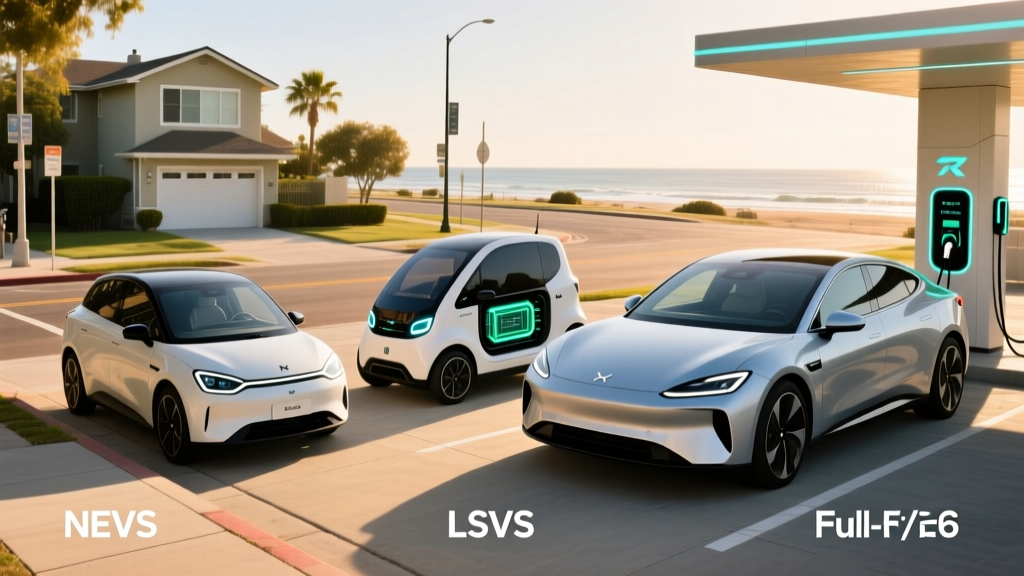
A street-legal adult electric car typically falls into one of three categories: a Neighborhood Electric Vehicle (NEV) / Low-Speed Vehicle (LSV) limited to 25 mph on roads with speed limits up to 35 mph, a medium-speed electric vehicle (up to 35 mph, available in select states), or a full-size highway-capable BEV like a Chevrolet Equinox EV or Tesla Model 3. NEVs/LSVs start around $8,000–$15,000 but offer 30–60 miles of range and minimal crash protection. Full EVs start around $28,000–$35,000 after incentives, deliver 250–350+ miles of EPA range, and qualify for the federal §30D tax credit (up to $7,500) if you meet income, MSRP, and battery-sourcing requirements.
What Buyers Actually Mean by "Adult Electric Car Street"
The search term "adult electric car street" captures a real and underserved buyer segment: adults who want a small, affordable, electric vehicle they can legally drive on public roads — not a golf cart for private property, not an e-bike, and not a $60,000 luxury EV. In 2026, this buyer is usually looking at one of three paths, each with very different capabilities, costs, and legal requirements.
Understanding which category fits your driving pattern is the single most important decision here. A NEV/LSV is perfect for a 3-mile commute in a retirement community or small town. It is dangerously inadequate for a 15-mile suburban commute on 45 mph roads. Let's break down exactly what each option delivers.
NEV, LSV, and Medium-Speed: The Legal Definitions
Federal Motor Vehicle Safety Standard (FMVSS) No. 500 defines the Low-Speed Vehicle (LSV) category. An LSV must have four wheels, a top speed between 20 and 25 mph, and a gross vehicle weight rating under 3,000 lbs. The NHTSA requires LSVs to include headlamps, turn signals, stop lamps, reflex reflectors, exterior mirrors, a parking brake, a windshield (glazed or polycarbonate), a VIN, and seat belts — but they are exempt from crash-testing, airbag requirements, and most FMVSS crash standards that apply to full-size passenger vehicles.
A Neighborhood Electric Vehicle (NEV) is the battery-electric subset of the LSV class. The terms are often used interchangeably in marketing. Most states allow NEVs/LSVs on roads with posted speed limits of 35 mph or lower, though local ordinances vary. You need a valid driver's license, registration, and insurance in most jurisdictions.
Medium-speed electric vehicles (MSEVs), capped at 35 mph, are legal in a smaller number of states — including Texas, Oregon, and Tennessee — under specific statutes. They remain uncommon and are not recognized federally as a distinct class.
| Myth | Fact |
|---|---|
| "A golf cart is street-legal if I add seat belts." | A standard golf cart does not meet FMVSS 500 LSV requirements. It must be manufactured or certified as an LSV with all required equipment and a 17-character VIN. |
| "NEVs qualify for the $7,500 federal EV tax credit." | The IRS §30D credit requires a vehicle with a gross vehicle weight rating under 14,000 lbs, a battery of at least 7 kWh, and compliance with critical-mineral and battery-component sourcing rules. Most NEVs fall short on battery capacity and sourcing requirements. Verify at irs.gov. |
| "A NEV is safe enough for any road." | NEVs lack crumple zones, airbags, and crash-test ratings. They are appropriate only for low-speed, low-traffic environments. Mixing with 45+ mph traffic is extremely dangerous. |
| "I don't need insurance for a street-legal electric cart." | Most states require liability insurance for registered LSVs/NEVs, just as with a full-size car. |
Real Options in 2026: NEVs vs. Affordable Highway-Capable EVs
Here is where the rubber meets the road — or rather, where the battery meets the pavement. Below is a side-by-side comparison of representative vehicles in each category, with real specs and pricing for the 2025–2026 model years.
| Spec | GEM e2 NEV (Typical LSV) | Chevrolet Equinox EV LT (2026) | Nissan LEAF S (2025) |
|---|---|---|---|
| Vehicle Class | LSV / NEV (FMVSS 500) | Highway-capable BEV | Highway-capable BEV |
| Top Speed | 25 mph | ~112 mph (electronically limited) | ~95 mph |
| EPA Range | N/A (est. 30–50 mi at LSV speeds) | 319 mi (EPA est.) | 149 mi (EPA est.) |
| Battery Capacity | ~8–14 kWh (lead-acid or Li-ion) | 85 kWh usable (NMC) | 40 kWh usable (NMC) |
| Charging (Level 2) | ~1.2–1.9 kW; 6–10 hours | 11.5 kW; ~9 hours (0–100%) | 6.6 kW; ~7 hours (0–100%) |
| DC Fast Charge | None | 150 kW peak; 10–80% in ~25 min | 50 kW peak (CHAdeMO); 10–80% in ~45 min |
| Crash Test Ratings | None required / none available | NHTSA 5-star overall (when rated) | IIHS Top Safety Pick (prior years) |
| Airbags | No | Yes (front, side, curtain) | Yes (front, side, curtain) |
| MSRP (Base) | ~$9,000–$12,000 | ~$33,600 | ~$28,140 |
| Federal §30D Credit Eligibility | Unlikely (battery & sourcing) | Up to $7,500 if eligible | Up to $7,500 if eligible (verify sourcing) |
| Roads Permitted | Posted ≤35 mph only (most states) | All public roads | All public roads |
Real-world range caveat: The Equinox EV's 319-mile EPA estimate assumes mixed driving at moderate temperatures. Expect approximately 250–270 miles on sustained highway driving at 70+ mph, and a 15–30% reduction in freezing weather due to cabin heating demand and battery chemistry. The LEAF's 149-mile EPA range drops to roughly 100–115 miles under cold/highway conditions — adequate for commuting but limiting for road trips.
Cost Breakdown: Purchase, Charging, Maintenance, and Insurance
The sticker price is only the beginning. Here is what a 5-year ownership picture looks like for each category, assuming 8,000 miles driven annually and national-average electricity rates of $0.17/kWh.
| Cost Category | NEV/LSV (~$10,500 MSRP) | Nissan LEAF S (~$28,140 MSRP) | Comparable Gas Car (~$26,000 MSRP, 30 MPG) |
|---|---|---|---|
| Purchase Price (after credit) | $10,500 (credit unlikely) | $20,640 (with $7,500 §30D, if eligible) | $26,000 |
| Fuel/Energy (5 yrs) | ~$1,360 (18 kWh/100mi) | ~$2,267 (30 kWh/100mi) | ~$4,667 ($3.50/gal, 30 MPG) |
| Maintenance (5 yrs) | ~$800 (battery replacement risk) | ~$1,500 (tires, cabin filter, fluid top-offs) | ~$3,500 (oil, filters, brakes, belts) |
| Insurance (5 yrs, est.) | ~$3,000 ($600/yr avg) | ~$7,500 ($1,500/yr avg) | ~$6,500 ($1,300/yr avg) |
| Estimated 5-Year Total | ~$15,660 | ~$31,907 | ~$40,667 |
Key takeaways: A NEV is dramatically cheaper to own — but only if your driving needs fit within its 25-mph, 35-mph-road limitation. The LEAF, after the federal tax credit, approaches gas-car pricing upfront and beats it handily on fuel and maintenance over five years. Insurance for EVs runs 10–25% higher than equivalent gas cars in most states, driven by higher repair costs for battery packs and advanced driver-assistance sensors — factor this into your budget.
Home charging cost note: Installing a dedicated 240V Level 2 home charger typically costs $500–$1,800 for equipment and electrician labor, depending on panel capacity and conduit run length. Most NEVs charge on a standard 120V outlet (Level 1), eliminating this cost. For a full EV, Level 1 charging adds only 3–5 miles per hour — insufficient for the LEAF's full battery overnight but adequate for a 30-mile daily commute if you plug in every night.
Who Should Buy a NEV/LSV — and Who Shouldn't
NEVs and LSVs solve a real transportation problem for a specific buyer. Based on ownership data and real-world use patterns, here is a decision framework:
Decision Framework: Is a NEV/LSV Right for You?
Choose a NEV/LSV if:
- Your daily trips are under 15 miles round-trip
- All your regular routes are on roads with posted speed limits of 35 mph or lower
- You live in a planned community, retirement village, small town, or island with low-speed infrastructure
- You have a garage or covered outlet for overnight 120V charging
- You do not need to carry more than 1–2 passengers and minimal cargo
- You understand and accept the lack of crash protection
Choose a full highway-capable EV (LEAF, Equinox EV, Hyundai Kona Electric) if:
- Any part of your commute uses roads posted above 35 mph
- You drive in mixed traffic with vehicles traveling 40–70 mph
- You need climate control, crash safety ratings, and airbags
- You carry children (child seats are generally incompatible with NEVs)
- You need to drive in cold weather, rain, or on highways
- You want to qualify for the federal §30D tax credit (up to $7,500)
Federal Tax Credit Reality for 2026
The IRS §30D Clean Vehicle Credit offers up to $7,500 for qualifying new EVs purchased in 2026, but eligibility is constrained by three interlocking requirements:
- MSRP cap: Vans, SUVs, and pickups must be under $80,000; sedans and other body styles under $55,000.
- Buyer income cap: Modified adjusted gross income must not exceed $300,000 (joint), $225,000 (head of household), or $150,000 (single).
- Battery sourcing: A percentage of critical minerals and battery components must be sourced from the U.S. or free-trade-agreement partners. These percentages increase annually, disqualifying some models that were eligible in prior years.
- Point-of-sale transfer: As of 2024, buyers can transfer the credit to the dealer at purchase, reducing the sale price directly — no need to wait for a tax refund.
Most NEVs/LSVs do not qualify because their battery packs fall below the 7 kWh minimum threshold or fail the sourcing requirements. Always verify a specific vehicle's eligibility using the IRS's qualified vehicles list and consult a tax professional before relying on the credit in your purchase calculation.
What First-Time EV Buyers Need to Know Before Signing
If you are transitioning from a gas car to any electric vehicle — NEV or full-size BEV — these are the non-obvious realities that catch new owners off guard:
1. Charging access is your #1 constraint. If you cannot charge at home (apartment, street parking, no dedicated outlet), public charging infrastructure varies wildly by region. Use the DOE Alternative Fuels Data Center to map chargers near your home and commute before purchasing.
2. Cold weather reduces range by 15–30%. Lithium-ion batteries lose efficiency below freezing, and resistive cabin heating draws significant energy. A 319-mile EPA-rated EV may deliver 220–260 miles in a Minnesota January. NEVs, with minimal insulation and no heat pumps, fare even worse.
3. DC fast charging slows above 80%. The "peak" charge rate (e.g., 150 kW) is sustained only between roughly 10–50% state of charge. Above 80%, the charge curve tapers dramatically to protect battery chemistry. Plan road-trip stops around 10–80% charges, not 0–100%.
4. Battery degradation is real but manageable. Modern NMC and LFP packs typically retain 85–90% capacity after 100,000 miles and 8 years. Federal law mandates a minimum 8-year/100,000-mile battery warranty for highway-capable EVs. NEVs may have shorter or less comprehensive battery warranties — check the fine print.
5. Insurance is more expensive. EV insurance premiums run 10–25% higher than equivalent gas vehicles, driven by battery replacement costs, specialized repair requirements, and higher vehicle prices. Get quotes before you buy.
Frequently Asked Questions
Can I drive a NEV or LSV on any public road?
No. Most states restrict NEVs/LSVs to roads with posted speed limits of 35 mph or lower. Some localities allow crossing higher-speed roads at designated intersections. Check your state's DMV or transportation code — rules differ significantly between, say, California, Florida, and Texas.
Do I need a driver's license to operate a street-legal NEV?
Yes, in nearly all states. A NEV/LSV is a registered motor vehicle. You need a valid driver's license, vehicle registration, proof of insurance, and the vehicle must display a license plate. Operating one without these is a traffic violation.
How long does a NEV battery last, and what does replacement cost?
Lithium-ion NEV batteries typically last 3–5 years with daily use before noticeable range degradation. Lead-acid variants (still sold on budget models) last 2–3 years. Replacement costs range from $1,500 to $4,000 depending on chemistry and capacity. Factor this into your 5-year cost calculation.
Is a used EV a better deal than a new NEV?
For most buyers who need highway access, yes. A used 2022–2024 Nissan LEAF or Chevrolet Bolt EV can be found for $14,000–$20,000 and may qualify for the used clean vehicle credit (up to $4,000, or 30% of the sale price, with income caps). This delivers far more capability, safety, and range than a new NEV at a comparable price point.
Can I charge a NEV at a public EV charging station?
Generally no. Most NEVs use a standard 120V household plug (NEMA 5-15) and cannot connect to J1772 Level 2 or CCS/NACS DC fast chargers. Some newer lithium-ion LSVs include a J1772 inlet for Level 2 charging, but this is not universal. Confirm connector compatibility before purchasing.