The Analyst Who Moved Tesla's Stock — and the EV Industry
For over a decade, few Wall Street voices carried more weight in the electric vehicle space than Adam Jonas. As Morgan Stanley's lead auto analyst, Jonas became synonymous with bold Tesla price targets, provocative research notes on autonomous driving, and a willingness to frame Tesla not as a car company but as a technology platform. His coverage — spanning from the Model S era through the Cybertruck launch and into the robotaxi debates of 2025-2026 — shaped how institutional investors, retail traders, and even EV buyers thought about Tesla's trajectory.
But what did Jonas actually get right, where did his calls miss, and what does the Tesla lineup look like today as the company navigates intensifying competition? This piece unpacks the Adam Jonas–Tesla relationship, then grounds the conversation in hard specs on the vehicle most buyers actually consider: the 2026 Tesla Model Y.
Key Adam Jonas Tesla Calls: Hits, Misses, and Legacy
Jonas's tenure covering Tesla was defined by several landmark calls:
- The 2020 $1,200 split-adjusted bull case: Jonas argued Tesla's value lay in its software, energy, and network businesses — not just vehicle sales. While the exact price target proved aspirational, the thesis that Tesla should be valued as a tech company rather than an automaker became mainstream.
- Robotaxi skepticism vs. optimism: Jonas oscillated between assigning massive value to Tesla's autonomous driving potential and warning that regulatory timelines would stretch far beyond Elon Musk's projections. His 2023 note cautioning that Level 4 autonomy was "further away than the market assumes" aged well, as SAE Level 2 driver-assist systems like FSD (Supervised) remain the consumer reality in 2026.
- The "Dojo supercomputer" thesis: Jonas highlighted Tesla's custom AI training chip as a potential profit center. This call remains unproven — Dojo's commercial impact has been limited compared to Nvidia's dominance in AI compute.
- China competition warnings: Jonas was early in flagging BYD and other Chinese EV makers as existential threats to Tesla's margins. BYD's global expansion through 2025-2026 validated this concern.
Jonas's coverage was never without controversy. Critics pointed to his frequent target revisions and the inherent conflict of investment banks covering companies they also advise. Still, his willingness to engage with Tesla's technology narrative — rather than dismissing it as traditional auto analysts often did — helped legitimize EV analysis as a discipline.
2026 Tesla Model Y: The Vehicle Most Buyers Actually Research
Analyst narratives aside, Tesla's fortunes in 2026 rest heavily on the refreshed Model Y — the best-selling EV in the U.S. and a benchmark for the compact electric SUV segment. Here's what the current lineup delivers in hard numbers.
| Attribute | Long Range RWD | Long Range AWD | Performance |
|---|---|---|---|
| EPA Range | 320 mi | 305 mi | 285 mi |
| Battery (usable) | ~75 kWh, NMC | ~75 kWh, NMC | ~75 kWh, NMC |
| Drivetrain | Rear-Wheel Drive | Dual-Motor AWD | Dual-Motor AWD |
| Horsepower | 346 hp | 384 hp | 456 hp |
| 0–60 mph | 5.0 sec | 4.1 sec | 3.5 sec |
| Efficiency | 123 MPGe / 27 kWh/100mi | 117 MPGe / 29 kWh/100mi | 111 MPGe / 30 kWh/100mi |
| Max DC Fast Charge | 250 kW peak | 250 kW peak | 250 kW peak |
| 10–80% DC Charge | ~25 min | ~25 min | ~25 min |
| Level 2 Home Charge | 11.5 kW (~44 mi/hr) | 11.5 kW (~44 mi/hr) | 11.5 kW (~44 mi/hr) |
| Cargo (rear seats up / folded) | 30.2 / 72.0 cu ft | ||
| Rear Legroom | 40.5 in | ||
| Base MSRP | $44,990 | $47,990 | $52,490 |
Source: EPA fueleconomy.gov, Tesla.com specifications (2026 model year). Efficiency and range figures are EPA estimates.
Real-World Range: What the EPA Sticker Doesn't Tell You
EPA sticker: 305 miles
Real-world highway (70–80 mph, moderate temps): ~250–275 miles
Real-world cold weather (below 32°F, mixed driving): ~210–245 miles
City/regenerative driving (mild temps): ~285–305 miles
The Model Y's NMC (nickel manganese cobalt) battery chemistry offers high energy density but is more temperature-sensitive than LFP (lithium iron phosphate). In practice, this means:
- Highway driving at sustained 75+ mph increases aerodynamic drag substantially. Expect 15–20% range reduction versus the EPA combined figure.
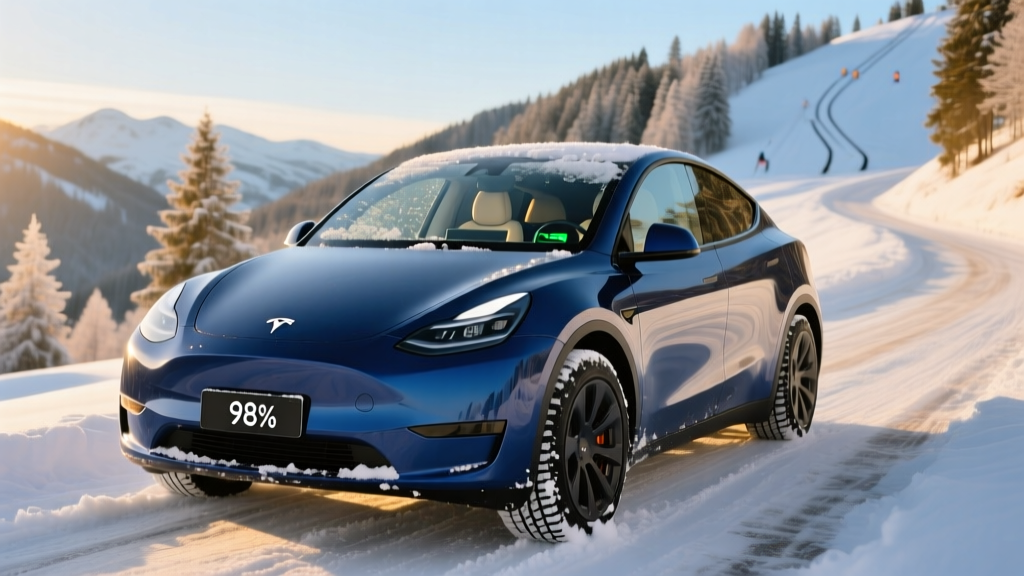
- Cold weather reduces battery efficiency and increases cabin heating demand. Tesla's heat pump mitigates this better than resistive heaters, but 20–30% range loss is typical in sub-freezing conditions.
- Preconditioning the battery before a DC fast charge session is essential. Without it, peak charge rates drop significantly — a cold battery might only accept 80–100 kW initially instead of the rated 250 kW peak.
Charging Speed: DC Fast, Level 2, and the Supercharger Advantage
Tesla's Supercharger network remains the most reliable DC fast-charging ecosystem in North America. The 2026 Model Y supports the NACS (North American Charging Standard) connector natively — no adapter needed at Tesla stalls.
| Level | Power | Miles Added | Notes |
|---|---|---|---|
| Level 1 (120V) | ~1.4 kW | ~4–5 mi/hr | Emergency/trickle only |
| Level 2 (240V, 48A) | 11.5 kW | ~44 mi/hr | Full overnight charge in ~7 hr |
| DC Fast (Supercharger V3) | 250 kW peak | ~162 mi in 15 min | Tapers above 60% SoC |
| DC Fast (CCS via adapter) | Up to 150–175 kW | Varies by station | Non-Tesla networks; adapter included |
Charging curve reality: The 250 kW peak rate holds only between roughly 10–30% State of Charge. By 60% SoC, the rate drops to ~120 kW, and above 80% it falls below 50 kW. This is why Tesla (and the industry) quotes 10–80% times rather than 0–100%. Plan road-trip stops around the 10–80% window for maximum efficiency.
Home charging cost: At the U.S. average residential rate of ~$0.16/kWh (per EIA data), a full 75 kWh charge costs roughly $12.00 — equivalent to about $0.04 per mile. Compare that to a 25 MPG gas SUV at $3.50/gallon: $0.14 per mile.
Pricing, Tax Credits, and Total Cost
The 2026 Model Y starts at $44,990 for the Long Range RWD. Here's how federal incentives apply:
| Trim | MSRP | §30D Credit | Effective Price* |
|---|---|---|---|
| Long Range RWD | $44,990 | Up to $7,500 | ~$37,490 |
| Long Range AWD | $47,990 | Up to $7,500 | ~$40,490 |
| Performance | $52,490 | Up to $7,500 | ~$44,990 |
*Effective price assumes full §30D credit eligibility. Actual credit depends on battery component and critical mineral sourcing requirements, buyer income caps, and point-of-sale transfer rules. See IRS §30D guidelines.
- MSRP cap: SUVs/pickups must be under $80,000 — all Model Y trims qualify.
- Income cap: Modified AGI ≤ $150,000 (single) / $300,000 (joint) / $225,000 (head of household).
- Battery sourcing: As of 2026, both battery components and critical minerals must meet escalating domestic-content thresholds. The full $7,500 requires meeting both halves ($3,750 each). Tesla's U.S. battery production has historically met these requirements, but verify at point of sale — rules tighten annually.
- Point-of-sale transfer: Buyers can transfer the credit to the dealer for an immediate price reduction rather than waiting for a tax refund.
Warranty, Tech, and Ownership Considerations
Battery & Drive Unit Warranty: 8 years / 120,000 miles (whichever comes first), with Tesla guaranteeing a minimum 70% capacity retention over the warranty period. This is competitive with Hyundai/Kia's 10-year/100,000-mile battery warranty, though Tesla's mileage cap is higher.
Vehicle Limited Warranty: 4 years / 50,000 miles — standard for the luxury segment but shorter than mainstream brands like Hyundai (5yr/60,000mi).
Standout Tech:
- 15.4-inch center touchscreen with Tesla's proprietary OS — responsive, frequent OTA updates
- Autopilot standard (adaptive cruise + lane centering); FSD (Supervised) available as a $8,000 option or $99/month subscription
- Sentry Mode, Dashcam, and Dog Mode as standard software features
- Native NACS connector — seamless Supercharger access with no adapter
- Front trunk (frunk): 4.1 cu ft of additional cargo space
Notable Drawbacks:
- No physical instrument cluster or head-up display — all information routes through the center screen
- Turn signals on the steering wheel yoke (if equipped) are divisive; traditional round wheel available
- Minimal button/tactile controls — climate and mirror adjustments require screen interaction
- Insurance costs run 15–30% higher than comparable gas SUVs (per IIHS and industry data)
- Service center availability varies by region — mobile service helps but doesn't cover everything
✓ Pros
- Best-in-class Supercharger network access
- Strong real-world efficiency (27 kWh/100mi)
- Spacious cargo area (72 cu ft max)
- Frequent OTA software improvements
- Competitive 0–60 performance across trims
- Federal tax credit eligible (verify sourcing annually)
✗ Cons
- No instrument cluster or HUD
- Higher insurance premiums
- Service center gaps in rural areas
- Build quality variability still reported
- FSD remains Level 2 — not autonomous
- Competition closing fast (Ioniq 5, EV6, Equinox EV)
Is the Model Y Worth It vs. Key Competitors?
The Model Y no longer competes in a vacuum. In 2026, credible alternatives include:
- Hyundai Ioniq 5: 800V architecture enables 10–80% charging in ~18 min (vs. Model Y's ~25 min). CCS connector requires an adapter for Tesla Superchargers. Slightly less range (305 mi EPA Long Range AWD) but faster peak charging.
- Kia EV6: Shares the Ioniq 5's E-GMP platform. Sportier styling, similar performance. Same CCS adapter consideration.
- Chevrolet Equinox EV: Undercuts on price (~$33,000 base, 319 mi range) but slower DC charging (~150 kW peak). A value play, not a performance match.
- Ford Mustang Mach-E: Competitive range and NACS adoption planned. BlueCruise hands-free driving on approved highways is a tangible Level 2 advantage for highway commuters.
The Model Y wins on Supercharger ecosystem integration, cargo versatility, and proven software maturity. It loses on charging architecture speed (400V vs. competitors' 800V), interior material quality relative to Hyundai/Kia, and the absence of a traditional instrument cluster.
Who Should Buy the 2026 Tesla Model Y?
- You road-trip frequently and value Supercharger reliability over absolute charging speed
- You want a spacious compact EV SUV with class-leading cargo volume
- You prefer OTA updates and software-driven features over traditional luxury materials
- You qualify for the full §30D tax credit and want the effective price near $37K–$40K
- You prioritize the fastest possible DC charging (Ioniq 5/EV6 at 800V)
- You want a physical gauge cluster or head-up display
- You live far from a Tesla Service Center and lack mobile service coverage
- You need hands-free highway driving today (Ford BlueCruise, GM Super Cruise)
Adam Jonas's Tesla Thesis vs. 2026 Reality
Looking back at Jonas's most consequential calls, the 2026 Tesla landscape is a mixed verdict:
He was right about: Tesla's Supercharger network becoming a competitive moat (so much so that Ford, GM, Rivian, and others adopted NACS). Software and OTA updates as a differentiator. Chinese EV competition pressuring margins globally.
The jury's still out on: Robotaxi revenue at scale (Waymo leads in commercial Level 4 operations; Tesla's FSD remains Level 2 supervised). Dojo as a profit center. Tesla's valuation premium versus traditional auto metrics.
He underestimated: The speed at which legacy automakers would deliver competitive EVs. The Hyundai Ioniq 5, Kia EV6, and GM Ultium-based vehicles have closed the product gap faster than Jonas's early-2020s notes suggested they would.
For the individual buyer, analyst narratives matter less than the spec sheet and the charging station down the road. The 2026 Model Y remains a strong, data-backed choice — but it's no longer the only one.
Frequently Asked Questions
What is the real-world range of the 2026 Tesla Model Y?
The EPA rates the Long Range AWD at 305 miles. In real-world highway driving at 70–80 mph, expect 250–275 miles. In cold weather below freezing, plan for 210–245 miles. City driving with regenerative braking in mild conditions can approach the EPA figure.
How fast does the Model Y charge at home and on the road?
At home on a 240V Level 2 charger (48A), the Model Y adds roughly 44 miles of range per hour, reaching a full charge from empty in about 7 hours. On a Tesla V3 Supercharger (250 kW peak DC), 10–80% takes approximately 25 minutes with a preconditioned battery. Charging slows substantially above 80% SoC to protect battery health.
Does the 2026 Model Y qualify for the $7,500 federal EV tax credit?
All Model Y trims fall under the $80,000 SUV MSRP cap. Eligibility for the full $7,500 under IRS §30D depends on battery component and critical mineral sourcing thresholds (which tighten annually), buyer income limits ($150K single / $300K joint MAGI), and point-of-sale transfer rules. Tesla's U.S. battery manufacturing has historically qualified, but confirm with your dealer at purchase. Consult a tax professional for personal eligibility. See IRS guidance.
Is the Model Y better than the Hyundai Ioniq 5 or Kia EV6?
It depends on priorities. The Model Y wins on cargo space (72 vs. ~53 cu ft), Supercharger network access, and software ecosystem. The Ioniq 5 and EV6 win on DC charging speed (800V architecture, ~18 min 10–80%), interior material quality, and available vehicle-to-load (V2L) power. Both are excellent EVs; the right choice depends on your road-trip frequency and charging access.
What did Adam Jonas get right and wrong about Tesla?
Jonas correctly identified the Supercharger network as a moat, software as a value driver, and Chinese competition as a margin threat. His robotaxi timeline optimism was tempered by his own later caution, and Tesla's FSD remains SAE Level 2 in 2026 — not the Level 4 service he sometimes modeled at high valuations. His legacy is framing Tesla as a technology platform, which remains the central debate in EV investing.
How long will the Model Y battery last?
Tesla warranties the battery for 8 years / 120,000 miles with a minimum 70% capacity retention guarantee. Real-world data from Tesla's impact reports and third-party fleet studies suggest NMC batteries in the Model Y retain approximately 85–90% capacity at 100,000 miles under normal use. Full replacement outside warranty currently costs $12,000–$16,000 depending on the pack, though prices continue to decline.