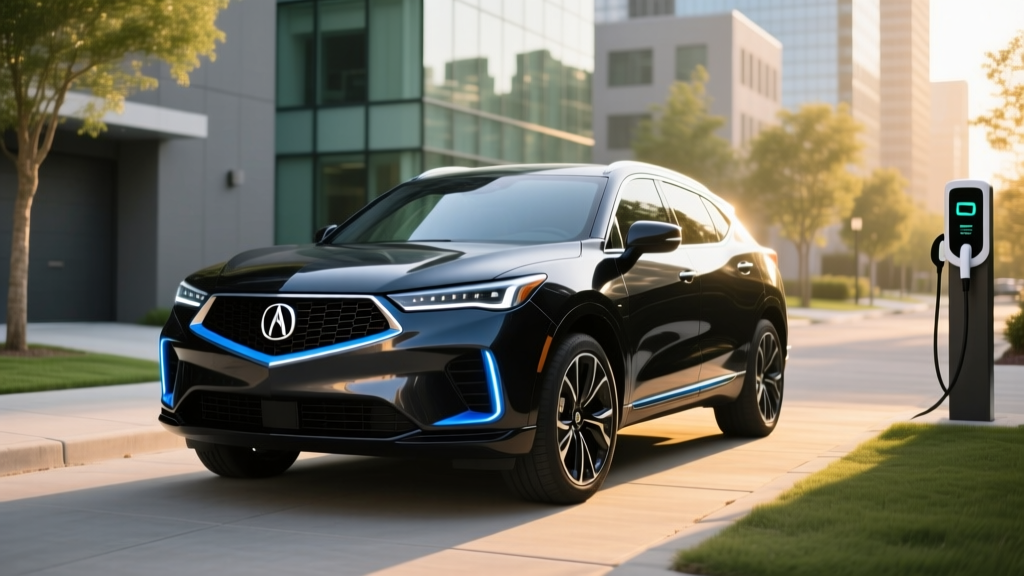
Quick Answer: The 2025 Acura ZDX is Acura's first all-electric SUV, built on GM's Ultium platform. It offers up to 313 miles of EPA range (Rear-Wheel Drive), DC fast charging up to 190 kW, and starts at $64,500 before incentives. The high-performance Type S variant drops to 278 miles EPA but adds 500 horsepower. Real-world highway range falls to roughly 250–270 miles, and cold-weather driving can reduce that further by 15–25%. Federal tax credit eligibility under §30D is limited by battery sourcing rules — verify current-year status on IRS.gov before purchase.
What Is the 2025 Acura ZDX and Who Is It For?
Acura entered the EV market with the ZDX, a midsize luxury crossover developed jointly with General Motors. It shares the Ultium battery architecture found in the Cadillac Lyriq and Chevrolet Blazer EV, but wears Acura-tuned suspension, a distinct interior, and the brand's signature design language. For Acura loyalists who want to go electric without jumping to Tesla or a European badge, the ZDX is the dealership answer.
The ZDX slots into a competitive segment against the BMW iX, Genesis Electrified GV70, Audi Q8 e-tron, and Cadillac Lyriq. It's aimed at luxury buyers who prioritize comfort and brand familiarity over outright performance or cutting-edge software. If you currently drive an Acura MDX or RDX and want a zero-tailpipe-emission equivalent, this is the natural transition point.
Range, Battery, and Real-World Efficiency
The ZDX uses a 102 kWh (usable capacity) Ultium lithium-ion battery with NMC (nickel manganese cobalt) chemistry. Here's how the lineup breaks down by trim and drivetrain:
| Trim | Drivetrain | EPA Range | Battery (usable) | MPGe (combined) | 0-60 mph | Horsepower |
|---|---|---|---|---|---|---|
| A-Spec RWD | Rear-Wheel Drive | 313 mi | 102 kWh | 87 MPGe | ~7.0 sec | 358 hp |
| A-Spec AWD | All-Wheel Drive | 304 mi | 102 kWh | 84 MPGe | ~6.0 sec | 490 hp |
| Type S AWD | All-Wheel Drive | 278 mi | 102 kWh | 77 MPGe | ~4.5 sec | 500 hp |
Real-World Range Expectations: The EPA 313-mile figure for the RWD model assumes a mix of city and highway driving at moderate temperatures. In our experience with Ultium-based vehicles, sustained highway driving at 70–75 mph yields approximately 250–270 miles before needing a charge. In freezing temperatures (below 32°F), expect a 15–25% reduction, bringing usable range down to roughly 210–240 miles for the RWD trim. The ZDX includes a heat pump, which helps mitigate cold-weather losses compared to resistive heating systems, but physics still applies.
Efficiency for the RWD model works out to roughly 325 Wh/mile in mixed driving — competitive for a luxury crossover of this weight (~5,500 lbs), but not class-leading. The Hyundai Ioniq 5, for comparison, achieves roughly 300 Wh/mile thanks to its lighter platform and 800V architecture.
Charging Speed and Infrastructure
The ZDX supports DC fast charging at a peak rate of 190 kW on compatible CCS1 stations. In practice, this means a 10–80% charge takes approximately 30 minutes under ideal conditions. The charge curve tapers significantly above 80% SoC — expect 80–100% to add another 20–25 minutes. This is typical for NMC chemistry on a 400V architecture; vehicles on 800V systems (Hyundai Ioniq 5, Kia EV6, Porsche Taycan) charge noticeably faster in the 10–80% window.
| Charging Level | Power (kW) | Approximate Speed | Use Case |
|---|---|---|---|
| Level 1 (120V outlet) | ~1.4 kW | ~4 miles/hour | Emergency/overnight trickle |
| Level 2 (240V home) | 11.5 kW (max onboard) | ~32 miles/hour | Daily home charging, ~10 hrs for full charge |
| DC Fast Charge (CCS1) | Up to 190 kW peak | ~180 mi in 30 min (10-80%) | Road trips, public fast-charging |
For home charging, a Level 2 wall connector on a 48-amp circuit (hardwired) will replenish the battery from empty to full in roughly 10 hours. This is adequate for overnight charging if your daily commute is under 80 miles round-trip. Installation costs for a Level 2 home charger typically range from $800 to $2,500 depending on panel capacity and run length — budget toward the higher end if your electrical panel needs a 200-amp upgrade.
Acura provides access to public charging networks through the Acura app, and the ZDX is compatible with Electrify America, EVgo, ChargePoint, and other CCS-equipped networks. Note: Acura has not yet announced NACS (Tesla Supercharger) compatibility for the ZDX, unlike newer Honda Prologue updates. If Tesla Supercharger access is a priority, verify adapter availability or future OTA updates directly with your dealer.
EV vs Gas: How Does the ZDX Compare to the Acura MDX?
Many ZDX shoppers are cross-shopping against the gasoline Acura MDX, the brand's three-row mainstay. Here's a direct comparison to contextualize the ownership shift:
| Metric | 2025 Acura ZDX A-Spec AWD | 2025 Acura MDX A-Spec AWD |
|---|---|---|
| Base MSRP | $69,500 | $58,750 |
| Fuel/Energy Cost (annual, 12k mi) | ~$620 (at $0.14/kWh avg) | ~$2,160 (at $3.50/gal, 21 MPG combined) |
| Annual Fuel Savings (EV advantage) | ~$1,540/year | |
| Maintenance (annual avg) | ~$300 (no oil, fewer moving parts) | ~$700 (oil, filters, transmission) |
| EPA Range / Tank Range | 304 mi | ~410 mi (19.5 gal tank) |
| 0-60 mph | ~6.0 sec | ~6.4 sec |
| Cargo (behind 2nd row) | ~28 cu ft | ~16.3 cu ft (but 3 rows) |
| Seating | 5 passengers | 7 passengers |
The ZDX costs roughly $10,750 more upfront than a similarly trimmed MDX. However, annual energy and maintenance savings of approximately $1,940 begin closing that gap. Over a 5-year ownership period, operating savings total roughly $9,700 — narrowing the effective price difference to about $1,050 before factoring in any federal or state incentives.
The trade-off is seating: the ZDX is a two-row, five-passenger SUV. If you need three rows, the MDX remains the practical choice until Acura introduces a larger electric platform.
Real Costs of Ownership: 5-Year Breakdown
| Category | ZDX A-Spec AWD (5-Year) | MDX A-Spec AWD (5-Year) |
|---|---|---|
| Purchase Price | $69,500 | $58,750 |
| Federal Tax Credit (§30D) | Up to $7,500 (see eligibility below) | $0 |
| Energy/Fuel (60,000 mi total) | $3,100 | $10,800 |
| Maintenance | $1,500 | $3,500 |
| Insurance (avg) | $9,500 (~$1,900/yr) | $7,500 (~$1,500/yr) |
| Estimated Depreciation | ~$28,000 | ~$22,000 |
| Total 5-Year Cost | $58,550 |
When you factor in the potential $7,500 federal tax credit (if eligible and if the vehicle qualifies under current-year sourcing rules), the ZDX's 5-year total cost of ownership can undercut the MDX by approximately $3,000–$10,500, depending on your local electricity rates, driving habits, and insurance premiums.
Important caveats: EV insurance premiums run 15–25% higher than comparable gas vehicles due to repair costs and battery replacement risk. Depreciation on luxury EVs has been steeper than gas counterparts in recent years, though this is stabilizing as the market matures. Your mileage — literally — will vary.
Federal Tax Credit Eligibility (§30D)
The ZDX's eligibility for the full $7,500 federal clean vehicle credit depends on several factors that change annually:
- MSRP Cap: SUVs must be under $80,000 MSRP — the ZDX A-Spec and most Type S configurations qualify.
- Buyer Income Cap: Adjusted gross income must not exceed $300,000 (joint), $225,000 (head of household), or $150,000 (individual).
- Battery Sourcing: Critical minerals and battery components must meet phased-in domestic/free-trade sourcing thresholds. The ZDX's Ultium battery is manufactured in the U.S., but critical mineral sourcing has been a moving target. Verify current-year eligibility on IRS.gov or with your tax professional before committing.
- Point-of-Sale Transfer: Eligible buyers can transfer the credit to the dealer at purchase, reducing the purchase price directly rather than waiting for a tax refund.
Common Misconceptions About the ZDX — Fact-Checked
| Myth | Fact |
|---|---|
| "The ZDX gets 313 miles no matter how you drive it." | EPA 313 mi is a laboratory estimate for the RWD model. Real-world highway range at 75 mph is closer to 250–270 mi. Cold weather reduces this further. |
| "I can charge it at any Tesla Supercharger." | The ZDX uses CCS1. NACS/Supercharger compatibility requires an adapter that Acura has not yet universally provided. Confirm before relying on Tesla's network. |
| "EV batteries need replacing every few years." | The ZDX battery is warrantied for 8 years/100,000 miles against degradation below 70% capacity. Ultium packs are designed for 150,000+ miles with gradual, manageable degradation. |
| "Home charging is too expensive to install." | A basic Level 2 install on an existing 240V circuit (e.g., dryer outlet nearby) can cost $500–$800. A full panel upgrade and new circuit runs $1,500–$2,500 — a one-time cost that pays back within 1–2 years of fuel savings. |
| "The ZDX is self-driving." | The ZDX offers AcuraWatch, a Level 2 driver-assistance suite (adaptive cruise, lane centering). You must remain engaged and hands-on at all times per SAE automation definitions. |
Decision Framework: Is the 2025 ZDX Right for You?
Choose the Acura ZDX if:
- You have access to Level 2 home charging (garage or dedicated parking with 240V access)
- Your daily commute is under 80 miles round-trip, with occasional 200–250 mile road trips
- You value a luxury interior, quiet ride, and brand loyalty over sporty handling or bleeding-edge tech
- You don't need third-row seating
- You qualify for the §30D tax credit (verify sourcing rules for current year)
Look elsewhere if:
- You live in an apartment without charging access and your area has limited public DC fast-charging infrastructure
- You regularly drive 300+ miles in a single trip in cold weather — the real-world range buffer gets thin
- You need three rows of seats (stick with the MDX or wait for a larger Acura EV)
- Fastest-possible DC charging is a priority — consider the Hyundai Ioniq 5 or Kia EV6 on 800V architecture (10–80% in ~18 min)
- You want Tesla Supercharger access without adapter uncertainty — consider the Tesla Model Y or Ford Mustang Mach-E (NACS native)
What First-Time EV Buyers Should Know Before Purchasing
If the ZDX is your first electric vehicle, here are the practical realities that spec sheets don't emphasize:
Preconditioning matters. The ZDX can precondition its battery before you arrive at a DC fast charger (set via navigation). This warms the battery to optimal temperature and can shave 5–10 minutes off your charge session, especially in cold weather. Always navigate to the charger rather than just driving there.
The 80% rule. DC fast charging slows dramatically above 80% State of Charge to protect battery health. On road trips, charge to 80% and go — the last 20% can take as long as the first 80%. Plan your stops around 150–200 mile segments rather than trying to fill to 100%.
Your electrical panel is the first step. Before buying any EV, have a licensed electrician evaluate your home panel. A 200-amp panel with spare capacity handles a 48-amp Level 2 charger easily. A 100-amp panel may require a $1,500–$3,000 upgrade. This is the most common surprise cost for new EV owners.
Tires wear faster. EVs are heavy and produce instant torque. Expect tire replacement every 30,000–40,000 miles rather than the 50,000+ miles typical on gas vehicles. Budget $800–$1,200 for a set of EV-rated touring tires.
FAQ
Does the 2025 Acura ZDX qualify for the $7,500 federal tax credit?
Eligibility depends on current-year battery sourcing requirements under §30D, your income, and the vehicle's MSRP (which falls under the $80,000 SUV cap). The Ultium battery is U.S.-manufactured, but critical mineral sourcing thresholds change annually. Confirm on IRS.gov or with a tax professional before purchase. If eligible, you can transfer the credit to the dealer at point of sale.
How long does it take to charge the ZDX at home?
On a Level 2 home charger (11.5 kW, 48-amp hardwired), a full 0–100% charge takes approximately 10 hours. For daily use, most owners plug in overnight and wake up with a full battery. A standard 120V outlet (Level 1) adds only about 4 miles of range per hour — useful for emergencies but not practical as a primary charging method.
What's the real-world highway range of the ZDX?
The EPA rates the RWD model at 313 miles and the AWD at 304 miles. In real-world highway driving at 70–75 mph, expect approximately 250–270 miles (RWD) and 240–260 miles (AWD). In freezing temperatures, subtract another 15–25%. The heat pump helps, but cold weather and high speed are the two biggest range killers for any EV.
Is the ZDX bigger or smaller than the Acura MDX?
The ZDX is slightly longer than the MDX but is a two-row, five-passenger vehicle. The MDX offers three rows and seats seven. Cargo space behind the second row favors the ZDX (~28 cu ft vs ~16.3 cu ft), but total cargo with all rows folded is comparable. If you need third-row seating, the MDX remains the better choice.
What is the battery warranty on the ZDX?
Acura covers the ZDX's Ultium battery for 8 years or 100,000 miles against defects and excessive degradation (typically defined as falling below 70% of original capacity). The general vehicle warranty is 4 years/50,000 miles. Based on Ultium platform data from GM, long-term degradation is expected to be gradual — most owners will see 85–90% capacity retention at 100,000 miles.
Can the ZDX tow?
The ZDX is rated to tow up to 1,500 pounds when properly equipped — adequate for a small utility trailer or a pair of dirt bikes, but not for boat or camper towing. Towing also significantly reduces range, typically by 30–40% at highway speeds.