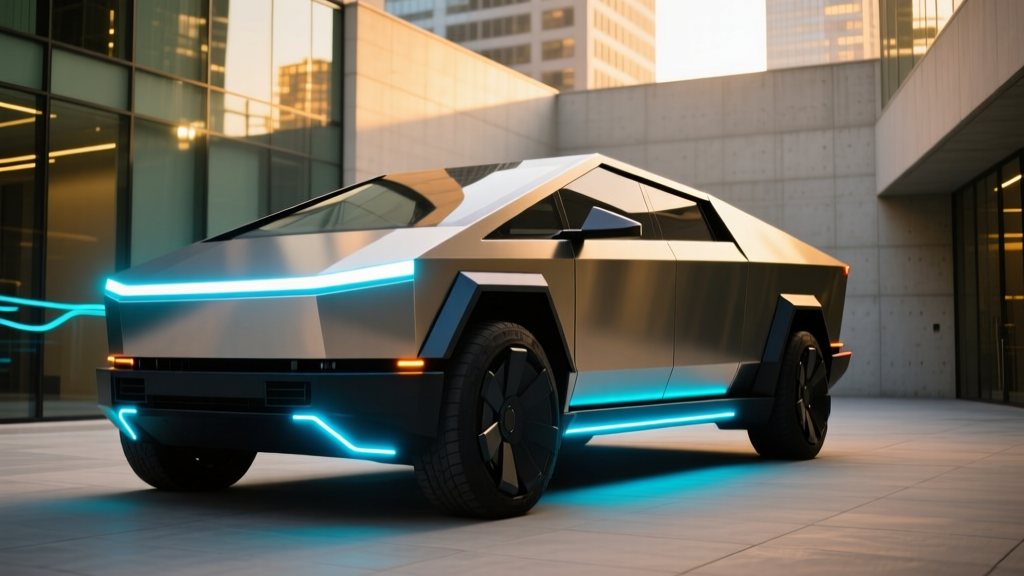
If you've seen a Tesla Cybertruck pulsing with synchronized LED light patterns in a dark parking lot, you've witnessed what the community calls Tron mode — a dazzling light show sequence that turns the Cybertruck's angular light bars into a futuristic display. Before we break down exactly how to activate it, here's the bigger picture: the 2026 Cybertruck is a polarizing, technically impressive electric pickup that demands a thorough look at its real-world range, charging performance, and ownership economics.
How to Activate Tron Mode on Tesla Cybertruck
"Tron mode" isn't an official Tesla feature name — it's the community nickname for the Light Show feature available on the Cybertruck. Here's how to access it:
- Park the vehicle — Light Show only activates when the Cybertruck is in Park.
- On the center touchscreen, tap the Controls menu (car icon).
- Select Lights from the submenu.
- Scroll to find Light Show and tap to activate.
- The Cybertruck will begin a choreographed sequence using its front light bar, rear light bar, bed lights, and interior ambient lighting synchronized to music from the vehicle's audio system.
Pro tip: For the full "Tron" effect, activate Light Show at night in a dark environment. The Cybertruck's full-width LED light bars — front and rear — create a more dramatic visual effect than any other Tesla model because of the truck's sharp geometric body lines. You can also trigger the light show from the Tesla mobile app by selecting your vehicle and tapping Light Show remotely.
If your Cybertruck doesn't show the Light Show option, ensure your software is up to date — Tesla has expanded the feature set via OTA updates throughout 2025 and into 2026. Some early 2024 delivery vehicles needed a software update to gain full light show functionality.
2026 Cybertruck Specs at a Glance
| Spec | AWD (Dual-Motor) | Cyberbeast (Tri-Motor) |
|---|---|---|
| EPA Range | 340 miles | 320 miles |
| Battery Capacity | ~123 kWh usable (NMC) | ~123 kWh usable (NMC) |
| 0-60 mph | 4.1 seconds | 2.6 seconds |
| Horsepower | 600 hp | 845 hp |
| Drivetrain | Dual-motor AWD | Tri-motor AWD |
| Towing Capacity | 11,000 lbs | 11,000 lbs |
| Max DC Fast Charge | ~350 kW peak (800V architecture) | ~350 kW peak (800V architecture) |
| 10-80% DC Charge Time | ~18 minutes (optimal conditions) | ~18 minutes (optimal conditions) |
| Level 2 Home Charging | 11.5 kW (~44 mi/hr) | 11.5 kW (~44 mi/hr) |
| MPGe (Combined) | ~67 MPGe | ~62 MPGe |
| Base MSRP (2026) | $79,990 | $99,990 |
Real-World Range: What the EPA Number Doesn't Tell You
The Cybertruck's 123 kWh usable battery pack uses NMC (nickel manganese cobalt) chemistry, which provides higher energy density than LFP cells — important for a vehicle this heavy (curb weight exceeds 6,600 lbs for the AWD trim). However, NMC batteries benefit from daily charging limits of 80-90% for longevity, meaning your practical daily range is closer to 250-270 miles unless you charge to 100% before a long trip.
The Cybertruck's stainless steel exoskeleton and angular shape create a higher drag coefficient (~0.34 Cd) than a sleek sedan, which is why highway efficiency drops noticeably above 65 mph. If your commute is mostly suburban or city driving with speeds under 55 mph, you'll see numbers much closer to the EPA sticker.
According to fueleconomy.gov, the AWD Cybertruck achieves approximately 67 MPGe combined, which translates to roughly 50 kWh per 100 miles — high by EV standards but expected for a 6,600+ lb stainless steel pickup.
Charging Speed: 800V Architecture in Practice
| Level | Power / Voltage | Speed |
|---|---|---|
| Level 1 (120V household) | ~1.4 kW | ~5 miles per hour |
| Level 2 (240V home charger) | 11.5 kW max | ~44 miles per hour |
| DC Fast Charge (V4 Supercharger) | ~350 kW peak (800V) | 10-80% in ~18 min; 150+ miles in 10 min |
The Cybertruck uses an 800-volt electrical architecture, enabling peak DC charge rates around 350 kW at Tesla's latest V4 Supercharger stations. However, as with all EVs, the charge curve matters more than the peak number. The Cybertruck sustains its highest charge rate between roughly 10-40% state of charge, then progressively tapers. Above 80% SoC, charging slows dramatically to protect battery health — a 10-80% session takes approximately 18 minutes under ideal thermal conditions, but 80-100% can add another 25-30 minutes.
Preconditioning is critical. When you navigate to a Supercharger in the Cybertruck's built-in navigation, the battery management system preconditions the pack to optimal charging temperature. Arriving at a Supercharger without preconditioning (for example, using a third-party charger without nav routing) can result in significantly slower initial charge rates, particularly in cold weather.
For home Level 2 charging, the Cybertruck's onboard charger accepts up to 11.5 kW (48 amps on a 60-amp circuit). A full overnight charge from 20% to 90% takes approximately 7-8 hours — perfectly adequate for daily use. Plan on a dedicated 240V/60A circuit installation; see a licensed electrician for your specific panel capacity.
Pricing, Tax Credits, and Ownership Cost
| Trim | Base MSRP | §30D Credit Eligible? | Effective Price (with credit) |
|---|---|---|---|
| AWD (Dual-Motor) | $79,990 | Potentially — see rules below | As low as ~$72,490 |
| Cyberbeast (Tri-Motor) | $99,990 | Potentially — see rules below | As low as ~$92,490 |
Federal tax credit eligibility for the Cybertruck depends on several IRS §30D requirements that change periodically:
- MSRP cap: The vehicle must have an MSRP at or below $80,000 for trucks/vans/SUVs. The AWD trim at $79,990 qualifies on MSRP alone; the Cyberbeast at $99,990 exceeds the cap and does not qualify for the new-vehicle credit.
- Buyer income limits (2026 tax year): Modified adjusted gross income must not exceed $150,000 (single), $225,000 (head of household), or $300,000 (married filing jointly).
- Battery component & critical mineral sourcing: The vehicle must meet progressive North American battery component manufacturing and critical mineral sourcing thresholds that tighten each year. Tesla has worked to qualify, but verify current-year status at purchase.
- Point-of-sale transfer: As of 2024+, eligible buyers can transfer the credit to the dealer at purchase, reducing the out-of-pocket price immediately rather than waiting for a tax refund.
Bottom line: The AWD Cybertruck at $79,990 can potentially qualify for up to $7,500 in federal tax credit if all sourcing and income requirements are met, bringing the effective price to approximately $72,490. The Cyberbeast does not qualify for the new-vehicle credit due to the MSRP cap. Always consult a tax professional and verify current eligibility at the time of purchase, as rules and manufacturer qualification status can shift.
Performance, Interior, and Standout Tech
The Cyberbeast's 2.6-second 0-60 mph time makes it one of the quickest production pickups ever built — and one of the quickest vehicles of any kind. Even the "base" AWD model hits 60 mph in 4.1 seconds, which is sports-car territory from a vehicle that can tow 11,000 pounds. The steer-by-wire system (no mechanical connection between steering wheel and wheels) takes some acclimation but offers variable ratio steering that's remarkably quick at low speeds and stable on the highway.
Interior and cargo:
- Front headroom: ~41.0 inches | Legroom: ~42.0 inches
- Rear headroom: ~38.5 inches | Legroom: ~36.0 inches
- Bed length: 6 feet (with tailgate closed) | Bed width: ~53 inches between wheel wells
- Frunk (front trunk): ~7.1 cu ft of lockable storage
- Total cargo volume (bed + frunk + cabin storage): significantly more than a sedan, though the bed is shorter than a traditional full-size pickup
The 18.5-inch center touchscreen runs Tesla's latest software with access to the full Tesla app ecosystem, streaming services, and gaming. Standout features include the 120V/240V bed outlet (Powershare) for running tools or appliances, the power-operated tonneau cover, and Armor Glass (laminated glass designed for impact resistance).
Driver assistance: The Cybertruck comes with Tesla's Basic Autopilot (adaptive cruise control and lane centering). Full Self-Driving (Supervised) is available as an $8,000 add-on or subscription. Importantly, FSD remains an SAE Level 2 driver-assist system — the driver must remain fully attentive, hands on the wheel (or applying steering torque), and ready to take over at any moment. This is not autonomous driving.
Pros, Cons, and Who Should Buy
Pros
- Class-leading acceleration (Cyberbeast: 2.6s 0-60)
- 800V fast-charging architecture (~350 kW peak)
- 11,000-lb towing capacity with integrated trailer features
- Stainless steel exoskeleton — no paint to scratch
- Powershare 120V/240V outlets in bed
- Light Show / "Tron mode" for entertainment
- Over-the-air updates continually add features
Cons
- Efficiency is low (~50 kWh/100mi) — high electricity cost vs. sedans
- Real-world highway range well below 340-mile EPA sticker
- Steer-by-wire acclimation curve for some drivers
- Bed is shorter than full-size truck competitors
- No Apple CarPlay or Android Auto
- Cyberbeast exceeds $80K MSRP cap — no federal tax credit
- Polarizing design — love-it-or-hate-it factor
- Tech-enthusiast truck buyers who want EV performance and don't need a traditional 8-foot bed.
- Tool and job-site users who benefit from Powershare 240V outlets and the lockable frunk + bed combo.
- Performance seekers who want supercar acceleration with truck utility.
- Not ideal for: Fleet buyers needing maximum bed length, budget-focused shoppers, or those who prioritize efficiency over presence.
Warranty and Long-Term Ownership
Tesla covers the Cybertruck with the following warranty terms:
- Limited vehicle warranty: 4 years / 50,000 miles (whichever comes first)
- Battery & drive unit warranty: 8 years / 120,000 miles for the AWD; 8 years / 120,000 miles for Cyberbeast, with minimum 70% battery capacity retention over the warranty period
The 123 kWh NMC battery pack is among the largest in any consumer EV. Based on Tesla's track record with similar chemistry in the Model S and Model X, expect approximately 10-15% degradation over the first 100,000 miles with normal use patterns. Avoid frequent 100% charges and prolonged storage at very low or very high state of charge to maximize long-term battery health.
Frequently Asked Questions
What is the real-world range of the Cybertruck?
The EPA rates the AWD Cybertruck at 340 miles. In real-world highway driving at 70+ mph, expect 270-290 miles. In cold weather, plan for 220-250 miles. City driving with regenerative braking gets closer to the EPA figure.
How fast does the Cybertruck charge at home and on the road?
At home on a Level 2 (240V, 48A) charger, the Cybertruck adds approximately 44 miles of range per hour, with a full overnight session covering daily needs. On a V4 Supercharger, it can peak at ~350 kW and charge from 10-80% in approximately 18 minutes under ideal conditions.
Does the Cybertruck qualify for the $7,500 federal EV tax credit?
The AWD trim at $79,990 potentially qualifies — it's under the $80,000 truck MSRP cap. The Cyberbeast at $99,990 does not. Buyer income limits, battery sourcing rules, and current-year IRS guidance all apply. Verify at purchase and consult a tax professional per IRS §30D guidelines.
How do I activate Tron mode (Light Show) on my Cybertruck?
Park the vehicle, go to Controls > Lights on the touchscreen, and tap Light Show. The Cybertruck will run a synchronized LED light sequence across its front and rear light bars. You can also trigger it from the Tesla mobile app. Ensure your software is updated to the latest version.
Is the Cybertruck worth buying over the Ford F-150 Lightning or Rivian R1T?
The Cybertruck wins on acceleration and has a competitive fast-charging architecture. The F-150 Lightning offers a more traditional truck experience with a larger bed and lower starting price. The Rivian R1T provides a more refined interior and adventure-focused features. Your choice depends on whether you prioritize performance and tech (Cybertruck), traditional truck utility (Lightning), or adventure versatility (R1T).
What's the biggest drawback of owning a Cybertruck?
Efficiency. At roughly 50 kWh per 100 miles, the Cybertruck uses significantly more electricity per mile than an EV sedan, which means higher charging costs and more frequent stops on road trips compared to more aerodynamic EVs. If efficiency is a top priority, a sedan or crossover will serve you better.