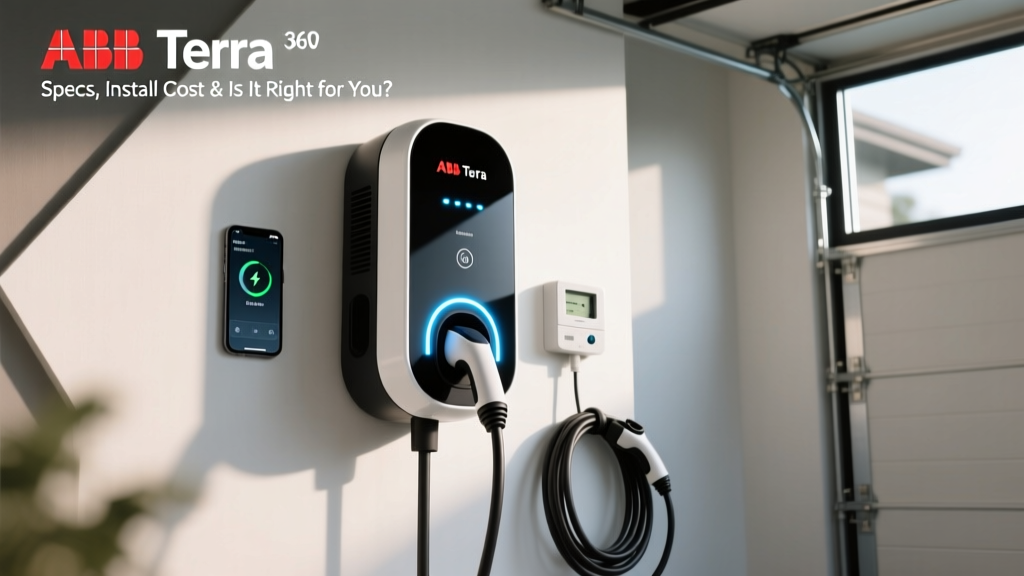
What Is the ABB Terra 360 EV Charger?
The ABB Terra 360 is a commercial-grade DC fast charger capable of delivering up to 360 kW of peak power to a single vehicle — enough to add roughly 62 miles (100 km) of range in under three minutes under ideal conditions. Launched by Swiss-Swedish industrial giant ABB, the Terra 360 targets high-throughput locations: highway rest stops, fleet depots, fuel-station conversions, and urban charging hubs where minimizing dwell time is the entire business model.
Unlike the Level 2 home chargers most EV owners interact with daily, the Terra 360 is a massive piece of infrastructure. It stands roughly 6.5 feet tall, weighs over 1,100 pounds, and requires three-phase 480V commercial power. If you've seen one at an Electrify America or Ionity station in Europe or North America, you've likely noticed its distinctive dual-cable design and large touchscreen interface.
This guide breaks down what the Terra 360 actually delivers in real-world charging sessions, how its 360 kW peak compares to what your vehicle can accept, what it costs to install and operate, and how it fits into the broader charging ecosystem that includes the home Level 2 units most buyers actually purchase.
Charging Levels Explained: Where the Terra 360 Fits
Before evaluating any charger, you need to understand the three charging tiers and what they mean for your battery. The critical distinction: kW (kilowatts) measures power — the rate of energy flow — while kWh (kilowatt-hours) measures energy — the total capacity stored in your battery. A 360 kW charger can theoretically push 360 kWh of energy in one hour, though no EV battery is large enough to absorb that.
| Level | Voltage | Power (kW) | Miles of Range Added per Hour | Typical Use |
|---|---|---|---|---|
| Level 1 | 120V AC | 1.0–1.4 kW | 3–5 mi/hr | Emergency / overnight trickle |
| Level 2 | 240V AC | 3.3–19.2 kW | 12–75 mi/hr | Home daily charging, workplace |
| DC Fast (Level 3) | 200–925V DC | 50–360+ kW | 150–800+ mi/hr (peak) | Road trips, commercial hubs |
The ABB Terra 360 sits at the top of the DC fast-charging tier. Its 360 kW peak output is among the highest available for passenger vehicles globally as of 2026. For context, a typical Tesla Supercharger V3 peaks at 250 kW, Electrify America's CCS stalls commonly deliver 150–350 kW, and most home Level 2 chargers operate at 7.7–11.5 kW.
ABB Terra 360 Specifications and Charge Times
Here's what the Terra 360 delivers on paper and in practice:
| Specification | Value |
|---|---|
| Peak Power Output | 360 kW |
| Voltage Range | 150–920V DC |
| Max Current (single cable) | 500A (liquid-cooled cable) |
| Connector Options | CCS1, CCS2, CHAdeMO, NACS (market-dependent) |
| Simultaneous Vehicles | Up to 4 (power splits across ports) |
| Cable Length | ~13 ft (4 m) liquid-cooled |
| Display | 27-inch touchscreen with payment |
| Weight | ~1,100 lbs (500 kg) |
| Input Power Required | 3-phase 480V AC, ~400A service |
| Advertised 62-mile Add | Under 3 minutes (at peak acceptance) |
Estimated 10–80% Charge Times by Vehicle
Your actual charge time depends on your vehicle's maximum charge acceptance rate and battery size. The Terra 360 can only deliver what your car's battery management system (BMS) will accept:
| Vehicle (2025–2026) | Battery (kWh usable) | Max DC Acceptance | Est. 10–80% Time |
|---|---|---|---|
| Hyundai Ioniq 5 (Long Range) | 77.4 kWh (NMC) | ~240 kW peak | ~18 min |
| Porsche Taycan (Performance Plus) | 83.7 kWh (NMC) | ~270 kW peak | ~22 min |
| Tesla Model 3 Long Range (NACS) | ~75 kWh (NMC) | ~250 kW peak | ~25 min |
| Kia EV9 GT-Line AWD | 99.8 kWh (NMC) | ~210 kW peak | ~28 min |
| Chevrolet Silverado EV (4WT) | ~200 kWh (NMC) | ~350 kW peak | ~40 min |
| Ford F-150 Lightning (Extended) | 131 kWh (NMC) | ~150 kW peak | ~42 min |
The Terra 360's 360 kW headroom matters most for vehicles with 800V architectures (Hyundai/Kia E-GMP, Porsche/Audi PPE, GM Ultium trucks) that can sustain high charge rates longer. For a vehicle capped at 150 kW acceptance, the Terra 360 simply charges it at 150 kW — no faster than a standard 150 kW stall.
Connector Compatibility: NACS, CCS, and CHAdeMO
The ABB Terra 360 is configurable with multiple connector standards, but which connectors a specific station offers depends entirely on the network operator and market. Here's how connector compatibility breaks down across major brands sold in North America:
| Connector | Brands Using It | Adapter Notes |
|---|---|---|
| NACS (Tesla) | Tesla, Ford, GM, Rivian, Volvo, Polestar, Hyundai (2026+) | Most non-Tesla EVs shifting to native NACS by 2026; CCS-to-NACS adapters widely available |
| CCS1 | BMW, Stellantis, some VW/Audi (legacy), Honda, Toyota bZ4X | NACS-to-CCS adapters available from Ford, Tesla, and third parties |
| CHAdeMO | Nissan Leaf (legacy only) | Effectively discontinued; no new CHAdeMO vehicles sold in the US |
If you drive a 2025 Ford Mustang Mach-E (CCS1 native) and pull up to a Terra 360 equipped only with NACS cables, you'll need a CCS-to-NACS adapter. Ford provides one at no cost to Mach-E and F-150 Lightning owners. Always check the station's connector listing in apps like PlugShare or A Better Routeplanner before committing to a stop.
Installation Cost: Commercial vs. Home Context
The ABB Terra 360 is not a residential charger. It requires three-phase 480V commercial electrical service, a concrete pad, utility coordination, and typically a dedicated transformer. Installation costs are site-specific and substantial:
| Component | Estimated Cost Range |
|---|---|
| Terra 360 unit (hardware) | $85,000–$120,000 |
| Utility service upgrade (480V 3-phase, transformer) | $25,000–$100,000+ |
| Electrical labor & conduit | $15,000–$40,000 |
| Concrete pad & site prep | $5,000–$15,000 |
| Permits, engineering, utility interconnection | $10,000–$30,000 |
| Network connectivity & payment system | $2,000–$5,000 |
| Total Installed | $142,000–$310,000+ |
For context, most home EV owners install a Level 2 charger. Here's what that looks like:
| Component | Estimated Cost Range |
|---|---|
| Level 2 charger (hardware, 40–48A) | $400–$800 |
| Electrician labor (240V/50A circuit, wiring, mounting) | $600–$2,500 |
| Electrical permit | $50–$200 |
| Panel upgrade (if needed — 100A to 200A) | $1,500–$4,000 |
| Total (no panel upgrade) | $1,050–$3,500 |
| Total (with panel upgrade) | $2,550–$7,500 |
Homes built before 1990 often have 100A panels that cannot spare the 40–50A a Level 2 charger demands alongside existing loads (HVAC, electric oven, dryer). A panel upgrade to 200A is common and adds $1,500–$4,000. Always have a licensed electrician perform a load calculation before purchasing equipment.
Home Level 2 Charger Recommendations
Since the Terra 360 is a commercial product, most readers need a reliable Level 2 unit for daily home charging. Here are three proven options across budgets:
Emporia Vue Level 2 (Best Value)
- Power: 48A (11.5 kW on 240V/60A circuit)
- Connector: J1772 (NACS adapter included)
- Cable: 24 ft
- Smart features: Wi-Fi, scheduling, solar integration, energy monitoring
- Price: ~$400
- Outdoor rated: NEMA 4
ChargePoint Home Flex (Best Smart Charger)
- Power: Up to 50A (12 kW, adjustable 16–50A)
- Connector: J1772 or NACS (select at purchase)
- Cable: 23 ft
- Smart features: Wi-Fi, Alexa/Google, detailed app, utility demand-response
- Price: ~$550–$700
- Outdoor rated: NEMA 4
Tesla Wall Connector (Best for NACS Vehicles)
- Power: 48A (11.5 kW on 240V/60A circuit)
- Connector: NACS native
- Cable: 24 ft
- Smart features: Wi-Fi, OTA updates, power-sharing (link up to 6 units), J1772 adapter included
- Price: ~$475
- Outdoor rated: NEMA 3R (weather-resistant, not fully sealed)
All three require a dedicated 240V circuit installed by a licensed electrician. The National Electrical Code (NEC) requires the circuit breaker to be rated at 125% of the charger's continuous draw — a 48A charger needs a 60A breaker.
Cost to Charge: Home vs. Public DC Fast
The economics of EV charging depend heavily on where and when you plug in. Here's a realistic comparison:
| Charging Scenario | Rate ($/kWh) | Cost for 60 kWh Fill | Cost per Mile (at 3 mi/kWh) |
|---|---|---|---|
| Home Level 2 (off-peak utility rate) | $0.08–$0.14 | $4.80–$8.40 | $0.027–$0.047 |
| Home Level 2 (standard residential avg) | $0.16 | $9.60 | $0.053 |
| Public Level 2 (ChargePoint, EVgo) | $0.25–$0.49 | $15.00–$29.40 | $0.083–$0.163 |
| DC Fast (Electrify America, EA Pass) | $0.35–$0.55 | $21.00–$33.00 | $0.117–$0.183 |
| Tesla Supercharger (varies by location) | $0.28–$0.40 | $16.80–$24.00 | $0.093–$0.133 |
| Gasoline (30 MPG, $3.40/gal) | — | $6.80 (equiv. energy) | $0.113 |
Home off-peak charging is the economic sweet spot: roughly $0.03–$0.05 per mile, compared to $0.11+ for gasoline at current prices. Public DC fast charging erases most of the cost advantage, which is why home Level 2 access remains the single biggest factor in EV ownership satisfaction. According to fueleconomy.gov, the average EV achieves 3–4 miles per kWh, making home charging dramatically cheaper than gas on a per-mile basis.
Safety, Code, and Electrical Requirements
Whether you're installing a 48A home charger or evaluating a commercial site for Terra 360 deployment, electrical safety is non-negotiable:
Home Level 2 Installation Requirements
- Dedicated circuit: Your charger must have its own breaker — never share a circuit with an appliance.
- GFCI protection: NEC 2023 and later requires GFCI (Ground Fault Circuit Interrupter) protection on all EV charging circuits, including outdoor outlets. Many modern chargers have built-in GFCI; confirm with your electrician.
- Outdoor rating: If mounting outside, the charger must be rated NEMA 4 (fully sealed against rain and dust) or NEMA 3R (weather-resistant). Never use an indoor-rated unit outdoors.
- Wire gauge: A 60A circuit typically requires 6 AWG copper wire for runs up to 50 feet; longer runs may need 4 AWG to prevent voltage drop.
- Permit: Virtually all jurisdictions require an electrical permit for new 240V circuits. The permit ensures inspection and code compliance — skip it at the risk of voided insurance claims.
Commercial Terra 360 Requirements
- Three-phase 480V service with 400A+ capacity
- Utility interconnection agreement and possible demand-charge tariff
- Concrete pad engineered for 1,100+ lb static load
- ADA-compliant placement and cable reach
- Networked payment and remote monitoring (OCPP 2.0.1 protocol)
Frequently Asked Questions
How much does it cost to install a home EV charger?
A typical Level 2 home charger installation runs $1,050–$3,500 when your electrical panel has sufficient capacity. If you need a panel upgrade from 100A to 200A, add $1,500–$4,000, bringing the total to $2,550–$7,500. The charger hardware itself costs $400–$800. Always get a load calculation from a licensed electrician before purchasing equipment.
How fast will each charging level add range?
Level 1 (120V) adds 3–5 miles per hour — essentially overnight trickle charging. Level 2 (240V, 48A) adds roughly 35–45 miles per hour, enough to fully recharge most EVs overnight. DC fast charging at 150–350 kW can add 150–800+ miles of range per hour at peak, though the charge curve tapers significantly above 80% SoC. A 10–80% session on a Terra 360 takes 18–40 minutes depending on your vehicle's acceptance rate.
Which connector is compatible with my EV?
As of 2026, most new EVs in North America use either NACS (Tesla standard, now adopted by Ford, GM, Rivian, Hyundai, and others) or CCS1 (BMW, Stellantis, and some carryover models). CHAdeMO is effectively discontinued. Check your vehicle's charge port — if it's a Tesla-shaped slim connector, it's NACS. If it has two extra DC pins below the J1772 portion, it's CCS1. Adapters are widely available for cross-compatibility.
How much does charging cost per mile vs. gas?
Home Level 2 charging on off-peak rates costs $0.03–$0.05 per mile for most EVs. Public DC fast charging costs $0.10–$0.18 per mile. A 30 MPG gas car at $3.40/gallon costs about $0.11 per mile. Home charging is 2–3x cheaper than gasoline; exclusive public fast charging roughly breaks even with gas.
What electrical upgrades might I need?
The most common upgrade is a panel replacement from 100A to 200A ($1,500–$4,000) if your existing panel lacks spare capacity. Some older homes need a full service upgrade from the utility, which can cost $3,000–$8,000. Homes with 200A panels and gas appliances usually have sufficient headroom for a 48A Level 2 charger without any upgrade. A load calculation by a licensed electrician is the definitive answer.
Can I install an ABB Terra 360 at home?
No. The Terra 360 requires three-phase 480V commercial power, a dedicated transformer, and utility-grade infrastructure that no residential service provides. It's designed for commercial operators — gas stations, highway rest areas, fleet depots, and retail charging hubs. For home use, a Level 2 charger at 11.5 kW on a 240V/60A circuit covers virtually all daily charging needs.
Does the ABB Terra 360 support Tesla/NACS vehicles?
Market-dependent. Some Terra 360 deployments include NACS cables, while others offer CCS1 only. Tesla owners at CCS-only stations need a CCS-to-NACS adapter (included with newer Teslas, available for ~$200 for older models). Check the specific station in PlugShare or the network's app before arriving.
For authoritative information on EV efficiency ratings and MPGe figures, consult fueleconomy.gov. For current federal tax credit rules that may offset EV purchase costs (not charger installation), see the IRS §30D clean vehicle credit page. Always verify local electrical codes with your municipality and work with a licensed electrician for any installation.