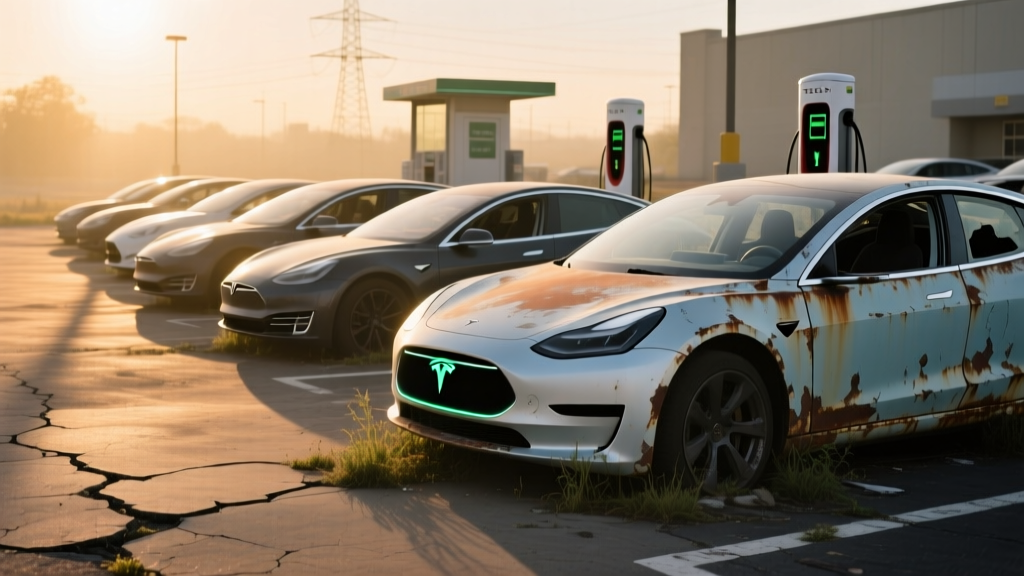
Search any junkyard, impound lot, or long-term airport parking structure, and you'll eventually spot them: abandoned Tesla vehicles with expired registrations, cracked windshields, and depleted 12V batteries. The phenomenon of the abandoned Tesla isn't just an internet curiosity—it's a window into the real ownership risks that EV buyers need to understand before signing a delivery agreement.
This isn't a hit piece. Tesla still builds some of the most efficient, technologically advanced electric vehicles on the market. But the gap between marketing promises and ownership reality has left a measurable number of vehicles stranded, auctioned, or simply walked away from. In this deep-dive review, we'll examine what drives Tesla abandonment, break down the hard specs of current models, and give you the data to decide whether a Tesla is the right EV for you—or whether you're walking into the same traps.
The Abandoned Tesla Problem: What the Data Shows
Abandoned Tesla vehicles typically fall into three categories: battery-out-of-warranty write-offs, collision-damage totals (where repair costs exceed salvage value), and financial distress walk-aways (lease returns or repossessions where the owner simply stops paying). Industry data from salvage auction platforms like Copart and IAAI shows Teslas appearing at rates higher than you'd expect for a brand with fewer than 2% of US vehicles on the road.
The core issue? Teslas depreciate faster than many competitors in the used market, and out-of-warranty repair costs—particularly for battery packs and drive units—can exceed the vehicle's residual value. A 2018 Model 3 Long Range with 110,000 miles might be worth $14,000 at auction, but a replacement battery pack could cost $12,000–$16,000 installed. When the math doesn't work, owners walk away.
Current Tesla Lineup: 2026 Specs at a Glance
Before we get into what goes wrong, let's establish what you're actually buying. Here are the core specifications for Tesla's current US consumer lineup as of the 2026 model year:
| Spec | Model 3 LR AWD | Model Y LR AWD | Model S LR | Model X LR |
|---|---|---|---|---|
| EPA Range | 341 mi | 320 mi | 402 mi | 348 mi |
| Battery (usable) | ~75 kWh (NMC) | ~75 kWh (NMC) | ~95 kWh (NMC) | ~95 kWh (NMC) |
| Peak DC Charge | 250 kW | 250 kW | 250 kW | 250 kW |
| 10–80% DC Time | ~27 min | ~27 min | ~32 min | ~32 min |
| Level 2 Rate | 11.5 kW (~44 mi/hr) | 11.5 kW (~44 mi/hr) | 11.5 kW (~44 mi/hr) | 11.5 kW (~44 mi/hr) |
| 0–60 mph | 4.2 sec | 4.8 sec | 3.1 sec | 3.8 sec |
| Horsepower | 346 hp | 384 hp | 670 hp | 670 hp |
| Drivetrain | Dual-motor AWD | Dual-motor AWD | Dual-motor AWD | Dual-motor AWD |
| Efficiency | 132 MPGe / 25 kWh/100mi | 122 MPGe / 27 kWh/100mi | 120 MPGe / 28 kWh/100mi | 109 MPGe / 31 kWh/100mi |
| Base MSRP | $47,740 | $46,630 | $79,990 | $84,990 |
Source: fueleconomy.gov and Tesla's official specifications page. Model 3 RWD (LFP battery, 272 mi EPA, $38,990) is also available for buyers prioritizing price over range.
Real-World Range: The Numbers Tesla Doesn't Advertise
EPA Sticker: 341 miles (Model 3 Long Range AWD)
Expect in reality: ~270–290 miles at sustained 70 mph highway speeds; ~240–260 miles in sub-30°F winter conditions with cabin heat; ~310+ miles in city driving with regenerative braking active.
The EPA cycle blends city and highway driving at moderate temperatures. If your commute is 90% highway in a northern climate, plan for 20–30% range loss from the sticker figure.
Tesla's range estimates are among the more optimistic in the industry. Independent testing by outlets like Car and Driver and Edmunds consistently shows Tesla models falling 10–15% short of EPA range on highway loops at 70 mph. The Model 3 Long Range, rated at 341 miles EPA, typically delivers 280–300 miles in mixed real-world driving and can drop to 230–250 miles in freezing temperatures.
This matters because range shortfall is one of the top reasons cited by owners who abandon or sell their Teslas within the first two years. Buyers who assumed 341 miles meant 341 miles on an interstate road trip discover they need to charge every 250 miles—adding time, frustration, and in some cases, buyer's remorse.
Charging Speed and Infrastructure: Where Tesla Still Leads
This is where Tesla ownership still has a genuine advantage. The Supercharger network remains the most reliable DC fast-charging ecosystem in North America, with over 30,000 stalls globally and growing. Tesla vehicles peak at 250 kW on V3 Superchargers, though sustained rates taper significantly above 60% state of charge (SoC).
| Charging Level | Power | Speed | Notes |
|---|---|---|---|
| Level 1 (120V outlet) | ~1.4 kW | ~5 mi/hr | Emergency/trickle only; impractical for daily use |
| Level 2 (240V home) | 11.5 kW max | ~44 mi/hr | Requires 60A circuit; full charge in ~7 hours (Model 3) |
| DC Fast (Supercharger V3) | 250 kW peak | ~170 mi in 15 min | 10–80% in ~27 min; tapers sharply above 80% |
| DC Fast (CCS adapter) | Up to 250 kW | Varies by station | Tesla now includes CCS adapter; unlocks Electrify America, EVgo |
Charging curve reality: That 250 kW peak only holds for a narrow SoC window (roughly 10–35%). From 50–80%, expect 80–120 kW sustained. The 10–80% time of ~27 minutes is accurate, but if you're in a rush and need 80–100%, that last 20% can take another 25–30 minutes. Preconditioning the battery (automatic when navigating to a Supercharger) is essential for hitting peak rates in cold weather.
Home Level 2 charging is straightforward. Tesla's Wall Connector costs ~$475 and requires a licensed electrician to install a 60-amp dedicated circuit. Total installation typically runs $800–$2,000 depending on your electrical panel's capacity and proximity to the parking spot. If your home has a 100-amp main panel, you may need a $1,500–$3,000 panel upgrade to 200 amps—a cost that catches many new EV owners off guard and contributes to the "I can't charge at home" frustration that leads to vehicle abandonment.
Battery Degradation and the Out-of-Warranty Cliff
This is the single biggest factor behind the abandoned Tesla phenomenon. Tesla's battery and drive unit warranty covers 8 years or 100,000 miles (120,000 miles for Model S/X), whichever comes first, with a guaranteed minimum 70% capacity retention. Once you pass that threshold, you're on your own.
Real-world degradation data from Tesla fleet analytics shows most Model 3 and Model Y packs lose 10–12% capacity in the first 50,000 miles, then degrade more slowly, settling around 85–88% capacity at 100,000 miles. That's within warranty tolerance. But vehicles reaching 150,000–200,000 miles may see 15–25% degradation, and if a cell module fails or the pack develops an imbalance, out-of-warranty replacement costs are steep:
- Model 3/Y battery replacement: $12,000–$16,000 (parts and labor)
- Model S/X battery replacement: $14,000–$22,000
- Drive unit replacement: $5,000–$8,000 per unit
When a 2018 Model 3 with 120,000 miles needs a $14,000 battery and the car's market value is $13,000, the vehicle is effectively totaled. That's when it ends up at a salvage auction or sitting in a driveway, abandoned. This is not unique to Tesla—all EVs face out-of-warranty battery risk—but Tesla's high volume and steep depreciation curve make the problem more visible.
The NMC (nickel manganese cobalt) chemistry used in Long Range and Performance models offers higher energy density than LFP but is somewhat more susceptible to calendar degradation, especially if routinely charged to 100% or exposed to sustained high temperatures. Tesla's LFP-equipped Model 3 RWD handles repeated 100% charging better and may prove more durable long-term, but sacrifices range (272 mi EPA vs. 341 mi).
Pricing, Tax Credits, and the True Cost of Ownership
| Model / Trim | Base MSRP | §30D Credit Eligible? | Est. Net Price |
|---|---|---|---|
| Model 3 RWD | $38,990 | Yes (up to $7,500)* | ~$31,490 |
| Model 3 LR AWD | $47,740 | Partial (up to $3,750)* | ~$43,990 |
| Model Y LR AWD | $46,630 | Yes (up to $7,500)* | ~$39,130 |
| Model S LR | $79,990 | No (MSRP cap exceeded) | $79,990 |
| Model X LR | $84,990 | No (MSRP cap exceeded) | $84,990 |
*Federal EV tax credit eligibility under IRS §30D depends on buyer income caps ($150K single / $300K joint AGI), vehicle MSRP caps ($55K for sedans, $80K for SUVs/trucks), and battery component + critical mineral sourcing requirements that tighten annually. Credit can now be transferred at point of sale as an instant discount. Consult a tax professional for your specific eligibility.
The tax credit situation for Tesla is fluid. Battery sourcing requirements under the Inflation Reduction Act have become stricter each year since 2023, and some Tesla trims that qualified for the full $7,500 credit in prior years now qualify for only $3,750 or none at all. Always verify current eligibility on the IRS clean vehicle credit page before relying on the credit in your purchase math.
Beyond the purchase price, Tesla owners face higher-than-average insurance premiums (typically 20–40% above comparable gas vehicles), and while electricity costs are far lower than gasoline, public Supercharging at $0.25–$0.40/kWh can narrow the savings gap for road-trip-heavy drivers. Home charging at $0.12–$0.18/kWh is where the economics shine.
Technology, Driver Assistance, and Interior
Tesla's technology stack remains a selling point—and a point of contention. The 15.4-inch central touchscreen handles virtually all vehicle controls, from climate to mirrors to glovebox release. There are no physical buttons, no instrument cluster, and no Apple CarPlay or Android Auto. You're all-in on Tesla's proprietary interface.
Autopilot and FSD (Supervised): Tesla's driver-assistance suite is classified as SAE Level 2—meaning the driver must remain fully engaged and responsible at all times. Despite the "Full Self-Driving" name, this is not autonomous driving. FSD Supervised adds automated city-street navigation, traffic-light recognition, and stop-sign handling, but requires constant supervision and intervenes unpredictably. NHTSA has opened multiple investigations into Tesla's Autopilot and FSD systems, and buyers should understand that no Tesla currently sold can drive itself without human oversight.
Tesla FSD (Supervised) and Autopilot are SAE Level 2 driver-assistance systems. They do NOT make the vehicle self-driving. The driver must keep hands on the wheel (or demonstrate attentiveness), monitor the road, and be prepared to take over instantly. Misuse of these systems has been a factor in multiple NHTSA-investigated crashes.
Cargo and passenger space varies by model. The Model Y offers 76 cu ft of cargo space with rear seats folded—best-in-class for electric crossovers. The Model 3 sedan provides 23 cu ft of trunk space plus a modest frunk. Rear legroom in the Model 3 is 35.2 inches, adequate for adults on shorter trips but tighter than a Camry or Accord. The Model X accommodates up to seven passengers with its optional third row, though third-row space is cramped at 32.7 inches of legroom.
Pros, Cons, and the Abandonment Verdict
- Best-in-class charging network (Supercharger)
- Industry-leading efficiency (kWh/100mi)
- Over-the-air updates add features post-purchase
- Strong performance across all trims
- Low running costs with home charging
- Extensive used market for budget buyers
- Out-of-warranty battery repair can total the car
- Steep depreciation in first 3 years (40–50% loss)
- No Apple CarPlay/Android Auto
- Build quality inconsistency (panel gaps, paint)
- FSD costs $8,000+ and is not self-driving
- Insurance premiums 20–40% above average
- Minimal physical controls — all touchscreen
Who Should Buy a Tesla — and Who Shouldn't
Buy a Tesla if: You have reliable home Level 2 charging access, drive primarily in moderate climates, value the Supercharger network for road trips, and plan to keep the vehicle within the 8-year/100,000-mile warranty window. The Model Y Long Range at ~$39,000 after the federal credit is one of the most practical electric SUVs available for families.
Look elsewhere if: You plan to keep the vehicle past 150,000 miles (out-of-warranty risk is real), you need Apple CarPlay integration, you want physical buttons and a traditional instrument cluster, or you live in an apartment without charging access. In those cases, consider the Hyundai Ioniq 5, Ford Mustang Mach-E, or a plug-in hybrid like the Toyota RAV4 Prime as a bridge.
The abandoned Tesla phenomenon isn't a sign that Teslas are bad cars—it's a sign that uninformed Tesla ownership is expensive. Buyers who understand the depreciation curve, budget for home charging installation, plan for the warranty cliff, and treat FSD as a convenience feature rather than a self-driving system tend to be satisfied owners. Those who don't are the ones leaving Model 3s in airport parking lots with dead 12V batteries and expired tags.
Frequently Asked Questions
What is the real-world range of a Tesla Model 3 Long Range?
The EPA rates the 2026 Model 3 LR AWD at 341 miles. In real-world highway driving at 70 mph, expect 280–300 miles. In freezing temperatures with cabin heat, plan for 230–250 miles. City driving with regenerative braking can approach or slightly exceed the EPA estimate.
How fast does a Tesla charge at home and on the road?
At home on a 240V Level 2 charger (11.5 kW), a Model 3 gains approximately 44 miles of range per hour, with a full charge taking about 7 hours. On a Tesla V3 Supercharger (250 kW peak), you'll go from 10–80% in roughly 27 minutes, but the rate tapers significantly above 60% SoC.
How much does a Tesla cost after federal tax credits?
The Model 3 RWD starts at $38,990 and may qualify for up to $7,500 in federal tax credits, bringing the net price to approximately $31,490. The Model Y LR AWD at $46,630 may also qualify for the full credit. However, eligibility depends on your income, the vehicle's battery sourcing compliance, and MSRP caps under IRS §30D rules. Model S and Model X exceed the MSRP cap and are ineligible.
Is a Tesla worth buying versus competitors like the Hyundai Ioniq 5 or Ford Mach-E?
Tesla still leads in charging infrastructure and energy efficiency. The Ioniq 5 offers faster 800V charging (10–80% in 18 minutes on a 350 kW charger), a more conventional interior, and competitive pricing. The Mach-E provides a more traditional driving feel and Apple CarPlay. If the Supercharger network is a priority and you accept the touchscreen-only interface, Tesla remains compelling. If you want faster third-party charging and physical controls, look at Hyundai or Ford.
Why do people abandon Tesla vehicles?
The primary drivers are out-of-warranty battery repair costs that exceed the vehicle's depreciated value, steep depreciation leaving owners underwater on loans, unexpected home charging installation costs, and buyer's remorse from overestimating real-world range or misunderstanding Autopilot/FSD capabilities. It's an ownership-education problem more than a vehicle-quality problem.
Does Tesla's battery warranty protect me from expensive repairs?
Tesla covers the battery and drive unit for 8 years or 100,000 miles (120,000 for Model S/X), guaranteeing at least 70% capacity retention. If your battery degrades below 70% within that window, Tesla will repair or replace it at no cost. After the warranty expires, you bear full replacement cost—$12,000–$22,000 depending on the model. This post-warranty exposure is a key factor in Tesla abandonment.