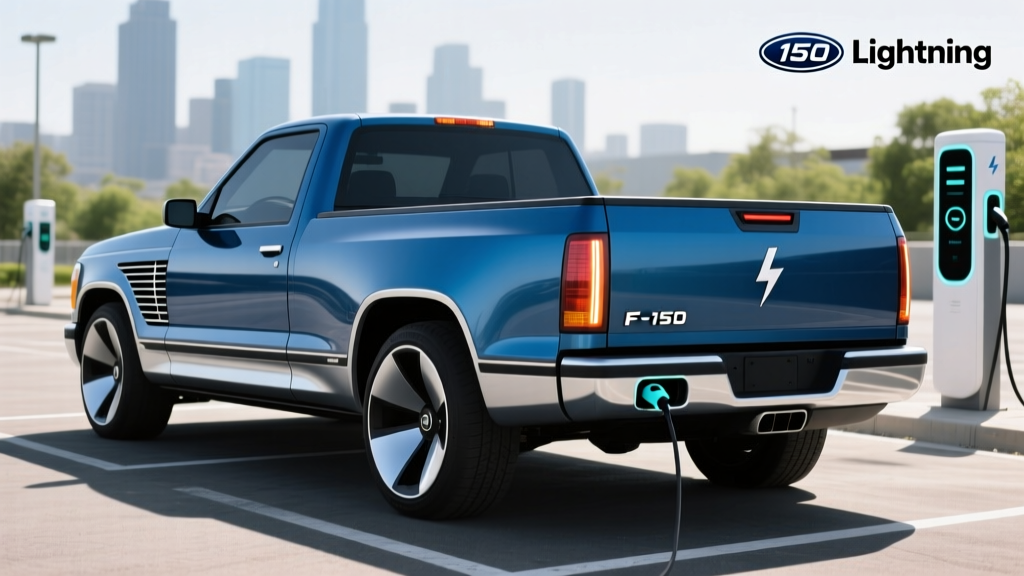
The original 1993 Ford F-150 SVT Lightning was a rear-wheel-drive, single-cab pickup with a 5.8L V8 making 240 horsepower — a street truck that defined an era. Today, the modern Ford F-150 Lightning (2022–present) carries the nameplate into the electric age. But what if you're searching for a '93 F-150 Lightning EV — whether as a restomod project, a curiosity, or a misunderstood search? Let's clarify what exists, what doesn't, and how a retro-electrified Lightning would actually perform using 2026 EV-swapping technology.
What the 1993 F-150 Lightning Actually Was (And Wasn't)
The 1993 Ford F-150 SVT Lightning was never an electric vehicle. It was a performance variant of the ninth-generation F-150, built by Ford's Special Vehicle Team (SVT) with a 351 Windsor V8, lowered suspension, and aggressive styling. Only 11,500 were produced between 1993 and 1995. If you've seen references to a "93 F-150 Lightning EV," they're either discussing a custom EV conversion/restomod or confusing the classic with the modern Ford F-150 Lightning BEV introduced in 2022.
That said, the classic Lightning's simple chassis, solid rear axle, and spacious engine bay make it an increasingly popular candidate for EV restomods — the process of replacing a combustion drivetrain with a modern electric motor and battery pack. Let's explore what that looks like in 2026.
Speculating a '93 Lightning EV Restomod: Realistic 2026 Specs
Based on current EV-swap platforms (like those from EV West and Cascadia Motion), here's what a professionally built 1993 F-150 Lightning EV restomod could realistically achieve:
| Specification | Estimated Value |
|---|---|
| Battery Capacity | 75–100 kWh (NMC chemistry, salvaged or new modules) |
| Motor | Single rear-mounted AC motor (RWD, like original) |
| Horsepower | 250–400 hp (depending on motor/controller) |
| 0-60 mph | 5.5–7.0 seconds |
| EPA-Equivalent Range | 150–200 miles (estimated; no official EPA test) |
| DC Fast Charging | 50–150 kW peak (CCS1, depending on onboard charger) |
| 10-80% DC Charge Time | 35–50 minutes |
| Level 2 Home Charging | 7.2–11.5 kW (25–40 miles/hour) |
| Drivetrain | RWD (solid rear axle retained) |
| Curb Weight (est.) | 5,200–5,800 lbs |
Charging a Retro EV: What You'd Actually Need
Most EV restomods in 2026 use a CCS1 charge port and a 6.6–11.5 kW onboard charger for Level 2 AC charging. DC fast charging capability depends heavily on the battery management system (BMS) and pack configuration.
| Charge Level | Power (kW) | Miles Added Per Hour | Notes |
|---|---|---|---|
| Level 1 (120V) | 1.4 kW | ~4 miles/hr | Emergency/top-off only |
| Level 2 (240V, 48A) | 11.5 kW | ~35 miles/hr | Full overnight charge in ~8 hrs |
| DC Fast (50 kW) | 50 kW | ~120 miles/30 min | Minimum viable road-trip speed |
| DC Fast (150 kW peak) | 150 kW | ~300 miles/30 min (peak) | Requires advanced BMS; tapers above 80% |
For a restomod, expect to pay $2,500–$5,000 additional for a DC fast-charge-capable system. Most budget EV swaps in 2026 still use CHAdeMO or CCS1 at 50 kW, which adds roughly 100 miles in 30 minutes — adequate for regional trips but not cross-country touring.
The Real 2026 Ford F-150 Lightning: What You Can Actually Buy
If your interest in "93 F-150 Lightning EV" is actually about the modern electric truck, here's the current-generation spec sheet for comparison:
| Specification | 2026 F-150 Lightning (Standard Range) | 2026 F-150 Lightning (Extended Range) |
|---|---|---|
| Battery | 98 kWh usable (NMC) | 131 kWh usable (NMC) |
| EPA Range | 240 miles | 320 miles |
| Motor | Dual-motor AWD, 563 hp | Dual-motor AWD, 563 hp |
| 0-60 mph | ~4.0 seconds | ~3.8 seconds |
| DC Fast Charge (peak) | 150 kW | 150 kW |
| 10-80% DC Time | ~44 minutes | ~41 minutes |
| Level 2 (home) | 11.3 kW (~25 mi/hr) | 19.2 kW (~42 mi/hr) w/optional charger |
| MPGe (combined) | 78 MPGe | 70 MPGe |
| Base MSRP (2026) | ~$55,000 | ~$70,000 |
The modern Lightning is a dual-motor AWD crew cab with independent rear suspension, Pro Power Onboard (V2L capability up to 9.6 kW), and available BlueCruise (SAE Level 2 hands-free driving on mapped highways). It's a fundamentally different vehicle from the '93 original — heavier, more powerful, and vastly more capable, but also more expensive and less "raw" in character.
Cost of a '93 Lightning EV Restomod vs. New F-150 Lightning
Here's where reality bites. A professional EV restomod on a 1993 F-150 chassis in 2026 typically costs:
| Item | Estimated Cost |
|---|---|
| Donor 1993 F-150 (clean title, SVT or replica) | $15,000–$35,000 |
| EV conversion kit (motor, controller, BMS) | $20,000–$40,000 |
| Battery pack (75–100 kWh, NMC modules) | $15,000–$30,000 |
| Fabrication & labor (professional shop) | $30,000–$60,000 |
| Charging system (CCS1, onboard charger) | $3,000–$6,000 |
| Suspension/brake upgrades (for added weight) | $5,000–$10,000 |
| Total Restomod Cost | $88,000–$181,000 |
Compare that to a new 2026 F-150 Lightning XLT starting around $55,000 — potentially $47,500 after the federal §30D tax credit (if you meet income caps and the vehicle meets battery-sourcing requirements). The restomod is a passion project, not a value proposition.
- Applies only to NEW clean vehicles from a licensed dealer — restomods and conversions do not qualify.
- Buyer income cap: $150k single / $300k joint (modified AGI).
- MSRP cap: $80,000 for trucks/vans (F-150 Lightning qualifies).
- Battery must meet critical-mineral and component sourcing thresholds (check IRS.gov for current-year lists).
- Point-of-sale transfer available — reduces purchase price at the dealer.
Pros and Cons: Restomod vs. Modern Lightning
Pros of a '93 Lightning EV Restomod
- Unique, one-of-a-kind vehicle with classic styling
- Lighter than modern Lightning (~5,500 vs. 6,500+ lbs)
- Simpler chassis — easier to work on
- No depreciation curve (collector value)
- RWD driving feel closer to original SVT intent
Cons of a '93 Lightning EV Restomod
- $100k+ build cost with no warranty
- No EPA range rating or crash-test safety
- Limited DC fast-charge capability
- No modern ADAS, airbags, or crumple zones
- Not eligible for federal or state EV incentives
- Insurance and registration complications
Who Should Actually Consider a '93 Lightning EV?
This build is for:
- Collector-car enthusiasts who want a unique EV with vintage aesthetics and don't need daily-driver practicality.
- Fabricators and hobbyists with EV-swap experience looking for a challenging, high-profile project.
- Short-range commuters who want a conversation piece and have home charging (Level 2 overnight is sufficient for 150-mile daily loops).
This build is NOT for:
- Buyers seeking a practical, warrantied, incentive-eligible electric truck.
- Anyone who needs to tow (restomods rarely have rated towing capacity).
- Road-trippers who need reliable DC fast charging on the Electrify America or Tesla Supercharger networks.
FAQ: 1993 F-150 Lightning EV Questions
Did Ford ever make a 1993 F-150 Lightning electric?
No. The 1993 F-150 SVT Lightning was exclusively a gasoline V8 vehicle. Ford's first factory electric F-150 (the modern Lightning) debuted for the 2022 model year.
What's the real-world range of a '93 Lightning EV restomod?
Expect 150–170 highway miles with a 90 kWh pack, dropping to ~120 miles in cold weather. City range with regen could reach 190 miles. These are estimates — no restomod is EPA-certified.
How much does a '93 F-150 Lightning EV conversion cost?
A professional restomod typically costs $88,000–$181,000 all-in, depending on battery size, motor choice, and fabrication complexity. DIY builds can reduce cost to $40k–$60k but require advanced electrical and fabrication skills.
Can a '93 Lightning EV restomod use Tesla Superchargers?
Not natively. Most restomods use CCS1 or CHAdeMO connectors. You'd need a NACS adapter (available from companies like Lectron) to access Tesla's network, and DC charge speed would still be limited by the vehicle's BMS and pack configuration.
Is a restomod '93 Lightning eligible for the $7,500 federal tax credit?
No. The IRS §30D credit applies only to new vehicles purchased from a licensed dealer with qualifying battery sourcing. Restomods, conversions, and used vehicles are excluded (though the separate §25E used-EV credit also wouldn't apply to a custom conversion).
What's the better buy: restomod or 2026 F-150 Lightning?
For 99% of buyers, the 2026 F-150 Lightning is the rational choice — it has a warranty, EPA-certified range (240–320 miles), DC fast charging, modern safety, and potential tax-credit eligibility. The restomod is a passion project for collectors and fabricators who value uniqueness over practicality.
If you're genuinely interested in the classic Lightning aesthetic with modern EV performance, your best path in 2026 is either commissioning a restomod from a reputable EV-swap shop (budget $120k+) or buying a modern F-150 Lightning and wrapping it in a retro SVT livery. Either way, you'll have a head-turning truck — just with very different trade-offs.