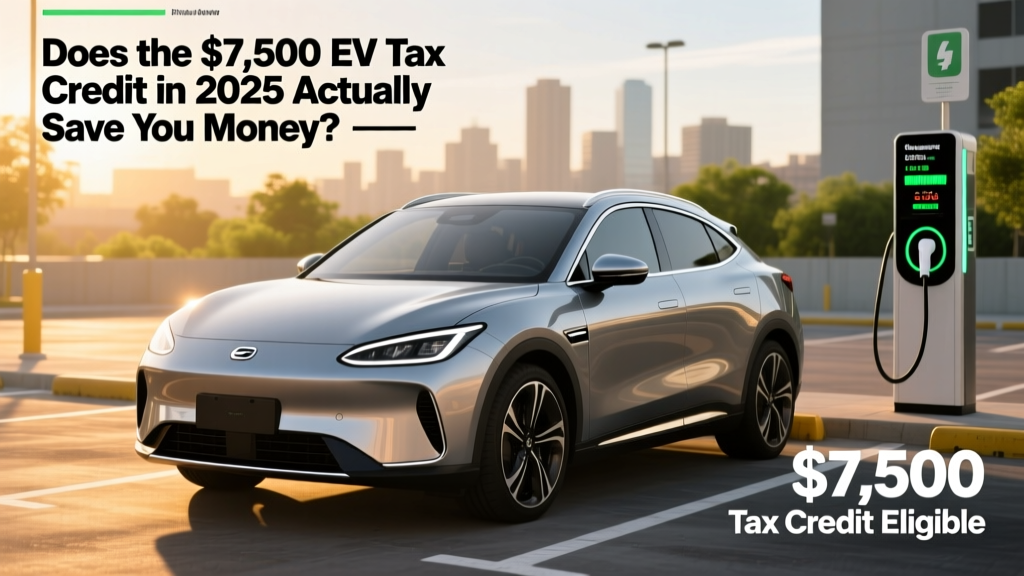
The $7,500 EV Tax Credit: A 2025 Reality Check
The federal clean vehicle credit under IRS §30D can knock up to $7,500 off the effective price of a new electric vehicle — but "up to" is doing heavy lifting. Since the Inflation Reduction Act reshaped the rules, qualifying for the full amount depends on your income, the vehicle's MSRP, and where its battery materials are sourced. For 2025, the IRS clean vehicle credit page remains the definitive source, and the rules have tightened on critical-mineral and battery-component sourcing year over year.
Below, we'll map out exactly who qualifies, how the point-of-sale transfer works, and whether an EV actually costs less to own over five years once you factor in insurance premiums, charging costs, and depreciation — not just the sticker savings.
Federal §30D Tax Credit: Who Qualifies in 2025?
The §30D credit is split into two halves: $3,750 for meeting critical-mineral sourcing requirements and $3,750 for meeting battery-component manufacturing requirements. A vehicle can earn one, both, or neither. Many popular EVs in 2025 qualify for the full $7,500, but the list shifts as automakers restructure supply chains.
§30D Eligibility Checklist (2025 Tax Year)
- Buyer income caps (modified AGI): $150,000 single / $225,000 head of household / $300,000 married filing jointly
- Vehicle MSRP caps: $80,000 for SUVs, vans, and pickups; $55,000 for sedans and other body styles
- Vehicle must be new (not previously titled) and placed in service for personal use, primarily in the U.S.
- Battery capacity: At least 7 kWh
- Critical minerals: A specified percentage must be extracted or processed in the U.S. or a free-trade-agreement country (threshold increases annually)
- Battery components: A specified percentage must be manufactured or assembled in North America (threshold increases annually)
- Foreign entity of concern (FEOC) restriction: Vehicles with battery components from a FEOC are disqualified; critical-mineral FEOC restrictions phase in
- Point-of-sale transfer: Buyers can transfer the credit to the dealer at purchase, receiving it as a down-payment reduction or cash — regardless of tax liability
The point-of-sale transfer is the biggest practical change from pre-IRA credits. If you owe less than $7,500 in federal tax, you can still capture the full value by transferring it to the dealer. You'll need to complete IRS Form 8936 through the IRS Energy Credits Online portal at the time of sale. Consult a tax professional for your specific situation — eligibility hinges on details that vary by household.
State, Local, and Utility Incentives
Federal credits stack with state and utility programs, which vary widely by jurisdiction. Some states offer rebates of $1,000–$5,000 (California's CVRP, Colorado's state credit, New York's DRIVE program), while many utilities offer $250–$1,500 rebates for home Level 2 charger installation or off-peak charging rate plans.
Your mileage will vary — literally. State and utility incentives change frequently and often have income caps, residency requirements, or application deadlines. Check your state's energy office, your utility's EV program page, and the DOE's Alternative Fuels Data Center for current programs in your ZIP code. We can't list exact amounts here because they shift by jurisdiction and calendar year.
5-Year Total Cost of Ownership: EV vs. Gas Baseline
To answer the core question — does an EV actually save money over five years? — we modeled a representative mid-size electric SUV (e.g., Hyundai Ioniq 5 or Tesla Model Y) against a comparable gasoline crossover (e.g., Toyota RAV4 AWD). Assumptions: 15,000 miles/year, 75,000 miles total, electricity at $0.16/kWh (national residential average), gasoline at $3.50/gallon, and the gas vehicle averaging 28 MPG combined.
| Category | EV (with $7,500 credit) | Gas Crossover |
|---|---|---|
| Purchase price (after credit) | $38,500 | $36,000 |
| Fuel / energy | $3,600 | $9,375 |
| Maintenance | $1,800 | $4,200 |
| Insurance (5 years) | $9,500 | $7,200 |
| Depreciation (est.) | $16,500 | $12,000 |
| Total 5-year cost | $69,900 | $68,775 |
The numbers are close — and the EV's advantage in fuel and maintenance is partially offset by higher insurance and steeper depreciation. The $7,500 credit closes most of the purchase-price gap, but it doesn't guarantee the EV will be cheaper overall. Your actual result depends heavily on local electricity rates, how much you drive, and which model you choose.
Cost Per Mile: Charging vs. Gasoline
This is where EVs shine most clearly. A typical EV consuming 3.5 miles per kWh at $0.16/kWh costs about $0.046 per mile. That same gas crossover at 28 MPG and $3.50/gallon costs $0.125 per mile. Over 75,000 miles, that's a fuel savings of roughly $5,775.
| Energy Source | Rate | Efficiency | Cost per Mile |
|---|---|---|---|
| Home Level 2 (electricity) | $0.16/kWh | 3.5 mi/kWh | $0.046 |
| Public DC fast charging | $0.40/kWh | 3.5 mi/kWh | $0.114 |
| Gasoline | $3.50/gallon | 28 MPG | $0.125 |
The caveat: if you rely primarily on public DC fast charging at $0.35–$0.50/kWh, your per-mile cost approaches gasoline. Home charging is where the economics work best. If you can't install a Level 2 charger at home (apartment living, no garage), run the numbers with your local public charging rates before committing.
Maintenance Savings: Fewer Parts, Less Wear
EVs eliminate oil changes, spark plugs, timing belts, exhaust systems, and multi-speed transmissions. Regenerative braking significantly reduces brake pad and rotor wear — many EV owners report original brake pads at 70,000+ miles.
| Maintenance Item | EV | Gas Vehicle |
|---|---|---|
| Oil changes | None | $200–$400/year |
| Brake pads (replacement interval) | 80,000+ mi | 30,000–50,000 mi |
| Transmission fluid | None (single-speed) | $150–$300 at 60K mi |
| Coolant flush | Every 5 years | Every 3–5 years |
| Cabin air filter | $25–$50/year | $25–$50/year |
| Tire rotation | $50–$80/year | $50–$80/year |
The savings are real but not unlimited. EVs still need tires (often wearing faster due to higher vehicle weight and instant torque), cabin air filters, wiper fluid, and occasional suspension work. Budget roughly $350–$450/year for EV maintenance versus $700–$900/year for a gas equivalent.
Insurance: The Cost Most Buyers Overlook
EV insurance premiums typically run 15–25% higher than comparable gas vehicles. The reasons are structural: EVs have higher repair costs after collisions (specialized high-voltage components, aluminum-intensive bodies, calibrated ADAS sensors), and total-loss thresholds are lower when a battery pack is damaged.
For our modeled mid-size SUV, expect annual premiums of $1,800–$2,100 for the EV versus $1,400–$1,600 for the gas equivalent — a difference of $300–$500/year, or $1,500–$2,500 over five years. Shop quotes from multiple insurers before purchasing; some carriers now offer EV-specific policies with bundled home-charger coverage.
Depreciation and Resale Value
EV depreciation has been volatile. Early EVs depreciated steeply, but models like the Tesla Model Y and Hyundai Ioniq 5 have held value better as demand stabilized. Industry data from 2024–2025 shows mainstream EVs retaining roughly 45–55% of value after five years, compared to 55–65% for popular gas crossovers.
Key depreciation factors for EVs:
- Battery health uncertainty: Buyers discount used EVs based on perceived battery degradation risk, even though most modern packs retain 90%+ capacity at 100,000 miles
- Price wars: Aggressive new-EV pricing (especially from Tesla) cascades into used values
- Tax credit effect: The $7,500 credit effectively lowers the "real" purchase price, which can compress resale values since used buyers don't receive the new-vehicle credit
- Technology obsolescence: Faster charging and longer range on newer models make older EVs feel dated sooner than gas cars
If you plan to keep your EV 8–10 years, depreciation matters less. If you trade in every 3–4 years, expect to absorb more value loss than with a popular gas model.
Frequently Asked Questions
How much does it really cost to own an EV over 5 years?
Our modeling shows a total 5-year cost of roughly $65,000–$75,000 for a mainstream electric SUV, depending on purchase price, local electricity rates, insurance premiums, and how the vehicle depreciates. The $7,500 federal credit narrows the gap with gas vehicles, but higher insurance and steeper depreciation can offset fuel and maintenance savings. Your mileage — literally — matters: high-mileage drivers save more on fuel; low-mileage drivers see less advantage.
Do I qualify for the $7,500 federal EV tax credit?
It depends on three factors: your modified adjusted gross income (must be under $150K single / $300K joint), the vehicle's MSRP (under $80K for SUVs/trucks, $55K for sedans), and the vehicle's battery sourcing compliance with critical-mineral and component rules. The qualifying vehicle list changes as automakers adjust supply chains. Check the IRS Energy Credits Online portal and consult a tax professional before relying on the credit.
How much do I save on fuel and maintenance?
Expect to save $4,000–$6,000 on fuel over five years (75,000 miles) if you charge primarily at home at residential electricity rates. Maintenance savings add another $1,500–$2,500. Combined, that's $5,500–$8,500 in operational savings — but verify your local rates and driving patterns, as heavy DC fast-charging use erodes the fuel advantage.
Are EVs more expensive to insure?
Yes, typically 15–25% more per year due to higher repair costs, specialized parts, and ADAS sensor recalibration after collisions. Budget an extra $300–$500 annually compared to a gas equivalent. Get quotes before buying — premiums vary significantly by insurer, model, and your driving record.
How well do EVs hold their value?
Mainstream EVs retain approximately 45–55% of their value after five years, generally 5–10 percentage points below comparable gas crossovers. Battery health perception, new-vehicle price cuts, and rapid technology improvements all pressure resale values. Long-term owners (8+ years) are less affected; short-term lessees and trade-in buyers absorb the most depreciation.
Can I get the tax credit if I lease instead of buy?
Leased EVs fall under a different credit (§45W commercial clean vehicle credit), which goes to the leasing company. Many lessors pass this savings through as a "lease cash" reduction, effectively giving you the $7,500 benefit without the income or MSRP caps. This "lease loophole" makes leasing an attractive option for buyers who exceed the §30D income limits or want a vehicle above the MSRP cap. Confirm with the dealer that the lease cash is being applied to your deal.