Quick Verdict: A Compact Third Row With Big Utility
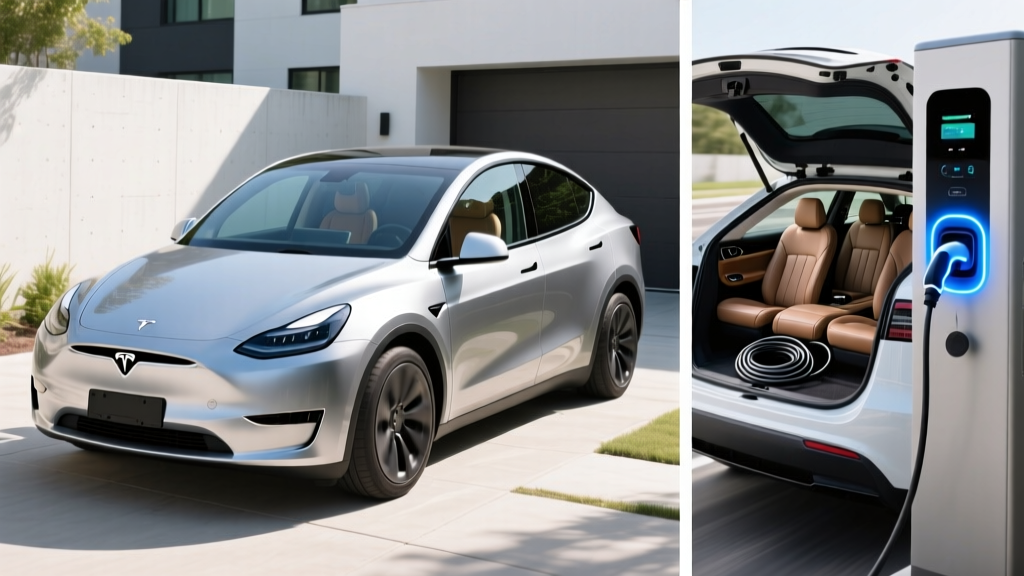
The 2026 Tesla Model Y Long Range AWD with the optional third-row seat is a study in trade-offs. You gain seating for seven in a footprint that still fits a standard garage, but that third row is best reserved for children or short trips. For families who need occasional extra seating without stepping up to a full-size SUV like the Rivian R1S or Kia EV9, the 7-seat Model Y occupies a unique niche — especially when you factor in Tesla's Supercharger network and the vehicle's class-leading efficiency.
Starting at $49,990 (including destination) before incentives, the 7-seat Model Y Long Range AWD adds a $2,500 third-row option, bringing the effective base to $52,490. Federal tax credit eligibility under IRS §30D depends on your income, the vehicle's MSRP cap compliance, and battery-sourcing requirements that shift annually. We break all of that down below.
Range, Battery & Real-World Efficiency
The 2026 Model Y Long Range AWD carries a 78 kWh usable lithium-ion battery pack using NMC (nickel manganese cobalt) chemistry. NMC offers higher energy density than LFP, which is why Tesla reserves it for Long Range and Performance trims where maximizing range per kilogram matters most.
Real-World Expectation: Expect 265–280 miles on highway-heavy trips at 70–75 mph. In freezing temperatures (below 32°F), plan for 20–30% range reduction, yielding roughly 210–245 miles. City driving with regenerative braking can push closer to or slightly above the EPA sticker. The 7-seat option adds approximately 60 lbs of weight, reducing range by roughly 3–5 miles versus the 5-seat configuration.
| Specification | Value |
|---|---|
| EPA Range | 303 miles |
| Battery (usable) | 78 kWh, NMC chemistry |
| EPA Efficiency | 122 MPGe combined / 28 kWh/100 mi |
| Drivetrain | Dual-motor AWD |
| Horsepower | 384 hp (combined) |
| 0–60 mph | 4.8 seconds |
| Max DC Fast Charge | 250 kW peak |
| 10–80% DC Charge Time | ~25 minutes |
| Level 2 Home Charge Rate | 11.5 kW (~44 mi/hr) |
| Seating | 7 (2+3+2 configuration) |
| Cargo (behind 3rd row) | 12.4 cu ft |
| Cargo (3rd row folded) | 34.2 cu ft |
| Cargo (all rear rows folded) | 72.1 cu ft |
| Base MSRP (7-seat) | $52,490 |
| Battery Warranty | 8 years / 120,000 miles |
Efficiency is where the Model Y continues to outperform most rivals. At 122 MPGe combined (roughly 28 kWh per 100 miles), it sips electrons more sparingly than the heavier Kia EV9 (97 MPGe combined) or the Ford Explorer EV. On a 300-mile road trip, that efficiency gap translates into fewer charging stops and lower electricity costs.
Charging Speed: DC Fast, Level 2 & Home Setup
The 2026 Model Y Long Range supports a peak DC fast-charge rate of 250 kW on V3 Superchargers or compatible CCS/NACS stations. Tesla's charge curve is well-managed: the pack pulls close to peak rate from roughly 10% to 45% state of charge, then tapers progressively. A 10–80% session takes approximately 25 minutes under ideal thermal conditions.
| Level | Power | Speed (approx.) | Use Case |
|---|---|---|---|
| Level 1 (120V) | ~1.4 kW | ~4–5 mi/hr | Emergency / overnight trickle |
| Level 2 (240V, 48A) | 11.5 kW | ~44 mi/hr | Home daily charging |
| DC Fast (V3 Supercharger) | 250 kW peak | ~175 mi in 15 min | Road trips |
| DC Fast (V4 Supercharger) | 250 kW peak* | ~175 mi in 15 min | Newer Tesla stations |
*The Model Y's onboard charge architecture limits it to 250 kW even at higher-capacity V4 posts.
At home on a Wall Connector (hardwired, 60A circuit, delivering 48A to the vehicle), you'll recover roughly 44 miles of range per hour. A full 10–80% home charge takes about 5.5 hours — easily accomplished overnight. Installation costs for a 240V/60A circuit typically run $800–$2,000 depending on panel proximity and local permit fees, according to Tesla's home charging guide.
Third-Row Reality: Space, Comfort & Cargo Trade-Offs
Let's address the core question directly: the Model Y's third row fits children and smaller teenagers comfortably, not adults. Third-row legroom measures approximately 26.5 inches — tight for anyone over about 5'4" on anything longer than a school run. Headroom is similarly constrained by the sloping roofline that gives the Model Y its crossover silhouette.
The 2+3+2 seating configuration means you access the third row by folding and sliding the second-row bench. It works, but it's not as seamless as the walk-through aisles in larger SUVs. With the third row upright, cargo space drops to 12.4 cubic feet — enough for a few grocery bags or a compact stroller, but not both simultaneously.
Fold the third row flat and you recover 34.2 cubic feet, which is generous for daily family use. Fold everything and the 72.1 cubic feet of total cargo volume rivals many midsize two-row SUVs. The front trunk (frunk) adds another 4.1 cubic feet for charging cables or a small bag.
Practically speaking, the 7-seat Model Y works best as a 5+2 vehicle: five passengers most days, with the third row deployed for carpool duty, playdates, or the occasional airport run with grandparents in tow for short segments.
Performance & Driving Dynamics
The dual-motor AWD powertrain produces 384 horsepower and delivers a 4.8-second 0–60 mph time — brisk for a family hauler and quicker than most three-row EV competitors. The instant torque makes merging and passing effortless, and the low center of gravity (battery pack mounted under the floor) keeps body roll well-controlled through corners.
Ride quality is firm but compliant. The 2026 Model Y continues to benefit from the "Juniper" suspension revisions introduced in the 2025 refresh, which softened low-speed impacts and reduced road noise. The steering remains quick and precise, though some drivers find it artificially weighted at low speeds.
Towing capacity stands at 3,500 pounds when properly equipped — sufficient for a small boat trailer, bike rack with cargo, or a lightweight camper. Note that towing at capacity will cut your range roughly in half; plan charging stops accordingly.
Tech, Driver Assistance & Safety
The 15.4-inch center touchscreen runs Tesla's latest software with responsive navigation, streaming media, and over-the-air updates. The 2026 model year continues to include an 8-inch rear touchscreen for second-row passengers — useful for climate control and entertainment, though third-row occupants have no dedicated screen.
Standard driver assistance includes Tesla Autopilot (Traffic-Aware Cruise Control and Autosteer), which is an SAE Level 2 system — meaning the driver must remain fully engaged with hands on the wheel and eyes on the road at all times. The optional Full Self-Driving (Supervised) package ($8,000 or $99/month) adds automatic lane changes, Navigate on Autopilot, and traffic light/stop sign recognition, but it remains a Level 2 system requiring continuous driver supervision. It is not autonomous driving.
Pricing, Tax Credits & Ownership Cost
| Item | Amount |
|---|---|
| Base MSRP (5-seat) | $49,990 |
| Third-row seat option | +$2,500 |
| Destination fee | Included |
| 7-Seat Base Price | $52,490 |
| FSD (Supervised) add-on | +$8,000 |
| As-tested (7-seat + FSD + red paint) | ~$62,490 |
| Federal tax credit (§30D) — if eligible | Up to $7,500 |
| Effective price after max credit | ~$44,990 (base 7-seat) |
Federal tax credit eligibility under IRS §30D involves several requirements that change periodically:
- MSRP cap: SUVs must be priced at or below $80,000. The 7-seat Model Y clears this easily.
- Buyer income cap: Modified AGI must not exceed $150,000 (single), $225,000 (head of household), or $300,000 (joint filers).
- Battery sourcing: A percentage of critical minerals and battery components must be sourced from the U.S. or free-trade-agreement countries. These thresholds increase annually and can affect eligibility mid-year.
- Point-of-sale transfer: As of 2024, eligible buyers can transfer the credit to the dealer at purchase, reducing the purchase price directly rather than waiting for a tax refund.
Consult a tax professional and verify current-year rules on IRS.gov before relying on credit eligibility in your purchase decision.
On the ownership-cost side, the Model Y benefits from minimal maintenance (no oil changes, fewer brake replacements due to regen), low electricity costs relative to gasoline, and strong resale value. Insurance premiums tend to run 15–25% higher than comparable ICE SUVs, according to industry averages — get a quote before purchasing.
Pros
- Class-leading efficiency (122 MPGe)
- Access to Tesla Supercharger network
- Strong performance (4.8s 0–60)
- Over-the-air updates keep vehicle current
- Competitive pricing after tax credit
- 5-star NHTSA safety rating
Cons
- Third row is tight — children only for anything beyond short trips
- Cargo space limited with third row up (12.4 cu ft)
- No third-row climate controls or USB-C ports
- FSD package is expensive and still Level 2
- Firm ride on larger wheel options
- Insurance costs above segment average
Who Should Buy the 7-Seat Model Y?
Choose the 7-seat Model Y if: You have a family of five and occasionally need to haul two extra kids for carpools, sports events, or short family gatherings. You value efficiency, the Supercharger network, and a relatively compact footprint. Your budget is roughly $45K–$55K after incentives.
Look elsewhere if: You regularly need to seat six or seven adults. You want generous cargo space with all seats in use (consider the Kia EV9 at 20.2 cu ft behind the third row, or the Rivian R1S). You prioritize ride comfort over sporty handling. You need more than 3,500 lbs of towing capacity.
Frequently Asked Questions
What is the real-world range of the 7-seat Tesla Model Y?
The EPA rates the 2026 Model Y Long Range AWD (7-seat) at 303 miles. In mixed real-world driving with highway segments, expect 265–280 miles. In cold weather (below freezing), range can drop to 210–245 miles depending on cabin heating demands and driving speed.
How fast does the 7-seat Model Y charge?
On a V3 or V4 Tesla Supercharger, the Model Y peaks at 250 kW and charges from 10–80% in approximately 25 minutes with battery preconditioning. At home on a 240V Wall Connector (11.5 kW), you gain about 44 miles of range per hour, or a full 10–80% charge in roughly 5.5 hours.
Does the 7-seat Model Y qualify for the federal EV tax credit?
The Model Y Long Range AWD qualifies under the MSRP cap (under $80,000 for SUVs). However, your personal eligibility depends on income limits ($300K joint / $150K single), battery-sourcing requirements that change annually, and whether you have already claimed the credit on another vehicle. Always verify current rules on IRS.gov and consult a tax professional.
Is the third row worth it over the 5-seat Model Y?
Only if you'll use it at least a few times per month. The $2,500 option cost is modest, but it does reduce cargo space slightly and adds weight (costing 3–5 miles of range). If your use case is strictly five passengers or fewer, the 5-seat configuration is more practical with its larger rear cargo area.
How does the 7-seat Model Y compare to the Kia EV9?
The Kia EV9 offers a genuinely usable third row for adults, more cargo space behind the third row (20.2 vs 12.4 cu ft), and a longer EPA range (up to 304 miles for RWD). However, the EV9 starts at ~$54,900 for the base model, is significantly less efficient (97 MPGe vs 122 MPGe), and cannot access Tesla's Supercharger network without an adapter. Choose the EV9 if third-row comfort and cargo are priorities; choose the Model Y for efficiency, charging infrastructure, and lower running costs.
What is the battery warranty on the Model Y?
Tesla covers the Model Y Long Range battery and drive units for 8 years or 120,000 miles, whichever comes first, with a guaranteed minimum 70% capacity retention over that period. This is competitive with most EV manufacturers, though some (like Hyundai/Kia) offer longer 10-year/100,000-mile powertrain coverage.