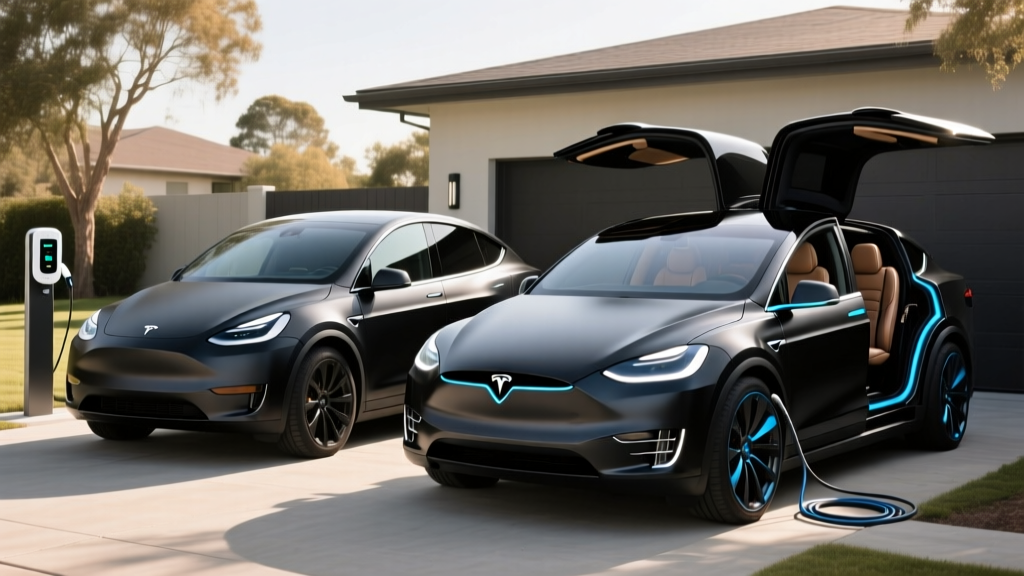
If you're searching for a 7 passenger Tesla in 2026, you have exactly two options: the compact-crossover Model Y with its optional third row, and the flagship Model X with its standard six- or optional seven-seat layout. Both wear the Tesla badge and tap into the Supercharger network, but they serve very different family use cases — and their range, charging behavior, and pricing diverge sharply once you look past the brochure.
Below, we break down both 7-seat Teslas with the exact numbers that matter: EPA range versus real-world highway and cold-weather expectations, battery chemistry, DC fast-charge curves, home Level 2 speeds, cargo volume behind each row, and the fine print on the §30D federal tax credit. If you're cross-shopping three-row EVs, this is the spec-driven teardown you need before signing a delivery agreement.
Which Tesla Models Actually Seat Seven?
Tesla's current lineup narrows the 7-seat question quickly. The Model Y offers an optional third row only on the Long Range AWD trim (not the Performance or Standard Range RWD). The third row is best suited for children or short-trip adults. The Model X offers three interior configurations: 5-seat, 6-seat (with second-row captain's chairs and a center console), and 7-seat (bench second row). Only the 7-seat config gives you the full passenger count.
The Cybertruck seats five maximum. The Model S is a five-seat sedan. The Model 3 is also five seats. And Tesla's long-teased next-gen platform vehicle has not been released as of 2026 — treat any online speculation about a smaller 7-seat Tesla as unconfirmed.
| Spec | Model Y Long Range AWD (7-seat) | Model X Long Range (7-seat) |
|---|---|---|
| EPA Range | 308 mi (est. ~295 mi w/ 3rd-row option) | 335 mi |
| Battery (usable) | ~75 kWh, NMC | ~95 kWh, NMC |
| Drivetrain | Dual-Motor AWD | Dual-Motor AWD |
| Horsepower | 384 hp | 670 hp |
| 0-60 mph | 4.8 sec | 3.8 sec |
| MPGe (combined) | 122 MPGe | 102 MPGe |
| Efficiency | 28 kWh/100 mi | 33 kWh/100 mi |
| Peak DC Charge | 250 kW | 250 kW |
| 10–80% DC Time | ~27 min | ~32 min |
| Level 2 Rate | 11.5 kW (~37 mi/hr) | 11.5 kW (~32 mi/hr) |
| Cargo (behind 3rd row) | 12.8 cu ft | ~15 cu ft |
| Cargo (3rd row folded) | 30.2 cu ft | ~42 cu ft |
| Cargo (max, all rows folded) | 72.1 cu ft | 81.5 cu ft |
| Battery Warranty | 8 yr / 120,000 mi | 8 yr / 150,000 mi |
| Base MSRP (7-seat) | ~$52,990 (+$3,000 3rd-row) | ~$81,990 |
Real-World Range: What the EPA Sticker Doesn't Tell You
The EPA numbers above are a starting point, not a promise. Tesla's range testing tends to favor favorable conditions, and both vehicles lose meaningful miles in the real world — especially the Model Y, whose smaller battery leaves less buffer.
EPA: 308 mi (likely ~295 mi with the added weight and drag of the 3rd-row option).
Real-world highway (70–75 mph): expect 245–265 mi in mild weather.
Cold weather (below 32°F): expect 195–230 mi, depending on cabin heat use and whether you precondition.
Model X Long Range (7-seat)
EPA: 335 mi.
Real-world highway: expect 270–290 mi.
Cold weather: expect 220–260 mi. The larger battery provides a bigger absolute buffer, and the Model X includes a standard heat pump, which helps efficiency in cold climates.
For context, the EPA's fueleconomy.gov database is the authoritative source for the official sticker figures. If your commute is mostly city driving with frequent regenerative braking, you'll land closer to — or even slightly above — the EPA number. Sustained highway speeds above 70 mph and cold weather are the two biggest range killers in any EV, and 7-seat Teslas are no exception.
Charging Speeds: DC Fast, Level 2, and the Curve Reality
Both the Model Y and Model X peak at 250 kW on DC fast chargers using the native NACS connector. That's the headline number, but EV charging doesn't hold peak rate for long. Here's what actually happens at a V3 Supercharger or any 250+ kW NACS-equipped station:
- 10–30% SoC: Both models sustain near-peak rates (~220–250 kW).
- 30–60% SoC: Rate tapers to roughly 150–180 kW as cell temperature and voltage rise.
- 60–80% SoC: Further taper to 80–120 kW.
- Above 80%: Sharp drop to under 50 kW — never fast-charge past 80% on a road trip unless you absolutely need the miles.
The Model X takes longer to reach 80% (~32 minutes vs ~27 for the Model Y) because its larger ~95 kWh battery has more total energy to push, even at the same peak kW. This is the difference between kW (power, or how fast energy flows) and kWh (energy, or how much the battery holds) — a distinction every EV buyer should internalize.
| Charging Level | Power | Model Y (mi/hr added) | Model X (mi/hr added) |
|---|---|---|---|
| Level 1 (120V household) | ~1.4 kW | ~3–4 mi/hr | ~3 mi/hr |
| Level 2 (240V, 48A home) | 11.5 kW | ~37 mi/hr | ~32 mi/hr |
| DC Fast (V3 Supercharger) | Peak 250 kW | 10–80% in ~27 min | 10–80% in ~32 min |
Home charging reality: A full overnight charge on Level 2 is the practical standard for Tesla owners. The Model Y replenishes its ~75 kWh battery in about 7 hours; the Model X's ~95 kWh battery takes roughly 8.5 hours. Most owners never use DC fast charging except on road trips. Install a Tesla Wall Connector on a 60A circuit for the full 48A/11.5 kW rate.
Performance, Drivetrain, and Towing
Both 7-seat Teslas come with dual-motor all-wheel drive as standard. The Model Y Long Range AWD puts out 384 hp and hits 60 mph in 4.8 seconds — genuinely quick for a family crossover. The Model X Long Range is in another league at 670 hp and a 3.8-second 0-60, which is sports-car territory in a three-row SUV that weighs over 5,000 pounds.
For towing, the Model Y is rated for up to 3,500 lbs with the optional tow hitch, while the Model X can pull up to 5,000 lbs. Towing any trailer will cut range by 30–50% depending on weight, aerodynamics, and speed — plan your charging stops accordingly if you're hauling a boat or camper.
Pricing, Trims, and Federal Tax Credit Eligibility
Pricing a 7-seat Tesla requires adding up the base MSRP, the third-row option (on Model Y), destination fees, and then subtracting any applicable incentives. Here's where things stand for 2026:
| Model / Trim | Base MSRP | 7-Seat Config Cost | Est. Out-the-Door | §30D Credit Eligibility |
|---|---|---|---|---|
| Model Y Long Range AWD | ~$49,990 | +$3,000 (3rd-row option) | ~$54,390 (incl. dest.) | Eligible up to $7,500 (see caveats below) |
| Model X Long Range | ~$81,990 | Included (select 7-seat) | ~$83,990 (incl. dest.) | Not eligible — exceeds MSRP cap |
The critical detail: the IRS §30D federal tax credit has an MSRP cap of $80,000 for SUVs and vans (per IRS.gov). The Model X, at ~$82,000+ with destination, exceeds that cap and does not qualify. The Model Y Long Range AWD with the third-row option comes in under the cap and may qualify for up to $7,500 — but only if you meet all of the following:
- Income caps: Modified AGI ≤ $300,000 (joint filers), $225,000 (head of household), $150,000 (single).
- Battery sourcing: The vehicle must meet critical-mineral and battery-component requirements, which Tesla has largely satisfied for US-built Model Y vehicles in recent years — but verify the specific VIN's eligibility at purchase time.
- Point-of-sale transfer: As of 2024+, you can transfer the credit to the dealer at purchase, effectively reducing your out-of-pocket price by up to $7,500 on the spot.
- One credit per VIN, one new-vehicle credit per taxpayer per year.
Always confirm eligibility with a tax professional and check the latest fueleconomy.gov credit listings before signing. Rules and sourcing requirements have shifted year over year.
Interior Space, Cargo, and Family Practicality
This is where the two vehicles diverge most sharply. The Model Y's optional third row is compact — roughly 26.5 inches of third-row legroom. It's fine for children on school runs or short errands but genuinely uncomfortable for adults on longer drives. With the third row upright, you get 12.8 cu ft of cargo space — enough for a couple of grocery bags or a stroller, but not much more.
The Model X's 7-seat configuration offers substantially more room. Second-row legroom is about 38 inches, and the third row is usable for teenagers and adults on moderate-length trips. Behind the third row, you get roughly 15 cu ft of cargo — and with the third row folded, ~42 cu ft opens up. The Model X also features the signature falcon-wing rear doors, which hinge upward and make loading children into car seats dramatically easier in tight parking spaces. The trade-off: falcon-wing doors add mechanical complexity and have historically been a reliability concern, though Tesla has refined the mechanism in recent model years.
Both vehicles use Tesla's minimalist interior with a central 15-inch touchscreen (Model Y) or 17-inch touchscreen (Model X), no physical instrument cluster, and a secondary rear-seat screen in the Model X. The glass roof is standard on both and provides an airy feel that passengers in the third row especially appreciate.
Technology, Autopilot, and Driver Assistance
Every 2026 Tesla ships with Basic Autopilot as standard — this includes Traffic-Aware Cruise Control and Autosteer (lane centering). This is an SAE Level 2 driver-assistance system, meaning you must remain engaged and supervising at all times. It is not self-driving.
Tesla Autopilot and FSD (Supervised) are Level 2 systems — the driver must monitor the road, keep hands available, and intervene at any moment. No Tesla vehicle sold to consumers is Level 3, 4, or 5. Fully driverless operation (Level 4) currently exists only in geofenced commercial robotaxi services like Waymo.
Full Self-Driving (Supervised) remains an optional $8,000 add-on (or $99/month subscription as of 2026). FSD adds features like automatic lane changes, traffic light and stop sign recognition, and Navigate on Autopilot for highway interchanges. Despite the name, it still requires active driver supervision and does not make the vehicle autonomous. Real-world FSD performance has improved significantly on highways but remains inconsistent on complex urban streets — treat it as an advanced convenience feature, not a replacement for your attention.
Both vehicles include Tesla's full infotainment suite: streaming music and video, over-the-air software updates, Sentry Mode (surveillance recording), Dog Mode (climate control for pets), and the Tesla app for remote preconditioning, charging status, and location. The Model X adds a premium 22-speaker audio system and a rear-seat entertainment screen as standard.
- They do not drive the car without your supervision.
- They do not handle all construction zones, unmapped roads, or severe weather reliably.
- They do not absolve you of legal liability — you are the responsible driver.
- FSD (Supervised) performance varies by geography and software version. Always keep hands near the wheel.
Model Y vs Model X: Which 7-Seat Tesla Should You Buy?
- Your third-row passengers are children or occasional-use adults.
- You want the most range per dollar and the lowest operating cost.
- The §30D tax credit is important to your purchase math.
- You prioritize efficiency (122 MPGe combined) over raw performance.
- Your daily driving is under 200 miles round-trip.
- You regularly carry six or seven passengers, including adults in the third row.
- You need maximum cargo space (81.5 cu ft with all rows folded).
- Falcon-wing doors would genuinely help with car-seat loading.
- You want 5,000-lb towing capacity and 670 hp.
- The $80,000+ price and ineligibility for the federal tax credit fit your budget.
Against non-Tesla competitors, the Model Y competes with the Kia EV9 (3-row, up to 300 mi EPA, starts ~$56,000) and the Rivian R1S (3-row, up to ~400 mi with Max Pack, starts ~$80,000). The Model X's closest rival is the Rivian R1S in performance and space, though the Rivian offers a more traditional SUV layout and better off-road capability. The Tesla advantage remains the Supercharger network — though NACS adoption by Ford, GM, Rivian, and others in 2025–2026 has narrowed that gap significantly.
- Best efficiency in its class (122 MPGe)
- Eligible for up to $7,500 §30D credit
- 250 kW DC fast charging, NACS native
- Low starting price for a 7-seat EV
- Over-the-air updates keep improving the car
- Third row is very tight — children only
- Minimal cargo space with 3rd row up (12.8 cu ft)
- Real-world highway range drops to ~250 mi
- No heat pump in all model years (verify for 2026)
- Ride quality is firm, especially when loaded
- Genuinely usable third row for adults
- 335 mi EPA range, 670 hp, 3.8-sec 0-60
- Falcon-wing doors ease car-seat loading
- 81.5 cu ft max cargo volume
- 5,000-lb towing capacity
- $82,000+ and no federal tax credit (MSRP cap)
- Falcon-wing doors add repair complexity
- Lower efficiency (102 MPGe) means higher charging cost
- Large footprint can be tricky in tight garages
- Insurance premiums are higher than Model Y
Frequently Asked Questions
What is the real-world range of a 7 passenger Tesla?
For the Model Y Long Range AWD with the 7-seat option, expect roughly 245–265 miles on the highway in mild weather and 195–230 miles in cold weather, versus the 308-mile EPA sticker. The Model X Long Range delivers about 270–290 highway miles and 220–260 in the cold, against its 335-mile EPA rating.
How fast does a 7-seat Tesla charge at home and on the road?
Both models peak at 250 kW on DC fast chargers, achieving 10–80% in about 27 minutes (Model Y) or 32 minutes (Model X). On a home Level 2 charger at 11.5 kW, the Model Y adds about 37 miles of range per hour and the Model X adds about 32 miles per hour. A full overnight charge takes 7–8.5 hours.
Does the 7-seat Tesla Model Y qualify for the $7,500 federal tax credit?
The Model Y Long Range AWD with the third-row option generally qualifies for up to $7,500 under IRS §30D, provided you meet income caps ($300K joint / $150K single), the vehicle meets battery-sourcing requirements, and the MSRP stays under the $80,000 SUV cap. The Model X does not qualify — its MSRP exceeds the cap. Always verify with the IRS and a tax professional before purchasing.
Is the Model Y third row worth it for families?
It depends on who sits there. For children aged roughly 5–12 on school runs and short trips, it works well. For teenagers or adults, it's cramped with only ~26.5 inches of legroom. If you regularly need seven seats, the Model X or a competitor like the Kia EV9 is a better fit.
Is it worth buying a 7-seat Tesla vs. the Kia EV9 or Rivian R1S?
The Model Y wins on price and efficiency if you only need an occasional third row. The Kia EV9 offers more third-row space and similar range at a comparable price, though it charges slower on DC. The Rivian R1S offers genuine off-road capability and more third-row room but starts significantly higher. The Model X competes on performance and range but is priced against luxury SUVs where the Rivian R1S and BMW iX are strong alternatives.
What's the battery warranty on a 7-seat Tesla?
The Model Y Long Range AWD carries an 8-year / 120,000-mile battery and drive unit warranty. The Model X carries an 8-year / 150,000-mile warranty. Both guarantee at least 70% battery capacity retention over the warranty period. Real-world Tesla battery degradation data from high-mileage owners suggests typical loss of 8–12% over the first 100,000 miles, with the curve flattening significantly afterward.
Sources: fueleconomy.gov (EPA range and MPGe data), IRS.gov §30D clean vehicle credits, Tesla official specifications.