Quick Verdict: Is the 3-Row Model Y a Genuine Family Hauler?
Tesla's optional third-row seat for the Model Y transforms the popular electric crossover from a five-passenger vehicle into a seven-passenger configuration — but "seven-passenger" requires generous use of quotation marks. The 3-row Tesla Model Y is best understood as a 5+2: five adults in reasonable comfort, plus two small children in the rearmost seats for short trips. If your household regularly needs to carry more than five people, a dedicated three-row SUV like the Kia EV9 or Rivian R1S will serve you better. If you need the occasional extra seats for school carpools or weekend outings with nieces and nephews, the Model Y's third row is a clever, if compromised, solution that preserves Tesla's charging network advantage and efficiency leadership.
| Specification | Value |
|---|---|
| EPA Range | 308 miles (7-seat option reduces by ~4 mi vs 5-seat) |
| Battery (usable) | ~75 kWh, NMC (nickel-manganese-cobalt) |
| Drivetrain | Dual-motor AWD |
| Horsepower | 384 hp (combined) |
| 0-60 mph | 4.8 seconds |
| Max DC Fast Charge | 250 kW peak (V3 Supercharger) |
| 10-80% DC Time | ~27 minutes |
| Level 2 Home Charging | 11.5 kW / 44 mi/hr |
| EPA Efficiency | 111 MPGe combined (30 kWh/100 mi) |
| Cargo (behind 3rd row) | 12.2 cu ft |
| Cargo (3rd row folded) | 30.2 cu ft |
| Cargo (all rear seats folded) | 72.1 cu ft |
| 3rd-Row Legroom | 26.5 inches |
| Base MSRP (7-seat) | $50,490 (incl. $2,000 3rd-row option) |
| Battery Warranty | 8 years / 120,000 miles (70% retention) |
Range and Efficiency: EPA Numbers vs. Real-World Driving
The Long Range AWD Model Y with the third-row option carries the same ~75 kWh usable NMC battery pack as the five-seat variant. Tesla lists the EPA range at approximately 308 miles for the seven-seat configuration, a slight reduction from the 320-mile estimate on the five-seat Long Range AWD due to the added weight of the third-row hardware (roughly 60-70 pounds including seatbelts, anchors, and folding mechanisms).
EPA sticker: 308 miles. In practice, plan for:
- City/suburban mixed driving (65-75°F): 290-310 miles achievable with moderate regen use
- Highway cruising at 70-75 mph: 255-275 miles (aerodynamic drag cuts efficiency ~15%)
- Cold weather (below 32°F): 210-245 miles depending on cabin heating demand and battery preconditioning
- Full load (7 passengers + cargo): subtract another 5-8% from the above figures
The Model Y's efficiency remains a class benchmark. At roughly 30 kWh per 100 miles (111 MPGe combined), it extracts more miles per kilowatt-hour than nearly every competing electric SUV. That efficiency matters when you're loading down the vehicle with passengers and gear — the energy penalty of extra weight is smaller in a highly efficient platform.
Charging Speed: DC Fast Charging and Home Level 2 Setup
Tesla's Supercharger network remains the strongest public charging infrastructure in North America, and the Model Y Long Range takes full advantage. On a V3 Supercharger (250 kW peak), the Model Y can add up to 200 miles of range in about 15 minutes under ideal conditions — meaning a preconditioned battery at low state of charge and moderate ambient temperature.
| Charging Level | Power / Rate | Miles Added | Notes |
|---|---|---|---|
| Level 1 (120V household) | ~1.4 kW | ~4 mi/hr | Emergency/trickle only; 75+ hours for full charge |
| Level 2 (240V home, 48A) | 11.5 kW | ~44 mi/hr | Full charge in ~7 hours; requires NEMA 14-50 or hardwired Wall Connector |
| DC Fast (V3 Supercharger) | 250 kW peak | ~200 mi in 15 min | 10-80% in ~27 min; tapers significantly above 80% |
| DC Fast (V4 Supercharger) | Up to 350 kW* | Slightly faster 10-80% | *Model Y architecture caps intake near 250 kW regardless of stall capability |
| CCS Adapter (non-Tesla DC) | Up to 150-170 kW typical | Varies | Works with Electrify America, EVgo; adapter included on 2025+ models |
Charging curve reality check: The 250 kW peak is only sustained between roughly 10-30% state of charge. From 30-60%, expect ~150-180 kW. From 60-80%, the rate drops to ~80-100 kW. Above 80%, charging slows dramatically to protect battery health — plan to unplug at 80% on road trips unless you genuinely need the last 20%.
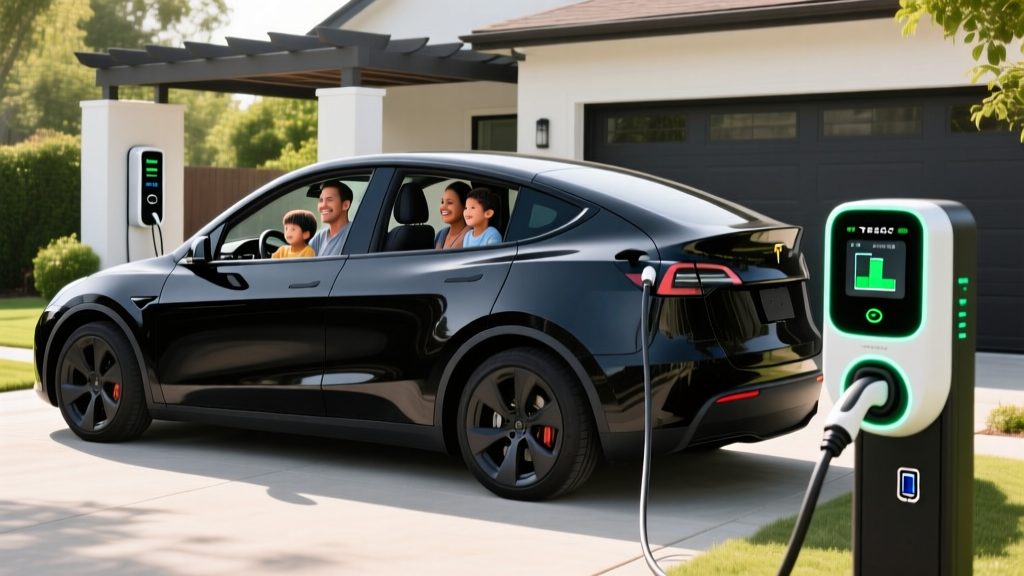
For home charging, Tesla's Wall Connector ($420) on a 60-amp circuit delivers 48 amps / 11.5 kW to the vehicle. That's roughly 44 miles of range per hour of charging, meaning an overnight session from 20% to 80% takes about 4 hours. Installation of a 240V/60A circuit typically runs $800-$2,000 depending on your electrical panel's capacity and the distance from panel to charger location. If your home has a 100-amp main panel, you may need a $1,500-$3,000 panel upgrade to 200 amps to support Level 2 charging alongside other household loads.
Performance, Drivetrain, and Ride Quality
The dual-motor all-wheel-drive powertrain produces 384 horsepower and delivers a 4.8-second 0-60 mph time — brisk for a family crossover and more than adequate for highway merging even with a full passenger load. The instant torque from the electric motors means you never feel underpowered, though the Performance trim (3.5-second 0-60) is no longer offered with the third-row option as of the 2025 model year refresh.
Ride quality is firm but controlled. Tesla retuned the suspension for the refreshed Model Y (sometimes called the "Juniper" update), adding frequency-selective dampers that absorb sharp impacts better than the pre-2025 version. Road noise is reduced thanks to acoustic glass and additional insulation, though it's still louder than a Hyundai Ioniq 5 or BMW iX at highway speeds. The low center of gravity from the under-floor battery pack keeps body roll minimal in corners, a benefit you'll notice on winding back roads even if you're not driving aggressively.
Interior, Third-Row Practicality, and Technology
This is where the 3-row Tesla Model Y faces its toughest scrutiny. The third-row seats are best suited for children under about 5'4" tall. Adult passengers in the third row will find their knees pressed into the second-row seatbacks, and the low floor (dictated by the battery pack underneath) forces a knees-up seating position that becomes uncomfortable after 15-20 minutes. The 26.5 inches of third-row legroom compares unfavorably to the Kia EV9 (32.0 inches) or Rivian R1S (34.4 inches).
Access to the third row requires folding and sliding the second-row bench, which is a two-step process that works reasonably well but takes longer than the one-touch tumble mechanisms in purpose-built three-row SUVs. ISOFIX/LATCH child-seat anchors are available on the second-row outboard seats but not the third row, limiting car-seat placement flexibility.
With the third row upright, cargo space shrinks to just 12.2 cubic feet — enough for a couple of grocery bags or a small stroller but not much else. Fold the third row flat (a 60/40 split) and you regain 30.2 cubic feet, which is adequate for a family road trip with five passengers. Fold everything and the 72.1 cubic feet of maximum cargo volume is competitive with midsize crossovers.
Technology highlights:
- 15.4-inch center touchscreen running Tesla's latest software with improved navigation, trip planning, and Supercharger routing
- 8-inch rear touchscreen for second-row passengers (controls climate, media, ventilation)
- Tesla Autopilot (SAE Level 2) standard — adaptive cruise, lane centering, automatic emergency braking
- Full Self-Driving (Supervised) available as a $8,000 option or $99/month subscription — still requires active driver supervision at all times
- Over-the-air updates continue to add features; Sentry Mode, Dashcam, and Dog Mode remain useful daily tools
- No Apple CarPlay or Android Auto — Tesla's native infotainment is the only option, though Bluetooth audio and Spotify/Tidal integration work well
Pricing, Trim Levels, and Federal Tax Credit Eligibility
The 3-row Tesla Model Y is available exclusively on the Long Range AWD trim. The third-row seat is a $2,000 factory option added at time of order, bringing the base MSRP to approximately $50,490 including destination. Tesla periodically adjusts pricing, so verify current figures on Tesla's configurator before ordering.
| Item | Cost |
|---|---|
| Base MSRP (Long Range AWD) | $48,490 |
| Third-Row Seat Option | +$2,000 |
| Destination Fee | Included |
| Paint (Solid Black — free; other colors $1,000-$2,500) | $0 - $2,500 |
| FSD (Supervised) Subscription or Purchase | $99/mo or $8,000 |
| As-Tested Price (typical configuration) | ~$52,500 |
| Federal Tax Credit (§30D) — if eligible | Up to $7,500 (point-of-sale) |
| Effective Price After Max Credit | ~$45,000 |
Federal tax credit eligibility is not guaranteed. Under the current IRS §30D rules, the $7,500 credit requires meeting all of the following criteria:
- MSRP cap: SUVs must be priced at or below $80,000 (Model Y qualifies)
- Buyer income cap: Modified AGI must not exceed $150,000 (single), $225,000 (head of household), or $300,000 (joint filers)
- Battery sourcing: A percentage of critical minerals must be sourced from the U.S. or free-trade-agreement countries, and battery components must be manufactured/assembled in North America — the split is $3,750 for minerals + $3,750 for components. Tesla's supply chain has been evolving, and eligibility can change month to month.
- Point-of-sale transfer: As of 2024+, you can transfer the credit to the dealer (Tesla) at purchase, reducing your out-of-pocket cost immediately rather than waiting for a tax refund.
Verify current eligibility at fueleconomy.gov and consult a tax professional before relying on the credit. Rules have changed multiple times since the Inflation Reduction Act passed, and they may shift again.
How It Stacks Up Against 3-Row EV Competitors
The 3-row Tesla Model Y occupies a unique niche: it's the most affordable and most efficient electric vehicle with any kind of third row, but it's also the smallest and least practical in terms of actual third-row usability. Here's how it compares to the key alternatives:
| Vehicle | EPA Range | 3rd-Row Legroom | Cargo (behind 3rd) | Base MSRP | Max DC Charge |
|---|---|---|---|---|---|
| Tesla Model Y LR AWD (7-seat) | 308 mi | 26.5 in | 12.2 cu ft | $50,490 | 250 kW |
| Kia EV9 Land AWD | 270 mi | 32.0 in | 20.2 cu ft | $64,900 | 236 kW |
| Rivian R1S Dual-Motor | 316 mi | 34.4 in | 18.0 cu ft | $75,900 | 200 kW |
| Hyundai Ioniq 9 (announced) | ~300 mi (est.) | TBD | TBD | ~$55,000 (est.) | TBD |
- Choose the 3-row Model Y if: you need occasional extra seats for small children, prioritize charging network access and efficiency, want the lowest price point, and rarely carry more than 5 passengers.
- Choose the Kia EV9 if: you regularly carry adults or older children in the third row, need more cargo space behind the third row, and are willing to pay ~$14,000 more for a purpose-built three-row platform.
- Choose the Rivian R1S if: you need genuine off-road capability, towing (7,700 lbs vs. Model Y's 3,500 lbs), and a usable adult-sized third row, and budget is less of a concern.
Pros, Cons, and Ownership Considerations
- Class-leading efficiency (111 MPGe)
- Access to Tesla Supercharger network (17,000+ stalls in North America)
- Lowest starting price of any 3-row EV
- Strong over-the-air update pipeline
- Competitive 0-60 performance for the segment
- Eligible for up to $7,500 federal credit (verify sourcing rules)
- Third row only usable for small children on short trips
- Minimal cargo space (12.2 cu ft) with third row up
- No Apple CarPlay or Android Auto
- Firm ride compared to body-on-frame SUVs
- Towing limited to 3,500 lbs
- Insurance premiums run 15-25% higher than comparable ICE crossovers
Ownership costs to budget for: Tesla's battery and drive unit warranty covers 8 years or 120,000 miles (whichever comes first) with a minimum 70% capacity retention guarantee. Real-world data from Tesla's fleet suggests the NMC pack in the Model Y degrades roughly 10-12% over the first 100,000 miles, with degradation slowing significantly after the initial break-in period. A full battery replacement out of warranty currently costs $12,000-$16,000, though this is rare before 200,000+ miles.
Frequently Asked Questions
Can adults fit in the 3-row Tesla Model Y's third seat?
Technically yes, but not comfortably. With 26.5 inches of legroom and a low floor creating a knees-up seating position, adults over about 5'4" will find the third row cramped within 15 minutes. It's best reserved for children under 12 or very short trips with flexible adults.
How much range do you lose with the 7-seat option?
The third-row hardware adds roughly 60-70 pounds, reducing EPA range by about 4-12 miles compared to the five-seat Long Range AWD (320 miles vs. ~308 miles). The bigger range impact comes from carrying seven passengers and their cargo, which can reduce real-world range by an additional 5-8%.
Does the 3-row Model Y qualify for the $7,500 federal EV tax credit?
It can, but eligibility depends on current battery-sourcing rules, your income, and the vehicle's MSRP. The Model Y is below the $80,000 SUV cap. Check fueleconomy.gov for the latest sourcing-status updates, and consult a tax professional to confirm your personal eligibility under IRS §30D.
What's the real-world range of the 3-row Model Y on a road trip?
On a highway road trip at 70-75 mph with mild weather, expect 255-275 miles before needing to charge. In cold weather (below freezing), plan for 210-245 miles. The Supercharger network's density means you'll typically find a charger every 150-180 miles on major interstate routes, so range is manageable with planning.
Is the 3-row Tesla Model Y worth buying over a Kia EV9?
If your budget is firm around $50,000 and you only need the extra seats occasionally for small children, the Model Y offers better efficiency and charging infrastructure. If you regularly carry six or seven people and need a genuinely usable third row with real cargo space behind it, the Kia EV9 is the better vehicle — but it costs roughly $14,000 more.
Can I install a home charger for the Model Y myself?
Tesla's Mobile Connector with a NEMA 14-50 plug can be used with a professionally installed 240V/50A outlet. The electrical work — running a new circuit from your panel, installing the outlet, and pulling permits — must be done by a licensed electrician. Budget $800-$2,000 for the installation, potentially more if your panel needs upgrading from 100A to 200A service.