Quick Verdict: Is a Used Model S Still a Smart Buy?
The Tesla Model S defined the luxury EV sedan segment, and on the used market, it remains one of the most compelling ways to get 350+ miles of range, brutal acceleration, and access to the Supercharger network without paying six figures. But buying a 2nd hand Tesla Model S in 2026 requires careful navigation: battery degradation varies wildly by model year and chemistry, the federal used-EV tax credit has strict eligibility gates, and older units with early-generation drive units carry known failure points.
This guide covers the refreshed (2021+) Model S primarily, with notes on pre-refresh (2012–2020) units where relevant. If you're cross-shopping a used Model S against a new Hyundai Ioniq 6, BMW i5, or Mercedes EQE, the data below will help you decide whether the savings justify the trade-offs.
Model S Generations at a Glance: What Changed and When
Tesla doesn't follow traditional model years the way legacy automakers do, but the Model S has gone through two major hardware generations that matter enormously on the used market:
| Generation | Years | Battery (usable kWh) | Chemistry | EPA Range (Long Range) | Platform |
|---|---|---|---|---|---|
| Pre-refresh | 2012–2020 | 75–100 kWh | NMC (varies by pack) | 259–370 mi | Original architecture |
| Refresh (Plaid era) | 2021–2025 | ~95 kWh usable | NMC | 402 mi (LR) / 396 mi (Plaid) | Palladium (new interior, tri-motor Plaid) |
The 2021 refresh brought a completely redesigned interior (yoke or conventional wheel, 17-inch landscape touchscreen, rear-seat screen, ventilated seats), a new heat pump for better cold-weather efficiency, structural battery pack changes, and the introduction of the tri-motor Plaid variant. If your budget allows, the refresh generation is significantly more desirable — not just for tech, but because the battery packs have less mileage and more remaining useful life.
Range, Efficiency, and the Real-World Reality
EPA estimated range: 402 miles
Real-world highway (70 mph, 72°F): ~320–340 miles
Real-world highway (32°F, winter): ~250–280 miles
City/mixed driving (mild weather): ~360–390 miles
The Model S's large battery and low drag coefficient (Cd 0.208) help it outperform most EVs in cold weather, but expect 25–35% range loss at freezing temperatures on the highway.
The EPA rates the 2023–2025 Model S Long Range at 402 miles on a full charge. The Plaid variant drops slightly to 396 miles (with 21-inch wheels; 19-inch wheels yield 359 miles). These are among the highest EPA range figures of any production EV sold in the US.
Efficiency lands at 120 MPGe combined (Long Range) and 116 MPGe (Plaid), which translates to roughly 28–30 kWh per 100 miles in mixed driving. On the highway at sustained speeds above 75 mph, consumption climbs to 32–35 kWh/100mi. The heat pump introduced in the refresh generation meaningfully reduces cabin-heating energy draw in winter — a measurable advantage over pre-2021 units that relied on resistive heating.
For pre-refresh models, real-world range depends heavily on the specific pack. The 100 kWh versions (2017–2020, badged as 100D or Long Range) typically deliver 280–320 real-world miles when new, with 10–20% degradation common at 80,000+ miles. Earlier 85 and 90 kWh packs degraded more noticeably, particularly the 90 kWh packs, which Tesla acknowledged had higher-than-expected degradation.
Charging Speed: DC Fast Charging and Home Setup
| Charging Level | Connector | Max Power (kW) | Speed (miles added) | Notes |
|---|---|---|---|---|
| Level 1 (120V) | NACS (native) | ~1.4 kW | ~3–5 mi/hr | Emergency/trickle only |
| Level 2 (240V) | NACS (native) | 11.5 kW (48A) | ~34–38 mi/hr | Full charge in ~10–12 hours |
| DC Fast (V3 Supercharger) | NACS (native) | 250 kW peak | ~200 mi in 15 min | 10–80% in ~27 min |
| DC Fast (V4 Supercharger) | NACS (native) | 250 kW (current vehicles) | Similar to V3 | V4 cabinet supports higher speeds for future vehicles |
| CCS adapter (DC) | CCS1 via adapter | ~150–170 kW typical | Varies | Requires Tesla CCS adapter; speed limited by adapter thermal limits |
The 2021+ Model S peaks at 250 kW on V3 and V4 Superchargers. The charge curve is fairly aggressive: it holds above 200 kW from roughly 10% to 35% state of charge, then tapers progressively. A 10–80% session takes approximately 25–30 minutes under ideal thermal conditions. Preconditioning the battery by navigating to a Supercharger in the nav system is essential — arriving at a charger with a cold battery can double your charging time.
At home on a Level 2 Wall Connector (48 amps / 11.5 kW), expect to add roughly 34–38 miles of range per hour. A full 10–100% charge takes about 10–12 hours. The onboard charger accepts up to 11.5 kW on the refresh generation; pre-2021 models vary (some older units max out at 7.2 kW single-charger or 11.5 kW with dual chargers).
A critical advantage: the Model S uses the NACS (North American Charging Standard) connector natively. As of 2026, this gives it the widest fast-charging access in North America — Tesla's Supercharger network exceeds 6,500 US stations, and no adapter is needed. If you need to use Electrify America or other CCS networks, Tesla sells an official CCS adapter, but speeds are typically capped around 150–170 kW due to the adapter's thermal limitations.
Performance: The Numbers That Still Shock
| Variant | Drivetrain | Horsepower | 0–60 mph | Top Speed |
|---|---|---|---|---|
| Long Range (2021+) | Dual-motor AWD | 670 hp | 3.1 sec | 155 mph |
| Plaid (2021+) | Tri-motor AWD | 1,020 hp | 1.99 sec | 200 mph |
| Long Range (2017–2020) | Dual-motor AWD | ~518 hp | 3.7–4.2 sec | 155 mph |
| P100D / Performance (2017–2020) | Dual-motor AWD | ~762 hp | 2.4–2.6 sec | 155 mph |
Even a base Long Range Model S from the refresh era hits 60 mph in 3.1 seconds — faster than most sports sedans costing twice as much. The Plaid's 1.99-second 0–60 time remains one of the quickest production-car sprints ever recorded, enabled by the tri-motor setup (one front, two rear) and carbon-sleeved rotors that prevent power fade at high RPM.
On the road, the Model S delivers its performance with eerie quietness. The adaptive air suspension (standard on all refresh models) provides a comfortable ride with adjustable height and damping. Pre-refresh models also have air suspension, but earlier versions had higher failure rates on the front struts — budget $2,000–$3,500 per corner if they need replacement out of warranty.
Interior, Cargo, and Daily Livability
The refresh Model S interior is a significant leap over the pre-2021 cabin. The 17-inch landscape touchscreen runs a full vehicle computer (AMD Ryzen processor), supporting Netflix, YouTube, and full web browsing while parked. A second 8-inch screen serves rear passengers for climate and media control. Ventilated front seats, a panoramic glass roof, and a 22-speaker audio system round out the premium experience.
Space and cargo figures:
- Front headroom: 38.8 inches
- Rear headroom: 38.1 inches
- Rear legroom: 35.4 inches
- Trunk (rear cargo): 28.0 cu ft (seats up) / 64.9 cu ft (seats folded)
- Frunk (front trunk): 3.1 cu ft
- Seating: 5 passengers standard (no third-row option on refresh)
The rear seat is adequate for adults on shorter trips, though the low floor (battery underneath) means a slightly knees-up seating position. For families, the cargo space is generous — the hatchback design gives far more practical volume than a traditional sedan trunk. The frunk is small but useful for charging cables.
Notable drawbacks: Build quality on the refresh generation improved significantly over earlier years, but panel gaps and minor interior trim issues are still reported on 2021–2022 units. The yoke steering wheel (optional, sometimes standard depending on build date) is polarizing — many owners swap it for the round wheel after purchase. There are no physical buttons for turn signals or wipers on the yoke, which frustrates some drivers.
Used Pricing and the Federal Tax Credit Picture
As of early 2026, used Model S pricing varies enormously based on model year, mileage, condition, and battery health:
| Model | Typical Used Price Range | Original MSRP (when new) | Depreciation from New |
|---|---|---|---|
| 2021–2023 Long Range | $48,000–$62,000 | $89,990–$94,990 | 35–47% |
| 2021–2023 Plaid | $58,000–$75,000 | $129,990–$135,990 | 42–55% |
| 2018–2020 Long Range / 100D | $28,000–$42,000 | $79,990–$99,990 | 55–65% |
| 2015–2017 (75D/90D/100D) | $18,000–$30,000 | $68,000–$135,000 | 65–80% |
The depreciation on a Model S is steep — which is great news for used buyers. A 2022 Long Range with 30,000 miles can be had for roughly half its original sticker, making it one of the best value-per-mile-of-range propositions in the used EV market.
- Credit amount: Up to $4,000 or 30% of the sale price, whichever is lower
- Vehicle price cap: Sale price must be $25,000 or less
- Vehicle age: Must be at least 2 model years old (so 2024 or older in 2026)
- Buyer income caps (MAGI): $75,000 single / $112,500 head of household / $150,000 joint
- Dealer requirement: Must be purchased from a licensed dealer (private sales don't qualify)
- Claim limit: One used-EV credit per buyer every 3 years
Source: IRS §25E guidelines. Rules subject to change; consult a tax professional.
Practical impact: Most used Model S units sell above the $25,000 cap, meaning the §25E credit is only available on older, higher-mileage 2015–2018 examples. If you find a qualifying unit under $25,000, the credit is $4,000 (30% of $25K = $7,500, but capped at $4,000). This effectively drops a $25,000 Model S to $21,000 — exceptional value.
Note: The §30D new-vehicle credit does NOT apply to used purchases. The used credit (§25E) is a separate provision with its own rules.
Battery Health, Warranty, and Long-Term Costs
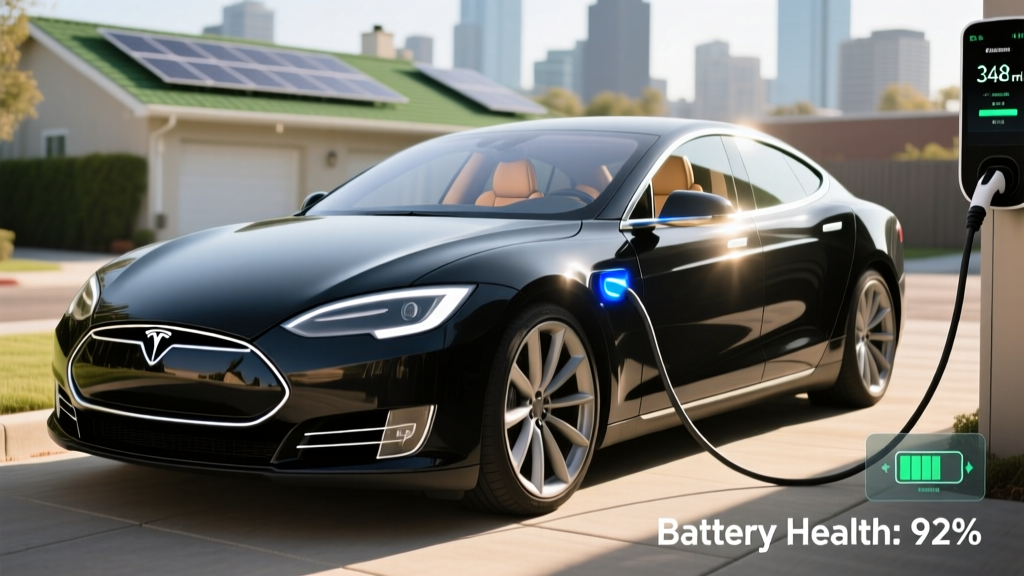
The single biggest concern when buying a 2nd hand Tesla Model S is battery state of health (SoH). Here's what the data tells us:
Battery warranty (new): Tesla covers the Model S battery and drive unit for 8 years / 150,000 miles (Long Range and Plaid), whichever comes first, with a minimum 70% capacity retention guarantee. For pre-refresh models, the warranty was 8 years / 150,000 miles (100D) or 8 years / 125,000 miles (earlier variants).
Degradation data: According to Tesla's own impact reports and third-party fleet data, the average Model S battery retains approximately 88–90% of its original capacity at 100,000 miles. The NMC chemistry used in all Model S variants degrades faster in the first 20,000–30,000 miles (typically 5–7% loss), then the curve flattens significantly. Units that were regularly charged to 100% and stored in hot climates show higher degradation.
What to check before buying:
- Request the battery health report from Tesla (available through service centers or via the Tesla app if the owner consents)
- Check the "rated range" at 100% SoC on the dashboard — compare it to the original EPA figure for that model year
- Look for battery replacement records (some high-mileage units had warranty replacements, which is actually a positive)
- Pre-refresh 85 kWh and 90 kWh packs are known for higher degradation — avoid unless heavily discounted
- Verify the 8-year battery warranty hasn't expired, or price in the risk of out-of-warranty replacement ($20,000–$28,000 for a refurbished pack)
Other ownership costs to budget for:
- Tires: The Model S is heavy (~4,500–4,800 lbs) and torquey. Expect tire replacement every 20,000–30,000 miles. A set of four 21-inch Michelin PS4S tires runs $1,400–$1,800 installed.
- Insurance: Model S insurance premiums run 20–40% higher than comparable ICE luxury sedans. Get quotes before purchasing.
- Air suspension: Out-of-warranty replacement is $2,000–$3,500 per strut. Common failure point on pre-2021 units above 80,000 miles.
- Drive unit: Early pre-refresh models (2012–2015) had higher drive unit failure rates. Later units are far more reliable, but a replacement runs $5,000–$8,000 out of warranty.
- Supercharging: Some older Model S vehicles came with free unlimited Supercharging that transfers to subsequent owners. This is a significant value-add — verify before purchase.
Autopilot, FSD, and Smart Driving Features
All Tesla driver-assistance features, including Full Self-Driving (Supervised), are SAE Level 2. The driver must remain fully attentive, keep hands on the wheel (or apply torque, depending on model year), and be prepared to take over at any moment. No Tesla vehicle sold to consumers is capable of autonomous (Level 4/5) driving.
Every Model S includes Basic Autopilot (Traffic-Aware Cruise Control and Autosteer) as standard. The optional Enhanced Autopilot ($6,000 when new) adds Navigate on Autopilot, Auto Lane Change, Autopark, and Summon. Full Self-Driving (Supervised), priced at $8,000–$12,000 depending on when it was purchased, includes all of the above plus traffic light/stop sign control and city street driving assistance.
On used models, FSD may or may not transfer. Tesla's policy has changed over time: generally, FSD purchased outright stays with the vehicle. FSD subscriptions do not transfer. Verify FSD status through the vehicle's software screen before buying.
In practice, Autopilot excels at highway cruising and reduces fatigue on long trips. FSD (Supervised) has improved substantially but still requires active monitoring — expect occasional disengagements in construction zones, complex intersections, and inclement weather. It's a convenience feature, not a chauffeur.
Pros, Cons, and Who Should Buy
✅ Pros
- Class-leading range (402 mi EPA on refresh LR)
- NACS native — full Supercharger access, no adapter needed
- Brutal performance even on base Long Range (3.1s 0–60)
- Massive depreciation = strong used value
- Over-the-air updates keep older cars gaining features
- Hatchback cargo practicality (28 cu ft rear + frunk)
- Strong battery warranty (8yr/150k mi) with good retention data
- Heat pump (refresh) improves cold-weather efficiency
❌ Cons
- 250 kW peak DC charging trails newer 800V rivals (Hyundai, Porsche, Lucid)
- Pre-refresh build quality and reliability inconsistent
- Expensive out-of-warranty repairs (suspension, drive unit, screen)
- High insurance premiums
- Rear seat comfort trails German luxury rivals (BMW i5, Mercedes EQE)
- No third-row option on refresh (pre-refresh had a tiny rear-facing seat)
- Yoke steering wheel not preferred by all drivers
- Used-EV tax credit rarely applies due to $25K price cap
Who the 2nd hand Tesla Model S suits best:
- Long-distance commuters who want 350+ real-world miles and Supercharger access for multi-state travel
- Performance sedan buyers who want sports-car acceleration with four doors and a hatchback
- Tech-forward owners who value OTA updates, the Supercharger ecosystem, and the large-screen infotainment experience
- Families of 4–5 who need cargo space and don't require a third row
Who should look elsewhere:
- Buyers on a tight repair budget considering pre-2018 models (out-of-warranty risk is real)
- Those who prioritize rear-seat luxury over performance (BMW i5, Mercedes EQE are more refined back there)
- Anyone who needs the fastest possible DC charging (800V vehicles like the Ioniq 5 or Taycan charge significantly faster)
How It Stacks Up Against Key Competitors
| Vehicle | Typical Used Price (2022–2023) | EPA Range | DC Fast Charge Peak | 0–60 mph |
|---|---|---|---|---|
| Tesla Model S LR (2022) | $50,000–$60,000 | 402 mi | 250 kW | 3.1 sec |
| Lucid Air Pure / Touring (2023) | $60,000–$78,000 | 419 mi (Pure+) | 200+ kW | 3.2 sec (Touring) |
| BMW i5 eDrive40 (2024) | $52,000–$62,000 | 295 mi | 205 kW | 5.7 sec |
| Mercedes EQE 350+ (2023) | $48,000–$58,000 | 305 mi | 170 kW | 6.2 sec |
| Porsche Taycan 4S (2022) | $62,000–$78,000 | 227 mi | 270 kW | 3.8 sec |
The Model S wins decisively on range, performance per dollar, and charging-network access. The Lucid Air offers more range and a more luxurious interior but costs more used and has a smaller service footprint. The BMW i5 and Mercedes EQE are more refined and better-built but sacrifice 100+ miles of range. The Taycan charges faster (800V architecture) but gives up enormous range and interior space.
Frequently Asked Questions
What is the real-world range of a used Tesla Model S?
A 2021+ Model S Long Range delivers approximately 320–340 real-world highway miles in mild weather, dropping to 250–280 miles in freezing temperatures. City and mixed driving can approach the EPA's 402-mile figure. Older pre-refresh models (100D, 2017–2020) typically deliver 260–310 real-world miles depending on battery degradation.
How fast does a used Model S charge at home and on the road?
On a DC fast charger (Tesla V3/V4 Supercharger), the refresh Model S peaks at 250 kW and charges from 10–80% in roughly 25–30 minutes. At home on a Level 2 Wall Connector (11.5 kW), it adds about 34–38 miles per hour, with a full charge taking 10–12 hours. Always precondition the battery before DC fast charging for optimal speed.
Does a used Tesla Model S qualify for any federal tax credit?
Possibly, but it's limited. The IRS §25E used-EV credit offers up to $4,000, but only on vehicles with a sale price of $25,000 or less. Most used Model S units sell above this threshold. If you find a qualifying older model (typically 2015–2018) under $25,000 from a licensed dealer, and your income is below the caps ($75K single / $150K joint), you can claim $4,000. The new-vehicle §30D credit does not apply to used purchases.
Is a used Model S worth buying vs. a new EV in 2026?
For the right buyer, yes. A 2022 Model S Long Range at $55,000 delivers 402 miles of range, 670 hp, Supercharger access, and premium tech — a combination no new EV under $70,000 matches. The trade-off is out-of-warranty repair risk (especially on pre-refresh units), higher insurance, and a charging speed that trails newer 800V platforms. If you can verify battery health, stay within the powertrain warranty window, and budget for tires and insurance, the value proposition is strong.
What should I check before buying a 2nd hand Tesla Model S?
Priority checks: (1) Battery health report and rated range at 100% SoC; (2) remaining battery/drive-unit warranty (8yr/150k mi from original in-service date); (3) service history for drive unit, air suspension, or screen replacements; (4) whether free Supercharging transfers with the vehicle (pre-2017 units); (5) FSD/Autopilot purchase status; (6) tire condition (replacement is expensive on this heavy, powerful car). A pre-purchase inspection at a Tesla service center is strongly recommended.
How long do Tesla Model S batteries last?
Tesla's fleet data and third-party studies indicate the average Model S battery retains 88–90% capacity at 100,000 miles. The NMC chemistry degrades most in the first 20,000–30,000 miles, then stabilizes. Many Model S vehicles have exceeded 200,000 miles on the original pack with 80–85% capacity remaining. The 8-year/150,000-mile warranty guarantees at least 70% retention, providing a solid floor.