The 2027 Toyota Highlander EV: Pricing, Incentives, and What It Really Costs to Own
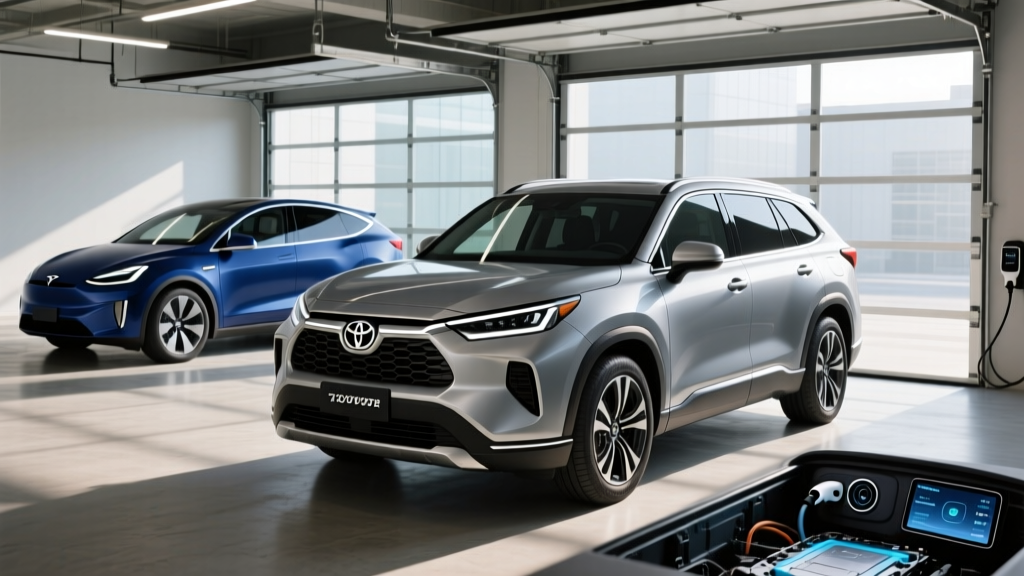
Toyota's first dedicated electric three-row SUV is generating serious interest among family EV shoppers, and for good reason: the Highlander nameplate carries decades of reliability reputation. But before you reserve one, the real question isn't just the sticker price — it's what you'll actually spend over five years of ownership after factoring in federal tax credits, charging costs, insurance premiums, and depreciation.
Because the 2027 Toyota Highlander EV is an announced model not yet on sale, all pricing, range, and battery figures below are based on Toyota's preliminary disclosures and industry estimates. Final MSRP and EPA certification will be confirmed closer to launch. Treat these numbers as planning baselines, not guarantees.
2027 Toyota Highlander EV — Preliminary Specs
| Est. Base MSRP | $48,000 – $52,000 (LE AWD) |
| Est. Top-Trim MSRP | $58,000 – $62,000 (Platinum AWD) |
| Battery (est.) | ~90–100 kWh usable, NMC chemistry |
| EPA Range (est.) | 280–320 miles |
| DC Fast Charge (peak) | ~150–175 kW (10–80% est. ~28–32 min) |
| Level 2 Charge | ~11 kW onboard charger |
| Horsepower (est.) | ~300–340 hp (dual-motor AWD) |
| 0–60 mph (est.) | ~6.0–6.5 seconds |
| Battery Warranty | 8 years / 100,000 miles (est.) |
| Connector | NACS (Tesla Supercharger compatible) |
Federal Tax Credit: Do You Qualify for Up to $7,500?
The IRS §30D Clean Vehicle Credit can knock up to $7,500 off the effective cost of the 2027 Highlander EV — and since 2024, buyers can transfer the credit to the dealer as a point-of-sale discount, meaning you don't need to wait until tax season to benefit. But eligibility is far from automatic. The rules have tightened significantly under the Inflation Reduction Act.
§30D Tax Credit Eligibility Checklist (2026 Rules)
- MSRP Cap: SUVs/pickups/vans must have an MSRP ≤ $80,000. The Highlander EV should clear this easily at all trims.
- Buyer Income Cap (Modified AGI): Married filing jointly: ≤ $300,000 · Head of household: ≤ $225,000 · Single/other: ≤ $150,000. You must fall under the cap in either the purchase year or the prior year.
- Battery Sourcing — Critical Minerals ($3,750 half): A required percentage of critical minerals must be extracted or processed in the US or a free-trade-agreement country (threshold increases annually; 80% for vehicles placed in service in 2027).
- Battery Sourcing — Components ($3,750 half): A required percentage of battery components must be manufactured or assembled in North America (100% for 2029+; 90% for 2027).
- Foreign Entity of Concern (FEOC) Exclusion: Vehicles with battery components from a FEOC (effective 2024) or critical minerals from a FEOC (effective 2025) are disqualified entirely.
- Point-of-Sale Transfer: You can assign the credit to the dealer at purchase for an immediate price reduction — but you must still meet income requirements, or you'll owe it back at tax time.
- One Credit Per Vehicle, Per Taxpayer: You can claim the credit once every three years for new EVs.
Source: IRS Clean Vehicle Tax Credits. Rules are subject to legislative change — verify eligibility with a tax professional before purchase.
The Toyota wildcard: Toyota has historically sourced battery cells from Panasonic (Japan) and other suppliers. Whether the 2027 Highlander EV's battery meets the increasingly strict North American component and critical-mineral thresholds will determine if buyers qualify for the full $7,500, a partial $3,750, or nothing at all. Toyota's North Carolina battery plant is ramping up production, which should improve eligibility — but this won't be confirmed until the EPA/IRS certifies the specific VIN configuration. Always check the fueleconomy.gov credit lookup for the exact trim before purchasing.
5-Year Total Cost of Ownership Breakdown
To understand the real financial picture, we modeled a 5-year / 75,000-mile ownership scenario for a 2027 Toyota Highlander EV (est. $50,000 MSRP LE AWD) against the current gas Highlander V6 (est. $42,000 MSRP). We assumed 15,000 miles/year, home Level 2 charging at $0.14/kWh (national average), and gas at $3.50/gallon.
| Category | Highlander EV (est.) | Highlander Gas V6 |
|---|---|---|
| Purchase Price (MSRP) | $50,000 | $42,000 |
| Federal Tax Credit (§30D) | –$7,500 (if eligible) | $0 |
| Effective Purchase Cost | $42,500 | $42,000 |
| Fuel/Energy (75k mi) | $3,150 | $9,643 |
| Maintenance (5 yr) | $1,200 | $3,500 |
| Insurance (5 yr) | $11,250 | $9,500 |
| Est. Depreciation (5 yr) | $22,500 | $18,900 |
| 5-Year Total Cost | $80,600 | $83,543 |
The EV wins on operating costs — dramatically on fuel and meaningfully on maintenance — but loses ground on insurance and depreciation. With the full $7,500 tax credit applied at point of sale, the five-year gap narrows to roughly $2,900 in the EV's favor. Without the credit, the gas Highlander is cheaper to own over five years by approximately $4,600.
Charging vs. Gas: The Per-Mile Math
Energy Cost Per Mile
| Highlander EV (est.) | ~3.2 kWh/mile (est. 95 MPGe combined) × $0.14/kWh = $0.042/mile |
| Highlander EV (DC fast charging at $0.40/kWh) | 3.2 kWh/mi × $0.40/kWh = $0.128/mile |
| Highlander Gas V6 | 24 MPG combined × $3.50/gal = $0.146/mile |
Annual fuel savings (15,000 mi, home charging): ~$1,560/year, or ~$7,800 over five years.
Home charging is where the economics work. At $0.14/kWh, the EV costs less than a third per mile compared to gas. But if you rely heavily on public DC fast charging at $0.35–$0.48/kWh, the savings shrink dramatically — and can even exceed gas costs in some regions. This is why home Level 2 access is practically a prerequisite for EV ownership economics to make sense.
Also factor in preconditioning: warming or cooling the battery before a DC fast charge session. Toyota's thermal management system should handle this, but preconditioning in cold weather can consume 3–5 kWh before you even start driving, effectively reducing your range that day.
Maintenance Savings: Where EVs Quietly Win
EVs eliminate the maintenance items that add up over years of gas-car ownership. No engine means no oil changes, no spark plugs, no timing belt, no transmission fluid, no exhaust system. The Highlander EV will still need tire rotations, cabin air filter replacements, brake fluid checks, and windshield washer fluid — but that's essentially it.
| Maintenance Item | Highlander EV | Highlander Gas |
|---|---|---|
| Oil changes (5 yr / 75k mi) | $0 | $750–$1,125 |
| Brake pad replacement | $0 (regen extends life) | $400–$700 |
| Transmission fluid | $0 | $200–$350 |
| Spark plugs / ignition | $0 | $300–$500 |
| Tire rotation & replacement | $800–$1,100 | $700–$900 |
| Cabin air filter / wipers / misc. | $400 | $400 |
| 5-Year Total (est.) | $1,200 | $3,500 |
Tire note: EVs are heavier and deliver instant torque, which accelerates tire wear. Expect to replace tires 10–20% sooner than on a gas equivalent. Budget for a set of four all-season or all-weather tires (~$800–$1,200 for a three-row SUV) once during the five-year window. The maintenance savings are real, but they're $2,000–$2,500 over five years — not the $5,000+ some marketing materials suggest.
Insurance Costs: The Uncomfortable Truth
EV insurance premiums are typically 15–25% higher than equivalent gas vehicles. For the Highlander EV, expect annual premiums in the range of $2,100–$2,400 (national average, varies heavily by state, driving record, and coverage level) compared to $1,800–$2,000 for the gas Highlander.
Why the premium?
- Higher repair costs: EV battery packs and power electronics are expensive to replace after collision damage. Even minor rear-end impacts can total an EV if the battery enclosure is compromised.
- Specialized repair network: Fewer body shops have high-voltage certification, limiting insurer repair options and driving up labor rates.
- Higher vehicle value: A $50,000 EV costs more to insure than a $42,000 gas SUV simply because the replacement cost is higher.
Shop quotes from at least three insurers before purchasing. Some carriers (GEICO, Progressive, State Farm) now offer specific EV discounts or bundling that can partially close the gap. Also check whether your state offers any insurance-related EV incentives — a few do, though they're rare.
Depreciation and Resale Value
This is where the ownership math gets complicated. EVs have historically depreciated faster than gas vehicles, though the gap has been narrowing as the market matures and battery longevity data improves.
Current EV depreciation trends (5-year):
- Average EV: 45–55% depreciation over 5 years
- Average gas SUV: 40–48% depreciation over 5 years
- Toyota gas vehicles: Typically 35–42% — Toyota's resale value is among the best in the industry
The gas Highlander holds its value exceptionally well — one of the best in the three-row SUV segment. The EV version faces headwinds: rapid technology advancement makes older EVs feel dated faster, battery degradation concerns linger in the used market, and Tesla price cuts have compressed used EV values broadly since 2023.
However, Toyota's brand equity and the Highlander nameplate could provide a resale floor that lesser-known EVs lack. If Toyota delivers a competitive battery warranty (8 years / 100,000 miles with ≥70% capacity retention is the industry standard) and the EV proves reliable, expect 5-year depreciation in the 42–50% range — still worse than the gas model, but better than EVs from less-established brands.
On a $50,000 purchase, 45% depreciation means losing $22,500 in value over five years. On the gas Highlander at $42,000 with 45% depreciation, you lose $18,900. That $3,600 gap is the single largest cost disadvantage for the EV.
State, Local, and Utility Incentives
Beyond the Federal Credit: Regional Incentives Vary Widely
State, local, and utility incentives can stack on top of the federal §30D credit, but they vary enormously by jurisdiction and change frequently. Examples of what's available in some regions:
- State rebates: California (CVRP, up to $2,000 for income-qualified buyers), Colorado (up to $5,000 tax credit), Massachusetts (MOR-EV, up to $3,500), New York (Drive Clean, up to $2,000)
- Utility rebates: Many electric utilities offer $500–$1,500 rebates for purchasing an EV and/or installing a home Level 2 charger. Some offer time-of-use (TOU) rates that cut charging costs by 30–50% if you charge overnight.
- HOV lane access: States like California, Colorado, Virginia, and Maryland offer single-occupant HOV lane access for EVs — a significant commute-time savings with real dollar value.
- Registration fee offsets: Some states waive or reduce EV registration fees; others actually charge higher fees (e.g., Ohio's $200 annual EV fee) to compensate for lost gas tax revenue.
Check your state's energy office and local utility for current programs. The AFDC State Laws and Incentives database maintains a comprehensive, regularly updated list.
Home Charging Setup: The Hidden Upfront Cost
To capture the full fuel-cost savings, you'll need a Level 2 home charger. Here's what to budget:
| Item | Cost Range |
|---|---|
| Level 2 charger (40–48A, hardwired) | $400 – $700 |
| Electrician labor (240V circuit run) | $500 – $2,000 |
| Electrical permit | $50 – $200 |
| Panel upgrade (if needed: 100A → 200A) | $1,500 – $3,500 |
| Total (no panel upgrade) | $950 – $2,900 |
| Total (with panel upgrade) | $2,450 – $6,400 |
At 11 kW onboard charging, the Highlander EV should add roughly 25–30 miles of range per hour on Level 2. An overnight charge (8 hours) would replenish 200–240 miles — more than enough for most daily driving. Always have a licensed electrician assess your panel capacity before committing to a charger purchase.
Decision Framework: Should You Buy the 2027 Highlander EV?
Choose the Highlander EV If:
- You qualify for the full $7,500 federal tax credit (income, MSRP, and battery sourcing all check out)
- You can install a Level 2 home charger and will do 80%+ of charging at home
- You drive 12,000–18,000 miles/year (high mileage amplifies fuel savings)
- You live in a state with additional rebates or HOV lane access
- You plan to keep the vehicle 7+ years (amortizes the depreciation hit)
- You value instant torque, quiet operation, and zero tailpipe emissions
Choose the Gas Highlander (or a Hybrid) If:
- You don't qualify for the federal tax credit (income too high, or battery sourcing fails)
- You can't charge at home (apartment, street parking, no garage access)
- You regularly tow heavy loads (towing slashes EV range by 30–50%)
- You drive less than 8,000 miles/year (fuel savings won't offset higher purchase/insurance costs)
- You plan to sell or trade within 3 years (depreciation will hurt more)
- You frequently drive in extreme cold and rural areas with sparse charging infrastructure
Frequently Asked Questions
How much does it really cost to own the 2027 Toyota Highlander EV over 5 years?
With the full $7,500 federal tax credit, home charging, and average insurance, our model estimates roughly $80,600 over 5 years / 75,000 miles. Without the tax credit, that jumps to ~$88,100. The gas Highlander comes in around $83,500. The EV wins if you get the credit and charge at home; the gas model wins otherwise.
Do I qualify for the $7,500 federal EV tax credit on the Highlander EV?
Maybe. You must meet income caps (≤$300k married filing jointly, ≤$150k single), the vehicle MSRP must be ≤$80,000 (likely fine for the Highlander), and the battery must meet critical-mineral and component-sourcing thresholds that tighten each year. Toyota's specific battery supply chain will determine eligibility — check fueleconomy.gov for the certified credit amount on the exact trim before purchasing. Consult a tax professional for your personal situation.
How much do I save on fuel and maintenance compared to the gas Highlander?
With home charging at $0.14/kWh, expect to save roughly $1,560/year on fuel (~$7,800 over 5 years). Maintenance savings run about $2,000–$2,500 over 5 years, primarily from eliminated oil changes, longer brake pad life (regenerative braking reduces wear), and no transmission or exhaust service. Combined, that's approximately $10,000 in operating savings over five years.
Are EVs more expensive to insure than gas cars?
Yes, typically 15–25% more expensive. For a three-row SUV like the Highlander, expect annual premiums around $2,100–$2,400 for the EV versus $1,800–$2,000 for the gas version. Higher repair costs, specialized body shop requirements, and higher vehicle values drive the difference. Always get insurance quotes before purchasing to budget accurately.
How well do EVs hold their resale value?
Average EVs depreciate 45–55% over five years, worse than the average gas SUV (40–48%). However, Toyota's brand reputation and the Highlander nameplate may help the EV retain value better than lesser-known electric SUVs. Expect 42–50% depreciation — roughly 5–10 points worse than the gas Highlander, which is one of the best-retained SUVs on the market. Plan to hold the vehicle longer if possible to amortize this cost.
Will the 2027 Highlander EV use NACS or CCS for charging?
Toyota has committed to adopting the NACS (North American Charging Standard) connector across its EV lineup, giving the Highlander EV access to Tesla's Supercharger network — the largest and most reliable DC fast-charging network in North America. This is a significant practical advantage over CCS-only vehicles, particularly for road trips.