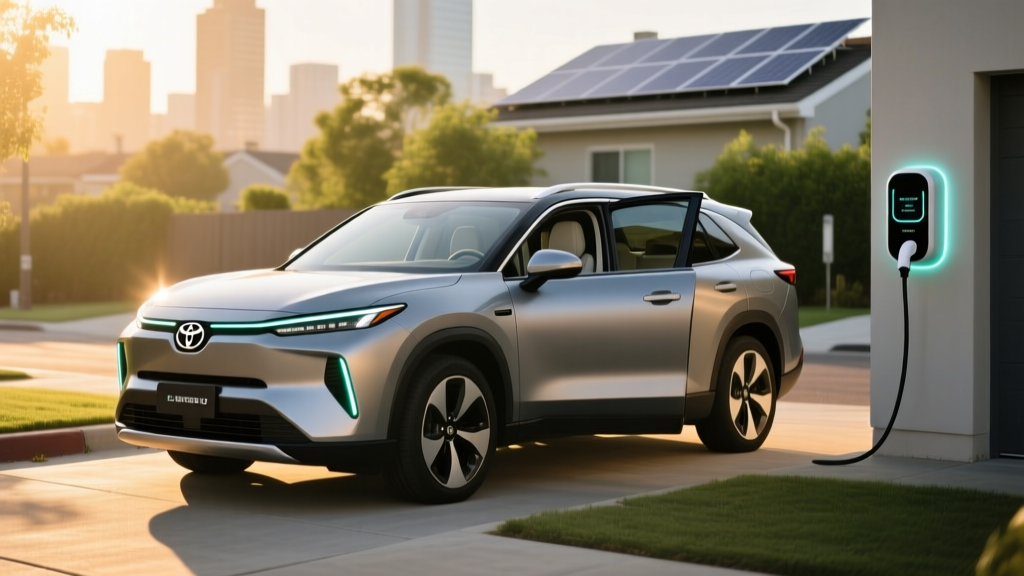
Toyota has confirmed a three-row electric SUV is coming to its US lineup, and all signs point to the 2027 Toyota Highlander BEV as the badge that will carry it. Built on an evolved version of Toyota's e-TNGA platform — the same architecture underpinning the bZ4X but stretched and re-engineered for a larger vehicle — the electric Highlander aims to fill a gap Toyota has left open since the RAV4 Prime: a mainstream, family-sized plug-in that doesn't force buyers into the luxury segment.
Because the 2027 Toyota Highlander BEV is still in pre-production as of early 2026, the figures below are based on Toyota's official teaser disclosures, supply-chain filings, and informed projections from comparable e-TNGA and competing three-row EVs. We'll flag every number as estimated or confirmed and update this profile as Toyota releases final specs closer to the on-sale date.
Projected Specs at a Glance
| Attribute | Estimated / Confirmed |
|---|---|
| EPA Range | ~300–320 mi (est., FWD); ~280–295 mi (est., AWD) |
| Battery Capacity | ~95–100 kWh usable (est., NMC lithium-ion) |
| Peak DC Fast Charge | ~175–200 kW (est.) |
| 10–80% DC Charge Time | ~28–32 min (est.) |
| Level 2 Home Charge Rate | 11.5 kW (~35 mi/hr added) |
| Drivetrain | FWD single-motor / AWD dual-motor |
| Horsepower | ~280 hp (FWD est.) / ~340 hp (AWD est.) |
| 0–60 mph | ~6.5 sec (AWD est.) |
| MPGe (combined) | ~90–95 MPGe (est.) |
| Seating | 7-passenger (2-3-2) or optional 6-passenger (2-2-2) |
| Cargo (behind 3rd row) | ~16 cu ft (est.) |
| Cargo (max, seats folded) | ~78 cu ft (est.) |
| Towing Capacity | ~3,500 lbs (est.) |
| Base MSRP | ~$48,000–$52,000 (est.) |
| Battery Warranty | 8 yr / 100,000 mi (confirmed Toyota standard) |
Range and Efficiency: What the EPA Sticker Won't Tell You
EPA estimate: ~300–320 mi (FWD), ~280–295 mi (AWD)
Real-world expectation: Expect 250–275 mi on sustained highway driving at 70+ mph. In freezing temperatures (below 32°F), plan for a 20–30% reduction — roughly 210–240 mi for the AWD variant. City/regenerative driving will track closer to or slightly above the EPA sticker.
Toyota has historically been conservative with EPA range claims — the bZ4X's real-world highway range fell notably short of its sticker, a lesson the company has acknowledged publicly. For the 2027 Highlander BEV, Toyota is expected to pair the larger ~95–100 kWh NMC battery pack with a more efficient heat-pump thermal management system and improved inverter logic. NMC chemistry was chosen over LFP for this application because the three-row platform demands higher energy density to keep pack weight manageable while still clearing 300 miles.
Efficiency should land around 90–95 MPGe combined, or roughly 33–35 kWh per 100 miles. That puts the Highlander BEV in the same efficiency neighborhood as the Hyundai Ioniq 9 and slightly behind the more aerodynamic Kia EV9, which benefits from a boxier-but-smoother underbody. For a three-row family hauler weighing over 5,000 lbs, that's respectable — but buyers who prioritize max range over seating capacity will still find longer-legged options in two-row SUVs.
Charging Speed: DC Fast, Level 2, and the Curve Reality
Charging is where three-row EV buyers often face unpleasant surprises. Here's what we project for the Highlander BEV:
| Charging Level | Power / Rate | Miles Added per Hour | Notes |
|---|---|---|---|
| Level 1 (120V household) | ~1.4 kW | ~4 mi/hr | Emergency/trickle only; ~75 hr for full charge |
| Level 2 (240V home, 48A) | 11.5 kW | ~35 mi/hr | Full charge in ~9 hours; ideal for overnight |
| DC Fast Charge (peak) | ~175–200 kW | ~180 mi in 15 min (est.) | Peak rate to ~55% SoC; tapers significantly above 80% |
The critical detail for road-trippers: the 175–200 kW peak rate is not sustained. Like nearly all NMC-based EVs, the Highlander BEV's charge curve will taper as the battery warms and fills. Expect the 10–80% session to take roughly 28–32 minutes at a capable 350 kW station (such as Electrify America or Tesla Supercharger with Magic Dock). Above 80% state of charge (SoC), speeds drop sharply — often below 50 kW — to protect battery longevity. If you're planning a 600-mile holiday drive, budget two 30-minute stops rather than one quick top-off.
Toyota has confirmed the Highlander BEV will ship with a NACS (North American Charging Standard) port, granting native access to Tesla's Supercharger network — currently the most reliable DC fast-charging infrastructure in the US. A CCS adapter will not be needed.
Performance and Drivetrain
Toyota is expected to offer the 2027 Highlander BEV in two drivetrain configurations:
- FWD (single rear-mounted motor): ~280 hp, targeting max efficiency and range. 0–60 mph in approximately 7.2 seconds.
- AWD (dual-motor): ~340 hp combined, with torque-vectoring rear motor. 0–60 mph in approximately 6.5 seconds. Adds roughly $3,000–$4,000 to MSRP and costs ~20 miles of range.
Neither configuration will be a performance SUV — that's not the Highlander's mission. The AWD variant's 6.5-second sprint is adequate for highway merging and confident passing, and the instant torque delivery makes it feel quicker than the number suggests around town. Toyota's eAxle system on the rear motor provides reasonable traction in snow and rain, though this is not a dedicated off-roader like a 4Runner. Towing capacity is estimated at 3,500 lbs — enough for a small boat or light camper, but not a large travel trailer.
Interior, Cargo, and Tech
The Highlander BEV's skateboard-style platform allows a flat floor and a slightly longer wheelbase than the outgoing gas Highlander, translating to improved third-row legroom. Toyota has teased a 14-inch central touchscreen running the latest Toyota Audio Multimedia system with wireless Apple CarPlay and Android Auto, a 12.3-inch digital instrument cluster, and available heads-up display.
Estimated interior dimensions:
- Front legroom: ~42.0 in
- Second-row legroom: ~39.5 in
- Third-row legroom: ~33.0 in (improved over gas model's ~29.5 in)
- Cargo behind 3rd row: ~16 cu ft
- Cargo behind 2nd row: ~45 cu ft
- Max cargo (all rear seats folded): ~78 cu ft
On the driver-assistance front, the Highlander BEV will come standard with Toyota Safety Sense 4.0 (TSS 4.0), which includes adaptive cruise control, lane-centering, automatic emergency braking with pedestrian detection, and blind-spot monitoring. Toyota's Advanced Drive system — a hands-on-wheel Level 2 highway assist — will be available on upper trims, offering lane-change assist and conditional hands-off driving in stop-and-go traffic. This remains an SAE Level 2 system: the driver must remain attentive and is legally responsible for the vehicle at all times.
Notable drawbacks: The third row, while improved, still won't comfortably seat adults on long trips — a limitation shared with nearly every three-row midsize SUV. The ~16 cu ft of cargo space behind the third row is tight for a family road trip with all seats occupied. And the projected 175–200 kW peak charging speed, while adequate, trails the 800V architectures of the Hyundai Ioniq 9 and Kia EV9, which can sustain 240+ kW.
Pricing, Trims, and Federal Tax Credit
| Trim | Est. MSRP | Est. After §30D Credit |
|---|---|---|
| XLE (FWD) | ~$48,000 | ~$40,500* |
| XLE (AWD) | ~$52,000 | ~$44,500* |
| Limited (AWD) | ~$56,000 | ~$48,500* |
| Platinum (AWD) | ~$60,000 | ~$52,500* |
*Tax credit figures assume full $7,500 eligibility under IRS §30D. Eligibility depends on multiple factors that change frequently:
- MSRP cap: SUVs/vans must be ≤$80,000 — the Highlander BEV clears this comfortably.
- Buyer income cap: Modified AGI ≤$150,000 (single) / ≤$300,000 (joint). Exceed these and the credit phases out.
- Battery sourcing: Critical minerals and battery components must meet escalating domestic-content thresholds. For 2027, the requirements are stringent — Toyota's supply chain is still ramping North American battery production through its NC-SAM joint venture. Confirm eligibility at the point of sale before committing.
- Point-of-sale transfer: As of 2024+, buyers can transfer the credit to the dealer for an immediate price reduction, rather than waiting to claim it on their tax return.
The Highlander BEV's projected $48,000 starting price positions it below the Kia EV9 (~$55,000 base) and the Hyundai Ioniq 9 (~$56,000 base), though those rivals offer more standard range and faster charging. Toyota is banking on brand loyalty, dealer network trust, and Toyota's reputation for long-term reliability to close the gap.
How It Stacks Up Against Key Competitors
| Spec | 2027 Toyota Highlander BEV (est.) | 2026 Kia EV9 (AWD) | 2026 Hyundai Ioniq 9 (AWD) |
|---|---|---|---|
| EPA Range | ~280–295 mi | 270–300 mi | ~300–320 mi |
| Battery | ~95–100 kWh (NMC) | 100 kWh (NMC) | 110.3 kWh (NMC) |
| Peak DC Charge | ~175–200 kW | ~235 kW (800V) | ~240 kW (800V) |
| 10–80% Time | ~28–32 min | ~24 min | ~24 min |
| 0–60 mph | ~6.5 sec | ~5.0 sec | ~5.2 sec |
| Base MSRP | ~$48,000 | ~$55,000 | ~$56,000 |
| 3rd-Row Legroom | ~33.0 in | 32.0 in | ~33.5 in |
Choose the 2027 Toyota Highlander BEV if: You're a current Toyota owner who values dealer familiarity, long-term reliability data, and a lower entry price — and you don't road-trip frequently enough for 15-minute charging to matter.
Choose the Kia EV9 or Hyundai Ioniq 9 if: You take regular road trips and want the fastest possible DC charging (800V architecture), more horsepower, or a more distinctive design. Both also offer vehicle-to-load (V2L) capability for powering devices from the battery.
Warranty and Ownership
Toyota has confirmed its standard electrified-vehicle warranty will apply to the Highlander BEV:
- Battery: 8 years / 100,000 miles (capacity retention threshold: expected ≥70%)
- Powertrain (eAxle, inverter): 8 years / 100,000 miles
- Bumper-to-bumper: 3 years / 36,000 miles
- Complimentary maintenance: 2 years / 25,000 miles (Toyota Care)
Toyota's battery degradation track record with its hybrids is among the best in the industry. While the bZ4X had early teething issues with charging consistency, the company has since issued software updates and extended warranty coverage on affected units. The Highlander BEV should benefit from those lessons, though we won't have real-world degradation data until owners accumulate mileage post-launch.
Pros and Cons
Pros
- Projected sub-$50K starting price undercuts EV9 and Ioniq 9
- Native NACS port — no adapter needed at Tesla Superchargers
- Toyota's reliability reputation and massive dealer network
- Improved third-row space vs. gas Highlander
- Standard TSS 4.0 safety suite
- Heat pump standard for better cold-weather efficiency
Cons
- Peak DC charging (~200 kW) trails 800V competitors by ~40 kW
- AWD 0–60 of ~6.5 sec feels leisurely vs. EV9's 5.0 sec
- Cargo behind 3rd row is tight at ~16 cu ft
- No confirmed V2L (vehicle-to-load) capability at launch
- Federal tax credit eligibility depends on evolving battery-sourcing rules
- Still 12+ months from delivery — specs may shift
Who the 2027 Highlander BEV Is For
This EV is purpose-built for families who need three rows, charge primarily at home, and value Toyota's ownership experience. If your daily routine involves school drop-offs, grocery runs, and a 30–50 mile round-trip commute — and you can install a Level 2 charger at home — the Highlander BEV will cover 95% of your driving without a drop of fuel. The ~300-mile range handles weekend trips within a 250-mile radius comfortably.
It's less ideal for frequent long-distance road-trippers who want the shortest possible charging stops (look at the EV9 or Ioniq 9), or for buyers who need serious towing capacity (consider a plug-in hybrid or body-on-frame EV truck). It's also not the right pick if you need an EV now — with deliveries not expected until late 2027 or early 2028, the Highlander BEV is a wait-and-see proposition.
Frequently Asked Questions
What is the real-world range of the 2027 Toyota Highlander BEV?
Based on projected specs, expect ~250–275 miles in real-world highway driving for the AWD variant, and ~210–240 miles in freezing winter conditions. The EPA sticker should land around 280–320 miles depending on drivetrain, but sustained 70+ mph speeds and cold temperatures reduce range by 15–30%.
How fast does the Highlander BEV charge at home and on the road?
At home on a 240V Level 2 charger (48A / 11.5 kW), you'll add roughly 35 miles of range per hour — enough for a full overnight charge in about 9 hours. On a DC fast charger, the estimated 175–200 kW peak rate delivers a 10–80% charge in approximately 28–32 minutes, though the rate tapers significantly above 80% SoC.
How much does the 2027 Highlander BEV cost after tax credits?
The estimated starting MSRP is ~$48,000 for the FWD XLE trim. If you qualify for the full $7,500 federal §30D credit (income caps, MSRP caps, and battery-sourcing rules all apply), the effective price could drop to approximately $40,500. Higher trims will range from ~$52,000 to ~$60,000 before credits.
Does it qualify for the $7,500 federal EV tax credit?
It's too early to confirm with certainty. The Highlander BEV clears the $80,000 SUV MSRP cap. However, §30D eligibility also depends on your income (≤$300,000 joint / ≤$150,000 single), and on Toyota's battery-critical-mineral and component sourcing meeting 2027 thresholds. Toyota's NC-SAM battery plant is ramping domestic production, but final eligibility won't be confirmed until closer to launch. Always verify at the point of sale and consult a tax professional.
Is the 2027 Highlander BEV worth buying vs. the Kia EV9 or Hyundai Ioniq 9?
If price, Toyota dealer trust, and long-term reliability are your top priorities, and you don't need the fastest DC charging, the Highlander BEV is a compelling option — especially at a ~$5,000–$8,000 lower starting price. If you road-trip frequently and want 800V ultra-fast charging, more power, or V2L capability, the EV9 and Ioniq 9 currently hold the edge.
When can I buy the 2027 Toyota Highlander BEV?
Toyota has confirmed a three-row BEV for the US market but has not announced an exact on-sale date. Based on typical Toyota product timelines and the model-year designation, expect order books to open in late 2027 with deliveries extending into early 2028. Reservations and deposit details have not yet been published.
Will the Highlander BEV have a frunk (front trunk)?
Toyota has not confirmed frunk dimensions, but the e-TNGA platform's packaging typically yields a modest front storage area. Expect a small compartment suitable for charging cables and a bag or two — not the deep frunk you'd find in a Ford F-150 Lightning or Rivian.
All specifications in this article are projected or estimated based on available information as of early 2026. Final EPA range, pricing, tax-credit eligibility, and feature availability will be confirmed by Toyota closer to launch. We will update this profile as official data becomes available. For current federal EV tax credit rules, consult IRS.gov. For safety ratings as they become available, check NHTSA and IIHS.