Toyota's electric three-row SUV ambitions are crystallizing in the 2027 Toyota bZ Highlander — a battery-electric successor-in-spirit to one of America's best-selling family haulers. Announced as part of Toyota's expanded bZ ("beyond Zero") lineup, the bZ Highlander aims to fill a gap that has frustrated EV-shopping families: a mainstream, three-row electric SUV with genuine cargo versatility and Toyota's reputation for long-term reliability.
As of this writing in mid-2026, the bZ Highlander has been officially announced but is not yet available for purchase. Toyota has shared preliminary specifications and design direction, with production expected to begin at the Georgetown, Kentucky plant in late 2026 for the 2027 model year. Below, we break down everything confirmed so far, where specs remain preliminary, and what real buyers should expect when this SUV reaches dealers.
Estimated Range, Battery, and Efficiency
The 2027 bZ Highlander is expected to ship with a ~90 kWh usable battery pack using lithium-ion NMC (nickel manganese cobalt) chemistry — a choice that prioritizes energy density over the LFP (lithium iron phosphate) chemistry found in some standard-range competitors. Toyota has not confirmed whether an LFP variant will follow, though the brand has signaled openness to LFP for lower-trim, lower-cost models in its broader EV portfolio.
Toyota targets an EPA-estimated 300–320 miles of range for the single-motor FWD configuration, with dual-motor AWD variants expected at approximately 280–295 miles EPA. In real-world driving, expect ~250–275 miles on highway-heavy road trips at 70–75 mph, and potentially 220–240 miles in sustained cold weather (below 30°F) without preconditioning. Three-row SUVs carry more mass and frontal area, both of which work against highway efficiency.
| Spec | FWD (Est.) | AWD (Est.) |
|---|---|---|
| Battery (usable) | ~90 kWh, NMC | ~90 kWh, NMC |
| EPA Range | 300–320 mi | 280–295 mi |
| Efficiency | ~98 MPGe / 34 kWh/100mi | ~92 MPGe / 36 kWh/100mi |
| Horsepower | ~220 hp | ~340 hp |
| 0–60 mph | ~7.5 sec | ~5.5 sec |
| Max DC Charge Rate | ~150 kW | ~150 kW |
| 10–80% DCFC Time | ~30 min | ~30 min |
For efficiency context, a 34–36 kWh/100mi consumption figure is competitive with the Kia EV9 but trails the more aerodynamically optimized Tesla Model X. Families doing mostly suburban and school-run driving at lower speeds will see better real-world numbers — potentially approaching or exceeding EPA estimates in stop-and-go conditions where regenerative braking recaptures energy.
Charging Speed: DC Fast and Home Level 2
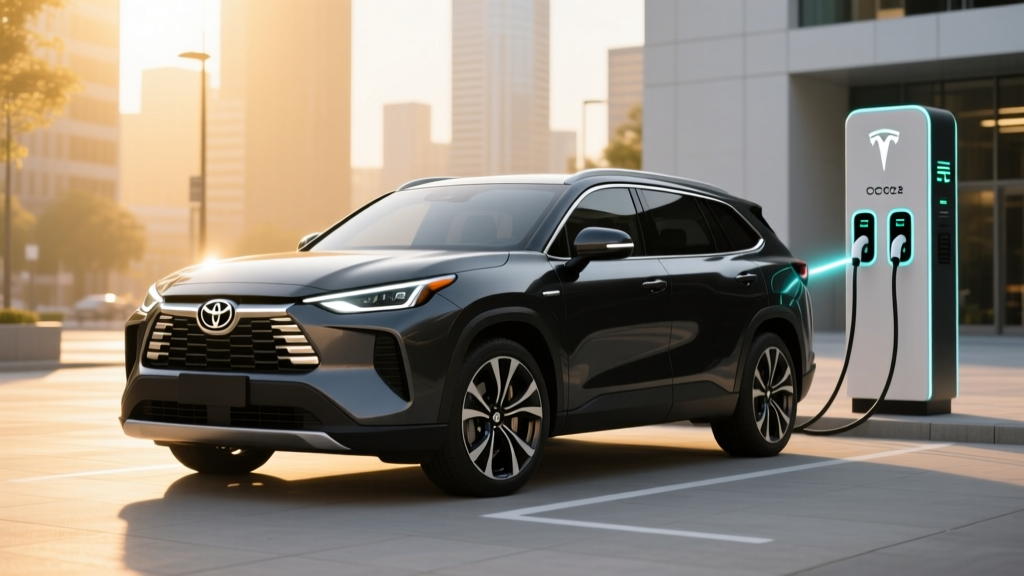
Toyota has confirmed the bZ Highlander will support DC fast charging at up to 150 kW via a CCS1 connector (with NACS adapter compatibility for Tesla Supercharger access). This is a meaningful improvement over the bZ4X's widely criticized ~100 kW peak charge rate, which was a significant pain point for early Toyota EV adopters.
| Level | Power | Miles Added per Hour | Typical Use |
|---|---|---|---|
| Level 1 (120V) | ~1.4 kW | ~4–5 mi/hr | Emergency / overnight trickle |
| Level 2 (240V, 32A) | ~7.7 kW | ~22–25 mi/hr | Home / workplace charging |
| Level 2 (240V, 48A) | ~11.5 kW | ~33–37 mi/hr | Home w/ higher-amperage circuit |
| DC Fast Charge | Up to 150 kW | ~180 mi in 30 min (10–80%) | Road trips, public stations |
Charging curve reality: The 150 kW peak rate will not be sustained across the entire charge session. Expect peak power between roughly 10–40% state of charge (SoC), tapering to ~100 kW by 60% and dropping further above 80%. The 30-minute 10–80% estimate assumes a preconditioned battery at a station capable of delivering the full 150 kW — conditions you won't always find at older Electrify America or EVgo stalls limited to 50–100 kW.
For home charging, a 48-amp Level 2 wallbox on a 60-amp circuit will fully recharge the ~90 kWh pack in roughly 8–9 hours, ideal for overnight replenishment. Budget $600–$1,200 for a quality Level 2 charger (e.g., ChargePoint Home Flex, Emporia V2) and $800–$2,500 for professional installation depending on your electrical panel's capacity. A 200-amp panel upgrade, if needed, can add $1,500–$3,000.
Performance and Drivetrain
The bZ Highlander will offer two drivetrain configurations:
- Single-motor FWD: Approximately 220 horsepower, targeting efficiency and maximizing range. The 0–60 mph time of ~7.5 seconds is adequate for family hauling but won't win drag races.
- Dual-motor AWD: Approximately 340 horsepower with a ~5.5-second 0–60 mph time. This variant sacrifices ~20–25 miles of range for all-weather traction and stronger acceleration — a worthwhile trade for buyers in snow-belt states.
Toyota has confirmed the bZ Highlander will feature a heat pump as standard equipment across trims, which is critical for maintaining cabin heating efficiency in cold weather without gutting range. The bZ4X's heat pump implementation was praised, and we expect similar or improved thermal management here.
Towing capacity is estimated at 3,500–4,000 pounds for the AWD variant — sufficient for a small boat trailer or lightweight camper but not competitive with the Rivian R1S (7,700 lb) or even the gas Highlander's 5,000-lb rating. If towing is a priority, this EV may not be your best fit.
Pricing, Trims, and Federal Tax Credit Eligibility
Toyota has not released official MSRP figures, but industry analysis and positioning relative to the Kia EV9 and Hyundai Ioniq 9 suggest the following pricing structure:
| Trim | Est. MSRP | Drivetrain | Under §30D MSRP Cap? |
|---|---|---|---|
| XLE (FWD) | ~$47,000 | Single-motor FWD | Yes ($80,000 SUV cap) |
| XLE (AWD) | ~$49,500 | Dual-motor AWD | Yes |
| Limited (AWD) | ~$55,000 | Dual-motor AWD | Yes |
| Platinum (AWD) | ~$59,000 | Dual-motor AWD | Yes |
Federal tax credit (§30D) eligibility is the critical question for buyers. Under current IRS rules, the bZ Highlander must clear three hurdles:
- MSRP cap: SUVs must be priced at or below $80,000. All estimated trims clear this comfortably.
- Buyer income cap: Modified adjusted gross income must not exceed $150,000 (single), $225,000 (head of household), or $300,000 (joint filers).
- Battery sourcing requirements: At least 80% of critical minerals must be sourced from the U.S. or free-trade-agreement partners, and 100% of battery components must be manufactured or assembled in North America. Toyota's Kentucky production plan and supply-chain announcements suggest compliance, but final determination rests with the IRS and may vary by build date.
If all requirements are met, qualifying buyers can claim up to $7,500 — and since 2024, this can be transferred to the dealer as a point-of-sale discount, effectively reducing your purchase price at signing. We recommend confirming eligibility with a tax professional before relying on the credit in your budget.
Interior Space, Cargo, and Family Practicality
The bZ Highlander is built on Toyota's e-TNGA platform, stretched to accommodate three rows. Preliminary interior dimensions suggest:
- First-row legroom: ~42 inches
- Second-row legroom: ~38 inches (sliding second row expected)
- Third-row legroom: ~30 inches — usable for children or short-trip adults, but tight for long journeys
- Cargo behind third row: ~18–20 cu ft
- Cargo behind second row (third row folded): ~46–50 cu ft
- Maximum cargo (both rear rows folded): ~82–86 cu ft
These figures put the bZ Highlander in the same ballpark as the Kia EV9 (~20.2 / 43.5 / 81.7 cu ft). The flat floor enabled by the skateboard-style battery pack should improve usable volume versus the gas Highlander, though the raised floor height (necessary for battery clearance) may create a slightly higher load-in point.
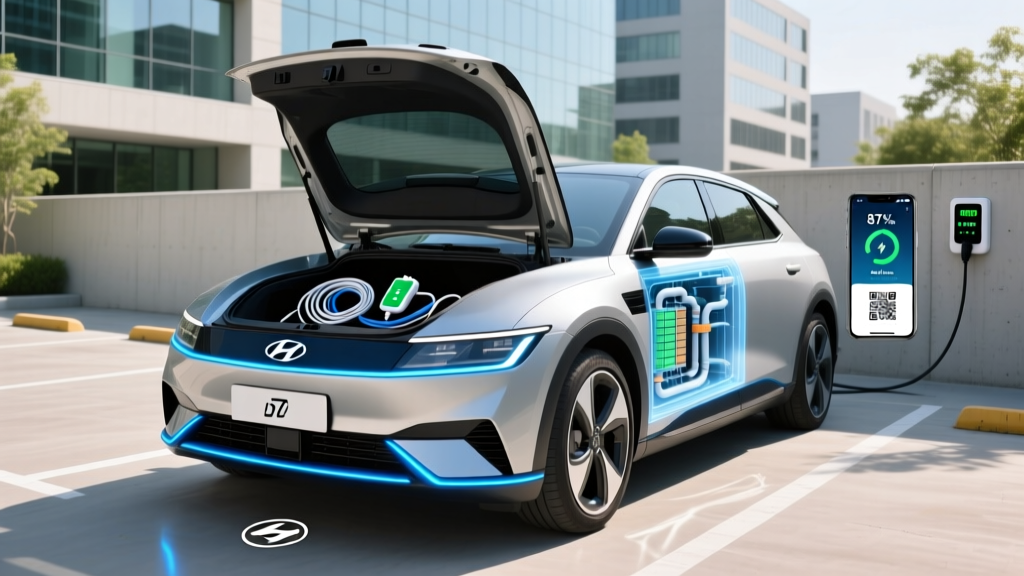
A front trunk (frunk) is expected but likely small — approximately 2–3 cu ft — suitable for charging cables and small bags rather than meaningful cargo. Toyota has prioritized cabin space over frunk volume, a sensible call for the family-SUV buyer.
Tech, Safety, and Driver Assistance
The bZ Highlander will debut Toyota's next-generation Toyota Safety Sense 4.0 (TSS 4.0) suite, which includes:
- Pre-Collision System with pedestrian and cyclist detection
- Lane Departure Alert with Steering Assist and Lane Tracing Assist
- Dynamic Radar Cruise Control (full-speed adaptive cruise)
- Road Sign Assist and Proactive Driving Assist (gentle braking/steering in low-risk scenarios)
Toyota Safety Sense 4.0 and any available semi-autonomous highway assist feature are SAE Level 2 driver-assistance systems. The driver must remain fully engaged, hands on or near the wheel, and eyes on the road at all times. This is not self-driving capability.
On the infotainment front, expect a 14-inch touchscreen running Toyota's latest Audio Multimedia system with wireless Apple CarPlay and Android Auto, built-in navigation with EV-specific route planning (incorporating charger stops and battery preconditioning), and over-the-air update capability. A digital rearview mirror and 360-degree camera system are expected on Limited and Platinum trims.
One welcome confirmation: Toyota has stated the bZ Highlander will support vehicle-to-load (V2L) capability, allowing owners to power devices, tools, or small appliances from the vehicle's battery — useful for camping, tailgating, or emergency backup power.
Pros, Cons, and the Competition
✓ Pros
- 300+ mile EPA range target (FWD) — viable for road trips
- Standard heat pump for cold-weather efficiency
- Toyota reliability reputation and strong dealer network
- Three-row seating with usable (if tight) third row
- 150 kW DC fast charging — a major improvement over bZ4X
- V2L capability for camping and emergency use
- Competitive pricing under $50K for base AWD trim
✗ Cons
- 150 kW peak charge rate lags Hyundai/Kia's 800V / 240+ kW platforms
- Third row is tight — adults won't enjoy long rides back there
- Towing limited to ~3,500–4,000 lbs (gas Highlander does 5,000)
- Final battery-sourcing compliance for tax credit not yet confirmed
- No frunk of meaningful size
- Real-world highway range will fall 40–50 miles below EPA sticker
The bZ Highlander's most direct competitors are the Kia EV9 (EPA range up to 304 mi, ~$54,900 starting, 240 kW DC charging via 800V architecture) and the upcoming Hyundai Ioniq 9. The EV9's faster charging and slightly more spacious third row give it an edge for road-trip-heavy families, while the bZ Highlander's lower starting price and Toyota brand trust may sway conservative buyers. The Tesla Model X offers more range and performance but at a significantly higher price point ($80K+), and the Rivian R1S excels at off-road capability and towing but also commands a premium.
Who Should Buy the 2027 Toyota bZ Highlander?
Choose the bZ Highlander if: You want a mainstream three-row EV SUV from a brand you trust, your daily driving is under 60 miles, you charge at home, and you value a lower entry price over bleeding-edge charging speed.
Look at the Kia EV9 instead if: You take frequent road trips and need the fastest possible DC charging (240 kW on 800V), or you regularly carry adults in the third row.
Consider a PHEV like the Toyota Grand Highlander Hybrid if: You lack reliable home charging access or regularly tow more than 4,000 lbs.
Warranty and Long-Term Ownership
Toyota is expected to carry forward its standard EV warranty structure:
- Basic vehicle warranty: 3 years / 36,000 miles
- Powertrain warranty: 5 years / 60,000 miles
- Hybrid/EV battery warranty: 8 years / 100,000 miles (against defects and excessive capacity loss — typically defined as dropping below 70% state of health)
Toyota's historical battery durability data from its hybrid lineup (Prius, RAV4 Hybrid) is encouraging, with many packs exceeding 150,000 miles with minimal degradation. However, BEV battery longevity depends heavily on charging habits — frequent DC fast charging to 100%, regular deep discharges below 10%, and sustained high-SoC storage in hot climates accelerate degradation. For daily use, charging to 80% and using scheduled departure preconditioning will maximize pack life. NMC chemistry generally shows ~10–15% capacity loss over 100,000 miles under moderate use conditions, based on industry-wide fleet data.
Frequently Asked Questions
What is the real-world range of the 2027 Toyota bZ Highlander?
While the EPA estimate targets 300–320 miles (FWD) and 280–295 miles (AWD), real-world highway driving at 70+ mph will likely yield 250–275 miles. In cold weather (below 30°F), expect 220–240 miles without diligent battery preconditioning. City and suburban driving with regenerative braking can match or slightly exceed EPA figures.
How fast does the bZ Highlander charge?
DC fast charging peaks at 150 kW, achieving a 10–80% charge in approximately 30 minutes under optimal conditions (preconditioned battery, capable charger). At home on a 48-amp Level 2 charger (~11.5 kW), a full charge takes 8–9 hours. The 150 kW rate is adequate but slower than the Kia EV9's 240 kW capability on 800V infrastructure.
Does the 2027 Toyota bZ Highlander qualify for the federal EV tax credit?
Based on preliminary information, the bZ Highlander is expected to qualify for up to $7,500 under IRS §30D, as all estimated trims fall well below the $80,000 SUV MSRP cap and Toyota's Kentucky production supports North American battery component sourcing. However, final eligibility depends on IRS confirmation of critical-mineral and battery-component compliance at time of purchase, plus buyer income limits ($150K single / $300K joint). Always verify at irs.gov and with a tax professional before purchase.
Is the bZ Highlander worth buying versus the Kia EV9?
The bZ Highlander is likely to be $5,000–$8,000 less expensive at the base trim and carries Toyota's long-term reliability reputation. The Kia EV9 counters with faster 240 kW charging, a slightly roomier third row, and more established market presence. If charging speed on road trips is your top priority, the EV9 wins. If budget and brand trust lead your decision, wait for the bZ Highlander's final specs.
When will the 2027 Toyota bZ Highlander be available?
Toyota has announced production at its Georgetown, Kentucky plant beginning in late 2026, with dealer deliveries expected in early-to-mid 2027. Reservations and final pricing have not yet opened as of mid-2026.
Can the bZ Highlander tow?
Estimated towing capacity is 3,500–4,000 pounds for AWD variants. This handles light-duty trailers and small boats but falls short of the gas Highlander's 5,000-lb rating and the Rivian R1S's 7,700-lb capability. Heavy towing will also significantly reduce range — expect a 30–50% range penalty when towing near maximum capacity.
Note: All specifications in this article are based on Toyota's preliminary announcements and industry analysis as of mid-2026. Final EPA range, pricing, tax credit eligibility, and feature availability will be confirmed closer to the vehicle's on-sale date. We will update this preview with official data as it becomes available. For the latest confirmed EV specifications, consult fueleconomy.gov and Toyota's official press site.