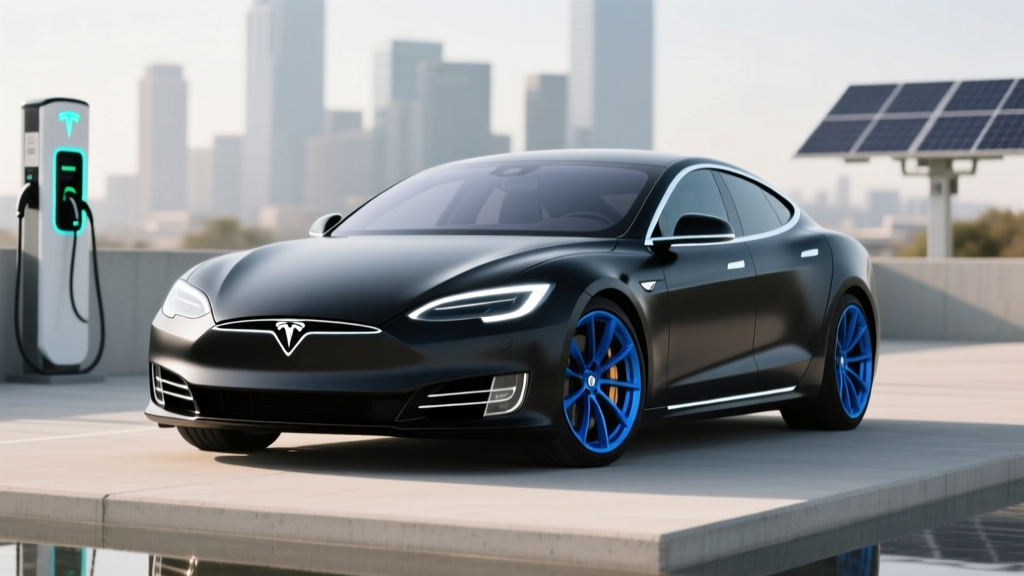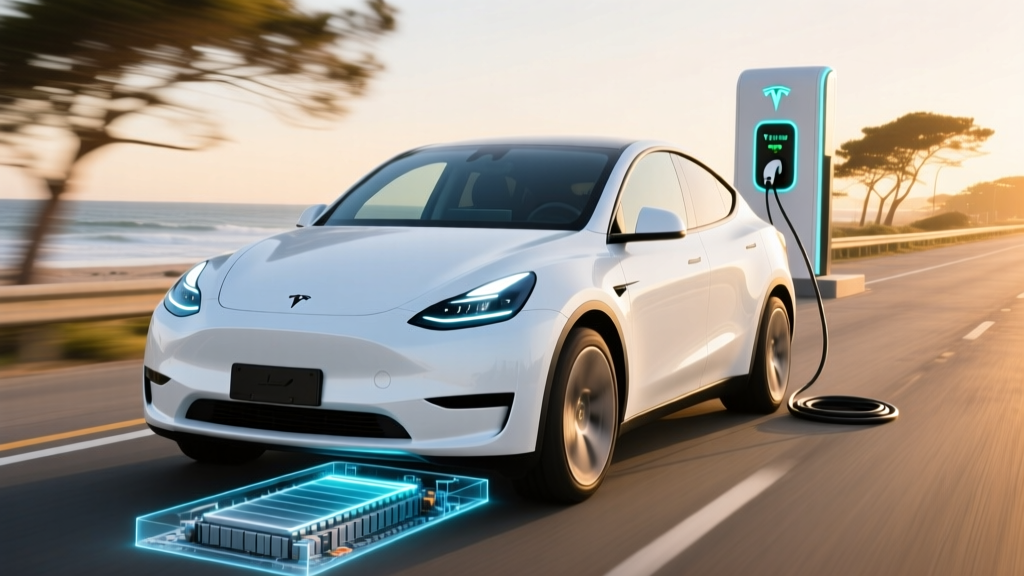
The Tesla Model Y entered its Juniper generation in early 2025, and the 2027 model year is shaping up to refine that platform further with potential battery chemistry tweaks, software-driven range gains, and continued NACS Supercharger network dominance. Because Tesla makes rolling production changes rather than traditional model-year rollovers, the "2027 Tesla" Model Y is best understood as the latest iteration of the Juniper architecture — not a ground-up redesign. Here is what current data, announced specs, and production trends tell us about the vehicle shoppers will be evaluating in late 2026 and into 2027.
2027 Tesla Model Y (Estimated) Key Specifications
| Spec | Long Range AWD | Performance (Est.) | RWD / Standard (Est.) |
|---|---|---|---|
| EPA Range | ~320–335 mi | ~290–305 mi | ~260–275 mi |
| Battery (usable) | ~78 kWh (NMC) | ~78 kWh (NMC) | ~60 kWh (LFP est.) |
| Peak DC Fast Charge | 250 kW | 250 kW | ~170 kW (LFP est.) |
| 10–80% DCFC Time | ~25 min | ~25 min | ~30 min |
| Level 2 Home Charge | 11.5 kW (~44 mi/hr) | 11.5 kW (~44 mi/hr) | 11.5 kW (~44 mi/hr) |
| 0–60 mph | 4.8 sec | 3.5 sec | ~6.5 sec |
| Horsepower | ~384 hp | ~456 hp | ~295 hp |
| Drivetrain | Dual-Motor AWD | Dual-Motor AWD | RWD |
| Efficiency | ~122 MPGe / 28 kWh/100mi | ~111 MPGe / 30 kWh/100mi | ~125 MPGe / 27 kWh/100mi |
| Est. Base MSRP | $48,990 | $54,990 | $44,990 |
Note: Tesla does not publish traditional model-year spec sheets. Figures above are projected from the current Juniper platform and recent production vehicles. Final 2027 specs may differ. Always verify at tesla.com before ordering.
Real-World Range: What the EPA Sticker Doesn't Tell You
EPA Estimate: ~320–335 miles (Long Range AWD)
Real-World Expectation: 265–290 miles at sustained 75 mph highway speeds; 230–260 miles in freezing temperatures with cabin heat.
Tesla's efficiency engineering remains among the best in the industry, and the Juniper platform's improved aerodynamics and heat pump give the Model Y an edge in cold weather compared to competitors without thermal management optimization. That said, physics is physics. Any EV will lose 15–30% of its rated range at highway speeds in sub-freezing temperatures. The Model Y's heat pump recovers waste heat from the drivetrain to warm the cabin, which mitigates — but does not eliminate — cold-weather range loss.
In mixed driving (city + highway), owners of the current Juniper Model Y Long Range consistently report achieving 90–95% of the EPA sticker in moderate temperatures (50–80°F). On a pure 75 mph highway run, expect closer to 82–87%. If your commute is mostly stop-and-go city driving with heavy regenerative braking opportunities, you may actually exceed the EPA number in warm weather — a rarity among EVs.
Charging Speed and Network Access
Charging Speeds at a Glance
| Level | Power | Miles Added per Hour | Notes |
|---|---|---|---|
| Level 1 (120V) | ~1.4 kW | ~4–5 mi/hr | Emergency/top-up only |
| Level 2 (240V, 48A) | 11.5 kW | ~44 mi/hr | Full charge in ~7–8 hours |
| DC Fast (V3 Supercharger) | 250 kW peak | ~1,000+ mi/hr (peak) | 10–80% in ~25 min |
| DC Fast (V4 Supercharger) | Up to 250 kW | Similar to V3 | Newer stalls; CCS adapter not needed for Tesla |
Tesla's Supercharger network remains the gold standard for public charging reliability, with over 6,000 U.S. stalls as of mid-2026. The Model Y, equipped with the native NACS connector, plugs directly into any Supercharger without an adapter. For non-Tesla networks (Electrify America, EVgo), a NACS-to-CCS adapter may be needed depending on station hardware, though the industry-wide shift to NACS is rapidly reducing this friction.
The charging curve matters more than peak kW. The Model Y Long Range peaks at 250 kW but sustains that rate only briefly — typically between 10–30% State of Charge (SoC). From 30–60%, expect ~170–200 kW, tapering further to ~100 kW by 70% and dropping sharply above 80%. This is why Tesla and experienced EV owners recommend charging to 80% on road trips and only going higher when necessary. The 10–80% time of approximately 25 minutes is competitive, though newer 800V architectures from Hyundai/Kia (Ioniq 5, EV6) can achieve 10–80% in roughly 18 minutes thanks to higher sustained charge rates.
For home charging, a 48-amp Level 2 wall connector on a 60-amp circuit delivers 11.5 kW, adding roughly 44 miles of range per hour. An overnight charge from 20% to 80% takes about 4 hours — more than sufficient for daily driving needs. Installation costs for a home Level 2 setup typically range from $500 to $2,000 depending on panel capacity and wiring distance, per Tesla's home charging guide.
Performance and Driving Dynamics
The dual-motor Long Range AWD delivers approximately 384 horsepower and reaches 60 mph in 4.8 seconds — quick enough to merge confidently and pass without hesitation, though not in supercar territory. The Performance variant bumps output to an estimated 456 hp and drops the 0–60 to 3.5 seconds, with track-oriented suspension tuning and larger brakes.
The Juniper refresh improved ride quality noticeably over the pre-2025 Model Y, with revised damping and additional acoustic insulation. Road noise at highway speeds is lower, and the suspension absorbs sharp impacts more gracefully. It still rides firmly compared to a Hyundai Ioniq 5 or Ford Mustang Mach-E, which prioritize comfort over sportiness.
Tesla's regenerative braking remains one-pedal-capable, though the company removed the user-adjustable regen setting several years ago. Lift-off deceleration is strong and predictable, making stop-and-go traffic manageable without touching the brake pedal in most situations.
Interior, Cargo, and Technology
The Juniper interior stripped away the remaining physical controls, moving turn signals to the steering wheel (a controversial decision) and gear selection to the touchscreen. The 15.4-inch center display handles everything: climate, media, navigation, vehicle settings, and the glovebox release. A rear-seat 8-inch screen was added for passengers, providing climate and entertainment controls.
Cargo Volume:
- Behind second row: ~30.2 cu ft
- Second row folded: ~72.1 cu ft
- Front trunk (frunk): ~4.1 cu ft
Passenger Space:
- Front legroom: ~41.8 inches
- Rear legroom: ~37.5 inches
- Seating capacity: 5 (optional 7-seat config available with reduced cargo)
The Juniper Model Y added ventilated front seats, ambient lighting, and power-folding second-row seats as standard or widely available features. Build quality has continued to improve from Tesla's earlier panel-gap reputation, though some owners still report minor trim inconsistencies.
Driver Assistance: Tesla's Autopilot (standard) provides adaptive cruise control and lane centering. Full Self-Driving (Supervised) — currently a $8,000 option or $99/month subscription — adds automated lane changes, traffic light/stop sign recognition, and city street navigation. This is an SAE Level 2 system, meaning the driver must remain fully engaged and responsible at all times. It is not autonomous driving.
SAE Automation Level: Tesla Autopilot and FSD (Supervised) are Level 2 driver-assistance systems. The driver must keep hands on or near the wheel, monitor the road, and be prepared to take over instantly. Only Level 4 services like Waymo operate without a human driver — and those are geofenced robotaxis, not consumer vehicles.
Pricing, Tax Credit Eligibility, and Total Cost
Estimated Pricing and Federal Tax Credit
| Trim | Est. Base MSRP | Federal Credit (§30D) | Effective Price (Est.) |
|---|---|---|---|
| RWD / Standard Range | $44,990 | Up to $7,500* | ~$37,490 |
| Long Range AWD | $48,990 | Up to $7,500* | ~$41,490 |
| Performance | $54,990 | Up to $7,500* | ~$47,490 |
*Federal tax credit eligibility under IRS §30D depends on: buyer AGI limits ($150K single / $300K joint), vehicle MSRP cap ($55K for SUVs), battery critical-mineral and component sourcing requirements, and point-of-sale transfer election. Rules are subject to change. Verify current eligibility at irs.gov and consult a tax professional.
The $30D credit can now be transferred to the dealer at point of sale as an instant discount, which simplifies the process significantly. However, battery sourcing requirements remain a moving target. Tesla sources LFP cells from CATL (China) for Standard Range models and NMC cells from Panasonic (U.S.-manufactured) for Long Range and Performance trims. The Long Range and Performance variants have historically qualified for the full $7,500 credit due to North American battery assembly, but critical-mineral sourcing rules tighten annually. Always confirm current eligibility before ordering.
The RWD / Standard Range model with its likely LFP battery faces greater uncertainty under §30D's foreign-entity-of-concern (FEOC) restrictions on critical minerals. Buyers targeting this trim should verify credit eligibility at the time of purchase rather than assuming it will match the Long Range.
§30D Federal EV Tax Credit Checklist
- Buyer AGI cap: $150,000 (single) / $225,000 (head of household) / $300,000 (married filing jointly)
- MSRP cap: $55,000 for SUVs (Model Y qualifies as SUV per IRS classification)
- Battery sourcing: Critical minerals and battery components must meet escalating domestic/free-trade-agreement thresholds
- FEOC restriction: Battery components cannot be manufactured by a "foreign entity of concern" (primarily targeting Chinese suppliers)
- Point-of-sale transfer: Credit can be applied as instant discount at purchase, reducing out-of-pocket cost
- Verification: Check fueleconomy.gov and IRS guidance for the specific VIN's eligibility
Pros, Cons, and the Competition
Pros
- Supercharger network access — still the most reliable public charging ecosystem
- Best-in-class efficiency (kWh/100mi) translates to lower charging costs
- Strong real-world range, especially Long Range AWD at 320+ miles EPA
- OTA updates continuously add features and refine performance
- Spacious cargo area with flat load floor and optional 7-seat layout
- Heat pump standard — superior cold-weather efficiency vs. resistive heating
Cons
- Steering-wheel turn signals and screen-only gear selection frustrate some drivers
- No Apple CarPlay or Android Auto — Tesla's ecosystem is closed
- FSD (Supervised) remains expensive and is not autonomous driving
- Ride quality firm compared to comfort-oriented competitors
- LFP Standard Range models may face §30D credit uncertainty due to FEOC rules
- Insurance premiums tend to run 15–25% higher than comparable non-Tesla SUVs
Key Competitors to Cross-Shop:
- Hyundai Ioniq 5: Faster 10–80% charging (~18 min on 350 kW), CarPlay, softer ride, but smaller cargo area and less Supercharger convenience (though gaining NACS access).
- Ford Mustang Mach-E: More traditional interior controls, strong handling, BlueCruise hands-free highway driving, but lower efficiency and slower charging.
- Chevrolet Equinox EV: Lower starting price, solid range (~315 mi), but less performance and no Supercharger-native access.
- Kia EV6: 800V architecture for rapid charging, sporty design, CarPlay, but tighter rear seat and smaller frunk.
Who Should Buy the 2027 Tesla Model Y?
Choose the Model Y if: You value Supercharger network reliability for road trips, want maximum cargo versatility with optional 7-seat capability, prioritize energy efficiency (lower cost per mile), and are comfortable with Tesla's minimalist, screen-centric interface.
Look elsewhere if: You need Apple CarPlay, prefer physical buttons and traditional controls, want the fastest DC charging times (Hyundai/Kia's 800V platform is faster), or need guaranteed hands-free highway driving (GM Super Cruise or Ford BlueCruise offer eyes-off capability on mapped highways — still Level 2, but less driver workload).
Warranty and Long-Term Ownership
Tesla's warranty structure remains straightforward:
- Vehicle Limited Warranty: 4 years / 50,000 miles
- Battery & Drive Unit Warranty (Long Range/Performance): 8 years / 120,000 miles, with minimum 70% capacity retention
- Battery & Drive Unit Warranty (Standard Range/LFP): 8 years / 100,000 miles, with minimum 70% capacity retention
The 70% retention threshold is the industry-standard floor. Real-world degradation data from Tesla's fleet suggests NMC batteries in Long Range models typically retain 88–92% capacity after 100,000 miles when charged primarily to 80% daily. LFP batteries in Standard Range models can be charged to 100% daily without accelerated degradation — a meaningful advantage for owners who want maximum daily range without babying the battery. Per Tesla's Impact Report, fleet data shows average battery degradation of roughly 15% after 200,000 miles across all chemistries.
Insurance costs deserve attention. Model Y premiums average 15–25% above comparable non-Tesla electric SUVs, driven by higher repair costs (aluminum body panels, sensor recalibration) and Tesla's direct repair network limitations. Get quotes before ordering — the delta can be $300–$600/year depending on your state and driving record.
Frequently Asked Questions
What is the real-world range of the 2027 Tesla Model Y?
The Long Range AWD is expected to carry an EPA rating of approximately 320–335 miles. In real-world highway driving at 75 mph, expect 265–290 miles in moderate temperatures, dropping to 230–260 miles in freezing conditions. City driving with regenerative braking can approach or slightly exceed the EPA number in warm weather.
How fast does the 2027 Model Y charge?
On a V3 or V4 Supercharger, the Long Range peaks at 250 kW and charges from 10–80% in approximately 25 minutes. At home on a 48-amp Level 2 Wall Connector (11.5 kW), it adds about 44 miles of range per hour, fully charging overnight in 7–8 hours. The LFP Standard Range model charges more slowly on DC fast chargers (~170 kW peak, ~30 minutes 10–80%) but can accept a full 100% daily charge without long-term degradation concerns.
How much does the 2027 Model Y cost after tax credits?
Estimated pricing starts around $44,990 for the Standard Range RWD and $48,990 for the Long Range AWD. If you qualify for the full $7,500 federal §30D credit (income limits, MSRP cap, battery sourcing all met), the effective price drops to approximately $37,490–$41,490. The credit can be transferred at point of sale as an instant discount. Verify eligibility at irs.gov and fueleconomy.gov before ordering.
Does the 2027 Tesla Model Y qualify for the federal EV tax credit?
The Long Range and Performance variants, with U.S.-assembled Panasonic NMC battery packs, have historically qualified for the full $7,500 credit under §30D. The Standard Range LFP model faces greater uncertainty due to FEOC restrictions on Chinese-sourced critical minerals (CATL cells). Eligibility rules tighten annually, and buyer income caps apply ($150K single / $300K joint). Always confirm the specific VIN's status before purchase.
Is the 2027 Model Y worth buying vs. competitors?
If Supercharger network access, cargo versatility, and energy efficiency are your top priorities, the Model Y remains the benchmark. If you prioritize faster DC charging (Hyundai/Kia 800V), physical controls, Apple CarPlay, or a softer ride, the Ioniq 5, EV6, or Mach-E may be a better fit. The Model Y's closed software ecosystem and minimalist controls are dealbreakers for some buyers and non-issues for others.
Is Tesla FSD actually self-driving?
No. Tesla Full Self-Driving (Supervised) is an SAE Level 2 driver-assistance system. It can navigate city streets, handle intersections, and change lanes automatically, but the driver must remain fully attentive and ready to intervene at any moment. It does not make the vehicle autonomous. Only Level 4 robotaxi services like Waymo operate without a human driver, and those are limited to geofenced urban areas.
What battery chemistry does the 2027 Model Y use?
The Long Range AWD and Performance trims use NMC (nickel manganese cobalt) cells manufactured by Panasonic in U.S. facilities. The Standard Range RWD is expected to use LFP (lithium iron phosphate) cells, likely from CATL. LFP offers longer cycle life and can be charged to 100% routinely, but has lower energy density (less range per kWh) and reduced cold-weather performance compared to NMC.