The Tesla Model X has occupied a unique niche since 2015: a three-row electric SUV with falcon-wing rear doors, supercar acceleration, and genuine towing capability. As we look ahead to the 2027 Tesla Model X, Tesla has not yet released official specifications or pricing. What follows is a data-grounded preview based on the current 2025–2026 Model X platform, confirmed Tesla engineering trajectories, and industry intelligence — with every projected figure clearly labeled.
This article will be updated when Tesla publishes formal 2027 Model X specifications. Until then, treat all range, pricing, and charging numbers as informed estimates rooted in the carryover architecture Tesla currently sells.
Projected Range and Efficiency
The current Model X Long Range carries an EPA-estimated 348 miles on its 100 kWh (usable ~95 kWh) battery pack. The Performance (formerly Plaid) variant drops to roughly 326 miles due to stickier tires and more aggressive powertrain calibration. For the 2027 model year, we anticipate Tesla will carry over the same battery architecture with possible efficiency gains from updated heat-pump calibration and minor aero refinements.
EPA estimate (projected): 340–355 miles (Long Range), 320–330 miles (Performance)
Real-world highway (70–80 mph): Expect 280–310 miles — the Model X's tall, heavy SUV profile creates significant aero drag at speed.
Cold-weather (below 32°F): Plan for 240–275 miles. The resistive cabin heater and battery conditioning draw heavily in winter, though Tesla's heat pump mitigates some loss versus older EVs.
Mixed suburban commute: 320–340 miles is achievable with moderate regen use and temperate weather.
| Metric | Long Range (est.) | Performance (est.) |
|---|---|---|
| EPA Range | ~348 mi | ~326 mi |
| Battery (usable) | ~95 kWh (NMC) | ~95 kWh (NMC) |
| Combined MPGe | ~100 MPGe | ~95 MPGe |
| Efficiency (kWh/100 mi) | ~33 kWh | ~35 kWh |
| Drivetrain | Dual-Motor AWD | Tri-Motor AWD |
The Model X uses NMC (nickel manganese cobalt) battery chemistry, which prioritizes energy density over cycle life compared to LFP (lithium iron phosphate). NMC packs are standard in long-range, high-performance Tesla products — the trade-off is that Tesla recommends daily charging to 80–90% rather than 100% for longevity, reserving full charges for road trips.
Charging Speed: DC Fast and Home Level 2
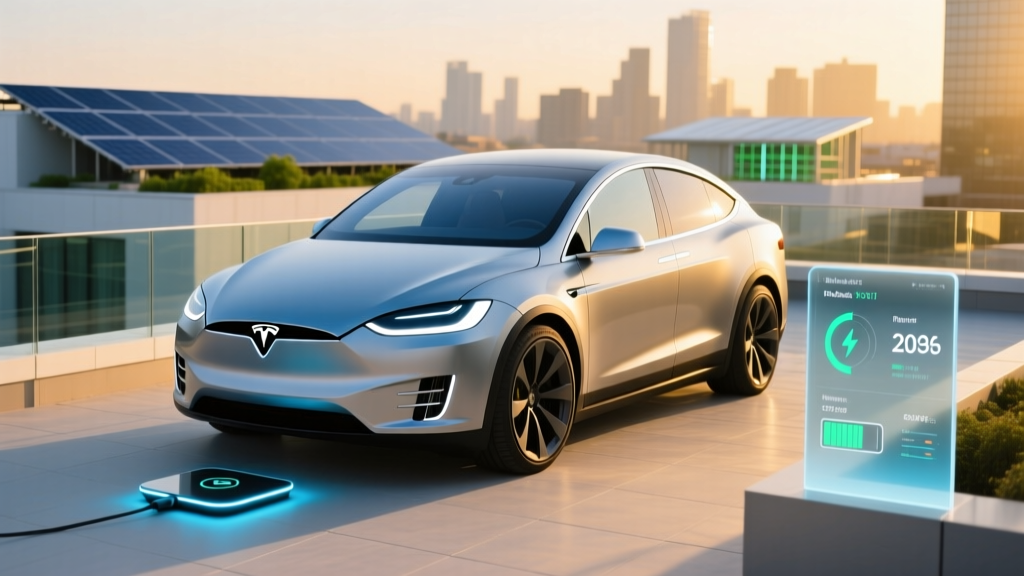
Charging remains one of the Model X's strongest ownership advantages, thanks to access to Tesla's Supercharger network — now exceeding 6,000 stalls in North America. The current Model X architecture supports up to 250 kW peak DC fast charging on V3 Superchargers. We project the 2027 model will retain this capability unless Tesla introduces a revised battery pack with higher C-rate tolerance.
| Charging Level | Power / Rate | Speed | Notes |
|---|---|---|---|
| DC Fast (V3 Supercharger) | 250 kW peak | 10–80% in ~30 min | Peak rate sustained to ~50% SoC, then tapers. Preconditioning essential. |
| DC Fast (CCS adapter) | ~150–175 kW | 10–80% in ~40 min | Non-Tesla networks via included CCS adapter; speed varies by station. |
| Level 2 (Wall Connector) | 11.5 kW (48A) | ~34 mi/hr | Requires 60A dedicated circuit. Full charge in ~9 hours. |
| Level 1 (120V outlet) | ~1.4 kW | ~4 mi/hr | Emergency/top-up only. Full charge takes ~68 hours. |
Charging-curve reality check: The 250 kW peak rate applies only between roughly 10–50% state of charge. Above 50%, the curve tapers progressively — by 80% SoC, you're charging at approximately 60–80 kW. This is why Tesla quotes 10–80% times rather than 0–100%. On a road trip, plan stops around the 20–80% window for the fastest throughput.
Preconditioning matters. When you navigate to a Supercharger in the Tesla infotainment system, the car automatically warms the battery to optimal temperature. Arriving without preconditioning — especially in cold weather — can cut peak charge rates by 30–50% for the first several minutes.
Performance and Powertrain
The Model X has never been a slow vehicle, and the 2027 iteration should continue that tradition. The dual-motor Long Range variant delivers approximately 670 horsepower and a 0–60 mph time of 3.8 seconds. The tri-motor Performance (Plaid) variant pushes roughly 1,020 horsepower with a 0–60 time of 2.5 seconds — numbers that rival a Lamborghini Urus in a family hauler with falcon-wing doors.
| Spec | Long Range | Performance (Plaid) |
|---|---|---|
| Horsepower | ~670 hp | ~1,020 hp |
| 0–60 mph | 3.8 sec | 2.5 sec |
| Top Speed | 155 mph | 163 mph |
| Drivetrain | Dual-Motor AWD | Tri-Motor AWD |
| Towing Capacity | 5,000 lbs | 5,000 lbs |
| Air Suspension | Standard (adaptive) | Standard (adaptive) |
The adaptive air suspension provides up to 8.1 inches of ground clearance — useful for snow and rough driveways — and automatically lowers at highway speeds for improved aerodynamics. Towing capacity holds at 5,000 lbs, competitive with the Rivian R1S and well above the Hyundai Ioniq 9. Just remember: towing a 4,000-lb trailer will cut real-world range roughly in half.
Pricing, Trims, and Federal Tax Credit Eligibility
Tesla pricing fluctuates frequently — sometimes multiple times per quarter. Based on current 2025–2026 pricing and typical year-over-year adjustments, we project the following MSRP structure for the 2027 Model X. Note that Tesla occasionally adjusts prices without model-year changes.
| Trim | Est. MSRP | §30D Credit Eligible? | Est. After Credit |
|---|---|---|---|
| Long Range (6-seat) | ~$79,990 | ⚠️ Likely NO (MSRP cap) | ~$79,990 |
| Long Range (7-seat) | ~$84,990 | ⚠️ Likely NO (MSRP cap) | ~$84,990 |
| Performance (Plaid) | ~$94,990 | ❌ NO (MSRP cap) | ~$94,990 |
Critical tax-credit detail: Under IRS §30D rules, the federal EV tax credit of up to $7,500 has an MSRP cap of $80,000 for SUVs, vans, and pickup trucks. The Model X Long Range base price has historically hovered right around this threshold — sometimes above, sometimes below, depending on Tesla's pricing moves and whether destination fees are included. The Performance/Plaid trim is well above the cap and categorically ineligible.
Even if the base Long Range squeaks under the $80,000 MSRP cap, buyers must also satisfy:
- Income caps: Modified AGI ≤ $300,000 (joint), $225,000 (head of household), $150,000 (individual)
- Battery sourcing: Critical minerals and battery components must meet escalating domestic-content thresholds that tighten each year through 2030
- Point-of-sale transfer: Eligible buyers can apply the credit as an immediate dealer discount rather than waiting for tax filing
Given the Model X's price point, many buyers will be above the income cap or find the vehicle above the MSRP cap. Consult a tax professional before assuming credit eligibility.
Interior Space, Cargo, and Technology
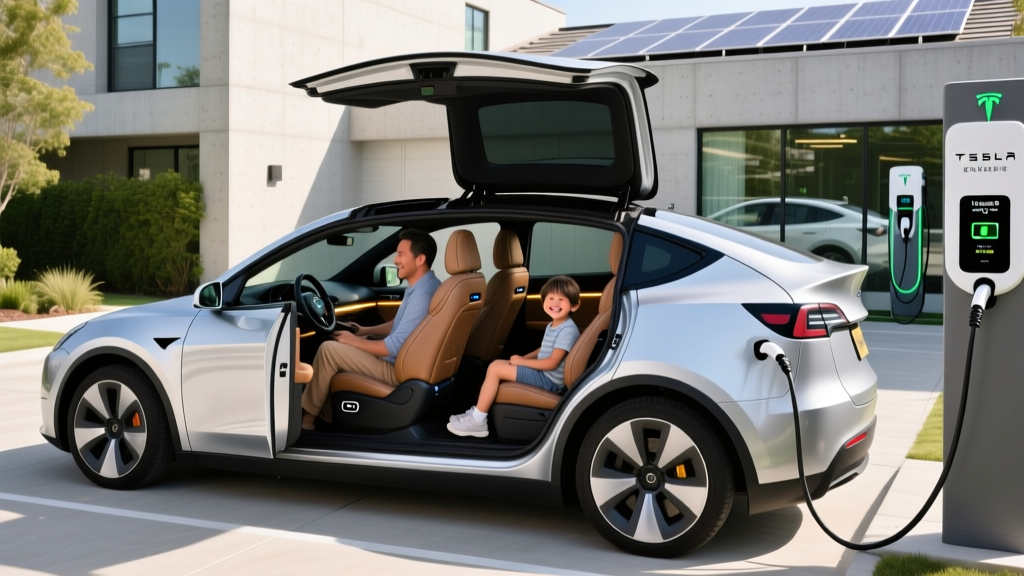
The Model X remains one of the few EVs offering genuine three-row seating for up to seven passengers. The six-seat configuration (with second-row captain's chairs) is more popular and provides better third-row access thanks to the powered-folding second row and the signature falcon-wing rear doors.
| Dimension | Measurement |
|---|---|
| Cargo (behind 3rd row) | ~16.3 cu ft |
| Cargo (3rd row folded) | ~41.1 cu ft |
| Cargo (all rear rows folded) | ~74.5 cu ft |
| Front headroom | 41.7 in |
| 2nd-row legroom | 41.2 in |
| 3rd-row legroom | 32.7 in |
| Frunk (front trunk) | ~6.7 cu ft |
The third row is best suited for children or occasional adult use on short trips — 32.7 inches of legroom is tight for long hauls. The falcon-wing doors are the Model X's party trick: they open vertically with obstacle-sensing articulation, making car-seat loading dramatically easier than in conventional SUVs. However, they are also a maintenance concern (more sensors, actuators, and seals than a standard door) and can be slow to operate in tight garages with low ceilings.
Tech highlights:
- 17-inch center touchscreen with 22-speaker premium audio
- Rear-seat 8-inch touchscreen for climate and entertainment
- Tesla Autopilot standard (SAE Level 2 adaptive cruise + lane centering)
- Full Self-Driving (Supervised) available as a $8,000 add-on or $99/month subscription — still SAE Level 2 requiring active driver supervision
- Over-the-air software updates that add features post-purchase
- Sentry Mode, Dog Mode, and Camp Mode as standard utility features
Warranty and Long-Term Ownership
Tesla's warranty structure for the Model X is competitive within the premium EV segment, though it falls short of Hyundai/Kia's industry-leading coverage.
| Component | Coverage |
|---|---|
| Basic Vehicle | 4 years / 50,000 miles |
| Battery & Drive Unit | 8 years / 150,000 miles |
| Battery Capacity Retention | Minimum 70% over warranty period |
| Roadside Assistance | 4 years / 50,000 miles |
The 8-year/150,000-mile battery warranty is the key figure. Tesla guarantees the pack will retain at least 70% of original capacity during that period. Real-world data from Tesla's own fleet reports suggest NMC packs in the Model X typically retain 85–90% capacity at 100,000 miles, with the degradation curve flattening after the initial 20,000-mile drop. Battery replacement outside warranty currently costs approximately $15,000–$22,000 including labor, depending on pack configuration.
Competitive Landscape: Is the Model X Worth It?
The three-row premium EV SUV segment has grown considerably. Here's how the 2027 Model X stacks up against its most direct competitors:
| Attribute | Tesla Model X LR | Rivian R1S | Kia EV9 GT-Line | BMW iX xDrive50 |
|---|---|---|---|---|
| Est. Price | ~$79,990 | ~$79,900 | ~$63,000 | ~$87,000 |
| EPA Range | ~348 mi | ~352 mi (Max Pack) | ~270 mi | ~324 mi |
| 0–60 mph | 3.8 sec | 4.5 sec (Dual) | 5.0 sec | 4.4 sec |
| DC Fast Charge | 250 kW | ~220 kW | ~210 kW | ~200 kW |
| Towing | 5,000 lbs | 7,700 lbs | 5,000 lbs | 3,500 lbs |
| Rows / Seats | 3 / up to 7 | 3 / up to 7 | 3 / up to 7 | 2 / 5 |
- Class-leading Supercharger network access
- Falcon-wing doors ideal for car-seat loading
- Tri-motor Plaid offers supercar acceleration in a family SUV
- Best-in-class DC fast-charge speed (250 kW)
- OTA updates continuously improve the vehicle
- Air suspension standard across all trims
- Likely ineligible for $7,500 federal tax credit (MSRP cap)
- Falcon-wing doors = higher repair cost and slow operation
- Third-row legroom is tight (32.7 in) for adults
- Panel gaps and interior quality inconsistent at this price point
- No Apple CarPlay or Android Auto support
- Steep depreciation historically vs. legacy luxury brands
Who Should Buy the 2027 Tesla Model X?
Choose the Model X if:
- You need three rows and prioritize Supercharger access for road trips
- You frequently load child car seats (falcon-wing doors are transformative here)
- You want supercar-level acceleration in a practical family vehicle
- You already own a Tesla and are invested in the ecosystem
- Federal tax credit eligibility is critical to your budget (consider the Rivian R1S or Kia EV9, which may qualify)
- You need maximum towing capacity (Rivian R1S tows 7,700 lbs)
- Third-row adult comfort is a priority (the BMW iX is only two-row; consider the Mercedes EQS SUV)
- Build quality consistency is a top concern at this price point
Frequently Asked Questions
What is the real-world range of the 2027 Tesla Model X?
Based on the current platform, expect approximately 280–310 miles on the highway at 70–80 mph, and 240–275 miles in cold weather (below 32°F). The EPA sticker of ~348 miles is achievable in mixed suburban driving at moderate speeds with temperate weather. The Model X's large frontal area and 5,000+ lb curb weight work against highway efficiency.
How fast does the 2027 Model X charge at home and on the road?
On a Tesla V3 Supercharger, the Model X peaks at 250 kW and charges from 10–80% in approximately 30 minutes. At home with a Tesla Wall Connector on a 60-amp circuit (11.5 kW), you'll add roughly 34 miles per hour — enough for a full overnight charge. A standard 240V/40A outlet delivers about 25 mi/hr.
Does the 2027 Tesla Model X qualify for the $7,500 federal EV tax credit?
It depends. The IRS §30D credit has an $80,000 MSRP cap for SUVs. The Model X Long Range base price has historically hovered right at or slightly above this cap. Even if MSRP qualifies, buyers must meet income caps ($300K joint / $150K individual) and battery-sourcing requirements. The Performance/Plaid trim is well above the cap and ineligible. Always verify current eligibility on irs.gov and consult a tax professional.
Is the Model X worth buying over the Rivian R1S or Kia EV9?
It depends on your priorities. The Model X wins on charging speed (250 kW vs. ~220 kW), Supercharger network convenience, and raw acceleration. The Rivian R1S wins on towing (7,700 lbs), off-road capability, and more conventional doors. The Kia EV9 wins on price (~$17,000 less) and potential tax-credit eligibility. If Supercharger access and performance matter most, the Model X leads. If value or utility matter more, look at the alternatives.
What are the biggest maintenance concerns with the Model X?
The falcon-wing door mechanisms (sensors, actuators, hydraulic struts) are the most common source of service visits beyond routine items. Air suspension components may require attention after 80,000–100,000 miles. The NMC battery has proven durable, with most fleet data showing 85–90% capacity retention at 100,000 miles. Tesla's 8-year/150,000-mile battery warranty provides substantial protection.
Will the 2027 Model X get a major redesign?
As of this writing, Tesla has not announced a next-generation Model X. The current platform received a significant interior refresh (new "Palladium" architecture) for the 2022 model year, including the horizontal touchscreen, rear-seat display, and updated powertrain. Incremental updates are likely; a full redesign is not confirmed. We'll update this article if Tesla announces structural changes.