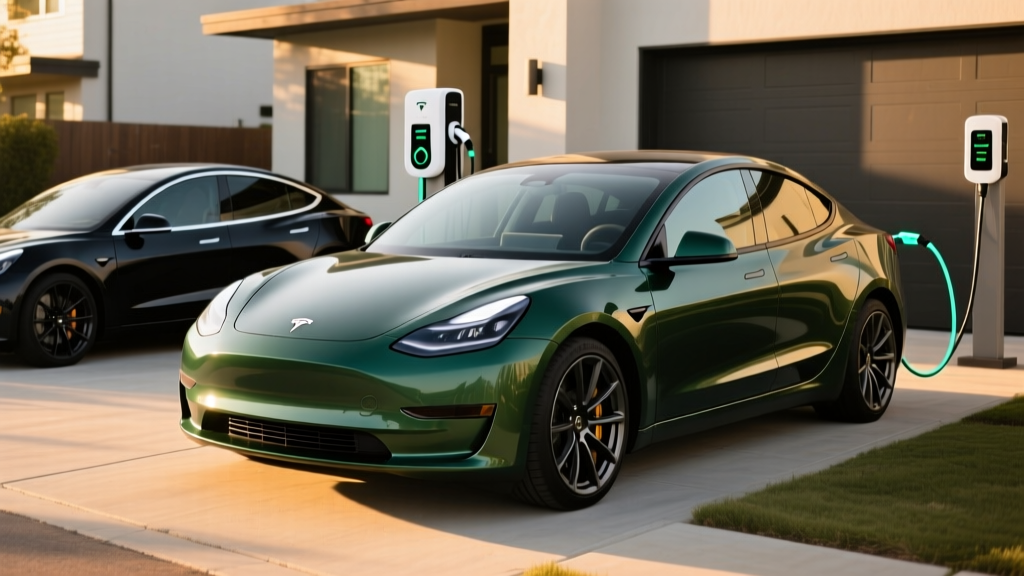
The Tesla Model 3 has long been the default answer for buyers entering the electric-vehicle market, and the 2027 Tesla Model 3 arrives with incremental but meaningful updates to Tesla's best-selling sedan. While the sweeping "Highland" redesign landed for the 2024 model year, the 2027 iteration refines battery chemistry options, slightly bumps efficiency, and continues to leverage Tesla's Supercharger network — now increasingly open to NACS-equipped rivals. If you're researching whether this is the year to pull the trigger, this review gives you the exact numbers that matter: EPA range, real-world expectations, charging curves, pricing, and whether you'll actually qualify for the federal tax credit.
2027 Tesla Model 3 At a Glance: Key Specs
| Spec | Model 3 RWD | Model 3 Long Range AWD | Model 3 Performance |
|---|---|---|---|
| EPA Range | 272 mi | 363 mi | 315 mi |
| Battery (usable) | 60 kWh (LFP) | 82 kWh (NMC) | 82 kWh (NMC) |
| Drivetrain | Rear-Wheel Drive | Dual-Motor AWD | Dual-Motor AWD |
| Horsepower | 271 hp | 346 hp | 510 hp |
| 0-60 mph | 5.8 sec | 4.2 sec | 2.9 sec |
| Peak DC Charge Rate | 170 kW | 250 kW | 250 kW |
| 10-80% DC Time | ~28 min | ~20 min | ~20 min |
| Level 2 Charge Rate | 11.5 kW (~37 mi/hr) | 11.5 kW (~44 mi/hr) | 11.5 kW (~44 mi/hr) |
| Efficiency (MPGe) | 132 MPGe combined | 130 MPGe combined | 118 MPGe combined |
| Base MSRP | $38,990 | $45,990 | $52,990 |
Source: Tesla official specifications and fueleconomy.gov for EPA data. Prices exclude destination fee.
Real-World Range: What the EPA Sticker Doesn't Tell You
Tesla's efficiency engineering remains among the best in the industry. The Model 3 Long Range achieves roughly 25 kWh per 100 miles in mixed driving — a number that beats most competitors in this segment. However, efficiency drops noticeably at sustained highway speeds above 75 mph, and the LFP battery in the RWD trim is heavier per kWh of capacity, which slightly hurts efficiency compared to the NMC-equipped Long Range.
For context, if your daily commute is under 50 miles round-trip, even the RWD model will require charging only twice a week. Road-trippers covering 300+ mile stretches will want the Long Range for its buffer — you'll arrive at Superchargers with a more comfortable state of charge and spend less time plugged in.
Charging Speed: DC Fast Charging and Home Setup
Charging speed is where trim selection matters significantly. The RWD model's LFP battery peaks at 170 kW on DC fast chargers, while the Long Range and Performance trims reach 250 kW. But peak kW is only part of the story — the charge curve determines how long you actually sit at a charger.
| Charging Level | Power (kW) | Miles Added per Hour | Best For |
|---|---|---|---|
| Level 1 (120V household) | ~1.4 kW | ~4-5 mi/hr | Overnight top-up, emergencies |
| Level 2 (240V, 48A home) | 11.5 kW | 37-44 mi/hr | Daily home charging |
| DC Fast (RWD peak) | 170 kW | ~700 mi/hr (peak) | Road trips, 10-80% in ~28 min |
| DC Fast (LR/Perf peak) | 250 kW | ~1,000 mi/hr (peak) | Road trips, 10-80% in ~20 min |
On a V3 Supercharger or equivalent 250 kW DC fast charger, the Long Range Model 3 sustains its peak rate up to roughly 40% state of charge, then tapers progressively. The 10-80% time of approximately 20 minutes is competitive, though newer platforms from Hyundai/Kia (with 800V architecture) can hit 10-80% in around 18 minutes. Above 80%, charging slows dramatically — plan to unplug at 80% during road trips rather than waiting for a full charge, which can add another 25-30 minutes.
For home charging, a Level 2 wall connector on a 60-amp circuit delivers the full 11.5 kW. That means the Long Range model adds roughly 44 miles of range per hour, easily replenishing a full day's driving in 2-3 hours. Installation costs for a dedicated 240V circuit typically run $800-$2,000 depending on your electrical panel's capacity and the distance from panel to charger location. If your home has a 100-amp panel, a panel upgrade to 200 amps may be required, adding $1,500-$3,000 to the project.
Performance, Ride, and Daily Drivability
The 2027 Model 3 Performance remains a serious machine: 510 horsepower and a 2.9-second 0-60 mph time put it in sports-car territory. Tesla's updated adaptive dampers (introduced with the Highland refresh) give the Performance trim a genuinely compliant ride while maintaining sharp handling. The Long Range AWD at 4.2 seconds to 60 mph is plenty quick for any real-world scenario and provides confident highway merging and passing.
The RWD model at 5.8 seconds isn't slow by any standard, but it does feel noticeably less urgent than its dual-motor siblings. For city commuting and suburban driving, the instant torque from the single rear motor is more than adequate, and the lighter front end gives the RWD model slightly better ride quality over rough pavement.
Regenerative braking remains a Tesla strong point. The one-pedal driving experience is well-calibrated, though unlike some competitors, Tesla does not offer adjustable regen levels — it's a fixed, strong setting. If you prefer a coasting feel, this may take adjustment.
Interior, Cargo Space, and Technology
The minimalist interior introduced with Highland carries forward: a 15.4-inch central touchscreen handles virtually all vehicle controls, with no physical instrument cluster. A rear 8-inch screen provides climate and entertainment controls for back-seat passengers. Build quality has improved meaningfully over pre-2024 Model 3s — panel gaps are tighter, and the cabin uses higher-quality soft-touch materials.
Cargo and passenger dimensions:
- Front legroom: 42.7 inches
- Rear legroom: 35.2 inches
- Trunk (rear): 21.0 cu ft
- Frunk (front trunk): 3.1 cu ft
- Total cargo: 24.1 cu ft
The rear seat is adequate for adults on shorter trips but tighter than a Toyota Camry or Hyundai Ioniq 6 for long-distance comfort. The trunk is deep and practical, though the absence of a hatchback/liftback design (unlike the Model Y) limits utility for bulky items. The small frunk is useful for charging cables or a laptop bag but won't swallow much more.
Standout tech features:
- Tesla Autopilot (standard): adaptive cruise, lane centering, auto emergency braking — SAE Level 2 driver-assist, requires full driver attention
- Full Self-Driving (Supervised) available as a $8,000 option or $99/month subscription — still Level 2, not autonomous
- Over-the-air updates continue to add features post-purchase
- Sentry Mode dashcam recording, Dog Mode climate, and theater-mode streaming while parked
- Native NACS charge port — full access to Tesla Supercharger network plus growing third-party networks adopting the standard
Pricing, Trims, and Federal Tax Credit Eligibility
| Trim | Base MSRP | Est. After §30D Credit | Federal Credit Eligible? |
|---|---|---|---|
| Model 3 RWD | $38,990 | ~$31,490 | Yes (up to $7,500) |
| Model 3 Long Range AWD | $45,990 | ~$38,490 | Yes (up to $7,500) |
| Model 3 Performance | $52,990 | ~$45,490 | Yes (up to $7,500) |
All 2027 Model 3 trims fall below the IRS §30D MSRP cap of $55,000 for sedans, making them potentially eligible for the full $7,500 federal tax credit — but eligibility is not automatic. You must meet all of the following requirements:
- Buyer income caps: Modified adjusted gross income (MAGI) must not exceed $150,000 (single), $225,000 (head of household), or $300,000 (married filing jointly)
- MSRP cap: Vehicle MSRP must be at or below $55,000 for sedans (all Model 3 trims qualify)
- Battery sourcing requirements: Critical minerals and battery components must meet phased-in domestic-content thresholds per IRS §30D rules — Tesla's US-built battery packs have largely met these thresholds, but always verify at point of sale
- Point-of-sale transfer: As of 2024, the credit can be transferred to the dealer at purchase, reducing your out-of-pocket cost immediately rather than waiting for a tax refund
- Tax liability: If claiming on your return (not transferred at sale), you must have sufficient federal tax liability to absorb the credit
Tax credit rules are subject to change. Consult a tax professional and verify eligibility on irs.gov before purchasing.
Pros and Cons: An Honest Assessment
Pros
- Class-leading efficiency (25 kWh/100 mi Long Range)
- Access to Tesla Supercharger network — still the most reliable DC fast-charging network in the US
- Strong real-world range, especially Long Range at 363 mi EPA
- Excellent over-the-air update track record
- Competitive pricing after federal tax credit
- Refined ride quality post-Highland redesign
Cons
- Rear seat space tighter than key competitors (Ioniq 6, BMW i4)
- No hatchback — trunk-only cargo access limits utility
- No physical stalks or instrument cluster — all screen-dependent
- FSD (Supervised) remains expensive and still requires full driver attention
- RWD LFP model charges slower than Long Range (170 kW vs 250 kW)
- Insurance premiums tend to run higher than segment average
Who Should Buy the 2027 Tesla Model 3?
Choose the Model 3 RWD if: You commute under 50 miles daily, can charge at home, want the lowest entry price, and don't regularly take road trips over 250 miles.
Choose the Model 3 Long Range AWD if: You want the best range-to-price ratio in the segment, take regular road trips, live in a cold-weather climate, or need dual-motor traction for snow and rain.
Choose the Model 3 Performance if: You prioritize acceleration and handling dynamics, enjoy track days, and are willing to trade some range for 510 hp and adaptive dampers.
Look elsewhere if: You need maximum rear-seat room for car seats or tall passengers, require hatchback/SUV cargo flexibility (consider the Model Y), or prefer physical controls and a traditional instrument cluster.
Warranty and Long-Term Ownership
Tesla's warranty structure is straightforward:
- Basic vehicle: 4 years / 50,000 miles
- Battery and drive unit (RWD): 8 years / 100,000 miles
- Battery and drive unit (Long Range/Performance): 8 years / 120,000 miles
- Battery capacity retention: Tesla warrants a minimum of 70% capacity retention during the warranty period
The LFP battery in the RWD model generally exhibits slower degradation than NMC chemistry, often retaining 90%+ capacity after 100,000 miles based on fleet data. NMC batteries in the Long Range and Performance trims may degrade slightly faster but still typically remain above 85% capacity at 100,000 miles. Tesla recommends charging LFP batteries to 100% regularly, while NMC batteries benefit from daily charges limited to 80-90% for longevity.
Frequently Asked Questions
What is the real-world range of the 2027 Tesla Model 3?
The Long Range AWD achieves approximately 300-320 miles in real-world highway driving and 260-280 miles in cold weather (below 30°F). The RWD model delivers roughly 230-245 miles highway and around 200 miles in freezing conditions. City driving with regenerative braking typically yields results closer to or slightly above EPA estimates.
How fast does the 2027 Model 3 charge?
On a 250 kW DC fast charger, the Long Range and Performance trims charge from 10-80% in approximately 20 minutes, peaking at 250 kW before tapering. The RWD model peaks at 170 kW and takes about 28 minutes for 10-80%. At home on a Level 2 (240V, 48A) charger, all trims charge at 11.5 kW, adding 37-44 miles of range per hour.
How much does the 2027 Tesla Model 3 cost after tax credits?
If you qualify for the full $7,500 federal tax credit under IRS §30D, the RWD starts at approximately $31,490, the Long Range at ~$38,490, and the Performance at ~$45,490. Eligibility depends on your income, the vehicle's battery sourcing compliance, and MSRP caps. The credit can now be applied at the point of sale as an immediate price reduction.
Is the 2027 Model 3 worth buying vs. competitors?
The Model 3 remains compelling for its efficiency, Supercharger access, and software ecosystem. However, the Hyundai Ioniq 6 offers comparable range (361 mi EPA) with 800V ultra-fast charging and a more spacious rear seat. The BMW i4 provides a more traditional luxury interior. If Supercharger reliability and software are your top priorities, the Model 3 wins. If rear-seat comfort or charging speed matter more, test-drive the competition.
Does the 2027 Tesla Model 3 qualify for the federal EV tax credit?
All three trims are under the $55,000 MSRP cap for sedans and Tesla's US-manufactured battery packs have generally met the critical-minerals and component sourcing thresholds. However, buyer income must not exceed IRS limits ($150K single / $300K joint), and sourcing requirements can shift. Always confirm eligibility with your dealer and verify current rules at irs.gov before finalizing your purchase.
Is Tesla Autopilot or FSD actually self-driving?
No. Both Autopilot and Full Self-Driving (Supervised) are SAE Level 2 driver-assistance systems. You must keep your hands on the wheel and eyes on the road at all times. The car does not drive itself — it assists with steering, acceleration, and braking under active driver supervision.