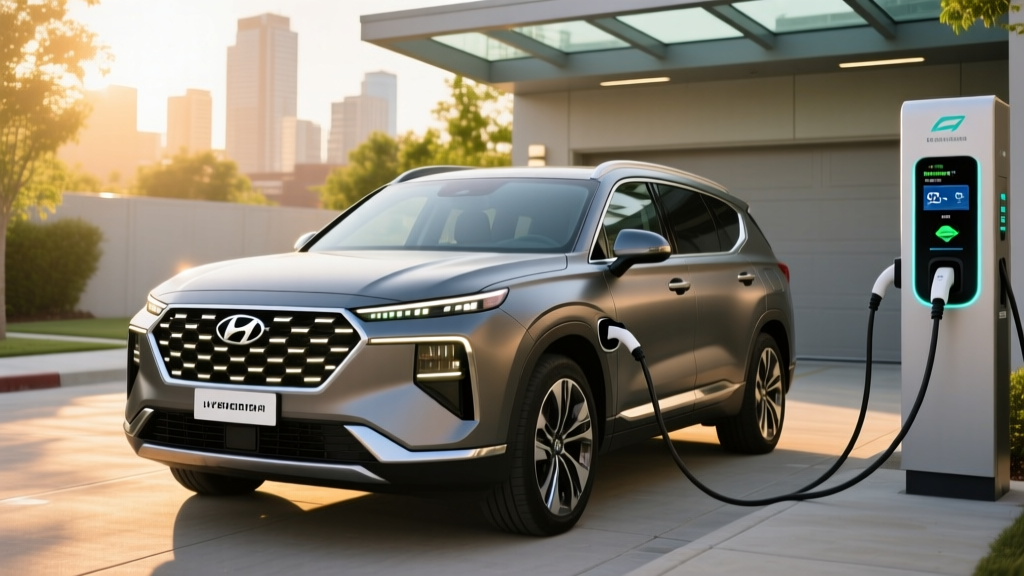
Hyundai is expanding its electrified lineup with a vehicle that bridges two worlds: the 2027 Hyundai Santa Fe EREV (Extended-Range Electric Vehicle). Announced as part of Hyundai's broader powertrain strategy, the EREV variant pairs a battery-electric drive system with an onboard gasoline generator that never mechanically turns the wheels. The result? Electric driving for daily commutes, with a gas tank as a range-extending safety net for road trips.
This profile is based on Hyundai's preliminary specifications and industry reporting as of early 2026. Final EPA certification figures, pricing, and trim details are subject to change before the vehicle reaches U.S. dealerships. We'll update this review when official data is published.
What Is an EREV and How Does the Santa Fe Fit In?
An Extended-Range Electric Vehicle (EREV) is sometimes confused with a traditional plug-in hybrid (PHEV), but the distinction matters for driving feel and efficiency. In the Santa Fe EREV, the gasoline engine acts solely as a generator to recharge the battery pack when it runs low. The wheels are always driven by the electric motor(s). This means you get the smooth, instant-torque character of an EV at all times, without the transmission shift points or engine-drivetrain coupling you'd feel in a conventional PHEV like the existing Santa Fe Hybrid.
Think of it as a series hybrid: battery drives the motor, engine charges the battery when needed. BMW's discontinued i3 REx was the last mainstream EREV sold in the U.S. The Santa Fe EREV aims to bring the concept to a mainstream three-row family SUV.
Estimated Range, Battery, and Efficiency
Real-World Expectation: Expect roughly 28–32 miles of electric-only range in mixed highway driving or in cold weather (below 40°F). Combined total range on a full tank and full battery should land in the 380–400 mile range on highway road trips, depending on speed, terrain, and climate-control use. The generator engine will activate once the battery's state of charge drops to its programmed buffer threshold.
Hyundai has indicated the Santa Fe EREV will use a mid-size battery pack — preliminary reports suggest a ~30 kWh usable capacity (gross capacity slightly higher). The chemistry is expected to be NMC (Nickel Manganese Cobalt), consistent with Hyundai's current PHEV and BEV lineup, prioritizing energy density for the relatively compact pack size.
| Specification | Estimated Value |
|---|---|
| Battery Capacity (usable) | ~30 kWh (NMC) |
| Electric-Only Range (EPA est.) | ~35 miles |
| Total Combined Range (est.) | ~420+ miles |
| Electric Motor Output | ~200–250 hp (preliminary) |
| Drivetrain | FWD standard; AWD available |
| 0–60 mph (est.) | ~7.5–8.5 seconds |
| MPGe (electric mode, est.) | ~90–100 MPGe combined |
| Generator Engine | ~1.5L turbocharged 4-cylinder |
| Fuel Tank Capacity (est.) | ~14–16 gallons |
Efficiency in electric-only mode should be competitive with compact PHEVs — roughly 3.0–3.5 kWh per mile, or around 90–100 MPGe combined. Once the generator kicks in, expect fuel economy in the range of 30–35 MPG combined, though Hyundai has not published official figures.
Charging: DC Fast Charge and Home Level 2
Charging an EREV is simpler than a full BEV because the battery is smaller, meaning shorter charge times across the board. Here's what preliminary data suggests:
| Charging Level | Power | Time (0–100% or 10–80%) | Miles of EV Range Added per Hour |
|---|---|---|---|
| Level 1 (120V household) | ~1.4 kW | ~22 hours (full charge) | ~4–5 mi/hr |
| Level 2 (240V home/public) | ~7.2 kW | ~4.5 hours (full charge) | ~22–25 mi/hr |
| DC Fast Charge | ~50–80 kW peak (est.) | ~25–35 min (10–80%) | ~60–80 mi/hr |
A note on DC fast charging: With a ~30 kWh battery, the Santa Fe EREV won't match the 200+ kW peak rates of full BEVs like the Ioniq 5. However, for a 35-mile electric range, most owners will recharge the pack overnight on Level 2 and rarely need DC fast charging for daily use. The DC port is there for topping up on road trips if you want to maximize electric driving between stops.
The charge connector is expected to be the NACS (North American Charging Standard), aligning with Hyundai's commitment to adopt Tesla's connector for all new U.S.-market electrified vehicles starting in 2025–2026. This grants access to the Tesla Supercharger network via native plug — no adapter required.
Performance and Drivetrain
The electric motor driving the wheels should produce in the neighborhood of 200–250 horsepower, depending on trim and whether AWD is equipped (AWD variants typically add a rear motor). Acceleration won't match a full BEV like the Ioniq 5, but the instant torque delivery will make the Santa Fe EREV feel responsive around town and in merge situations.
Estimated 0–60 mph times sit in the 7.5 to 8.5 second range — comparable to the current Santa Fe Hybrid and adequate for a family SUV. The key dynamic advantage over a conventional hybrid is the absence of gear shifts; the EREV delivers linear, uninterrupted acceleration in electric mode.
Regenerative braking with adjustable levels (likely via paddle shifters, as in other Hyundai electrified models) will allow one-pedal-style driving in city traffic, recapturing energy back into the battery.
Interior Space, Cargo, and Technology
The Santa Fe EREV is expected to share the current generation's boxy, upright design and three-row cabin layout. The EREV powertrain packaging should not significantly compromise interior volume, since the battery is relatively small and can be mounted under the floor or rear cargo area.
Estimated interior dimensions (based on current Santa Fe platform):
- Cargo volume (behind 3rd row): ~14–16 cu ft
- Cargo volume (3rd row folded): ~37–41 cu ft
- Cargo volume (max, all rows folded): ~72–79 cu ft
- Front legroom: ~41 inches
- Second-row legroom: ~40 inches
- Third-row legroom: ~30–32 inches (best for children or short trips)
On the technology front, expect Hyundai's latest infotainment suite with a 12.3-inch dual-screen setup (digital instrument cluster + touchscreen), wireless Apple CarPlay and Android Auto, over-the-air updates, and Hyundai's SmartSense driver-assistance suite. SmartSense includes adaptive cruise control with stop-and-go, lane-keeping assist, blind-spot monitoring, rear cross-traffic collision avoidance, and highway driving assist.
Pricing, Trims, and Federal Tax Credit Eligibility
Hyundai has not announced official U.S. MSRP figures for the 2027 Santa Fe EREV. Based on the current Santa Fe Hybrid pricing structure and the added cost of the EREV powertrain, we estimate the following:
| Trim (Estimated) | Est. Base MSRP | Federal §30D Credit Potential | Est. Net Price After Credit |
|---|---|---|---|
| SE (base) | ~$38,000–$40,000 | Up to $7,500* | ~$30,500–$32,500 |
| SEL / Limited | ~$43,000–$47,000 | Up to $7,500* | ~$35,500–$39,500 |
| Calligraphy (top) | ~$48,000–$52,000 | Up to $7,500* | ~$40,500–$44,500 |
*Federal tax credit (§30D) caveats — current as of 2026 IRS rules:
- MSRP cap: SUVs/vans must have an MSRP at or below $80,000 to qualify. All estimated Santa Fe EREV trims fall well under this limit.
- Buyer income cap: Modified adjusted gross income must not exceed $150,000 (single), $225,000 (head of household), or $300,000 (married filing jointly).
- Battery sourcing requirements: The credit is split into two halves — $3,750 for critical minerals sourcing and $3,750 for battery component manufacturing. Full $7,500 requires meeting both thresholds, which tighten annually. Hyundai's supply chain compliance for the EREV battery has not been confirmed.
- Point-of-sale transfer: Eligible buyers can transfer the credit to the dealer at purchase for an immediate price reduction, rather than waiting to claim it on their tax return.
- PHEV/EREV battery size requirement: The battery must have at least 7 kWh of capacity. The Santa Fe EREV's ~30 kWh pack clears this threshold easily.
We strongly recommend consulting a tax professional and checking the latest guidance at IRS.gov before making purchase decisions based on credit eligibility.
Warranty Coverage
Hyundai's electrified vehicle warranty is among the strongest in the mainstream market. For the Santa Fe EREV, expect:
- High-voltage battery: 10 years / 100,000 miles (capacity retention warranty — typically guarantees the battery will not fall below ~70% of original capacity)
- Electric powertrain components: 10 years / 100,000 miles
- New vehicle limited warranty: 5 years / 60,000 miles
- Generator engine: Likely covered under the standard 5-year/60,000-mile or powertrain warranty — Hyundai has not specified separately
The 10-year battery warranty provides meaningful long-term protection. For context, Hyundai's warranty program consistently ranks at or near the top for electrified vehicle coverage.
Who Should Consider the Santa Fe EREV?
- You want electric daily driving (30–35 miles covers most commutes) but need gas-powered range for road trips without charging-planning hassle.
- You don't have reliable access to DC fast charging on your regular routes but can install a Level 2 home charger.
- You need three-row seating and substantial cargo space in an electrified vehicle.
- You want EV-like driving smoothness without committing to a full BEV.
- Your daily commute exceeds 40 miles and you want to avoid using any gasoline — a full BEV like the Ioniq 5 or a longer-range PHEV may serve better.
- You prioritize maximum electric range above all else — dedicated BEVs offer 250–300+ miles.
- You need heavy towing capacity — the EREV's towing rating has not been published but is likely modest (1,500–2,500 lbs estimated).
Pros and Cons
- Smooth, EV-like driving at all speeds with no range anxiety
- Three-row seating in an electrified package — rare in the segment
- 35-mile EV range covers most daily commutes gas-free
- 420+ mile total range eliminates road-trip charging logistics
- Industry-leading 10-year/100,000-mile battery warranty
- NACS connector for native Supercharger access
- Point-of-sale tax credit transfer reduces upfront cost
- 35-mile EV range is modest vs. full BEVs or some competing PHEVs
- DC fast charging limited to ~50–80 kW (small battery constraint)
- Generator engine adds maintenance (oil changes, spark plugs) vs. a pure BEV
- Third row remains tight for adults on longer trips
- Full §30D credit depends on battery sourcing compliance — unconfirmed
- Towing capacity likely limited compared to body-on-frame SUVs
Frequently Asked Questions
What is the real-world electric-only range of the 2027 Santa Fe EREV?
Hyundai's preliminary EPA estimate is around 35 miles on battery power alone. In real-world conditions — highway speeds above 65 mph, cold temperatures below 40°F, or hilly terrain — expect closer to 28–32 miles before the generator engine activates. That's still enough for a typical round-trip commute under 30 miles.
How fast does the Santa Fe EREV charge?
On a 240V Level 2 home charger (~7.2 kW), a full charge takes roughly 4.5 hours — easily achievable overnight. DC fast charging peaks at an estimated 50–80 kW, reaching 10–80% in approximately 25–35 minutes. The smaller battery means faster full charges compared to a full BEV, but lower peak kW rates.
Does the 2027 Santa Fe EREV qualify for the $7,500 federal tax credit?
It is expected to qualify, but final eligibility depends on battery-sourcing and critical-mineral requirements under IRS §30D rules. The MSRP (estimated under $52,000) and battery capacity (~30 kWh, well above the 7 kWh minimum) are not barriers. Buyer income caps apply. Check IRS.gov for current eligibility details and consult a tax professional.
How does the Santa Fe EREV compare to the Toyota RAV4 PHEV or Kia Sorento PHEV?
The RAV4 Prime (PHEV) offers 42 miles of electric range and is a two-row SUV. The Sorento PHEV offers 32 miles of EV range with three rows. The Santa Fe EREV sits between them on EV range but differentiates with its pure electric-drive architecture — the engine never directly drives the wheels, yielding smoother acceleration. The Sorento PHEV is its closest rival; the EREV's advantage is driving feel and potentially better fuel economy when the generator is running.
Can I drive the Santa Fe EREV on electricity alone without the engine ever turning on?
Yes, for approximately 35 miles. If your daily driving stays within that range and you charge nightly, you could go weeks without the generator engine activating. However, the engine will start automatically when the battery reaches its buffer threshold, and Hyundai may also program periodic engine maintenance runs to prevent fuel system degradation — a common feature in EREVs and PHEVs.
Is the 2027 Santa Fe EREV available to buy now?
No. As of early 2026, the Santa Fe EREV is an announced model with preliminary specifications. Hyundai has not confirmed an exact U.S. on-sale date, though industry reports suggest late 2026 or early 2027. Final EPA figures, pricing, and trim details will be published closer to launch. We will update this profile when official data is available.